Ethereum To Hit $15,000 In 2026 As ‘Wall Street’s Default Chain’: Vivek Raman

bitcoinistPublished on 2026-01-06Last updated on 2026-01-06

Abstract

Ethereum could reach $15,000 by 2026 as it becomes Wall Street's preferred blockchain for tokenization, stablecoins, and institutional adoption, according to Vivek Raman of Etherealize. He argues that Ethereum will transition into a commercial deployment era, driven by regulatory clarity, mature infrastructure, and growing institutional use cases. Key factors include the expansion of tokenized assets to nearly $100 billion (with 66% on Ethereum and its L2s), the stablecoin market cap growing to $1.5 trillion, and ETH emerging as a productive store of value. Raman highlights institutional activity from firms like JPMorgan, BlackRock, and Deutsche Bank, alongside the rise of Ethereum Layer 2 networks for customized, high-margin business models.

Ethereum could reprice to $15,000 in 2026 as traditional finance accelerates into tokenization, stablecoins, and bespoke Layer 2 blockchains built on Ethereum, according to Vivek Raman, CEO and co-founder of Etherealize.

In a Jan. 5 guest post, Raman framed 2026 as the point where ETH shifts from a decade-long credibility build to a commercial deployment era, arguing that “from 2026 onward – Ethereum will become the best place to do business,” as regulatory posture, institutional precedent, and infrastructure maturity converge.

Institutions Will Tokenize On Ethereum

Raman’s core claim is that tokenization is moving from proof-of-concept into scaled product deployment, with Ethereum increasingly serving as the base layer institutions choose when the assets are high value and the operational requirements are strict. He describes tokenization as a business-process upgrade that collapses assets, data, and payments onto shared infrastructure, and he leaned heavily on the idea that once institutions experience the efficiencies, they will not revert.

“Tokenization upgrades entire business processes by digitizing assets, data, and payments onto the same infrastructure,” Raman wrote. “Assets (like stocks, bonds, real estate) and money will be able to move at the speed of the Internet. This is an obvious upgrade to the financial system that should have happened decades ago; public global blockchains like Ethereum enable this today.”

The post cites examples of institutional tokenization activity on Ethereum, including money market fund initiatives from JPMorgan and Fidelity, BlackRock’s tokenized fund BUIDL, Apollo’s private credit fund ACRED (with liquidity concentrated on Ethereum and its L2s), and European participation such as Amundi tokenizing a euro-denominated money market fund. Raman also pointed to tokenized products from BNY Mellon and a planned tokenized bond fund tied to Baillie Gifford that would span Ethereum and an L2 network.

Stablecoins As The “Green Light” Moment

Raman positioned stablecoins as the clearest product-market fit for onchain finance, citing “$10T+ in stablecoin transfer volumes in 2025” and claiming that “60% of all stablecoins are on Ethereum and its Layer 2 networks.” He argued that regulatory developments in the US have de-risked deployment for institutions, describing the passage of the GENIUS Act in 2025 as the moment public-chain stablecoin rails effectively received formal clearance.

As a near-term datapoint, Raman highlighted SoFi’s reported launch of a bank-issued stablecoin, SoFiUSD, on a “public, permissionless blockchain,” adding that the bank chose Ethereum. He suggested this is the start of a broader wave where investment banks, neobanks, and fintechs explore stablecoin issuance—either solo or via consortium structures—inside a single public-chain ecosystem to maximize network effects.

Layer 2s As The Institutional Business Model

A major part of Raman’s thesis hinges on the idea that institutions will not converge on a single chain, but will converge on a single interconnected network, Ethereum plus its Layer 2 ecosystem. He argued that L2s provide customization by jurisdiction and customer base while inheriting Ethereum’s security and liquidity, and he described L2 economics as unusually attractive for operators, citing “90+% profit margins” as a reason businesses will want their own chains.

Raman listed examples including Coinbase’s Base, Robinhood’s plans for an Ethereum L2 featuring tokenized stocks and other assets, SWIFT’s use of the Ethereum L2 Linea for settlements, JPMorgan deploying tokenized deposits on Base, and Deutsche Bank building a public, permissioned network as an Ethereum L2.

The $15,000 Ethereum Price Target

Raman also argued ETH is emerging as an institutional treasury asset alongside bitcoin, describing BTC as “digital gold” and ETH as “digital oil”, a productive store of value tied to ecosystem economic activity.

He pointed to four public-company “MicroStrategy-equivalents” accumulating ETH: BitMine Immersion (BMNR), Sharplink Gaming (SBET), The Ether Machine (ETHM), and Bit Digital (BTBT) and claimed they have collectively purchased roughly 4.5% of ETH supply in the last six months, comparing that to MicroStrategy’s 3.2% of BTC ownership.

Those dynamics underpin his 2026 “5x” forecast set: tokenized assets rising to nearly $100 billion (from an estimated $18 billion after growing from ~$6 billion in 2025, with “66%...on Ethereum and its L2s”), stablecoin market cap expanding to $1.5 trillion (from $308 billion), and ETH appreciating 5x to $15,000—an implied $2 trillion market cap in his framing.

At press time, ETH traded at $3,227.
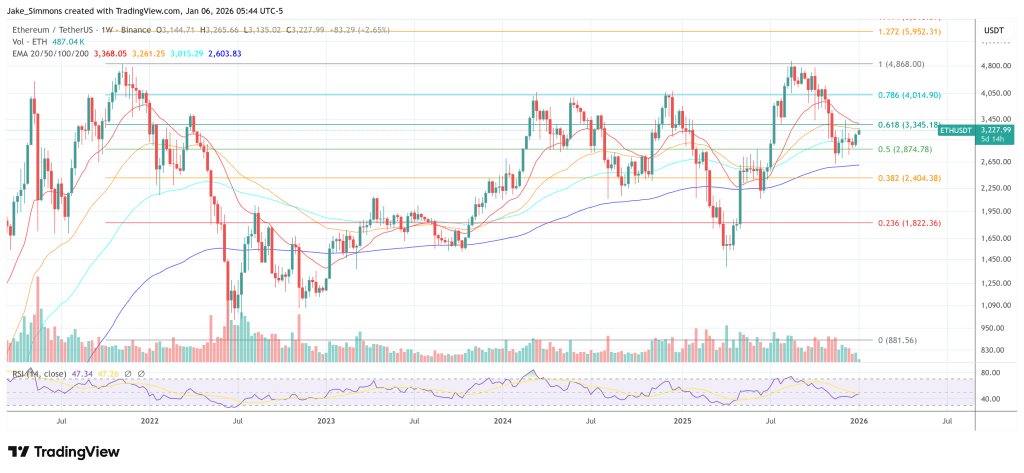
ETH faces the 0.618 Fib, 1-week chart | Source: ETHUSDT on TradingView.com

Related Questions

QWhat is the main reason Vivek Raman believes Ethereum will reach $15,000 by 2026?

AHe believes Ethereum will become 'Wall Street's default chain' due to the acceleration of traditional finance into tokenization, stablecoins, and bespoke Layer 2 blockchains built on Ethereum, leading to a 5x price appreciation.

QAccording to Raman, what is the key business-process upgrade that tokenization provides?

ATokenization upgrades entire business processes by digitizing assets, data, and payments onto the same shared infrastructure, allowing them to move at the speed of the internet.

QWhat role do stablecoins play in Raman's thesis for Ethereum's growth?

AStablecoins represent the clearest product-market fit for onchain finance, with regulatory developments like the GENIUS Act de-risking deployment for institutions and a projected $10T+ in transfer volumes by 2025.

QHow do Layer 2 networks fit into the institutional adoption of Ethereum?

AInstitutions will converge on the interconnected network of Ethereum and its L2 ecosystem, which provides customization by jurisdiction and customer base while inheriting Ethereum's security and liquidity, with attractive economics for operators.

QWhich four public companies does Raman cite as 'MicroStrategy-equivalents' that are accumulating ETH?

ABitMine Immersion (BMNR), Sharplink Gaming (SBET), The Ether Machine (ETHM), and Bit Digital (BTBT).

Related Reads

The Era Has Arrived Where Human Writers Must Prove They Are Not Machines

The article describes an era where AI-generated content is flooding the market, forcing human authors to prove they are not machines. It begins with the example of dozens of AI-written, error-ridden biographies of Henry Kissinger appearing on Amazon within hours of his death, a pattern repeated for other deceased celebrities and even living experts who find fraudulent books under their names. This spam content has exploded, with monthly new book releases on platforms like Amazon reaching 300,000 by late 2025. The issue spans genres, from suspiciously high proportions of AI-written teen romance and self-help books to dangerous, AI-generated foraging guides containing lethal advice. The platforms' automated review systems, designed to catch plagiarism and banned words, are ill-equipped to detect AI-generated text that avoids these pitfalls while being nonsensical or fraudulent. The problem has infiltrated traditional publishing. A major publisher, Hachette, had to recall a bestselling horror novel after AI detection tools suggested 78% of its content was machine-generated. An acclaimed European philosophy book was later revealed to be entirely written by AI under a fake author persona. In response, authors are fighting back. At the 2026 London Book Fair, 10,000 writers published a blank book titled "Don't Steal This Book" containing only their signatures—using emptiness as a protest weapon in an age of AI overproduction. Initiatives like the "Human Author Certification" program have emerged, ironically placing the burden on humans to prove their work is not machine-made. The article warns of a vicious cycle: AI-generated low-quality books pollute the data used to train future AI models, leading to "model collapse" and an ever-worsening flood of digital waste, eroding trust in publishing and devaluing human creativity.

marsbit13m ago

The Era Has Arrived Where Human Writers Must Prove They Are Not Machines

marsbit13m ago

The King of Blind Date Attire in Korea: How SK Hynix Made a Comeback Against Samsung?

In South Korea's dating scene, SK Hynix employees are now highly sought after, a status shift fueled by the company's astronomical profits and employee bonuses, projected to reach up to 6.1 million RMB per person by 2027. This marks a dramatic reversal for the long-time second-place player in memory semiconductors, which has now surpassed its rival Samsung in annual operating profit. The turnaround story began in 2008 when a struggling Hynix, emerging from bankruptcy restructuring, took a risky bet by agreeing to develop High Bandwidth Memory (HBM) with AMD. At the time, HBM had no clear market beyond high-end graphics cards and was a costly, complex technology. Major players like Samsung, pursuing its own HMC technology, declined. For Hynix, with only memory as its core business, it was a gamble born of necessity. The pivotal moment came in 2012 when SK Group Chairman Chey Tae-won acquired Hynix. Defying industry downturns, he invested heavily in R&D and fabrication, sustaining the HBM project through over a decade of commercial uncertainty and internal challenges. A key break occurred around 2016-2017 when Samsung faced production issues supplying HBM2 for Google's TPU, allowing SK Hynix to gain a crucial foothold in the data center market. The AI explosion post-ChatGPT in 2022 was the catalyst, turning HBM into a critical bottleneck for AI accelerators like NVIDIA's GPUs. By 2025, SK Hynix captured 62% of the global HBM market, leaving Samsung at 17%. For the first time, its annual operating profit exceeded Samsung's. Analysts point to the "innovator's dilemma" to explain Samsung's miss: its vast, successful business portfolio made it risk-averse, preventing an all-in bet on the initially niche HBM technology. In contrast, SK Hynix, as a challenger with its back against the wall, had no choice but to commit fully. The story highlights how Korea's chaebol system allows for ultra-long-term bets beyond quarterly pressures. However, SK Hynix's lead isn't guaranteed. Samsung is aggressively catching up on HBM4, and challenges like customer concentration (heavy reliance on NVIDIA) and technical hurdles in advanced packaging remain. The narrative underscores a market truth: the greatest alpha often comes from betting on uncertain, long-term directions others dismiss, much like HBM in 2008.

marsbit53m ago

The King of Blind Date Attire in Korea: How SK Hynix Made a Comeback Against Samsung?

marsbit53m ago

Trading

Spot
Futures

Hot Articles

Discussions

Welcome to the HTX Community. Here, you can stay informed about the latest platform developments and gain access to professional market insights. Users' opinions on the price of ETH (ETH) are presented below.

活动图片











