Ethereum Takes The Lead In DeFi Lending Revenue, Leaving Rivals Behind – See How

bitcoinistPublished on 2025-12-19Last updated on 2025-12-19

Abstract

Despite facing selling pressure, Ethereum has solidified its dominance in DeFi lending revenue, capturing 80-90% of all activity and fees. Data from Leon Waidmann shows Ethereum remains the core settlement layer for DeFi, significantly outpacing rivals like Base and Arbitrum. Aave drives over 50% of lending funds and 60% of active loans on Ethereum, generating $885 million in fees in 2025 alone. While Layer 2s improve user experience, the mainnet continues to be reinforced as the trusted hub for liquidity and credit markets. Additionally, active Ethereum addresses are nearing all-time highs, with 2.4 million weekly users, signaling strong retail and institutional engagement.

Ethereum’s price may be hampered by selling pressure, but the leading network continues to experience heavy utilization from developers and users. After robust interaction from the participants, the blockchain giant emerged once again as the leader in Decentralized Finance (DeFi) lending.

DeFi Lending Still Pays Best On The Ethereum Network

A recent report has underscored Ethereum’s growing dominance within the blockchain sector. The network is solidifying its position as the financial foundation for decentralized finance lending, and the data is starting to present a convincing picture.

A look at the data shared by Leon Waidmann, a market expert and the head of research at On-Chain Foundation, shows that ETH is now the revenue center of DeFi lending. This implies that most of the revenue flowed through the ETH ecosystem, outpacing other major chains like Base, Plasma, and Arbitrum.

From borrowing fees to interest paid by active users, the ETH network continues to be the key settlement layer where value is persistently created. ETH is at the center of the revenue outlines the network’s usage in addition to its ongoing dominance as the fundamental infrastructure driving DeFi’s most lucrative lending activity.
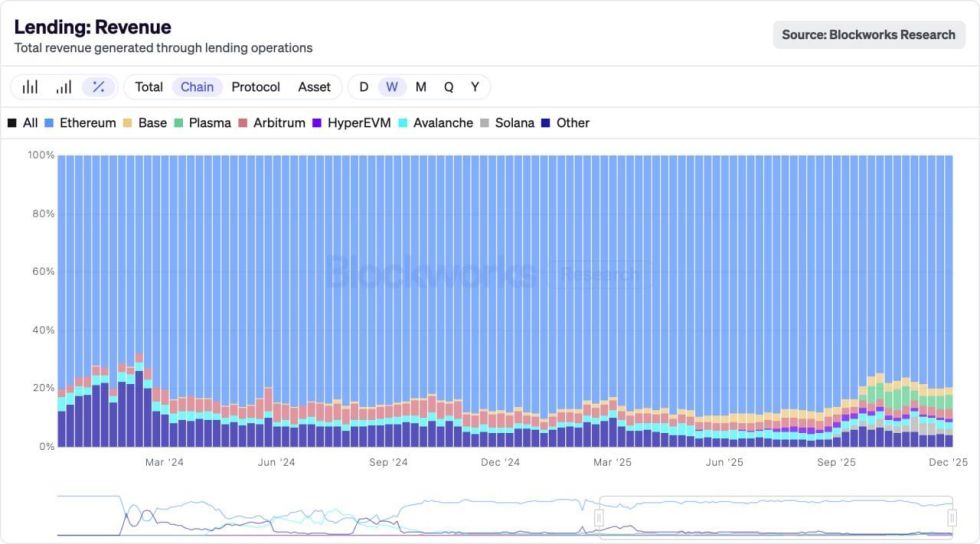
Source: Chart from Leon Waidmann on X

As seen on the chart, Ethereum mainnet steadily secured over 80% to 90% of all DeFi lending revenue and activity, reinforcing its increasing role in the financial landscape. Interestingly, this share has remained a dominant force even with the vigorous expansion of the Layer 2 and alt-Layer 1 chains.

Data shows that usage may be fragmented, but fees do not. Meanwhile, at the protocol layer, Waidmann highlighted that concentration is quite stronger. Amid this rising DeFi revenue lending, Aave is the core revenue engine on the Ethereum mainnet, attracting more than 50% of the total lending funds.

This part of the network was also responsible for over 60% of all active loans on ETH. In the end, the project generated approximately $885 million in fees in 2025 alone, reflecting the significant usage of the network.

While Ethereum mainnet secures balance sheets and profits, layer 2s are optimizing execution and User Experience (UX). Waidmann noted that where confidence and liquidity are greatest, DeFi credit markets converge. “Ethereum Mainnet is not being disrupted, but is being reinforced,” the expert added.

Active ETH Addresses Targeting Its Peak

Another instance of robust engagement across the Ethereum network is a spike in active wallet addresses. Joseph Young, a crypto enthusiast, previously highlighted that the active users on the network are drawing close to its all-time high. Such a rise in active addresses suggests a resurgence of interest and conviction among larger and retail investors.

At the time of the post, about 2.4 million wallet addresses were actively interacting with the network every week. This is an indication that tokenization, stablecoins, and privacy infrastructure are all converging on Ethereum. Currently, Young stated ETH is dominating the big three metas, while expressing his conviction in the network’s prospects.

ETH trading at $2,954 on the 1D chart | Source: ETHUSDT on Tradingview.com

Trending Cryptos

Related Questions

QAccording to the article, which blockchain network is the leader in DeFi lending revenue?

AEthereum is the leader in DeFi lending revenue, securing over 80% to 90% of all activity.

QWhat is the name of the expert and head of research at On-Chain Foundation cited in the report?

AThe expert cited is Leon Waidmann, the head of research at On-Chain Foundation.

QWhich protocol is highlighted as the core revenue engine on the Ethereum mainnet for DeFi lending?

AAave is the core revenue engine on the Ethereum mainnet, attracting more than 50% of the total lending funds.

QWhat does the significant increase in active Ethereum wallet addresses suggest, according to the article?

AThe spike in active wallet addresses suggests a resurgence of interest and conviction among both larger and retail investors.

QWhat role do Layer 2 networks play in relation to the Ethereum mainnet, as described in the article?

ALayer 2 networks are optimizing execution and User Experience (UX), while the Ethereum Mainnet secures balance sheets and profits, thereby being reinforced rather than disrupted.

Related Reads

Bitcoin Withdrawals Continue: 8 Years of Storage in a Coldcard Cold Wallet Ended in Zero

Coldcard Hardware Wallet Hacked: Losses Mount Due to Vulnerable Seed Generation A critical vulnerability in Coldcard hardware wallets has led to a continued wave of fund thefts. According to Galaxy Research, the total stolen has reached 1,367.05 BTC (approx. $88.6 million) from 4,585 addresses, a significant increase from the initial 594.5 BTC reported on July 30, 2026. Most of the stolen funds remain on the attackers' addresses. The issue is not with the current firmware, which Coinkite has updated, but with seed phrases generated on vulnerable devices between March 2021 and the release of fixed firmware versions. Due to a programmer error, devices switched from using a hardware random number generator to the software-based Yasmarang generator, which was initialized with publicly accessible data like the chip's serial number. This made the seed phrases predictable through offline brute-force attacks, meaning wallets remain at risk until funds are moved to a new wallet generated with the patched firmware. Affected devices include Mk2/Mk3 with firmware 4.0.1–4.1.9 (and up to 5.0.3), Mk4/Mk5 up to version 5.6.0, and Q models up to 1.5.0Q. The only exceptions are seeds created with a high-entropy method like at least 50 independent dice rolls or a strong unique BIP-39 passphrase. All other owners must generate a new seed on the fixed firmware and transfer their assets. A case highlighting the human impact involves a 39-year-old long-term investor who lost 2 BTC (approx. $130,000) in minutes. He had accumulated the Bitcoin over eight years through physical labor, viewing it as a financial lifeline and a retirement plan in a country suffering from hyperinflation. His story underscores that even conservative "buy and hold in cold storage" strategies can be compromised by such underlying technical flaws. From a technical perspective, this incident echoes historical failures where weak random number generators undermined cryptographic security, challenging the assumption that offline storage is automatically foolproof.

cryptonews.ru5h ago

Bitcoin Withdrawals Continue: 8 Years of Storage in a Coldcard Cold Wallet Ended in Zero

cryptonews.ru5h ago

Trading

Spot

Hot Articles

Discussions

Welcome to the HTX Community. Here, you can stay informed about the latest platform developments and gain access to professional market insights. Users' opinions on the price of ETH (ETH) are presented below.

活动图片















