Ethereum Staking Deposits Just Surpassed Withdrawals, Why This Could Send ETH Price Above $4,000

bitcoinistPublished on 2025-12-31Last updated on 2025-12-31

Abstract

Ethereum staking deposits have surpassed withdrawals for the first time in six months, signaling a potential major price recovery. On-chain data shows the validator entry queue has surged to 788,310 ETH ($2.3B), significantly larger than the exit queue of 312,091 ETH. This shift indicates renewed institutional and long-term holder confidence, tightening ETH's liquid supply. Notably, firm Bitmine staked 342,560 ETH ($1B) in late December. Historically, such staking inflows have preceded major rallies, like the price doubling in June 2025. Analysts suggest this could propel ETH from its current $2,930 level past $4,000 in 2026.

The ETH price could be gearing up for a major recovery from downtrends as the Ethereum network shows renewed signs of strength. On-chain data shows that validator deposits have once again outpaced exits, even after months of higher withdrawal activity, reflecting improved sentiment among holders. Notably, the change is being closely watched as a potential catalyst that could tighten supply and support a move towards or above the $4,000 level.

Ethereum Staking Deposits Overtake Withdrawals

Ethereum is seeing a notable shift in staking activity as validator deposits have surpassed withdrawals for the first time in six months. Validator entry queues have surged to more than twice the size of exit queues, pointing to renewed demand for staking and growing confidence among institutional partners and ETH long-term holders.

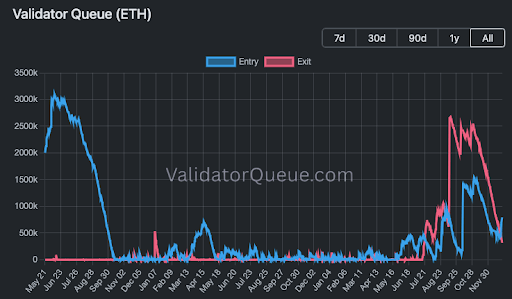
Data from ValidatorQueue shows that Ethereum’s validator entry queue has climbed to roughly 788,310 ETH, at the time of writing. At current prices, this represents about $2.3 billion in value and comes with an estimated wait time of 13 days and 16 hours to activate new validators. By contrast, ETH’s validator exit queue remains significantly smaller, standing at around 312,091, valued at approximately $916,923, as of writing.
Source: ValidatorQueue

Notably, the current level represents the highest ETH volume queued for staking since late November. A surge in staking inflows above withdrawals has also been frequently associated with bullish price action for Ethereum.

Meanwhile, treasury buyers have played a significant role in this increase in validator entry queues, with Ethereum-focused firm Bitmine leading the way. Data from LookOnChain reveals that the crypto company staked 342,560 ETH on December 28, valued at roughly $1 billion. Bitmine’s staking activity comes as it prepares to launch its Made in America Validator Network (MAVAN) in 2026. Such large-scale staking by treasury firms typically reduces ETH’s liquid supply, which, in turn, can support higher prices.

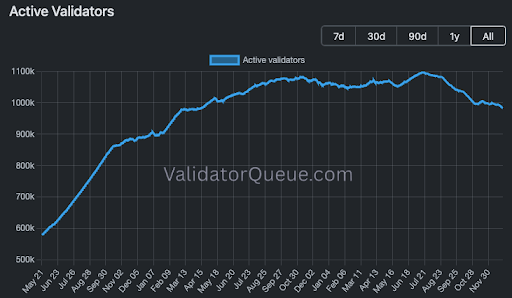
Beyond treasury companies, Ethereum’s broader network participation is also rising. ValidatorQueue reports that there are now more than 983,060 active validators on the blockchain, representing approximately 29.29% of the total supply, or around 35.5 million ETH, currently staked. Moreover, the Ethereum Pectra upgrade has improved users’ staking experience and raised maximum validator limits, making restating easier for large balances.
Source: ValidatorQueue

How This Could Push ETH Price Past $4,000

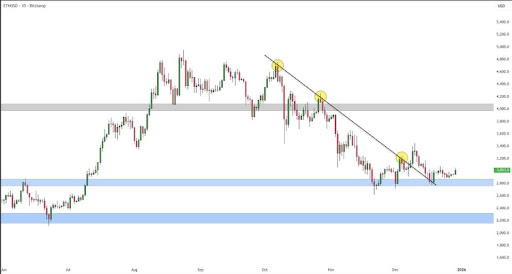
Historically, periods when the Ethereum validator entry queue exceeds the exit queue have often preceded major ETH price rallies. Analysts note that the last time staking deposits surpassed withdrawals, in June 2025, Ethereum’s price had doubled over a short span.
Source: X

If history repeats itself, the cryptocurrency could experience another sharp rally in 2026. From its current price of above $2,930, a continuation of trends could push it well above $4,000. Analysts also confirm that ETH is currently testing the $3,000 level, and a strong bounce from this zone could open the path toward $4,000.

ETH price fails to hold up | Source: ETHUSDT on Tradingview.com

Trending Cryptos

Related Reads

Can Japan Buy Growth with AI? Will the Bond Market Believe It?

Japan's cabinet has introduced the 2026 Basic Policy on Economic and Fiscal Management and Reform, shifting its primary fiscal target. The new framework moves away from the traditional annual primary balance goal and instead prioritizes a stable reduction of the debt-to-GDP ratio. This change is tied to a strategy of increased "responsible proactive fiscal" spending, aiming to boost long-term growth through investments in strategic sectors like AI, semiconductors, energy, and robotics. The government estimates total public and private investment in 62 key technologies could exceed 370 trillion yen by 2040. The market reaction has been mixed and cautious. While equity markets may respond to policy signals, bond markets are focused on fiscal credibility. Concerns center on whether the weakening of the clear primary balance anchor could lead to looser fiscal discipline. If investors doubt that these strategic investments will generate sufficient productivity gains, tax revenue, and nominal growth to outpace rising interest costs, they may demand higher yields on Japanese Government Bonds (JGBs). Recent volatility in the yen and JGB yields, with the 10-year yield briefly reaching 2.9%, reflects this skepticism. The success of this new framework hinges on two factors: whether Japan can achieve a nominal growth rate consistently higher than its long-term interest rates, and whether future budgets demonstrate disciplined control over bond issuance. The government's narrative is that strategic investment is essential to break Japan's cycle of low growth, aging, and labor shortages. However, the bond market will continuously assess the credibility of this plan, pricing the risk that it may represent fiscal expansion rather than a viable growth strategy.

marsbit26m ago

Can Japan Buy Growth with AI? Will the Bond Market Believe It?

marsbit26m ago

Misjudged A-Shares: Resilience, Expectations, and Confidence

China's A-share market recently faced selling pressure, especially in tech sectors, initially triggered by a global tech sell-off that began in South Korea. However, the article argues this is a case of "mistaken injury" and highlights the market's underlying resilience. This resilience stems from three main pillars: **1) Tech Sector Fundamentals:** Unlike Korea's market dominated by a few memory chip stocks, China's tech sector is diversified across computing, communications, electronics, and semiconductors, supported by dual narratives of global AI supply chains and domestic substitution. Core areas like optical modules and fiber optics continue to show strong earnings growth. **2) "National Team" Support:** State-backed institutions and large corporations have made significant market purchases and announced buybacks, providing liquidity and signaling confidence. This is seen as a stabilizing policy signal, often associated with market bottoms. **3) Broader Market Pillars:** Other major sectors are showing endogenous recovery momentum. Consumer stocks benefit from stabilizing CPI and signs of sector recovery (e.g., liquor price hikes). Cyclical sectors like aluminum have high earnings, potential price increases due to tight supply, and low valuations. The financial sector offers stable dividends and low valuations. The conclusion is that the sell-off was driven by external contagion, not a collapse in fundamentals. With strong policy support and recovering momentum across key sectors, the A-share market possesses the toughness to regain stability.

marsbit57m ago

Misjudged A-Shares: Resilience, Expectations, and Confidence

marsbit57m ago

Trading

Spot

Hot Articles

Discussions

Welcome to the HTX Community. Here, you can stay informed about the latest platform developments and gain access to professional market insights. Users' opinions on the price of ETH (ETH) are presented below.

活动图片















