Ethereum Shows Signs Of Strength With Stronger Network Activity Supporting Growth

bitcoinistPublished on 2026-05-14Last updated on 2026-05-14

Abstract

Despite a slight price pullback, Ethereum's fundamentals show strength, driven by robust network activity and transaction growth. The altcoin has broken out of a multi-year consolidation phase, suggesting potential for significant upward movement. Over 7.33 million ETH (6% of supply) is locked on corporate balance sheets, and Ethereum's inflation rate is now lower than Bitcoin's post-Merge. Network performance is surging, with transaction volumes on the mainnet and Layer 2 solutions reaching all-time highs. Ethereum maintains a dominant 55-60% share of the Total Value Locked (TVL) in DeFi since mid-2022, reinforced by deep collateral markets and proven resilience. It hosts 50% of all stablecoin market capitalization and over 60% of tokenized real-world assets, indicating strong institutional trust and sticky capital. Experts note the fundamentals are aligning with the positive technical chart setup, strengthening investor conviction in Ethereum's long-term value.

While the price of Ethereum may have slightly pulled back, the underlying structure and fundamentals continue to show signs of strength. At the same time, the ETH network is demonstrating robust performance as transaction activity sees a steady increase across the blockchain.

Growing Network Strength Pushes Ethereum Back Into Focus

Ethereum’s recent upward momentum in the past few days is not only seen in its price action. This renewed strength is being observed across the ETH ecosystem as the network’s performance surges, which is triggering fresh momentum in the market.

During the period, there has been rising transaction activity, stronger on-chain engagement, and continued growth in key sectors that appear to be strengthening investors’ conviction in the network’s long-term value.

After examining the ETH chart in the monthly time frame, Leon Waidmann, a market expert and head of research at Lisk, revealed that the altcoin is currently exhibiting a trend that has caught the attention of the market. The chart shows a three-year sideways consolidation in a clean range supported by a breakout. Specifically, the momentum indicator at the bottom just broke out of its multi-year base.

ETH has been ranging since 2023, and building energy at the base of the structure. After a period of building strength, the altcoin has broken above the multi-year resistance, which has created a classic accumulation before a major move.
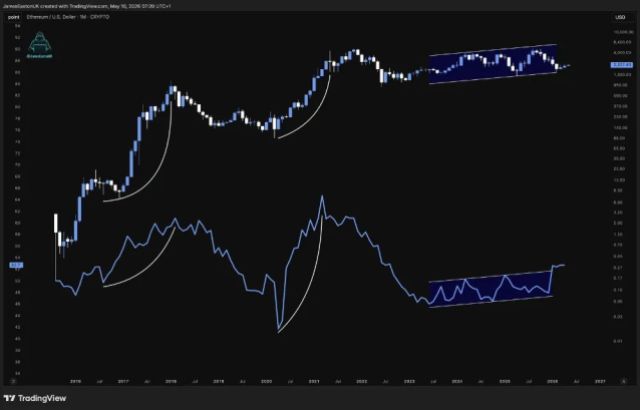
Source: Chart from Leon Waidmann on X

Consolidation phases are sometimes a positive reaction as they can precede upside movement. Waidmann noted that the longer the consolidation phase, the bigger the move out of it will be. What makes this period interesting is the increased network performance that is coinciding with the current momentum.

As stated by the expert, over 7.33 million ETH, representing 6% of all ETH supply, are locked on corporate balance sheets. Furthermore, inflation across the ETH ecosystem is currently lower than that of Bitcoin since the introduction of the Merge update. Other significant achievements include the surge in transactions on the ETH mainnet and layer 2 solutions, reaching new all-time highs. “The fundamentals are catching up, and the chart is setting up,” Waidmann added.

ETH Dominating DeFi And Lending

Etherealize has shared a recent report from Galaxy Research regarding Ethereum. In the report, the platform’s VP Research noted that ETH’s TVL market share has held remarkably steady at roughly 55% to 60% since mid-2022. The ETH network is witnessing notable liquidity, reinforcing its dominance in lending and DeFi.

This is due to the depth of its collateral markets, oracle infrastructure, and surviving multiple market crashes. Such development leads to the creation of a trust premium that newer chains cannot quickly replicate, particularly for the largest allocators whose risk tolerance is the lowest.

Also, stablecoin issuance on the network has skyrocketed to 50% of all stablecoin market cap, and over 60% of all tokenized real-world assets are issued on ETH. According to the platform, this is possibly some of the stickiest capital on Ethereum because institutional RWA issuers select a chain after months of legal examination, custodian integration, and compliance sign-off.

ETH trading at $2,301 on the 1D chart | Source: ETHUSDT on Tradingview.com

Trending Cryptos

Related Questions

QDespite a slight price pullback, what shows signs of strength for Ethereum according to the article?

AThe underlying structure and fundamentals of Ethereum, particularly the robust network performance and steady increase in transaction activity, show signs of strength.

QWhat key on-chain metrics are strengthening investor conviction in Ethereum's long-term value?

ARising transaction activity, stronger on-chain engagement, and continued growth in key sectors are strengthening investor conviction.

QWhat did analyst Leon Waidmann note about Ethereum's multi-year consolidation phase on the monthly chart?

AHe noted that the longer the consolidation phase, the bigger the move out of it will be, describing it as a classic accumulation before a major move.

QWhat is Ethereum's approximate TVL (Total Value Locked) market share in DeFi since mid-2022, as cited in the Galaxy Research report?

AEthereum's TVL market share has held remarkably steady at roughly 55% to 60% since mid-2022.

QWhat specific achievements highlight Ethereum's dominance in stablecoins and tokenized real-world assets (RWAs)?

AStablecoin issuance on Ethereum is 50% of the total market cap, and over 60% of all tokenized real-world assets are issued on the network.

Related Reads

The Verdict in Choi Tae-won's Divorce Case: Revealing the Inheritance Undercurrent Behind SK Hynix's Trillion-Won Empire

SK Group Chairman Chey Tae-won's high-profile divorce case, involving a record 1.38 trillion won settlement, has drawn attention to the succession plans for Korea's second-largest conglomerate, especially its crown jewel, SK hynix. Unlike traditional chaebol scripts centered on the eldest son, Chey's three children from his marriage to former President Roh Tae-woo's daughter, Roh Soh-yeong, are carving distinct, non-traditional paths. Eldest daughter Chey Yun-jung (b. 1989) is seen as the most evident successor. With a scientific and consulting background, she holds executive roles at SK bioscience and SK Inc.'s growth support department, focusing on future strategy and biopharma. Her marriage is to an AI infrastructure entrepreneur, not a traditional business alliance. Second daughter Chey Min-jung (b. 1991) took a unique route, voluntarily serving as a South Korean naval officer, including an anti-piracy deployment. She later worked on policy and strategy for SK hynix in Washington D.C. before co-founding an AI-driven healthcare startup. She married a former U.S. Marine Corps officer, connecting her to U.S. defense and policy circles—networks crucial for a global semiconductor giant. The only son, Chey In-geun (b. 1995), who studied physics like his father, worked briefly at SK E&S before joining McKinsey. Despite fitting the traditional "heir" profile as the eldest son, he remains silent and holds no public position or shares in SK, suggesting the old succession playbook is obsolete. As SK hynix's valuation soars, becoming a geopolitical asset in the AI era, the heirs' legitimacy is no longer automatic. They must prove themselves in fields like AI biotech, global policy, and strategic consulting. Their marriages also reflect new elite networks in tech and defense, not old political alliances. Their inheritance is the complex challenge of navigating a globalized, tech-driven world, not just a corporate throne.

marsbit9h ago

The Verdict in Choi Tae-won's Divorce Case: Revealing the Inheritance Undercurrent Behind SK Hynix's Trillion-Won Empire

marsbit9h ago

From OpenSea to OpenRouter: Is Alex Atallah Repeating His 'Exit at the Peak' Playbook?

From OpenSea to OpenRouter: Is Alex Atallah Repeating His "Exit at the Peak" Playbook? According to the Wall Street Journal, payments giant Stripe is in talks to acquire the AI model aggregation platform OpenRouter in a potential deal valuing the company near $100 billion. This would mark founder Alex Atallah's second creation of a company reaching a $100 billion valuation, following his co-founding of NFT marketplace OpenSea. OpenRouter, founded just over three years ago, has grown rapidly by acting as a unified gateway for developers to access over 400 AI models. It currently has about 10 million users and processes over 200 trillion tokens monthly. While the platform's annualized revenue is around $50 million, its valuation has skyrocketed from $1.3 billion in March 2026. The potential acquisition by Stripe, a company OpenRouter's founder once likened it to, represents a major expansion into AI infrastructure for the payments leader. This move echoes Atallah's previous timing with OpenSea, where he departed before the NFT market's significant downturn. For OpenRouter, selling now may be strategic. Despite its scale, its business model—charging a 5-5.5% fee on AI inference calls—faces pressure from competition, open-source models, and potential price wars among model providers, limiting its profitability narrative for an IPO. A key asset for potential acquirers like Stripe is OpenRouter's vast repository of real-world AI usage data, which offers unique insights into model performance and developer preferences that are difficult to replicate. Whether this potential deal signifies a new valuation benchmark for AI infrastructure or another market peak signal remains to be seen.

链捕手10h ago

From OpenSea to OpenRouter: Is Alex Atallah Repeating His 'Exit at the Peak' Playbook?

链捕手10h ago

Trading

Spot

Hot Articles

Discussions

Welcome to the HTX Community. Here, you can stay informed about the latest platform developments and gain access to professional market insights. Users' opinions on the price of ETH (ETH) are presented below.

活动图片