Ethereum Showcases Dominance, Claiming No.1 Spot In Global Validator Network Spread

bitcoinistPublished on 2026-04-18Last updated on 2026-04-18

Abstract

Ethereum has solidified its dominance by achieving the top position in global validator network distribution, a key indicator of decentralization. With approximately 921,500 validators, Ethereum far surpasses competitors like Cardano, which has only 2,900. This broad participation enhances the network's security, resilience, and role as a foundational layer for decentralized applications (dApps). Meanwhile, Ethereum's price is poised for a potential upward move, with key resistance levels at $2,900–$3,050. A break above $3,050 could signal a strong trend reversal, while support rests at $1,800. Investors are advised to watch these levels for confirmation of Ethereum's next major price direction.

Amid the growing recognition of the blockchain sector, the Ethereum network continues to be at the forefront of the growth, securing more user activity than most networks. The most recent aspect being dominated by the leading network is validator distribution, which makes it a leader in decentralized applications (dApps) activity.

Validator Distribution Strength Puts Ethereum On Top

The Ethereum network has emerged with another reason why it is considered the leading blockchain across the entire cryptocurrency sector. After a wave of demand, a significant milestone has now been reached in the evolution of Ethereum, putting the network in the spotlight once again.

In a report on the social media platform X, Everstake, a leader in global non-custodial staking infrastructure provider, revealed that the ETH network has emerged as the top blockchain in validator distribution. With validation authority distributed more fairly across participants rather than being concentrated among a few entities, this development highlights an increasing degree of decentralization.

As seen in the chart shared by Everstake, the total number of validators on the network is approximately 921,500. The ETH network is exceptionally leading in this context, with Cardano, which comes in the second position, recording a total of just 2,900 validators.
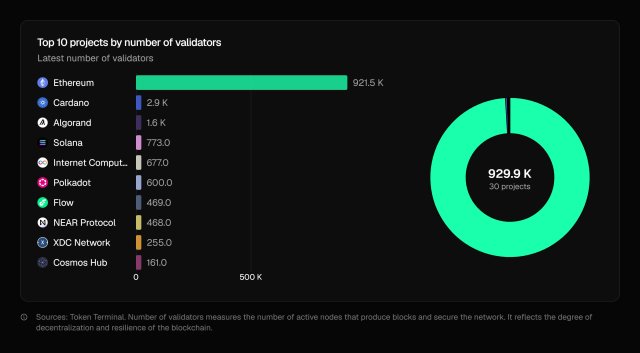
Source: Chart from Everstake on X

This level of validators enables the ETH network to operate at a scale that clearly sets it apart from the rest of the market. It is worth noting that this development also strengthens the network’s role as a fundamental layer for decentralized applications by bolstering its resilience and security.

At this point, different networks are persistently evolving and optimizing for their own priorities. Ethereum, on the other hand, is showing that its strength mainly relies on the breadth of participation securing the network.

Everstake stated that this degree of distribution supports long-term security and resilience in addition to decentralization. As the sector evolves, validator scale has become one of the clearest indicators of network maturity in numerous ways, but Ethereum continues to be the reference point.

ETH’s Price Set For A Massive Move

While Ethereum gains momentum, Crypto Patel has underlined that a key level will determine its next big move. In the analyst’s view, ETH’s bottom looks done for now after dropping hard from $4,800 to $1,765, wiping out almost every trader on the way down. However, the price has been slowly climbing inside a rising channel since then.

Currently, ETH’s price is positioned just below a big unfilled gap between $2,474 and $2,634, which is where the price is expected to go next. Above that is the real resistance at $2,900 and $3,050. If ETH makes a daily break and closes below $3,050, it would change the price dynamics to a full trend reversal.

On the downside, $1,800 is the key support, but losing $1,765 would mean trouble. Patel highlighted that ETH is still recovering, but has not shown serious strength yet. Thus, the expert claims it still needs to break $3,050 to confirm real strength, urging investors to be patient and wait for a clear price direction.

ETH trading at $2,335 on the 1D chart | Source: ETHUSDT on Tradingview.com

Related Questions

QWhat recent achievement has made Ethereum the top blockchain in terms of validator distribution?

AEthereum has emerged as the top blockchain in validator distribution, with approximately 921,500 validators, significantly more than second-place Cardano which has only 2,900 validators.

QAccording to Everstake, what are the benefits of Ethereum's high validator distribution?

AEverstake stated that this degree of validator distribution supports long-term security, resilience, and decentralization of the network.

QWhat key price level does analyst Crypto Patel identify as crucial for confirming Ethereum's strength?

ACrypto Patel identifies $3,050 as the key resistance level that Ethereum needs to break and close above on a daily basis to confirm real strength and a full trend reversal.

QWhat is the current trading price of ETH as shown in the chart from the article?

AETH is trading at $2,335 according to the 1D chart from Tradingview.com shown in the article.

QHow does the article describe the significance of validator scale for a blockchain network?

AThe article states that validator scale has become one of the clearest indicators of network maturity, with Ethereum serving as the reference point in the sector.

Related Reads

Jensen Huang's CMU Speech: In the AI Era, Don't Just Watch, Build

Jensen Huang, CEO of NVIDIA and a first-generation immigrant, delivered the commencement address to Carnegie Mellon University's class of 2026. He shared his personal journey from a humble background to founding NVIDIA, emphasizing resilience, learning from failure, and the responsibility that comes with leadership. Huang framed the present moment as the dawn of the AI revolution, a shift he believes is more profound than previous computing waves. He described AI as fundamentally resetting computing—moving from human-written software to machines that understand, reason, and use tools. This will create a new industry for generating intelligence and transform every sector. While acknowledging AI's potential to automate tasks and displace some jobs, Huang distinguished between the *tasks* of a job and its core *purpose*. He argued AI will augment human capability, not replace humans. The real risk, he stated, is not AI itself, but people being left behind by those who effectively use AI. He presented AI as a generational opportunity for massive infrastructure investment—in chip factories, data centers, energy grids, and advanced manufacturing—that could re-industrialize nations like the U.S. and bridge the digital divide by making computing and intelligent tools accessible to all. Huang called for a balanced approach: advancing AI safely and responsibly, establishing prudent policies, ensuring broad access, and encouraging universal participation. He urged the graduates not to fear the future but to engage with optimism and ambition, reminding them of CMU's motto, "My heart is in the work." His core message was clear: this is their moment to actively build and shape the AI-powered future, not merely observe it.

marsbit41m ago

Jensen Huang's CMU Speech: In the AI Era, Don't Just Watch, Build

marsbit41m ago

The Era Has Arrived Where Human Writers Must Prove They Are Not Machines

The article describes an era where AI-generated content is flooding the market, forcing human authors to prove they are not machines. It begins with the example of dozens of AI-written, error-ridden biographies of Henry Kissinger appearing on Amazon within hours of his death, a pattern repeated for other deceased celebrities and even living experts who find fraudulent books under their names. This spam content has exploded, with monthly new book releases on platforms like Amazon reaching 300,000 by late 2025. The issue spans genres, from suspiciously high proportions of AI-written teen romance and self-help books to dangerous, AI-generated foraging guides containing lethal advice. The platforms' automated review systems, designed to catch plagiarism and banned words, are ill-equipped to detect AI-generated text that avoids these pitfalls while being nonsensical or fraudulent. The problem has infiltrated traditional publishing. A major publisher, Hachette, had to recall a bestselling horror novel after AI detection tools suggested 78% of its content was machine-generated. An acclaimed European philosophy book was later revealed to be entirely written by AI under a fake author persona. In response, authors are fighting back. At the 2026 London Book Fair, 10,000 writers published a blank book titled "Don't Steal This Book" containing only their signatures—using emptiness as a protest weapon in an age of AI overproduction. Initiatives like the "Human Author Certification" program have emerged, ironically placing the burden on humans to prove their work is not machine-made. The article warns of a vicious cycle: AI-generated low-quality books pollute the data used to train future AI models, leading to "model collapse" and an ever-worsening flood of digital waste, eroding trust in publishing and devaluing human creativity.

marsbit1h ago

The Era Has Arrived Where Human Writers Must Prove They Are Not Machines

marsbit1h ago

Trading

Spot
Futures

Hot Articles

Discussions

Welcome to the HTX Community. Here, you can stay informed about the latest platform developments and gain access to professional market insights. Users' opinions on the price of ETH (ETH) are presented below.

活动图片