Ethereum Sees Spike In Daily Transactions While Price Momentum Gradually Fades

bitcoinistPublished on 2026-04-14Last updated on 2026-04-14

Abstract

Ethereum's daily transactions have reached a record high of over 3.6 million, marking the strongest on-chain activity in the network's history, despite ETH's price volatility and a 55% drop from its all-time high. This divergence between robust network engagement and struggling price action suggests underlying fundamental strength that may not yet be reflected in valuation. Reports indicate Ethereum is thriving as a settlement layer for on-chain finance, with stablecoin supply hitting a new all-time high of over $180 billion—a 150% increase in three years. Ethereum currently holds a 60% market share in stablecoins, with projections suggesting it could secure nearly $850 billion in new stablecoin supply by 2030.

Ethereum network activity is not being influenced or shaped by the current price action of the altcoin, which has been steadily battling with volatility. Even as the price of ETH has fallen sharply from its new peak, user activity on the leading blockchain network is experiencing robust growth, with more operations being carried out on a daily basis.

Rising On-Chain Activity Contrasts With Declining Price

In a highly uncertain and volatile cryptocurrency environment, the Ethereum network appears to be thriving, experiencing robust interest and engagement. ETH’s current network strength is evident, particularly in the number of transactions processed on the blockchain each day.

The daily transaction counts on the network have exploded while price action continues to struggle to regain bullish momentum. This mismatch between market performance and fundamentals often indicates underlying strength that may not yet be represented in valuation.

Reports from Everstake, the largest global non-custodial staking infrastructure provider, revealed that the Ethereum network is making history, recording over 3.6 million transactions on April 12, 2026. As of today, this figure marks the strongest daily activity on the network since its existence.

What makes this quite interesting is the fact that ETH’s price is still trading about 55% below its all-time high. The increase in on-chain activity indicates that consumers are still actively participating in the network despite the lack of price change.
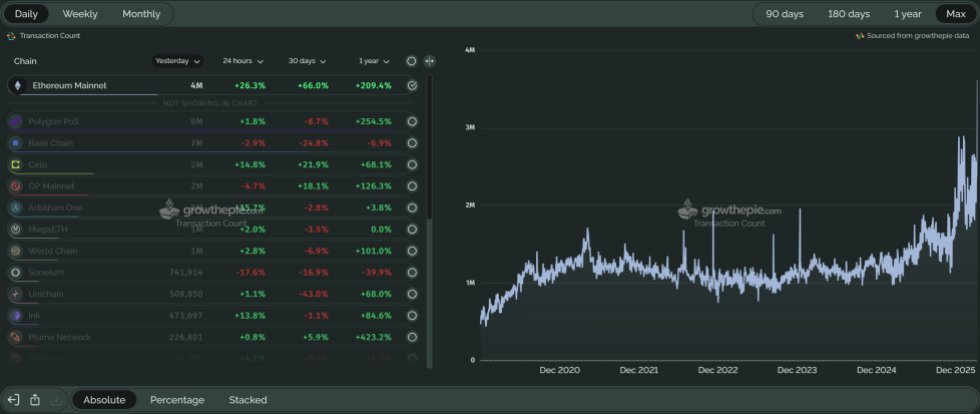
Source: Chart from Everstake on X

EverstaKe added that this trend creates a notable divergence because network activity is at peak levels in the absence of complete price strength. In the past, such gaps have demonstrated a tendency to narrow over time.

Adding to the network growth, the platform highlighted that Ethereum is now one of the strongest foundations it has ever had. Since choosing ETH, there have been record levels of usage, a deeply established ecosystem, and continued progress in scaling and development.

In many ways, this progress highlights a simple dynamic where price typically follows fundamentals, not the other way around. Meanwhile, Everstake stated that the fundamentals are already in place.

Ethereum Sees Stablecoin Supply Peak

As the financial sector grows, the Ethereum network is steadily emerging as the major settlement layer for on-chain finance activity. The stablecoin supply managed on the leading network is rising at a significant rate over the years.

In an X post, Leon Waidmann, a researcher and optimist, shared that stablecoin supply on ETH has reached a new all-time high. Data shows over $180 billion has been added to the network over the past 3 years, representing a 150% increase within the period.

Currently, Ethereum controls about 60% market share in stablecoins. In the next 4 years, an additional $1.7 trillion is set to go on-chain, and ETH could dominate this revenue. Even if Ethereum’s market share eventually drops from 60% to 50%, it still means that by 2030, the ETH network will secure almost $850 billion in new stablecoin supply.

ETH trading at $2,371 on the 1D chart | Source: ETHUSDT on Tradingview.com

Trending Cryptos

Related Questions

QWhat is the current trend in Ethereum's daily transaction count despite its price volatility?

AEthereum's daily transaction count is experiencing robust growth and has reached a record high, with over 3.6 million transactions on April 12, 2026, even as its price struggles with volatility.

QAccording to the article, what does the mismatch between Ethereum's market performance and its fundamentals often indicate?

AThe mismatch between market performance and fundamentals often indicates an underlying strength in the network that may not yet be reflected in its valuation.

QWhat significant milestone did the stablecoin supply on the Ethereum network achieve, as mentioned in the article?

AThe stablecoin supply on the Ethereum network reached a new all-time high, with over $180 billion added over the past 3 years, representing a 150% increase.

QWhat is Ethereum's current market share in the stablecoin sector, and what is its projected share of new supply by 2030?

AEthereum currently controls about 60% of the stablecoin market share. It is projected that by 2030, the network could secure almost $850 billion in new stablecoin supply, even if its market share drops to 50%.

QWhich company reported the record-breaking transaction count on the Ethereum network and highlighted the divergence between network activity and price?

AEverstake, the largest global non-custodial staking infrastructure provider, reported the record transaction count and highlighted the divergence between peak network activity and the lack of complete price strength.

Related Reads

The Verdict in Choi Tae-won's Divorce Case: Revealing the Inheritance Undercurrent Behind SK Hynix's Trillion-Won Empire

SK Group Chairman Chey Tae-won's high-profile divorce case, involving a record 1.38 trillion won settlement, has drawn attention to the succession plans for Korea's second-largest conglomerate, especially its crown jewel, SK hynix. Unlike traditional chaebol scripts centered on the eldest son, Chey's three children from his marriage to former President Roh Tae-woo's daughter, Roh Soh-yeong, are carving distinct, non-traditional paths. Eldest daughter Chey Yun-jung (b. 1989) is seen as the most evident successor. With a scientific and consulting background, she holds executive roles at SK bioscience and SK Inc.'s growth support department, focusing on future strategy and biopharma. Her marriage is to an AI infrastructure entrepreneur, not a traditional business alliance. Second daughter Chey Min-jung (b. 1991) took a unique route, voluntarily serving as a South Korean naval officer, including an anti-piracy deployment. She later worked on policy and strategy for SK hynix in Washington D.C. before co-founding an AI-driven healthcare startup. She married a former U.S. Marine Corps officer, connecting her to U.S. defense and policy circles—networks crucial for a global semiconductor giant. The only son, Chey In-geun (b. 1995), who studied physics like his father, worked briefly at SK E&S before joining McKinsey. Despite fitting the traditional "heir" profile as the eldest son, he remains silent and holds no public position or shares in SK, suggesting the old succession playbook is obsolete. As SK hynix's valuation soars, becoming a geopolitical asset in the AI era, the heirs' legitimacy is no longer automatic. They must prove themselves in fields like AI biotech, global policy, and strategic consulting. Their marriages also reflect new elite networks in tech and defense, not old political alliances. Their inheritance is the complex challenge of navigating a globalized, tech-driven world, not just a corporate throne.

marsbit19h ago

The Verdict in Choi Tae-won's Divorce Case: Revealing the Inheritance Undercurrent Behind SK Hynix's Trillion-Won Empire

marsbit19h ago

From OpenSea to OpenRouter: Is Alex Atallah Repeating His 'Exit at the Peak' Playbook?

From OpenSea to OpenRouter: Is Alex Atallah Repeating His "Exit at the Peak" Playbook? According to the Wall Street Journal, payments giant Stripe is in talks to acquire the AI model aggregation platform OpenRouter in a potential deal valuing the company near $100 billion. This would mark founder Alex Atallah's second creation of a company reaching a $100 billion valuation, following his co-founding of NFT marketplace OpenSea. OpenRouter, founded just over three years ago, has grown rapidly by acting as a unified gateway for developers to access over 400 AI models. It currently has about 10 million users and processes over 200 trillion tokens monthly. While the platform's annualized revenue is around $50 million, its valuation has skyrocketed from $1.3 billion in March 2026. The potential acquisition by Stripe, a company OpenRouter's founder once likened it to, represents a major expansion into AI infrastructure for the payments leader. This move echoes Atallah's previous timing with OpenSea, where he departed before the NFT market's significant downturn. For OpenRouter, selling now may be strategic. Despite its scale, its business model—charging a 5-5.5% fee on AI inference calls—faces pressure from competition, open-source models, and potential price wars among model providers, limiting its profitability narrative for an IPO. A key asset for potential acquirers like Stripe is OpenRouter's vast repository of real-world AI usage data, which offers unique insights into model performance and developer preferences that are difficult to replicate. Whether this potential deal signifies a new valuation benchmark for AI infrastructure or another market peak signal remains to be seen.

链捕手19h ago

From OpenSea to OpenRouter: Is Alex Atallah Repeating His 'Exit at the Peak' Playbook?

链捕手19h ago

Trading

Spot

Hot Articles

Discussions

Welcome to the HTX Community. Here, you can stay informed about the latest platform developments and gain access to professional market insights. Users' opinions on the price of ETH (ETH) are presented below.

活动图片
















