Ethereum Reclaims $2,000 as ETF Inflows and Upgrade Roadmap Boost Momentum

bitcoinistPublished on 2026-02-26Last updated on 2026-02-26

Abstract

After weeks of stagnation below $1,900, Ethereum surged past the key $2,000 level, reaching $2,158. This rally was driven by renewed institutional demand, with spot Ethereum ETFs recording over $125 million in inflows, led by Grayscale and Fidelity. On-chain data showed accumulation by large holders, and the Ethereum Foundation announced plans to stake 70,000 ETH, reducing circulating supply. The recovery aligns with a broader crypto market rebound. Beyond price, investor focus is on Ethereum's long-term upgrade roadmap. Co-founder Vitalik Buterin outlined plans to drastically reduce block times and achieve faster transaction finality, alongside implementing quantum-resistant cryptography over the coming years. However, short-term volatility may arise from $893 million in ETH options expiring this week. Traders are watching if ETH can hold above $2,000, with sustained institutional interest and upgrade progress being key to determining if this is a lasting trend reversal.

After weeks stuck below a key psychological level, Ethereum (ETH) surged past $2,000 in a swift rally, pushing prices to $2,158 within a day. The recovery comes after a prolonged period of sideways trading around $1,900 and a broader correction that had pushed ETH more than 60% below its previous peak.

The latest double-digit recovery coincided with a wider cryptocurrency market rebound, with total market capitalization rising by over 4% and Bitcoin also advancing during the same period.
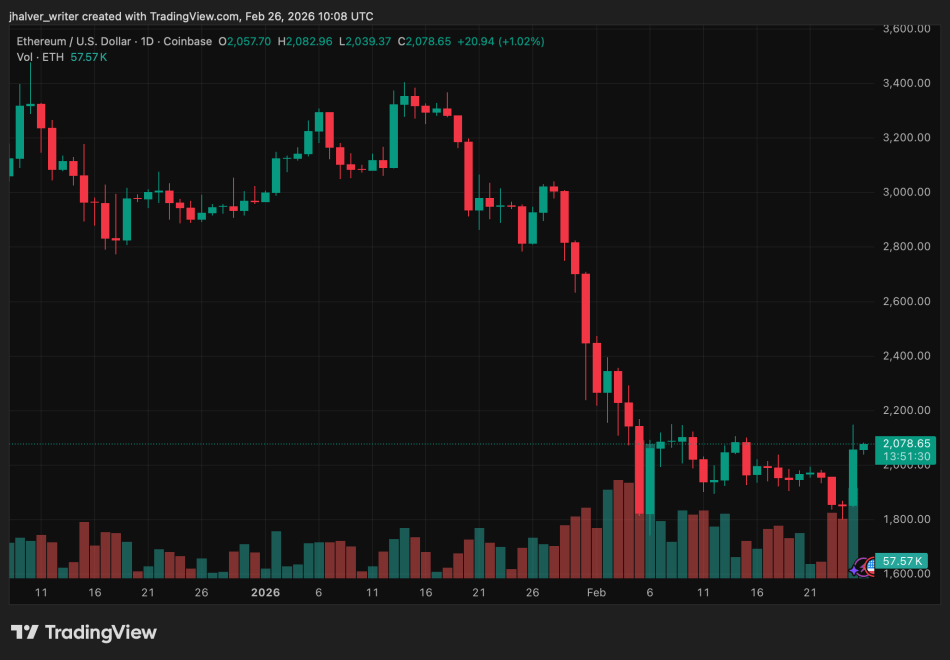
ETH's price trends to the downside on the daily chart. Source: ETHUSD on Tradingview

Ethereum ETF Inflows and Institutional Activity Drive Recovery

Renewed institutional demand helped drive Ethereum’s breakout, as spot ETFs recorded fresh inflows after weeks of outflows. Daily investments topped $20 million in some sessions, with total inflows exceeding $125 million on February 25, led largely by Grayscale and Fidelity products.

On-chain data also pointed to accumulation by large holders. Whale wallets added thousands of ETH while others withdrew significant amounts from exchanges, a pattern often interpreted as long-term positioning rather than short-term trading.

The Ethereum Foundation added another layer of support by announcing plans to stake 70,000 ETH from its treasury. The move reflects a shift toward active reserve management while reducing the circulating supply available on the market.

Technically, momentum indicators turned positive as capital flowed back into the asset. Analysts identified resistance zones between $2,080 and $2,150, while support formed around the psychologically important $2,000 level.

Upgrade Roadmap Signals Faster and More Secure Ethereum

Beyond price action, investor attention has also focused on Ethereum’s long-term development roadmap. Co-founder Vitalik Buterin recently outlined proposals to significantly improve transaction speed and security over the next several years.

The plan includes gradually reducing block slot times from 12 seconds to as low as two seconds, allowing faster transaction processing. Developers are also targeting transaction finality between 6 and 16 seconds, a major reduction from the current confirmation timeframe, which can stretch into minutes.

The roadmap spans multiple protocol upgrades expected through the end of the decade and introduces quantum-resistant cryptography designed to prepare the network for future computing risks. Changes will be implemented gradually to limit disruption and maintain network stability.

Options Expiry Could Increase Short-Term Volatility

Despite improving sentiment, derivatives markets may introduce near-term volatility. Around $893 million worth of ETH options are set to expire this week, with a “max pain” level near $2,200. The put-to-call ratio below 1 suggests traders are leaning toward upside exposure, though expiry mechanics can temporarily influence price direction.

Ethereum’s ability to hold above $2,000 remains the key signal for traders. Sustained institutional inflows and progress on network upgrades could determine whether the latest rally develops into a broader trend reversal or remains a short-term recovery within a larger consolidation phase.

Cover image from ChatGPT, ETHUSD chart on Tradingview

Trending Cryptos

Related Questions

QWhat key price level did Ethereum reclaim and what was the peak price reached during the recent rally?

AEthereum reclaimed the key psychological level of $2,000 and surged to a peak of $2,158 within a day.

QWhat two main catalysts are credited with boosting Ethereum's momentum according to the article?

AThe two main catalysts are renewed inflows into spot Ethereum ETFs and the announcement of a long-term upgrade roadmap for the network.

QHow did the Ethereum Foundation contribute to the positive market sentiment?

AThe Ethereum Foundation announced plans to stake 70,000 ETH from its treasury, which reduces the circulating supply and reflects a shift toward active reserve management.

QWhat are two specific improvements to transaction processing proposed in Ethereum's upgrade roadmap?

AThe roadmap proposes reducing block slot times from 12 seconds to as low as 2 seconds and achieving transaction finality between 6 and 16 seconds, a significant reduction from the current timeframe.

QWhat near-term event could introduce volatility to the ETH price, and what is the 'max pain' level for the expiring options?

AThe expiration of around $893 million worth of ETH options could introduce near-term volatility, with a 'max pain' level near $2,200.

Related Reads

Annual Salary of Millions Competing for Electricians, Meta Rushes to Open Its Own Technical School

The AI boom is facing an unexpected bottleneck: a severe shortage of skilled construction workers and electricians. As tech giants like Meta, OpenAI, and Alphabet race to build massive data centers—such as OpenAI's $16 billion "Stargate" project—they are hitting a critical labor wall. The U.S. needs an estimated 130,000 more electricians, 240,000 construction workers, and 150,000 supervisors by 2030 for AI infrastructure alone, but tens of thousands of electrician jobs go unfilled each year. While AI companies offer high premiums, with electricians earning up to $280,000 annually, worker scarcity still causes massive losses—delays on a single project can cost $14.2 million per month. The complexity of building AI data centers, which require immense power (equivalent to powering hundreds of thousands of homes), sophisticated electrical systems, and advanced liquid cooling solutions, demands highly skilled technicians who are in short supply. To combat this, companies are investing heavily in training. Meta has committed $115 million to a free training school offering tuition, housing, and stipends, targeting 5,000 new workers. OpenAI is partnering with unions to secure skilled labor. These efforts are paying off, with a significant rise in Gen Z interest in trade schools over college. However, the power demands are staggering. AI data centers are driving a rapid surge in electricity consumption, projected to account for up to 12% of U.S. power use by 2028 and raising costs for consumers. Furthermore, the construction boom is project-based, leading to a potential future glut of trained workers once building peaks, which could depress wages industry-wide. The race for AI supremacy now depends as much on skilled hands as on advanced chips.

marsbit57m ago

Annual Salary of Millions Competing for Electricians, Meta Rushes to Open Its Own Technical School

marsbit57m ago

OpenAI No Longer Sells Its Most Expensive Model for Profit

OpenAI is shifting its business strategy away from promoting its most expensive, flagship models for every task. Recent price cuts—80% for GPT-5.6 Luna and 20% for Terra—signal a deeper change: the company now actively advises users that many tasks don't require the most powerful model. Instead, OpenAI recommends a tiered approach: use the high-end GPT-5.6 Sol for complex planning and analysis, then delegate execution to cheaper models like Luna. This mirrors moves by Anthropic, which recently launched Claude Opus 5 at half the price of its top model, Fable 5. Both companies are de-emphasizing flagship models as primary revenue drivers, using them instead for brand prestige and technological showcases. The industry is entering a "mass-market" phase, similar to automotive, where high-volume, cost-effective models handle daily operations and drive scale. OpenAI's price reductions are partly enabled by AI models themselves optimizing underlying code and infrastructure, creating a self-reinforcing cycle of efficiency gains and cost reduction. Competition is shifting from "who is smartest" to "who offers the best value." The goal is no longer selling individual models but fostering widespread API adoption and ecosystem lock-in. By making AI calls cheap and ubiquitous, companies like OpenAI aim to become the indispensable, utility-like infrastructure powering automated workflows—the "water and electricity" of software, quietly embedded everywhere.

marsbit57m ago

OpenAI No Longer Sells Its Most Expensive Model for Profit

marsbit57m ago

Will the Fed Definitely Raise Interest Rates in September? How Will Crypto and U.S. Stocks Withstand the Pressure?

The market's expectation for a September Fed rate hike surged dramatically in early August, jumping from under 50% to over 80% within a week. This shift followed a contentious July FOMC meeting, where a 9-3 vote to hold rates revealed growing dissent from hawkish members advocating for an immediate hike to combat persistent inflation. The primary catalyst for this repricing is rising oil prices, driven by renewed geopolitical tensions around the Strait of Hormuz, which threaten global supply. Energy costs directly influence inflation metrics, making the upcoming July CPI report (due August 12th) a critical data point. If it shows inflation reaccelerating, the probability of a September hike will solidify. For Bitcoin and crypto assets, this is typically bearish news. Bitcoin continues to behave as a high-beta, liquidity-sensitive risk asset. A rate hike raises the opportunity cost of holding non-yielding assets and could drive capital toward money markets, pressuring crypto prices in the short term. However, historical patterns suggest that if a hike is perceived as the end of a tightening cycle rather than the start, any negative price impact may be brief. U.S. stocks, particularly crypto-linked equities like Coinbase and growth-oriented tech stocks, are also vulnerable. Higher rates increase discount rates in valuation models, putting pressure on high-multiple companies. This coincides with a pivotal tech earnings season where investor focus has shifted from massive AI capital expenditure to tangible revenue and cash flow generation. Companies with negative cash flow and weak growth narratives could face heightened volatility if borrowing costs rise in September. In summary, a September Fed hike has evolved into a mainstream market scenario. Key factors to watch are oil prices, the July CPI report, and Fed communications, which will determine the final decision and its impact on volatile crypto and equity markets.

marsbit1h ago

Will the Fed Definitely Raise Interest Rates in September? How Will Crypto and U.S. Stocks Withstand the Pressure?

marsbit1h ago

Trading

Spot

Hot Articles

Discussions

Welcome to the HTX Community. Here, you can stay informed about the latest platform developments and gain access to professional market insights. Users' opinions on the price of ETH (ETH) are presented below.

活动图片