Ethereum rebounds: Can ETH clear $2.2K as U.S. demand grows?

AmbcryptoPublished on 2026-03-06Last updated on 2026-08-02

Abstract

Ethereum rebounds from the $1,800–$1,900 support zone as U.S. demand strengthens, with $2,200 emerging as the first key test for the recovery.

Ethereum’s [ETH] decline through late January and February pushed price sharply toward the $1,924–$1,801 support zone, where selling pressure finally slowed.

As price briefly spiked near $1,801, buyers stepped in aggressively, defending the yellow support level and preventing a deeper breakdown.

Soon after, the price stabilized near $1,924, a historically validated level that has repeatedly attracted demand. Meanwhile, the RSI recovered to 51.48, at press time, signaling that bearish momentum has faded while buyers gradually regain control.
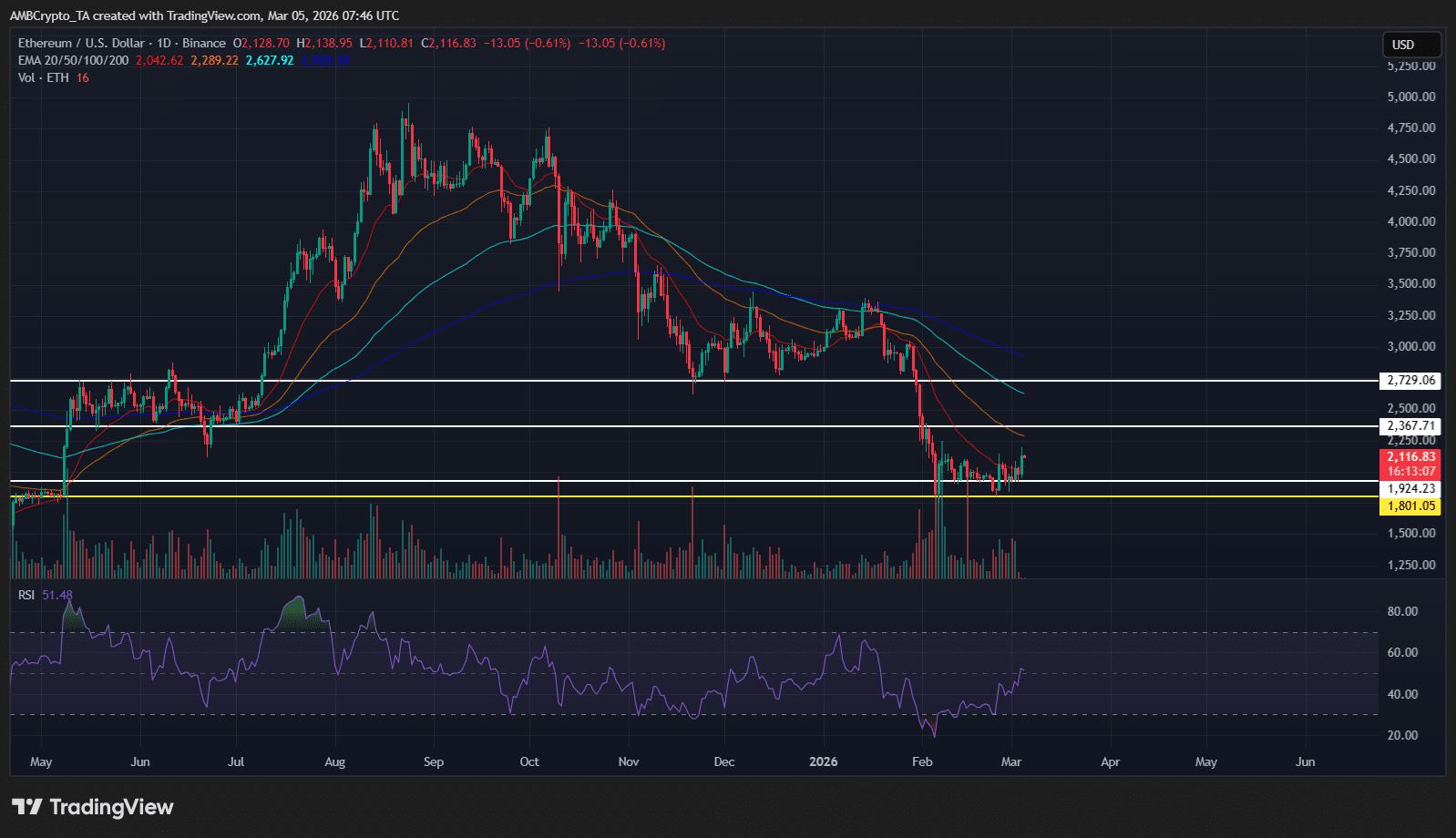
However, Ethereum still trades below major trend indicators. The 20-day EMA neared $2,042, and the 50-day EMA, around $2,289 continue acting as dynamic resistance, showing that sellers remain active during rebounds.

As the recovery unfolds, traders are now watching the $2,111–$2,150 resistance cluster, where the recent bounce approaches the upper boundary of a developing bearish pennant structure.

If buyers reclaim this zone, momentum could extend toward $2,250–$2,300. Meanwhile, failure here may send the price back toward $1,900 to retest the defended accumulation floor.

U.S. buying pressure supports Ethereum’s recovery

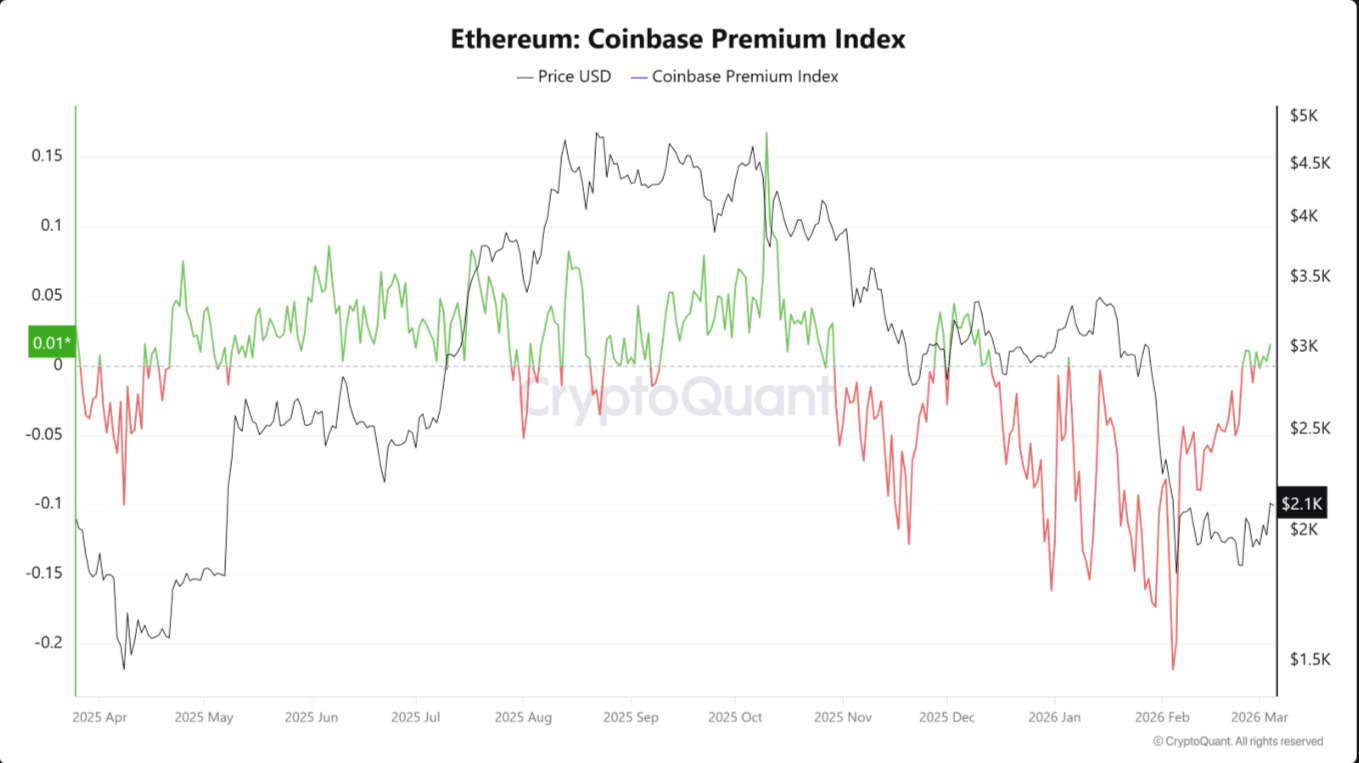
After Ethereum’s rebound from the $1,850–$1,900 demand zone, spot and exchange-flow signals indicate who supported the move.

First, the Coinbase Premium Index has shifted back into positive territory near +0.01, showing ETH has traded slightly higher on U.S. venues. As this premium holds, it suggests steady spot bidding rather than a one-off retail spike.
Meanwhile, CEX activity has also accelerated, which fits the rebound’s volatility regime. The 30-day ETH turnover jumped to roughly 29.6 million ETH, the highest since September.

At the same time, CEX reserves sat near 3.5 million ETH as of writing, meaning the market recycled the available supply multiple times. This lifted the Liquidity Ratio to about 8.47, reflecting intense repositioning and higher speculative churn.
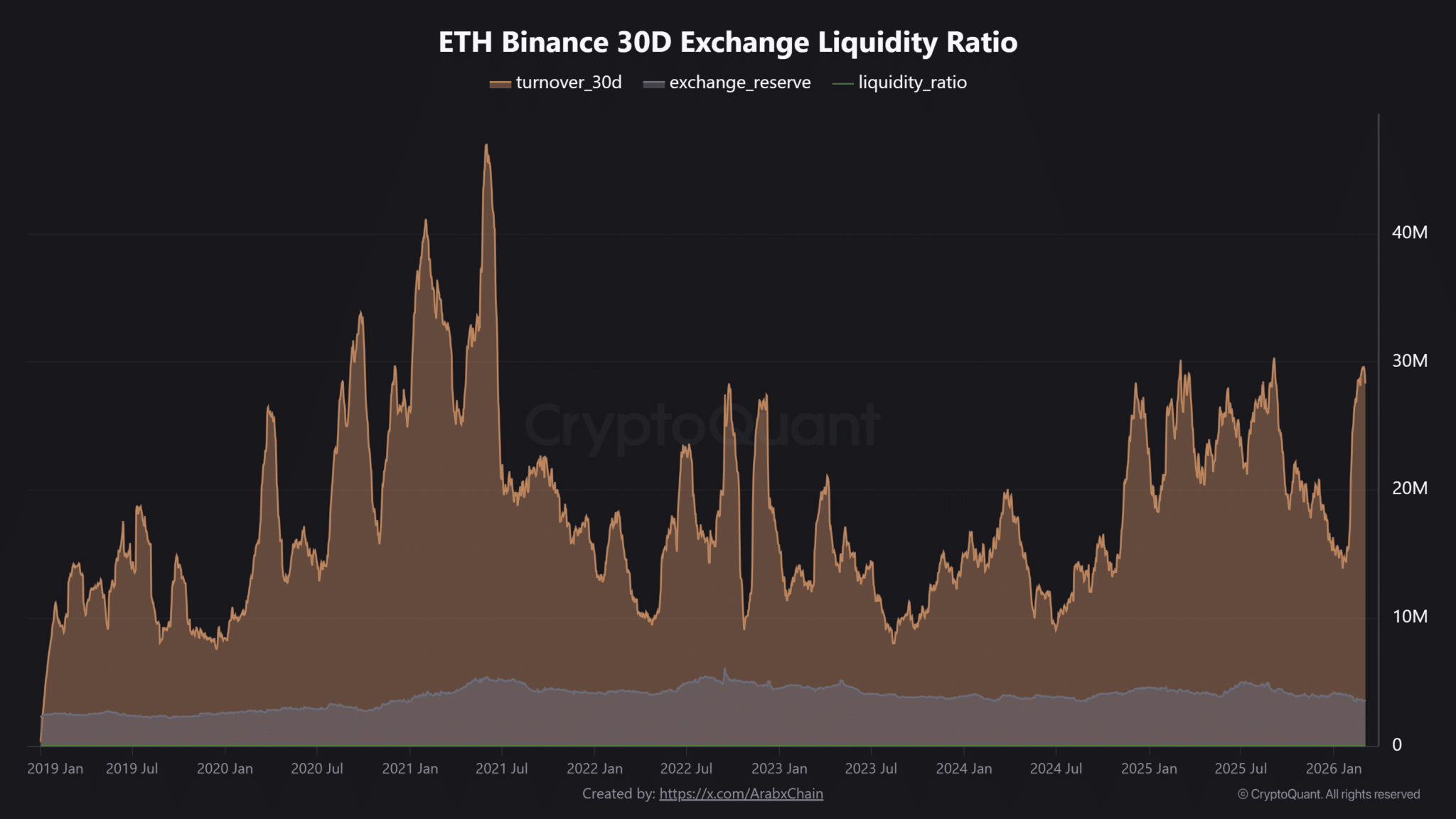
Taken together, fast turnover can reflect short-term trading or derivatives collateral use, while a sustained positive Coinbase premium implies persistent U.S. demand.

If the premium continues rising while the price holds above key supports, institutional accumulation becomes a stronger explanation than retail-driven speculation.

Ethereum rebound faces first structural test!

Ethereum traded near $2,128 at press time while consolidating above the $1,900 support region, where buyers recently absorbed the February sell-off.

This stabilization followed a sharp wick into the $1,700–$1,850 demand zone, signaling aggressive accumulation near the cycle’s lower boundary.

Meanwhile, Fibonacci retracement levels now define the recovery structure, with the first major resistance at the 61.8% level around $2,603, often seen as critical for trend reversals.

As the price approaches this zone, sellers may attempt to defend the broader bearish structure.

Above that, the 50% retracement around $2,985 represents the midpoint of the entire decline and could act as the next major upside objective.

If momentum continues strengthening, the price may eventually test the 38.2% level near $3,368, where a larger supply historically emerges.

At the same time, downside protection remains concentrated near $1,900, while the deeper $1,700–$1,850 zone serves as the key structural floor.

Maintaining this support keeps the current rebound intact while higher Fibonacci levels determine the recovery’s strength.


Trending Cryptos

Related Reads

Within Strategy's Framework, STRC's Dividend Yield Remains at 12% as Share Price Stays Below Par Value

Michael Saylor, Executive Chairman of Strategy (MSTR), confirmed that the dividend rate for its STRC perpetual preferred shares will remain at 12.00% through August 2026. The rate has increased from 9% at its July 2025 launch to the current high via a "ratchet" mechanism, which permanently raises the rate by 0.5% whenever the share price falls below $95. This mechanism is intended to push the price back toward its $100 par value and support Strategy's "at-the-market" (ATM) program for issuing new shares to fund Bitcoin purchases. However, the mechanism has not worked as intended. STRC shares closed at $89.46 on July 31, remaining about 10-11% below par value despite the record-high dividend. Competition from rival Strive's higher-yielding SATA securities has pressured demand. The persistent discount has forced Strategy to suspend new STRC issuances via its ATM program, limiting this funding channel for Bitcoin acquisitions. STRC's struggles reflect Bitcoin's own volatility, as the preferred shares historically move in tandem. Analysts have warned the ratchet structure carries long-term, one-way risk. A law firm is investigating Strategy's ability to maintain dividend payments if Bitcoin's price stays low. Retail investors own roughly 83% of outstanding STRC shares, a group seen as prone to panic selling during downturns. In response, Strategy has established financial reserves, including a liquidity cushion covering about 26 months of dividend/interest obligations, and a $2 billion share buyback program alongside a Bitcoin monetization framework, though the company emphasized it is not obligated to sell any Bitcoin.

cryptonews.ru29m ago

Within Strategy's Framework, STRC's Dividend Yield Remains at 12% as Share Price Stays Below Par Value

cryptonews.ru29m ago

Analyst: Bitcoin's Price Will Drop to $60k in August, Then Rebound to $70k

Financial analyst Andrey Poroshin has provided a new forecast for Bitcoin's price dynamics in August. Poroshin, an analyst at the Bitbanker exchange, expects the cryptocurrency market to experience a downturn this month, with prices retesting the $60,000 level due to a lack of supportive macroeconomic catalysts. He noted that the recent US Federal Reserve decision to hold interest rates did not significantly impact the market, while inflation remains above the 2% target. Poroshin stated that Bitcoin is ending July under pressure from moderate volatility and a lack of new macroeconomic stimuli, leading to continued market caution. According to his base scenario, Bitcoin will drop to a range of $60,000 to $62,000 before recovering to $70,000. He pointed out that even $70,000 remains below the cost of mining in the US, which has prompted some miners to shift towards AI data center operations. Poroshin cited the winding down of BitMEX's operations as a potential catalyst for a price rebound, suggesting the exit of weaker players often coincides with market reversals and reduced short-term selling pressure. He believes Bitcoin is currently less susceptible to geopolitical shocks, such as the Iran-US conflict, and does not expect significant market changes in August related to the pending CLARITY Act. Looking ahead, Poroshin forecasts that September will bring more active price fluctuations driven by potential Fed rate decisions and possible discussions or approval of the CLARITY Act.

cryptonews.ru29m ago

Analyst: Bitcoin's Price Will Drop to $60k in August, Then Rebound to $70k

cryptonews.ru29m ago

Trading

Spot

Hot Articles

Discussions

Welcome to the HTX Community. Here, you can stay informed about the latest platform developments and gain access to professional market insights. Users' opinions on the price of ETH (ETH) are presented below.

活动图片














