Ethereum price prediction – Is a breakout to $2.1K ahead after ETH shakes out weak hands?

ambcryptoPublished on 2026-03-31Last updated on 2026-03-31

Abstract

Ethereum's price reclaimed the $2,000 level, signaling a potential shift from selling pressure to recovery, with ETH trading near $2,060 at the time of writing. This move followed a brief breakdown that flushed out weak long positions in the $1,950–$2,050 liquidation zone, reducing immediate selling pressure and triggering a rebound. The price may now target the $2,100–$2,150 range, partly driven by short covering. However, the negative CMF indicates limited capital inflows, suggesting the uptrend is more due to positioning than strong demand. Key support at $2,000 must hold for the recovery to extend; a break below could see a retest of $1,800.

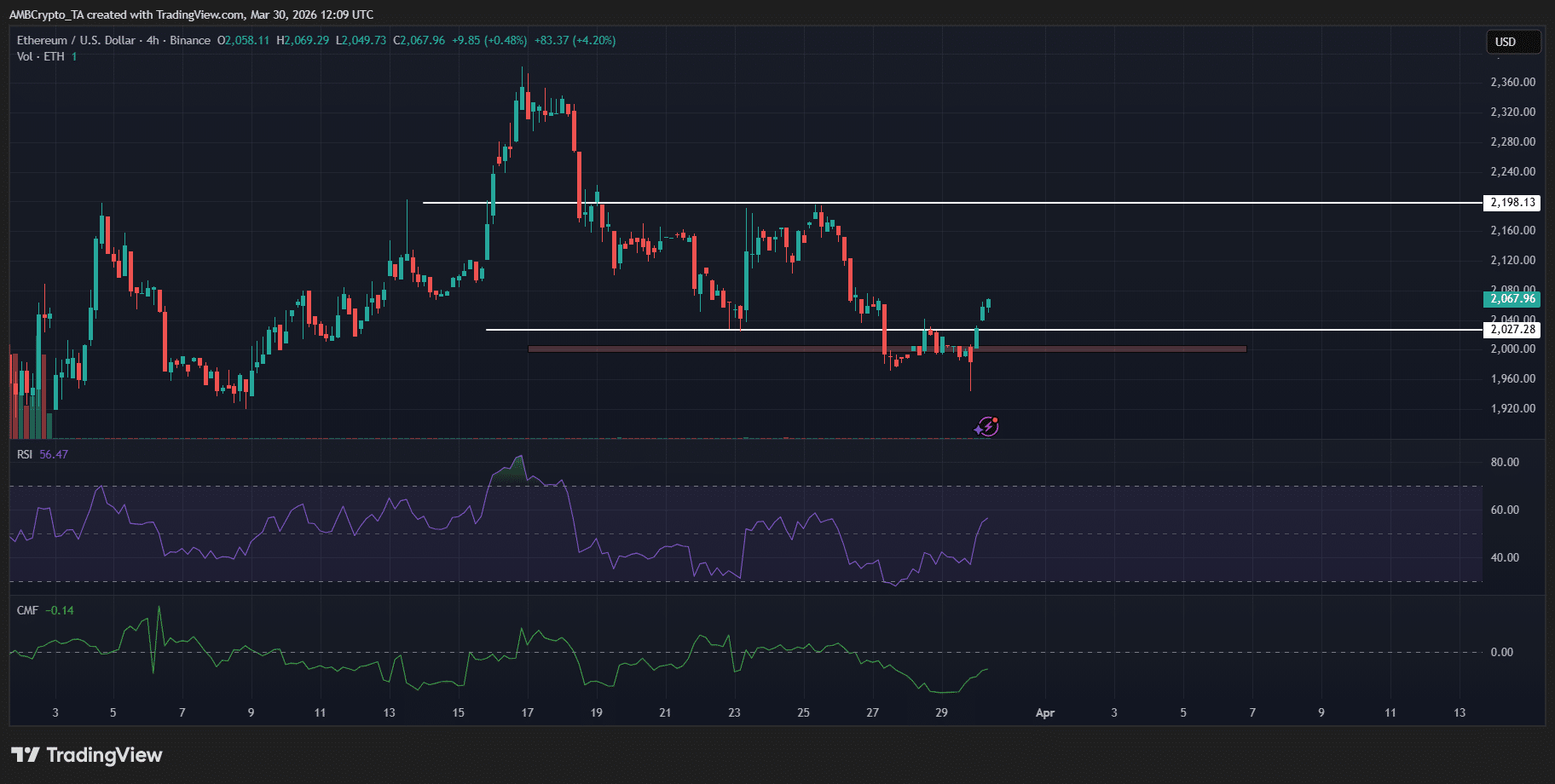
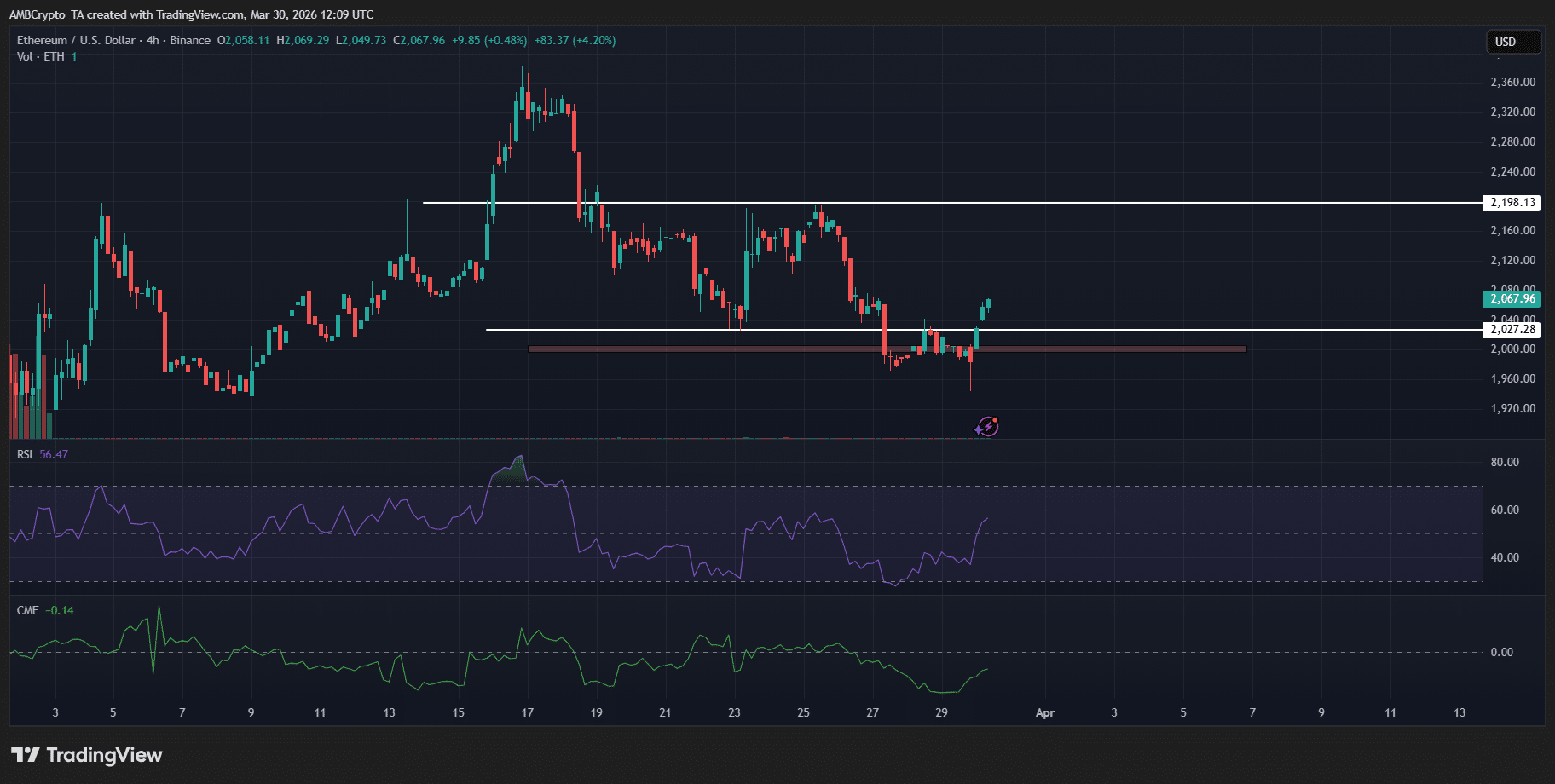
Ethereum’s [ETH] price moved above the $2,000-level following the weekend, highlighting a shift from selling pressure into early recovery. At the time of writing, the altcoin was trading near $2,060, reclaiming the $2,027 support zone after briefly breaking below it.

This move is evidence that buyers stepped in at lower levels. Especially as the breakdown failed to attract sustained selling and instead, triggered a reversal.

With the price stabilizing above this level, ETH might move towards the $2,100–$2,150 range – Its prior resistance range. This push would happen partly because short positions that entered below $2,000 are now closing, adding upward pressure.
Source: ETH/USD on TradingView

At the time of writing, momentum seemed to be improving too, with the RSI near 56 showing room for further upside without overbought conditions. However, the CMF was negative near -0.14 – A sign that capital inflows continue to be limited.

These findings are indicative of a mixed market structure, one where the price rises due to positioning rather than strong demand.

Thanks to the same, while the move may extend in the short term, it could struggle to sustain itself over the long term without stronger spot buying.
Liquidation flush drives ETH reclaim and squeeze setup

Ethereum’s move above $2,000 began with a sharp breakdown that quickly turned into opportunity.

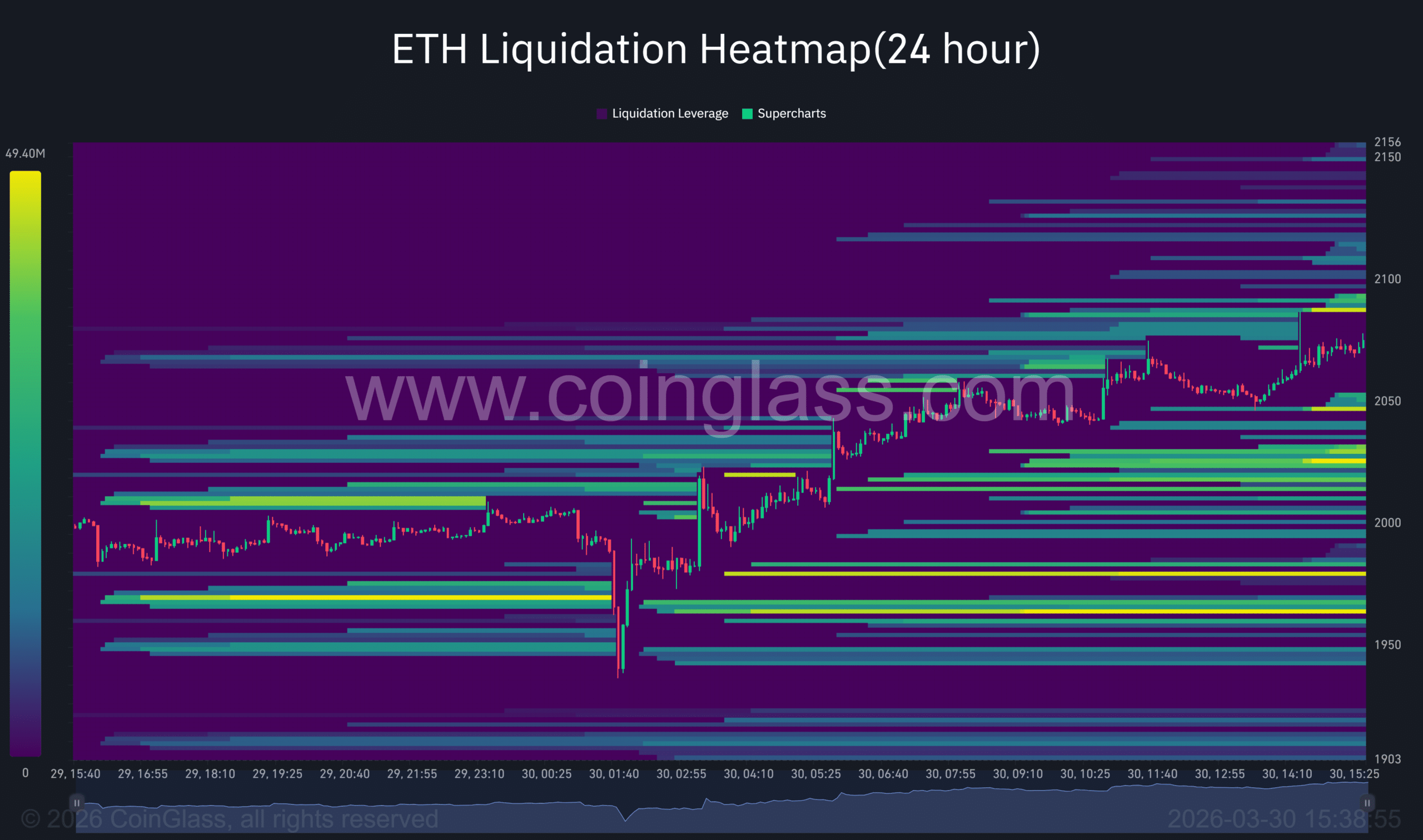
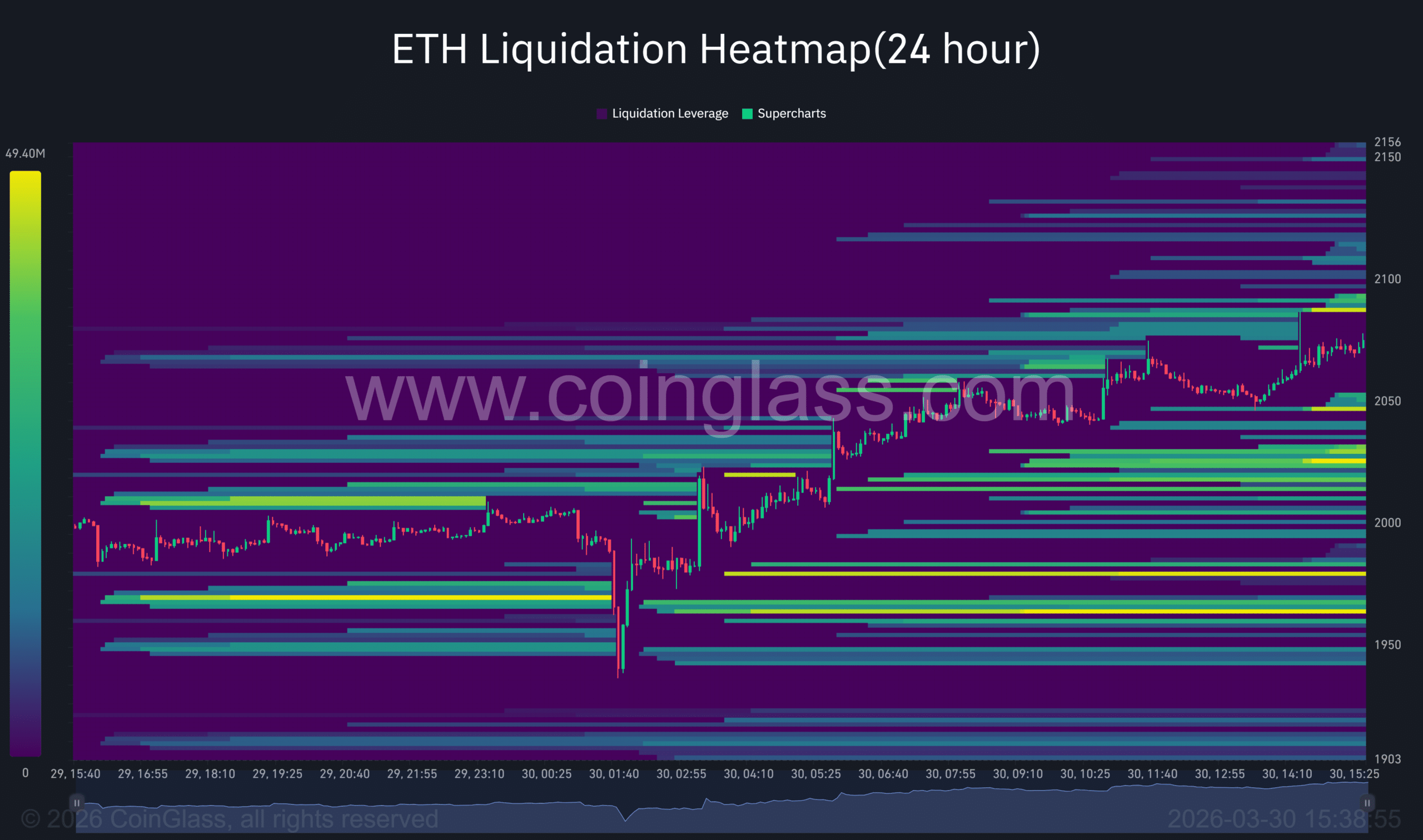
The price dropped towards $1,930–$1,980, directly into a dense liquidation zone between $1,950 and $2,050, where leveraged longs were forced out. This flush mattered because it removed weak positions, allowing the market to reset and reduce immediate selling pressure.

Source: CoinGlass

As that pressure cleared, the market direction flipped, and the price rebounded sharply back above $2,000, reaching the $2,050–$2,080 range. This recovery happened as short positions began to close while fresh buyers stepped in, turning the earlier sell-off into upward momentum.

At press time, the price was holding near $2,040–$2,060 while new liquidation clusters formed above $2,100. This creates a setup where sustained buying can trigger a short squeeze higher. However, if support weakens, the price may revisit lower liquidity zones, testing whether demand remains strong or not.

ETH defends key trendline as structure shifts towards recovery

Ethereum now sits at a point where the market is testing whether the recent recovery can turn into a sustained move or not.

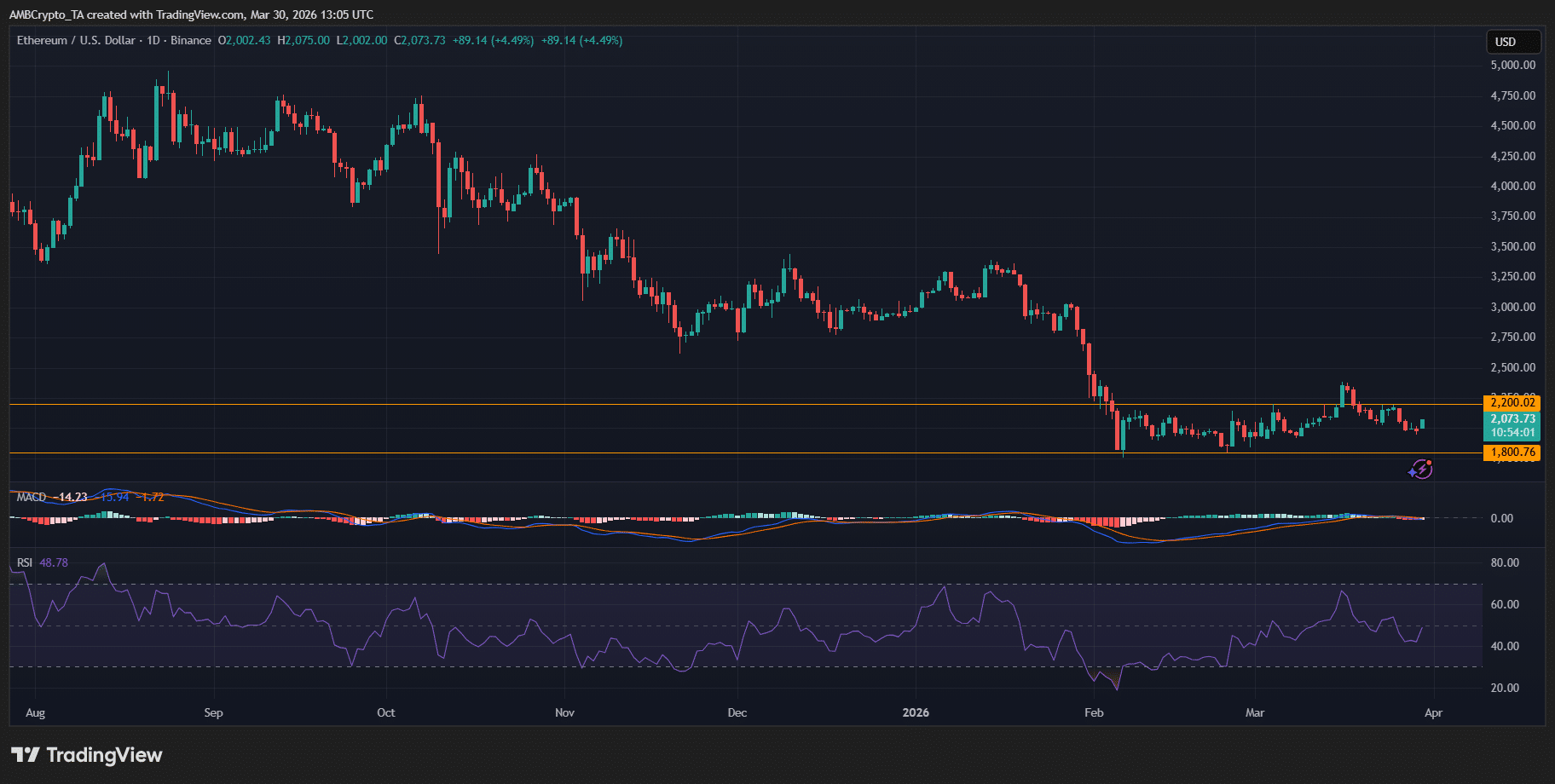
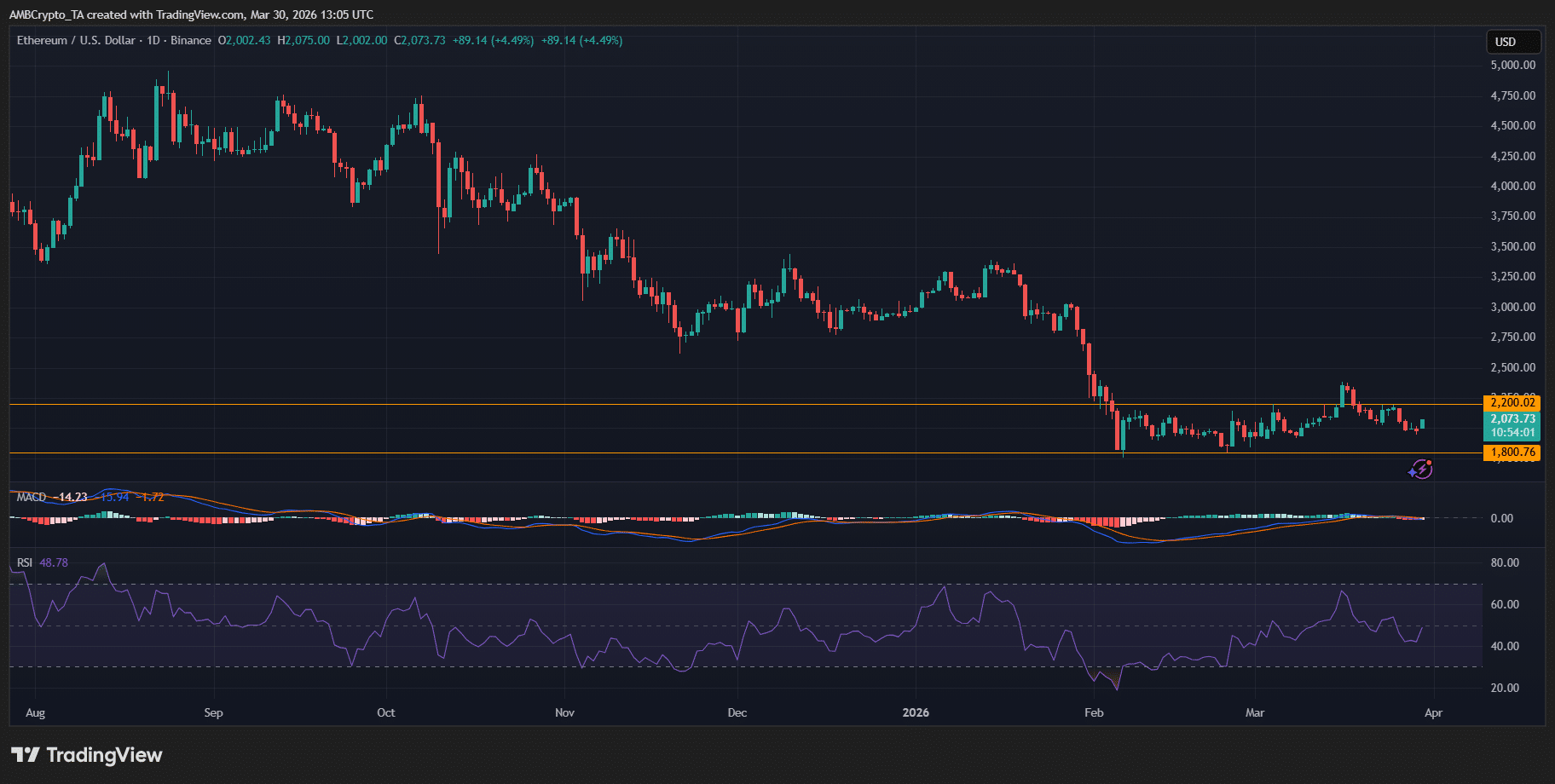
After bouncing from the $1,800-trendline, the price climbed above $2,050 to illustrate that buyers stepped in where structure matters most. This reaction was important because it confirmed that the broader range might still be intact.

Source: ETH/USD on TradingView

As the price moves towards the $2,100–$2,120 zone, traders should watch how it reacts under pressure. If buyers push through with strong participation, it would mean that demand is returning with intent. However, if the price stalls or is rejected, it would mean that sellers still control higher levels.

At the same time, holding above $2,000 will be key since it would keep short-term momentum stable. If this level holds, recovery can extend itself. However, failure would shift focus back towards $1,800.


Final Summary

  • Ethereum’s [ETH] price reclaimed $2,000 backed by liquidation-driven momentum, but weak inflows might limit sustained upside.
  • A breakout past its resistance would mean trend continuation while rejection risks a move back towards $1,800.

Trending Cryptos

Related Questions

QWhat was Ethereum's price movement over the weekend and what key level did it reclaim?

AEthereum's price moved above the $2,000 level, reclaiming the $2,027 support zone after briefly breaking below it.

QWhat is the significance of the liquidation zone between $1,950 and $2,050 mentioned in the article?

AThis dense liquidation zone forced out leveraged longs, removing weak positions and allowing the market to reset, which reduced immediate selling pressure and enabled the price rebound.

QWhat two technical indicators are mentioned to show mixed market signals for Ethereum?

AThe RSI near 56 shows room for further upside without overbought conditions, while the CMF near -0.14 indicates limited capital inflows.

QWhat are the potential price targets if Ethereum breaks through resistance versus if it gets rejected?

AIf buyers push through with strong participation, ETH could move towards the $2,100-$2,150 range. If rejected, the price risks moving back towards $1,800.

QWhy is holding above the $2,000 level crucial for Ethereum's short-term momentum according to the article?

AHolding above $2,000 is key to maintaining stable short-term momentum. If this level holds, recovery can extend, but failure would shift focus back towards $1,800.

Related Reads

In Jinjiang, Fujian, a Storage Super Unicorn Lies Quiet

In Fujian's Jinjiang, a city known for sportswear, lies a quiet semiconductor giant: Fujian Jinhua Integrated Circuit Co. (JHICC). Once a promising domestic DRAM manufacturer alongside Yangtze Memory and ChangXin Memory Technologies (CXMT), its journey was derailed in 2018 when the U.S. placed it on an Entity List and filed criminal charges for alleged trade secret theft. This halted production for years. A turning point came in February 2024 when a U.S. federal court found JHICC not guilty. However, it had lost crucial time. While CXMT soared to become a top-valued A-share company in 2024, JHICC, with an estimated valuation of 80 billion RMB, was just restarting. Its current output is primarily customized DDR4 chips, not the advanced DDR5/HBM demanded for AI, but it still benefits from the broader memory chip upcycle. JHICC's story is tied to Chen Zhengkun, a veteran engineer who left Micron to lead the venture. Founded in 2016 with state-backed funding, JHICC partnered with Taiwan's UMC to develop DRAM technology. Rapid progress was cut short by the U.S. actions, which Micron initiated, partly due to its heavy reliance on the Chinese market. Post-sanctions, Chen's team worked to rebuild the production line with reduced reliance on U.S. technology. According to its records, JHICC achieved small-scale production and revenue growth under immense pressure. It now focuses on the stable "niche" DRAM market (e.g., TVs, routers) with a monthly capacity of ~40,000 wafers, aiming for 60,000 by 2026. It holds over 1,000 patents but remains on the Entity List. For Jinjiang, investing in JHICC was a bold industrial leap. The local government provided unwavering financial and logistical support during the crisis, helping the company survive. JHICC has become the anchor for a growing local semiconductor cluster. Though its scale lags behind domestic peers, JHICC's persistence symbolizes a hard-won foothold in a global market long dominated by Samsung, SK Hynix, and Micron. Having missed one boom, it seeks a place in the new AI-driven memory supercycle.

marsbit1h ago

In Jinjiang, Fujian, a Storage Super Unicorn Lies Quiet

marsbit1h ago

Trading

Spot

Hot Articles

Discussions

Welcome to the HTX Community. Here, you can stay informed about the latest platform developments and gain access to professional market insights. Users' opinions on the price of ETH (ETH) are presented below.

活动图片