Ethereum network sees 62% drop in fees: Is ETH price at risk?

cointelegraphPublished on 2025-12-09Last updated on 2025-12-09

Abstract

Ethereum's network fees have dropped 62% over 30 days, significantly more than other major blockchains, indicating cooling base layer activity despite ETH's price rally to a three-week high near $3,400. While decentralized exchange volumes and DApp revenues on Ethereum have declined, layer-2 networks like Base and Polygon show substantial growth in transactions. The Fusaka upgrade may have contributed to lower fees. Derivatives data showing neutral funding rates and Ethereum's maintained dominance in Total Value Locked (TVL) suggest no immediate bearish pressure, with the ecosystem's shift to layer-2 scaling viewed as a sustainable growth model.

Key takeaways:

  • Ethereum’s base layer activity has cooled, with fees and TVL dropping, showing slower demand despite the recent price recovery.

  • Layer-2 networks are growing rapidly, helping to support Ethereum even as base layer usage weakens and traders remain cautious.

Ether (ETH) rallied to a three-week high near $3,400 on Tuesday after weak United States job market data reinforced expectations that US monetary policy could become less restrictive sooner than previously thought.

Even with the 11.2% weekly gains, traders still worry that sluggish Ethereum network activity and limited demand for bullish leverage may curb the short-term upside.
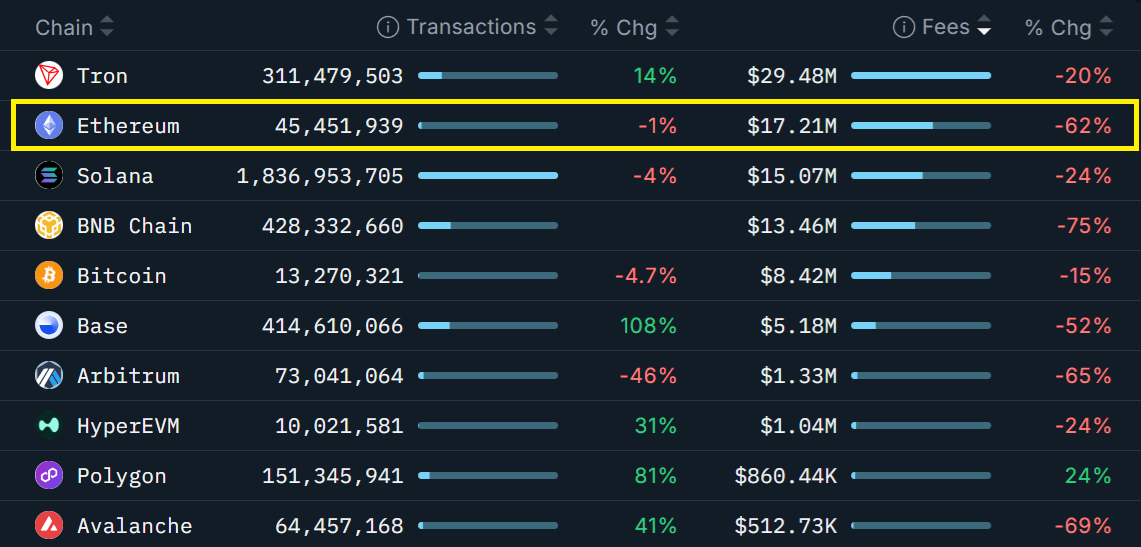
Blockchains ranked by 7-day network fees, USD. Source: Nansen

Nansen data shows that Ethereum’s 30-day network fees dropped by 62%, a far deeper pullback than the roughly 22% decline observed on Tron, Solana and HyperEVM during the same window.

Some activity, however, stood out: transactions on Base rose 108%, while Polygon recorded an 81% increase, suggesting continued momentum across Ethereum’s expanding layer-2 ecosystem.

The Ethereum Fusaka upgrade on Dec. 3 introduced changes designed to improve rollup efficiency, which may have contributed to the lower network fees noted throughout the month.
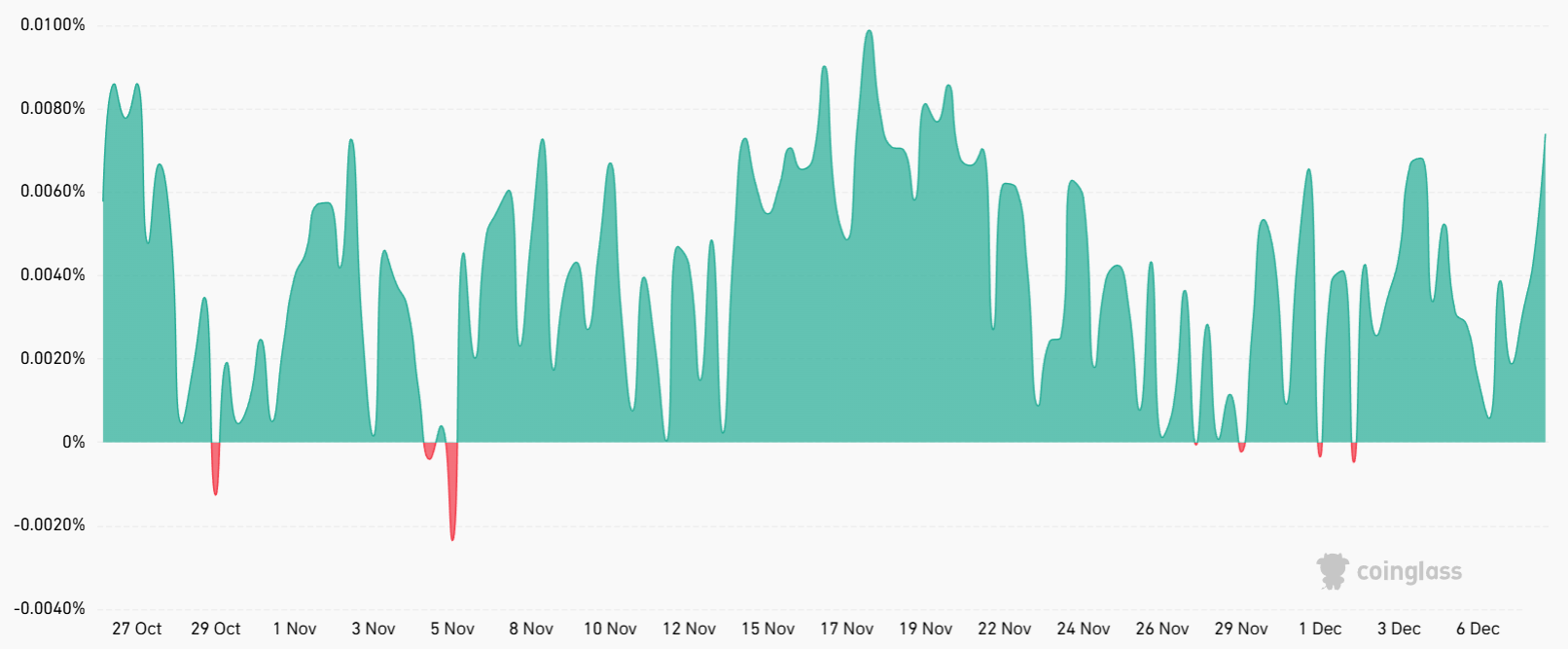
ETH perpetual futures 8-hour funding rate. Source: CoinGlass

On Tuesday, the annualized funding rate for ETH perpetual futures held near 9%, reflecting a fairly even distribution of leveraged positions between buyers (longs) and sellers (shorts). Under normal market conditions, this indicator tends to oscillate between 6% and 12% to account for capital costs; levels above that range usually signal stronger bullish positioning.

Traders turned more defensive after the US Bureau of Labor Statistics reported 1.85 million layoffs in October, the highest figure since 2023. Markets are now pricing in a 0.25% interest rate cut by the US Federal Reserve on Wednesday, while attention shifts to Fed Chair Jerome Powell’s comments following the Committee meeting.

Ethereum’s layer-2 growth offsets base layer fee declines

Despite the recent bullish momentum, Ether still trades 32% below its all-time high of $4,597 from August. To gauge whether demand for the Ethereum network is genuinely declining, it’s useful to look at the impact on decentralized applications (DApps).
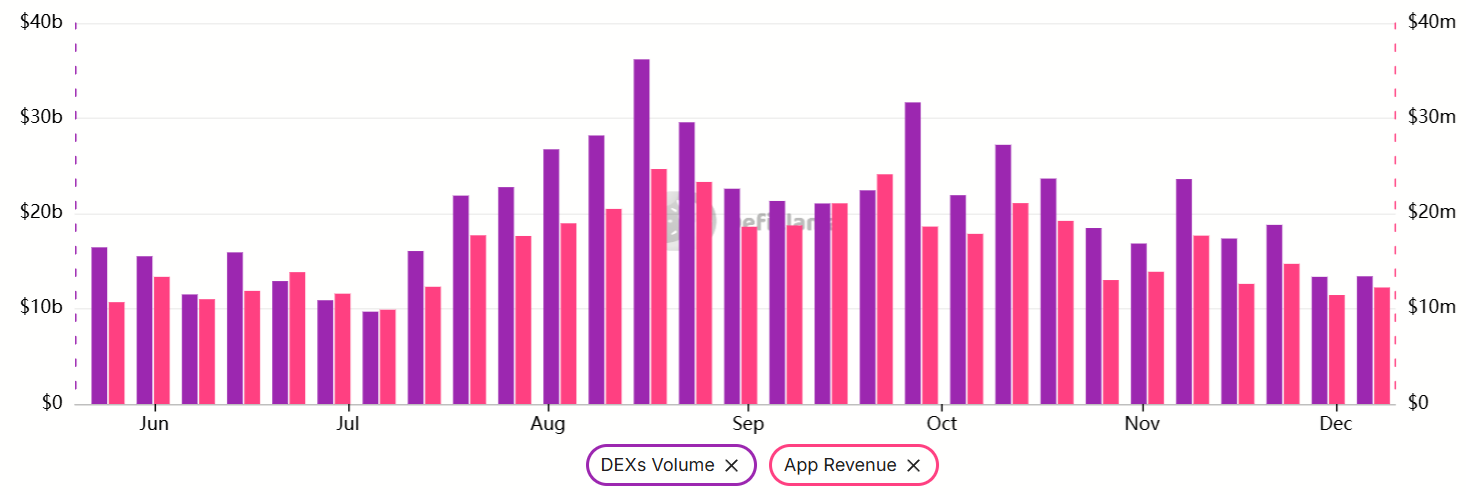
Ethereum network 7-day DEX volumes (left) vs. DApps revenue (right). Source: DefiLlama

Volumes on Ethereum-based decentralized exchanges fell to $13.4 billion over seven days, down from $23.6 billion four weeks earlier. Likewise, decentralized application revenues reached a five-month low of $12.3 million during the same period. Overall, demand for Ethereum’s base layer processing has been slipping since it peaked in late August.
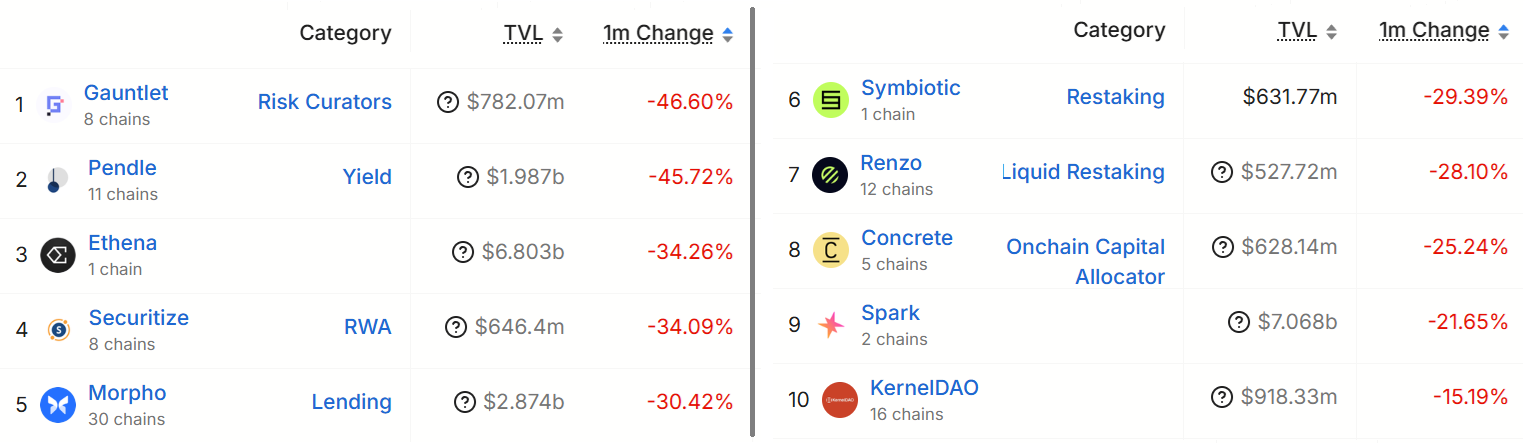
Ethereum DApps with $500 million or higher in TVL. Source: DefiLlama

Some of Ethereum’s leading DApps saw a sharp drop in total value locked (TVL), including Pendle, Athena, Morpho and Spark. Aggregate TVL on the Ethereum base layer fell to $76 billion from $100 billion two months earlier. Even so, Ethereum’s dominance remains intact with a 68% market share, while runner-up Solana holds under 10%.

Ether bulls argue that the network’s strong incentives for layer-2 scalability offer a more sustainable model compared with the heavier load and centralized coordination required by competing blockchains. Ethereum is positioned to capture a significant share of future growth in decentralized finance (DeFi).

Related: US Treasurys lead tokenization wave as CoinShares predicts 2026 growth

US Securities and Exchange Commission Paul Atkins reportedly said in a FOX Business interview that tokenization of the US market could occur in “a couple of years,” adding that blockchain offers “huge benefits” such as predictability and transparency. Atkins said the US should “embrace this new technology, bring it onshore where it can work under American rules.”

While Ethereum’s base layer fees have seen a sharp decline, along with the drop in TVL, activity across the layer-2 ecosystem continues to expand. Currently, neither onchain nor derivatives data indicate a meaningful weakness in ETH price dynamics.

This article is for general information purposes and is not intended to be and should not be taken as legal or investment advice. The views, thoughts, and opinions expressed here are the author’s alone and do not necessarily reflect or represent the views and opinions of Cointelegraph.


Trending Cryptos

Related Reads

Dialogue with Yihui Capital, SoundAI Technology, Ling Universe, and Zhongbo Jili: Opportunities and Challenges in the AI Smart Hardware Track

On June 28, 2026, an event titled "New Opportunities in AI Hardware: The Battle for Interactive Entry Points Begins" was held in Beijing. It featured a report from ITJuzi and discussions with experts from SoundAI, Ling Universe, One Reed Capital, and Zhongbo Juli on the opportunities and challenges in China's AI hardware sector. Key report findings highlight the sector's intense activity: 327 out of 431 startups founded post-2023 have secured funding, with 179 investments in H1 2026 alone. The landscape is dominated by embodied intelligent robots, while wearable tech like smart rings and AI glasses shows rapid growth. Geographically, Shenzhen leads, leveraging its superior hardware supply chain, followed by Beijing and Shanghai. The overarching trend is for companies to focus on micro-innovations within specific scenarios rather than reinventing foundational technology. Industry leaders shared several critical insights: 1. **Balancing Innovation & Market Readiness**: Entrepreneurs face the "hammer looking for a nail" dilemma. Success requires balancing technical capability with user acceptance, cost control, and incremental design improvements rather than chasing disruptive innovation. 2. **Competitive Landscape**: The future interactive entry point may not be a single super-device but a mix of universal terminals and specialized, scenario-specific hardware. While large companies have ecosystem advantages, startups can win by deeply targeting vertical markets and specific user groups. 3. **Core Challenges & Business Models**: Key hurdles include deep understanding of AI models and navigating non-transparent hardware supply chains. Viable business models may involve selling hardware at cost and generating revenue through software subscriptions, but this requires tight control over both hardware BOM and model inference costs. 4. **The Road to Commercialization**: The ultimate test is market validation—achieving sales growth and sustainable cash flow. Companies must find the right application scenario, use edge computing effectively, and close the loop from technology to commercial success. 5. **The Future of Interaction**: Proactive, context-aware interaction is the next frontier, though it's currently limited by issues like model hallucinations and environmental perception. The near-term focus should be on identifying target users and creating a coherent experience in specific domains, such as health wearables. In summary, to succeed in the competitive AI hardware arena, companies must strategically choose their niche, build a team with the right geographical advantages (e.g., leveraging Shenzhen's supply chain), and most importantly, execute a flawless commercialization strategy that translates technology into market-accepted products and sustainable business growth.

marsbit44m ago

Dialogue with Yihui Capital, SoundAI Technology, Ling Universe, and Zhongbo Jili: Opportunities and Challenges in the AI Smart Hardware Track

marsbit44m ago

CryptoQuant Founder: The Cost to Double BTC Has Increased by 20,000 Times, Where Will the $100 Billion Buying Power Come From?

CryptoQuant founder Ki Young Ju analyzes Bitcoin's current capital challenge. He notes that the cryptocurrency market has grown too large for retail-driven momentum alone to generate massive price increases as in past cycles. His calculations show that in 2011, approximately $2.7 million in capital inflow could push BTC's price up by 550x, whereas the current cycle requires an estimated $101 billion in new capital just for a 100% price increase. This shift underscores that sustaining a bull run now depends on attracting large-scale, long-term institutional capital rather than short-term speculative trading. Recent outflows from US spot Bitcoin ETFs, totaling nearly $10 billion since May, highlight the fragility of current demand and challenge the narrative of deep institutional support. While surveys indicate continued institutional interest, these entities prioritize regulated products, risk management, and portfolio integration over speculative gains. For the next significant bull market, Bitcoin must transition to being a core macro asset. The key drivers are no longer just more buyers, but capital allocation from larger, slower-moving entities like wealth advisors, corporate treasuries, banks, and sovereign wealth funds. This new phase pits Bitcoin against other major asset classes like AI for a share of institutional capital, making its growth trajectory dependent on sustained, high-quality inflows from diversified financial balance sheets.

marsbit47m ago

CryptoQuant Founder: The Cost to Double BTC Has Increased by 20,000 Times, Where Will the $100 Billion Buying Power Come From?

marsbit47m ago

Trading

Spot

Hot Articles

Discussions

Welcome to the HTX Community. Here, you can stay informed about the latest platform developments and gain access to professional market insights. Users' opinions on the price of ETH (ETH) are presented below.

活动图片