Ethereum network sees 62% drop in fees: Is ETH price at risk?

cointelegraphPublished on 2025-12-09Last updated on 2025-12-09

Abstract

Ethereum's network fees have dropped 62% over 30 days, significantly more than other major blockchains, indicating cooling base layer activity despite ETH's price rally to a three-week high near $3,400. While decentralized exchange volumes and DApp revenues on Ethereum have declined, layer-2 networks like Base and Polygon show substantial growth in transactions. The Fusaka upgrade may have contributed to lower fees. Derivatives data showing neutral funding rates and Ethereum's maintained dominance in Total Value Locked (TVL) suggest no immediate bearish pressure, with the ecosystem's shift to layer-2 scaling viewed as a sustainable growth model.

Key takeaways:

  • Ethereum’s base layer activity has cooled, with fees and TVL dropping, showing slower demand despite the recent price recovery.

  • Layer-2 networks are growing rapidly, helping to support Ethereum even as base layer usage weakens and traders remain cautious.

Ether (ETH) rallied to a three-week high near $3,400 on Tuesday after weak United States job market data reinforced expectations that US monetary policy could become less restrictive sooner than previously thought.

Even with the 11.2% weekly gains, traders still worry that sluggish Ethereum network activity and limited demand for bullish leverage may curb the short-term upside.
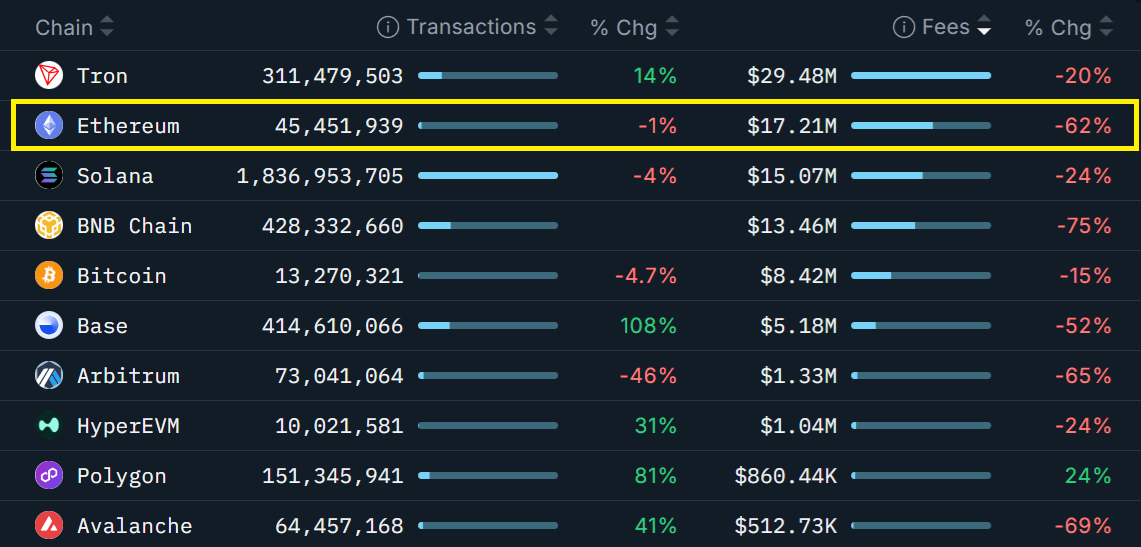
Blockchains ranked by 7-day network fees, USD. Source: Nansen

Nansen data shows that Ethereum’s 30-day network fees dropped by 62%, a far deeper pullback than the roughly 22% decline observed on Tron, Solana and HyperEVM during the same window.

Some activity, however, stood out: transactions on Base rose 108%, while Polygon recorded an 81% increase, suggesting continued momentum across Ethereum’s expanding layer-2 ecosystem.

The Ethereum Fusaka upgrade on Dec. 3 introduced changes designed to improve rollup efficiency, which may have contributed to the lower network fees noted throughout the month.
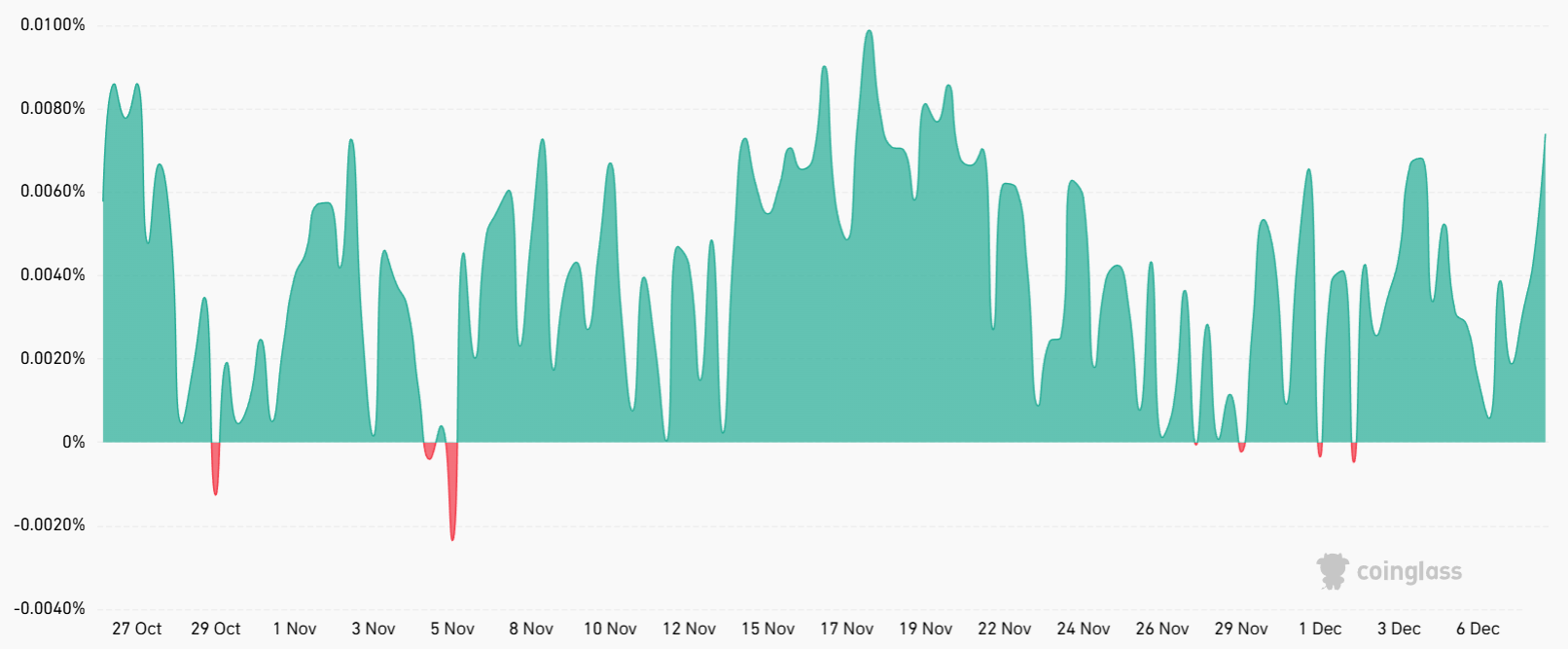
ETH perpetual futures 8-hour funding rate. Source: CoinGlass

On Tuesday, the annualized funding rate for ETH perpetual futures held near 9%, reflecting a fairly even distribution of leveraged positions between buyers (longs) and sellers (shorts). Under normal market conditions, this indicator tends to oscillate between 6% and 12% to account for capital costs; levels above that range usually signal stronger bullish positioning.

Traders turned more defensive after the US Bureau of Labor Statistics reported 1.85 million layoffs in October, the highest figure since 2023. Markets are now pricing in a 0.25% interest rate cut by the US Federal Reserve on Wednesday, while attention shifts to Fed Chair Jerome Powell’s comments following the Committee meeting.

Ethereum’s layer-2 growth offsets base layer fee declines

Despite the recent bullish momentum, Ether still trades 32% below its all-time high of $4,597 from August. To gauge whether demand for the Ethereum network is genuinely declining, it’s useful to look at the impact on decentralized applications (DApps).
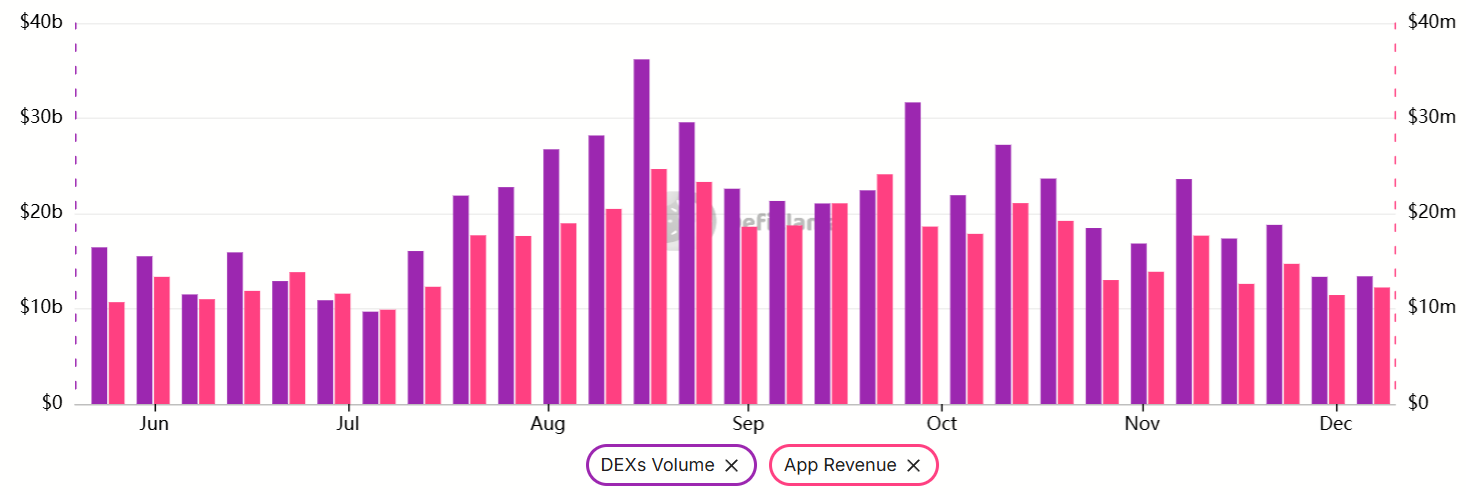
Ethereum network 7-day DEX volumes (left) vs. DApps revenue (right). Source: DefiLlama

Volumes on Ethereum-based decentralized exchanges fell to $13.4 billion over seven days, down from $23.6 billion four weeks earlier. Likewise, decentralized application revenues reached a five-month low of $12.3 million during the same period. Overall, demand for Ethereum’s base layer processing has been slipping since it peaked in late August.
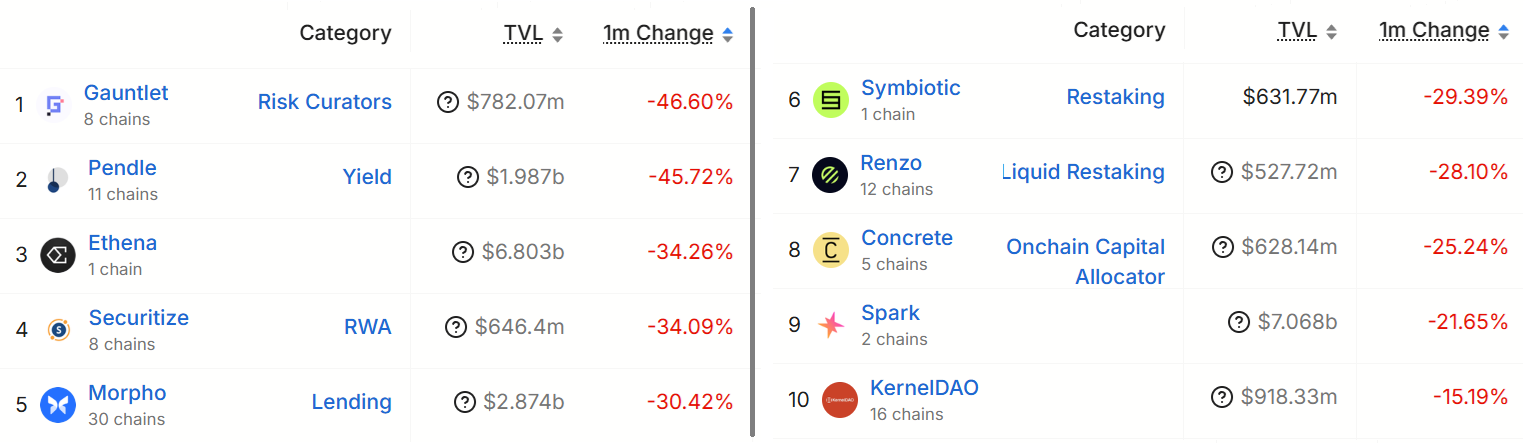
Ethereum DApps with $500 million or higher in TVL. Source: DefiLlama

Some of Ethereum’s leading DApps saw a sharp drop in total value locked (TVL), including Pendle, Athena, Morpho and Spark. Aggregate TVL on the Ethereum base layer fell to $76 billion from $100 billion two months earlier. Even so, Ethereum’s dominance remains intact with a 68% market share, while runner-up Solana holds under 10%.

Ether bulls argue that the network’s strong incentives for layer-2 scalability offer a more sustainable model compared with the heavier load and centralized coordination required by competing blockchains. Ethereum is positioned to capture a significant share of future growth in decentralized finance (DeFi).

Related: US Treasurys lead tokenization wave as CoinShares predicts 2026 growth

US Securities and Exchange Commission Paul Atkins reportedly said in a FOX Business interview that tokenization of the US market could occur in “a couple of years,” adding that blockchain offers “huge benefits” such as predictability and transparency. Atkins said the US should “embrace this new technology, bring it onshore where it can work under American rules.”

While Ethereum’s base layer fees have seen a sharp decline, along with the drop in TVL, activity across the layer-2 ecosystem continues to expand. Currently, neither onchain nor derivatives data indicate a meaningful weakness in ETH price dynamics.

This article is for general information purposes and is not intended to be and should not be taken as legal or investment advice. The views, thoughts, and opinions expressed here are the author’s alone and do not necessarily reflect or represent the views and opinions of Cointelegraph.


Trending Cryptos

Related Reads

The Verdict in Choi Tae-won's Divorce Case: Revealing the Inheritance Undercurrent Behind SK Hynix's Trillion-Won Empire

SK Group Chairman Chey Tae-won's high-profile divorce case, involving a record 1.38 trillion won settlement, has drawn attention to the succession plans for Korea's second-largest conglomerate, especially its crown jewel, SK hynix. Unlike traditional chaebol scripts centered on the eldest son, Chey's three children from his marriage to former President Roh Tae-woo's daughter, Roh Soh-yeong, are carving distinct, non-traditional paths. Eldest daughter Chey Yun-jung (b. 1989) is seen as the most evident successor. With a scientific and consulting background, she holds executive roles at SK bioscience and SK Inc.'s growth support department, focusing on future strategy and biopharma. Her marriage is to an AI infrastructure entrepreneur, not a traditional business alliance. Second daughter Chey Min-jung (b. 1991) took a unique route, voluntarily serving as a South Korean naval officer, including an anti-piracy deployment. She later worked on policy and strategy for SK hynix in Washington D.C. before co-founding an AI-driven healthcare startup. She married a former U.S. Marine Corps officer, connecting her to U.S. defense and policy circles—networks crucial for a global semiconductor giant. The only son, Chey In-geun (b. 1995), who studied physics like his father, worked briefly at SK E&S before joining McKinsey. Despite fitting the traditional "heir" profile as the eldest son, he remains silent and holds no public position or shares in SK, suggesting the old succession playbook is obsolete. As SK hynix's valuation soars, becoming a geopolitical asset in the AI era, the heirs' legitimacy is no longer automatic. They must prove themselves in fields like AI biotech, global policy, and strategic consulting. Their marriages also reflect new elite networks in tech and defense, not old political alliances. Their inheritance is the complex challenge of navigating a globalized, tech-driven world, not just a corporate throne.

marsbit12h ago

The Verdict in Choi Tae-won's Divorce Case: Revealing the Inheritance Undercurrent Behind SK Hynix's Trillion-Won Empire

marsbit12h ago

From OpenSea to OpenRouter: Is Alex Atallah Repeating His 'Exit at the Peak' Playbook?

From OpenSea to OpenRouter: Is Alex Atallah Repeating His "Exit at the Peak" Playbook? According to the Wall Street Journal, payments giant Stripe is in talks to acquire the AI model aggregation platform OpenRouter in a potential deal valuing the company near $100 billion. This would mark founder Alex Atallah's second creation of a company reaching a $100 billion valuation, following his co-founding of NFT marketplace OpenSea. OpenRouter, founded just over three years ago, has grown rapidly by acting as a unified gateway for developers to access over 400 AI models. It currently has about 10 million users and processes over 200 trillion tokens monthly. While the platform's annualized revenue is around $50 million, its valuation has skyrocketed from $1.3 billion in March 2026. The potential acquisition by Stripe, a company OpenRouter's founder once likened it to, represents a major expansion into AI infrastructure for the payments leader. This move echoes Atallah's previous timing with OpenSea, where he departed before the NFT market's significant downturn. For OpenRouter, selling now may be strategic. Despite its scale, its business model—charging a 5-5.5% fee on AI inference calls—faces pressure from competition, open-source models, and potential price wars among model providers, limiting its profitability narrative for an IPO. A key asset for potential acquirers like Stripe is OpenRouter's vast repository of real-world AI usage data, which offers unique insights into model performance and developer preferences that are difficult to replicate. Whether this potential deal signifies a new valuation benchmark for AI infrastructure or another market peak signal remains to be seen.

链捕手12h ago

From OpenSea to OpenRouter: Is Alex Atallah Repeating His 'Exit at the Peak' Playbook?

链捕手12h ago

Trading

Spot

Hot Articles

Discussions

Welcome to the HTX Community. Here, you can stay informed about the latest platform developments and gain access to professional market insights. Users' opinions on the price of ETH (ETH) are presented below.

活动图片