Ethereum needs simple explanation to see true trustlessness: Buterin

cointelegraphPublished on 2025-12-18Last updated on 2025-12-18

Abstract

Ethereum co-founder Vitalik Buterin emphasizes the need for the blockchain to simplify its protocol to achieve true trustlessness. He argues that if only a small group can understand the system, users must still trust that group, undermining decentralization. Buterin advocates for fewer features to improve accessibility. The article notes that complexity and jargon deter average users, a challenge echoed by other projects like privacy layer INTMAX. Ethereum’s roadmap includes upgrades like smart contract wallets and node accessibility to enhance user experience, alongside educational initiatives to broaden understanding.

The Ethereum blockchain needs to better explain its features to users in order to achieve true trustlessness, a challenge common across blockchain protocols, says its co-founder Vitalik Buterin.

Trustlessness would see a protocol work without the oversight of developers, as it enforces rules automatically with code. However, if a protocol is so complex that only a small group can work on it, then in practice, others still have to trust that group.

Ethereum is already trustless as transactions and smart contracts are enforced by open-source code and a decentralized network of validators, but Buterin said in a X post on Wednesday, the network still needs to improve user understanding.

“An important and underrated form of trustlessness is increasing the number of people who can actually understand the whole protocol from top to bottom. Ethereum needs to get better at this by making the protocol simpler.”

Asked how realistic the notion is, given the tradeoff between technological features and user understanding, Buterin said, “we should be willing to have fewer features sometimes.”
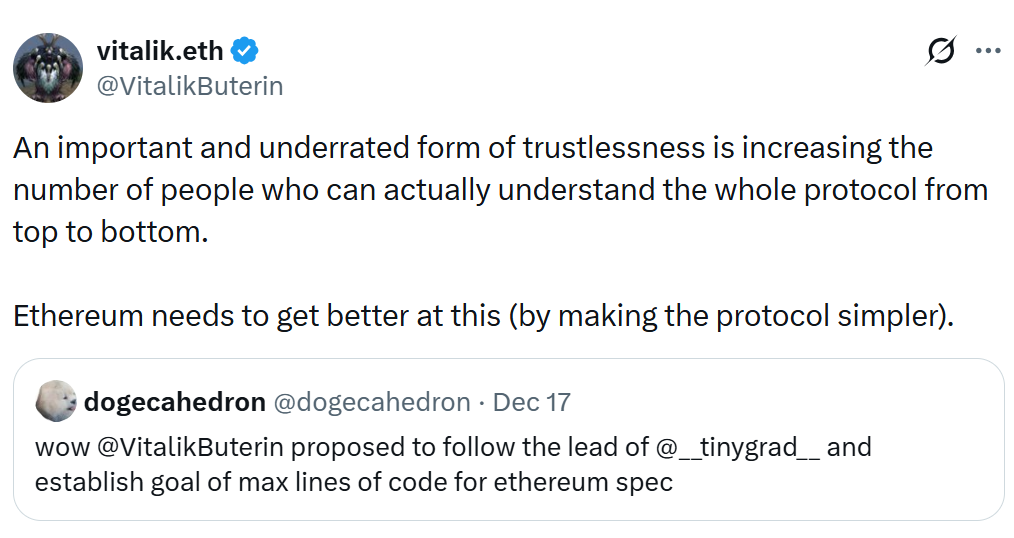
Source: Vitalik Buterin

Last year, crypto executives told Cointelegraph that confusion around crypto storage, regulations, and other factors tech-savvy people take for granted could be keeping average users on the sidelines and away from the technology.

Better understanding needed across all protocols

INTMAX, a privacy layer 2 built on Ethereum, agreed with Buterin, and said the same principle applies to privacy infrastructure.

“If only five people can understand how your privacy protocol works, you haven’t achieved trustlessness, you’ve just changed who you trust. Simple, auditable privacy architecture > complex black boxes,” INTMAX said.

Other remarked that deciphering tech-heavy jargon used by some protocols can feel like a full-time job, or outright repel users from an otherwise promising project.
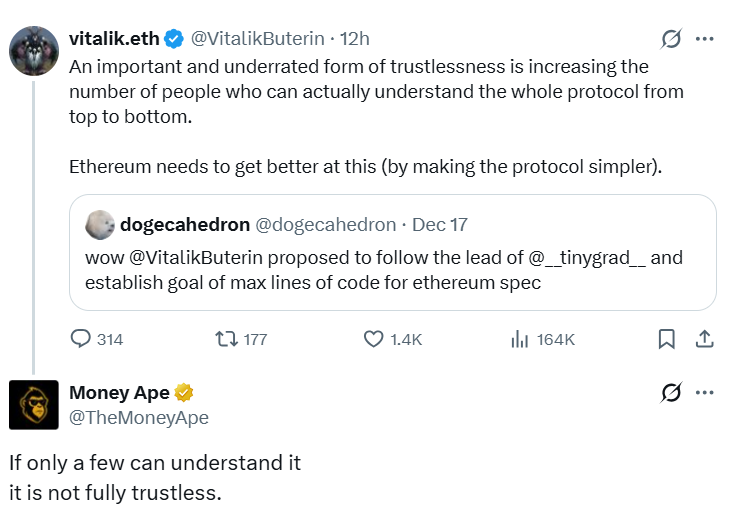
Source: Money Ape

Ethereum aiming for better user experience

Ethereum’s roadmap acknowledges it can still be “too complex to use Ethereum for most people,” and outlines plans to “drastically lower its barriers to entry,” and become “as frictionless as using a traditional Web2 app.”

Related: Ethereum could get faster in January with gas limit rise to 80M

Some of the flagged upgrades aimed at creating a better user experience include smart contract wallets, which streamline complex blockchain details such as gas fees and key management and reducing the barriers to running a node by making them accessible on devices like a phone or browser apps.

The Ethereum Foundation also funds a wide range of educational courses and programs to help people learn more about blockchain development and related technologies.

Magazine: Big questions: Would Bitcoin survive a 10-year power outage?

Trending Cryptos

Related Reads

In Jinjiang, Fujian, a Storage Super Unicorn Lies Quiet

In Fujian's Jinjiang, a city known for sportswear, lies a quiet semiconductor giant: Fujian Jinhua Integrated Circuit Co. (JHICC). Once a promising domestic DRAM manufacturer alongside Yangtze Memory and ChangXin Memory Technologies (CXMT), its journey was derailed in 2018 when the U.S. placed it on an Entity List and filed criminal charges for alleged trade secret theft. This halted production for years. A turning point came in February 2024 when a U.S. federal court found JHICC not guilty. However, it had lost crucial time. While CXMT soared to become a top-valued A-share company in 2024, JHICC, with an estimated valuation of 80 billion RMB, was just restarting. Its current output is primarily customized DDR4 chips, not the advanced DDR5/HBM demanded for AI, but it still benefits from the broader memory chip upcycle. JHICC's story is tied to Chen Zhengkun, a veteran engineer who left Micron to lead the venture. Founded in 2016 with state-backed funding, JHICC partnered with Taiwan's UMC to develop DRAM technology. Rapid progress was cut short by the U.S. actions, which Micron initiated, partly due to its heavy reliance on the Chinese market. Post-sanctions, Chen's team worked to rebuild the production line with reduced reliance on U.S. technology. According to its records, JHICC achieved small-scale production and revenue growth under immense pressure. It now focuses on the stable "niche" DRAM market (e.g., TVs, routers) with a monthly capacity of ~40,000 wafers, aiming for 60,000 by 2026. It holds over 1,000 patents but remains on the Entity List. For Jinjiang, investing in JHICC was a bold industrial leap. The local government provided unwavering financial and logistical support during the crisis, helping the company survive. JHICC has become the anchor for a growing local semiconductor cluster. Though its scale lags behind domestic peers, JHICC's persistence symbolizes a hard-won foothold in a global market long dominated by Samsung, SK Hynix, and Micron. Having missed one boom, it seeks a place in the new AI-driven memory supercycle.

marsbit1h ago

In Jinjiang, Fujian, a Storage Super Unicorn Lies Quiet

marsbit1h ago

Trading

Spot

Hot Articles

Discussions

Welcome to the HTX Community. Here, you can stay informed about the latest platform developments and gain access to professional market insights. Users' opinions on the price of ETH (ETH) are presented below.

活动图片















