Ethereum Needs Better Decentralized Stablecoins, Buterin Says

bitcoinistPublished on 2026-01-12Last updated on 2026-01-12

Abstract

Vitalik Buterin argues that Ethereum needs better decentralized stablecoins, highlighting three key challenges: the need for a stablecoin not solely pegged to the USD long-term due to inflation risks; the necessity of uncapturable oracles to avoid exploitative governance; and the issue of staking yield competing with stablecoins for capital, creating a usability penalty. He suggests potential solutions like reducing staking yields or creating new staking mechanisms without slashing risk. Buterin's comments coincide with broader critiques that Ethereum represents a "contrarian bet" against mainstream VC-backed crypto trends like gambling and centralized finance.

Ethereum needs “better decentralized stablecoins,” Vitalik Buterin said this weekend, arguing that the next iteration has to solve three design constraints that today’s models keep skirting. His comments landed alongside a broader claim from MetaLeX founder Gabriel Shapiro that Ethereum is increasingly a “contrarian bet” versus what much of the venture-backed crypto stack is optimizing for.

Shapiro framed the split in ideological terms, saying it is “increasingly obvious that Ethereum is a contrarian bet against most of what crypto VCs are betting on,” listing “gambling,” “CeDeFi,” “custodial stablecoins,” and “’neo-banks’” as the center of gravity. By contrast, he argued, “Ethereum is tripling down on disrupting power to enable sovereign individuals.”

Why Ethereum Lacks A Decentralized Stablecoin

Buterin’s stablecoin critique starts with what to stabilize against. He said “tracking USD is fine short term,” but suggested that a long-horizon version of “nation state resilience” points to something that is not dependent on a single fiat “price ticker.”

“Tracking USD is fine short term, but imo part of the vision of nation state resilience should be independence even from that price ticker,” Buterin wrote. “On a 20 year timeline, well, what if it hyperinflates, even moderately?”
That premise shifts the stablecoin problem from simply maintaining a peg to building a reference index that can plausibly survive macro regime changes. In Buterin’s framing, that is “problem” one: identifying an index “better than USD price,” at least as a north star even if USD tracking remains expedient near term.

The second issue is governance and oracle security. Buterin argued that a decentralized oracle must be “not capturable with a large pool of money,” or the system is forced into unattractive tradeoffs that ultimately land on users.

“If you don’t have (2), then you have to ensure cost of capture > protocol token market cap, which in turn implies protocol value extraction > discount rate, which is quite bad for users,” he wrote. “This is a big part of why I constantly rail against financialized governance btw: it inherently has no defense/offense asymmetry, and so high levels of extraction are the only way to be stable.”

He tied that to a longer-running discomfort with token-holder-driven control structures that resemble markets for influence. In his view, “financialized governance” trends toward systems that must continuously extract value to defend themselves, rather than relying on a structural advantage that makes attacks meaningfully harder than normal operation.

The third problem is mechanical: staking yield competes with decentralized stablecoins for capital. If stablecoin users and collateral providers are implicitly giving up a few percentage points of return relative to staking ETH, Buterin called that “quite bad,” and suggested it becomes a persistent headwind unless the ecosystem changes how yield, collateral, and risk interact.

He laid out what he described as a map of the “solution space,” while stressing it was “not endorsement.” Those paths ranged from compressing staking yield toward “hobbyist level,” to creating a staking category with similar returns but without comparable slashing risk, to making “slashable staking compatible with usability as collateral.”

Buterin also sharpened what “slashing risk” actually means in this context. “If you’re going to try to reason through this in detail,” he wrote, “remember that the ‘slashing risk’ to guard against is both self-contradiction, and being on the wrong side of an inactivity leak, ie. engaging in a 51% censorship attack. In general, we think too much about the former and not enough about the latter.”

The constraint bleeds into liquidation dynamics as well. He noted that a stablecoin “cannot be secured with a fixed amount of ETH collateral,” because large drawdowns require active rebalancing, and any design that sources yield from staking must reckon with how that yield turns off or changes during stress.

At press time, ETH traded at $3,118.
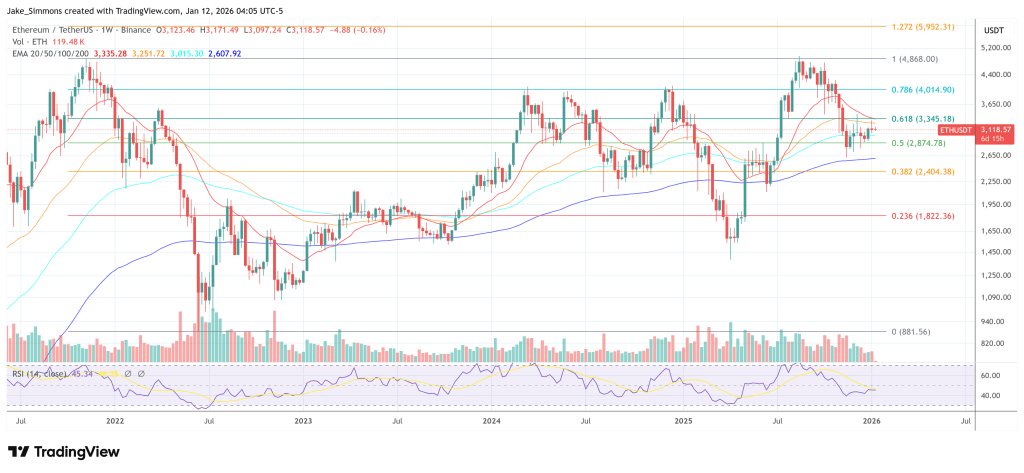
ETH remains between the 0.5 and 0.618 Fib, 1-week chart | Source: ETHUSDT on TradingView.com

Trending Cryptos

Related Questions

QWhat are the three main design constraints that Vitalik Buterin says the next iteration of decentralized stablecoins on Ethereum must solve?

AThe three main design constraints are: 1) Identifying a stable index 'better than USD price' for long-term resilience, 2) Ensuring oracle security that is 'not capturable with a large pool of money', and 3) Solving the mechanical issue where staking yield competes with decentralized stablecoins for capital.

QAccording to Gabriel Shapiro, what is Ethereum increasingly a 'contrarian bet' against?

AAccording to Gabriel Shapiro, Ethereum is increasingly a 'contrarian bet' against what most crypto VCs are betting on, which he lists as 'gambling,' 'CeDeFi,' 'custodial stablecoins,' and 'neo-banks'.

QWhy does Buterin argue that 'financialized governance' is problematic for stablecoins?

AButerin argues that financialized governance is problematic because it has no defense/offense asymmetry, meaning it inherently trends toward systems that must continuously extract high levels of value from users to defend themselves, as the cost of capture must be greater than the protocol token's market cap to be stable.

QWhat two specific risks does Buterin highlight when discussing 'slashing risk' in the context of staking?

AButerin highlights that 'slashing risk' includes the risk of self-contradiction and the risk of being on the wrong side of an inactivity leak, which means engaging in or being affected by a 51% censorship attack.

QWhat is one potential solution Buterin maps out in the 'solution space' for the staking competition problem?

AOne potential solution Buterin maps out is compressing staking yield toward a 'hobbyist level' to reduce its competition with decentralized stablecoins for capital.

Related Reads

The Verdict in Choi Tae-won's Divorce Case: Revealing the Inheritance Undercurrent Behind SK Hynix's Trillion-Won Empire

SK Group Chairman Chey Tae-won's high-profile divorce case, involving a record 1.38 trillion won settlement, has drawn attention to the succession plans for Korea's second-largest conglomerate, especially its crown jewel, SK hynix. Unlike traditional chaebol scripts centered on the eldest son, Chey's three children from his marriage to former President Roh Tae-woo's daughter, Roh Soh-yeong, are carving distinct, non-traditional paths. Eldest daughter Chey Yun-jung (b. 1989) is seen as the most evident successor. With a scientific and consulting background, she holds executive roles at SK bioscience and SK Inc.'s growth support department, focusing on future strategy and biopharma. Her marriage is to an AI infrastructure entrepreneur, not a traditional business alliance. Second daughter Chey Min-jung (b. 1991) took a unique route, voluntarily serving as a South Korean naval officer, including an anti-piracy deployment. She later worked on policy and strategy for SK hynix in Washington D.C. before co-founding an AI-driven healthcare startup. She married a former U.S. Marine Corps officer, connecting her to U.S. defense and policy circles—networks crucial for a global semiconductor giant. The only son, Chey In-geun (b. 1995), who studied physics like his father, worked briefly at SK E&S before joining McKinsey. Despite fitting the traditional "heir" profile as the eldest son, he remains silent and holds no public position or shares in SK, suggesting the old succession playbook is obsolete. As SK hynix's valuation soars, becoming a geopolitical asset in the AI era, the heirs' legitimacy is no longer automatic. They must prove themselves in fields like AI biotech, global policy, and strategic consulting. Their marriages also reflect new elite networks in tech and defense, not old political alliances. Their inheritance is the complex challenge of navigating a globalized, tech-driven world, not just a corporate throne.

marsbit9h ago

The Verdict in Choi Tae-won's Divorce Case: Revealing the Inheritance Undercurrent Behind SK Hynix's Trillion-Won Empire

marsbit9h ago

From OpenSea to OpenRouter: Is Alex Atallah Repeating His 'Exit at the Peak' Playbook?

From OpenSea to OpenRouter: Is Alex Atallah Repeating His "Exit at the Peak" Playbook? According to the Wall Street Journal, payments giant Stripe is in talks to acquire the AI model aggregation platform OpenRouter in a potential deal valuing the company near $100 billion. This would mark founder Alex Atallah's second creation of a company reaching a $100 billion valuation, following his co-founding of NFT marketplace OpenSea. OpenRouter, founded just over three years ago, has grown rapidly by acting as a unified gateway for developers to access over 400 AI models. It currently has about 10 million users and processes over 200 trillion tokens monthly. While the platform's annualized revenue is around $50 million, its valuation has skyrocketed from $1.3 billion in March 2026. The potential acquisition by Stripe, a company OpenRouter's founder once likened it to, represents a major expansion into AI infrastructure for the payments leader. This move echoes Atallah's previous timing with OpenSea, where he departed before the NFT market's significant downturn. For OpenRouter, selling now may be strategic. Despite its scale, its business model—charging a 5-5.5% fee on AI inference calls—faces pressure from competition, open-source models, and potential price wars among model providers, limiting its profitability narrative for an IPO. A key asset for potential acquirers like Stripe is OpenRouter's vast repository of real-world AI usage data, which offers unique insights into model performance and developer preferences that are difficult to replicate. Whether this potential deal signifies a new valuation benchmark for AI infrastructure or another market peak signal remains to be seen.

链捕手10h ago

From OpenSea to OpenRouter: Is Alex Atallah Repeating His 'Exit at the Peak' Playbook?

链捕手10h ago

Trading

Spot

Hot Articles

Discussions

Welcome to the HTX Community. Here, you can stay informed about the latest platform developments and gain access to professional market insights. Users' opinions on the price of ETH (ETH) are presented below.

活动图片