Ethereum Makes History With Majority Of Supply Staked – What It Means For Price And Network

bitcoinistPublished on 2026-02-20Last updated on 2026-02-20

Abstract

Ethereum has reached a historic milestone with over 50% of its total supply now staked, marking the first time such a level has been achieved. This significant reduction in liquid supply may decrease selling pressure and increase market sensitivity to new demand, potentially supporting long-term price dynamics. Despite recent price declines, with ETH falling below $2,000, the growing staking activity reflects strong conviction among long-term holders. Meanwhile, on-chain metrics suggest the market has cooled to levels that have historically preceded periods of accumulation and potential future expansion.

While buying interest in Ethereum may be losing momentum, the staking ecosystem has been experiencing significant growth over the past few months. Following a period of steady rise, the quantity of ETH locked away in staking contracts has reached a critical landmark that could impact its market outlook.

Over Half Of All Ethereum Now Staked

Ethereum’s price has fallen below the $2,000 mark once again as Wednesday drew to a close. During the waning price action, the network seems to have reached a historical inflection point, as shown by the massive staking ecosystem growth.

In an X thread, Everstake, a leading and responsible validator, has outlined a crucial landmark for ETH, which could play a role in shaping its future. ETH staking activity just exploded, with more than half of the entire supply being locked away in staking, marking the first time in its history. With the switch to proof-of-stake, Ethereum’s staking participation has increased steadily. However, its economic design enters a new phase when it surpasses the 50% of all supply.

Everstake’s report is solely derived from data from Santiment, a popular on-chain data analytics platform. Data from the platform shows that the proof-of-stake contract on Ethereum now controls 50.18% of the total historical ETH issuance. Beyond just being a remarkable figure, it represents a key milestone in the project’s 11 history. In other words, this implies that the majority of ETH is no longer circulating or active in the market.
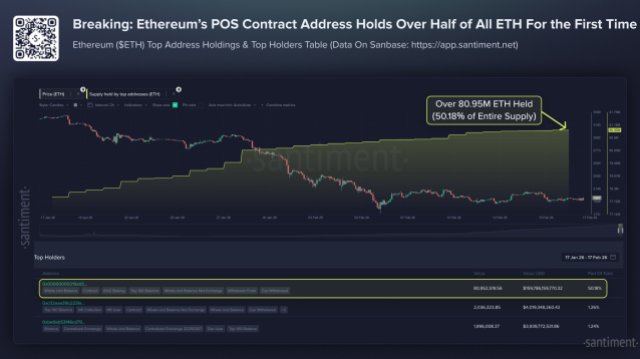
More than half of ETH is in staking contracts | Source: Chart from Everstake on X

When over 50% of the supply is being locked away in staking contracts, the liquid supply reduces, and fewer coins become available for trading. Such patterns often ignite sentiment as they decrease selling pressure and create a market sensitivity to new demand. At the same time, the development indicates conviction from long-term holders.

Users are determined to secure the network rather than carry out trades in short-term volatility. Everstake remains confident that this is a structural shift for Ethereum. It’s reducing supply coupled with steady or growing demand points to robust price dynamics for ETH over time. “It doesn’t guarantee an immediate pump, but it changes the foundation the price is built on,” the firm stated.

A Market That Has Fallen Into Cold Levels

After an analysis of the MVRV Z-Score, RVT, and NUPL, Alphractal disclosed that the Ethereum market temperature is near cold levels. Specifically, this key metric measures whether the market is overheated or oversold, providing insights into risk-elevated periods and when asymmetry favors long-term positioning.

When it gets close to zero or falls below, it indicates that the market has calmed down. Historically, readings below 0 typically precede a phase where risk and speculative are flushed, increasing the potential for long-term accumulation even as price declines.

These zones underscore periods of reduced unrealized profits, triggering a balanced valuation and removing emotional excess from the market. In the past, major expansion phases have been preceded by extended positions in cold temperature zones, as weaker participants gradually exit and stronger hands progressively accumulate.

ETH trading at $1,981 on the 1D chart | Source: ETHUSDT on Tradingview.com

Related Questions

QWhat historical milestone has Ethereum recently achieved according to the article?

AEthereum has achieved the historical milestone of having more than half (50.18%) of its total supply staked for the first time in its history.

QWhich data analytics platform's data was used by Everstake in its report on ETH staking?

AEverstake's report was derived from data provided by Santiment, a popular on-chain data analytics platform.

QWhat is one potential market effect of having over 50% of ETH supply locked in staking contracts?

AIt reduces the liquid supply available for trading, which can decrease selling pressure and create market sensitivity to new demand.

QAccording to the article, what does a market temperature near 'cold levels' (as measured by MVRV Z-Score, RVT, and NUPL) indicate for Ethereum?

AIt indicates that the market has calmed down, with reduced unrealized profits and emotional excess, which historically precedes phases where risk is flushed out and there is potential for long-term accumulation.

QWhat was the price of Ethereum mentioned at the time the article was written?

AEthereum was trading at $1,981, having fallen below the $2,000 mark.

Related Reads

Jensen Huang's CMU Speech: In the AI Era, Don't Just Watch, Build

Jensen Huang, CEO of NVIDIA and a first-generation immigrant, delivered the commencement address to Carnegie Mellon University's class of 2026. He shared his personal journey from a humble background to founding NVIDIA, emphasizing resilience, learning from failure, and the responsibility that comes with leadership. Huang framed the present moment as the dawn of the AI revolution, a shift he believes is more profound than previous computing waves. He described AI as fundamentally resetting computing—moving from human-written software to machines that understand, reason, and use tools. This will create a new industry for generating intelligence and transform every sector. While acknowledging AI's potential to automate tasks and displace some jobs, Huang distinguished between the *tasks* of a job and its core *purpose*. He argued AI will augment human capability, not replace humans. The real risk, he stated, is not AI itself, but people being left behind by those who effectively use AI. He presented AI as a generational opportunity for massive infrastructure investment—in chip factories, data centers, energy grids, and advanced manufacturing—that could re-industrialize nations like the U.S. and bridge the digital divide by making computing and intelligent tools accessible to all. Huang called for a balanced approach: advancing AI safely and responsibly, establishing prudent policies, ensuring broad access, and encouraging universal participation. He urged the graduates not to fear the future but to engage with optimism and ambition, reminding them of CMU's motto, "My heart is in the work." His core message was clear: this is their moment to actively build and shape the AI-powered future, not merely observe it.

marsbit57m ago

Jensen Huang's CMU Speech: In the AI Era, Don't Just Watch, Build

marsbit57m ago

The Era Has Arrived Where Human Writers Must Prove They Are Not Machines

The article describes an era where AI-generated content is flooding the market, forcing human authors to prove they are not machines. It begins with the example of dozens of AI-written, error-ridden biographies of Henry Kissinger appearing on Amazon within hours of his death, a pattern repeated for other deceased celebrities and even living experts who find fraudulent books under their names. This spam content has exploded, with monthly new book releases on platforms like Amazon reaching 300,000 by late 2025. The issue spans genres, from suspiciously high proportions of AI-written teen romance and self-help books to dangerous, AI-generated foraging guides containing lethal advice. The platforms' automated review systems, designed to catch plagiarism and banned words, are ill-equipped to detect AI-generated text that avoids these pitfalls while being nonsensical or fraudulent. The problem has infiltrated traditional publishing. A major publisher, Hachette, had to recall a bestselling horror novel after AI detection tools suggested 78% of its content was machine-generated. An acclaimed European philosophy book was later revealed to be entirely written by AI under a fake author persona. In response, authors are fighting back. At the 2026 London Book Fair, 10,000 writers published a blank book titled "Don't Steal This Book" containing only their signatures—using emptiness as a protest weapon in an age of AI overproduction. Initiatives like the "Human Author Certification" program have emerged, ironically placing the burden on humans to prove their work is not machine-made. The article warns of a vicious cycle: AI-generated low-quality books pollute the data used to train future AI models, leading to "model collapse" and an ever-worsening flood of digital waste, eroding trust in publishing and devaluing human creativity.

marsbit1h ago

The Era Has Arrived Where Human Writers Must Prove They Are Not Machines

marsbit1h ago

Trading

Spot
Futures

Hot Articles

Discussions

Welcome to the HTX Community. Here, you can stay informed about the latest platform developments and gain access to professional market insights. Users' opinions on the price of ETH (ETH) are presented below.

活动图片















