Ethereum Leads The Tokenization Race With Billions In Assets

bitcoinistPublished on 2026-04-12Last updated on 2026-04-12

Abstract

Ethereum is leading the tokenization of real-world assets, hosting over $22.5 billion in tokenized treasury products—nearly 72% of the total market share. Major institutions like JPMorgan Chase, BlackRock, and Franklin Templeton are using Ethereum for institutional-grade products such as tokenized bonds and funds. The network is becoming the preferred infrastructure for autonomous agents and DeFi due to its predictable yields, deep liquidity, and reduced smart contract vulnerabilities. Additionally, firms like Broadridge and Galaxy Digital are advancing on-chain governance and institutional participation, signaling a shift toward a new financial layer built by established Wall Street entities rather than crypto-native startups.

Ethereum is rapidly emerging as the dominant force in the race to tokenize real-world assets, with billions of dollars already flowing onto its network. From tokenized bonds and funds to real estate and treasuries, ETH has become the preferred infrastructure for institutions looking to bring traditional assets on-chain.

Institutional Capital Accelerates Ethereum Adoption

In a recent X post, The Etherealize revealed that Ethereum is rapidly emerging as the dominant layer for tokenized treasury products, with over $22.5 billion in fund assets already tokenized on the network, representing roughly 71.9% of the total market share across all blockchains.

The momentum is being driven by industry heavyweights like JPMorgan Chase, which launched its MONY market fund on ETH in early 2026, joining established offerings such as BlackRock’s BUIDL and Franklin Templeton’s on-chain money fund. These are institutional-grade treasury management products. These products are suited for autonomous agents with idle capital needs operating on permissionless infrastructure, allowing agents to access the system without a brokerage account.
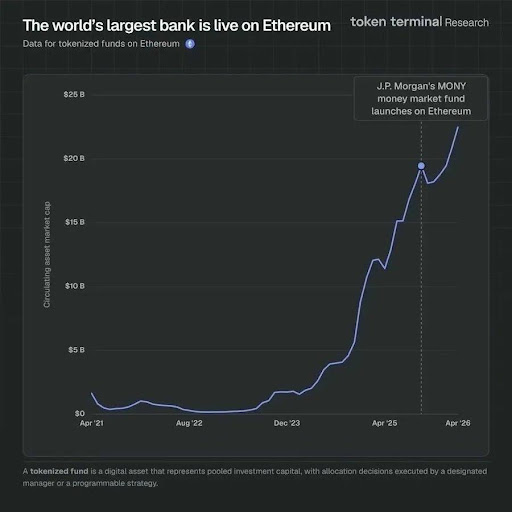
Source: Chart from The Etherealize on X

Ethereum is steadily evolving into the most viable financial layer for autonomous agents managing real capital. The Etherealize has also mentioned that an autonomous agent with a $500,000 treasury will need a stable requirements money market fund with a predictable yield, deep liquidity, minimal smart contract risk, and no centralized counterparty that can freeze or seize its assets. This is where the ETH DeFi ecosystem is beginning to stand out, and it meets these criteria.

The hacks and losses persist, but they are increasingly rare and concentrated at the speculative edges of the ecosystem. A stable core of application has proven remarkably robust through repeated stress events, and that track record shows what other chains can’t replicate. This growing stability is reflected in the declining share of DeFi losses relative to total value locked (TVL) on the ETH mainnet.

How Institutional DeFi Moves Beyond Experimentation

The tokenized finance could see a defining moment, one that markets may only fully appreciate in hindsight. Marc Baumann, the Founder of fiftyonexyz, has pointed out that Broadridge Financial Solutions has already processed over $8 trillion per month in tokenized repo settlements and has now taken a critical step beyond settlement by enabling real on-chain governance for tokenized equity.

At the same time, Galaxy Digital is serving as the staking provider for BlackRock’s ETHB staked Ethereum ETF, linking institutional capital directly into blockchain infrastructure. Together, these firms are involved in enabling the first on-chain shareholder vote for tokenized equity.

Baumann explained that the proxy voting market is estimated at $200 billion, and traditional players such as custodians, transfer agents, and proxy solicitors should pay attention, as the infrastructure for a new financial layer of institutional DeFi is being built by firms that already run on Wall Street. Rather than emerging from a purely crypto-native startup, the transformation is being driven by the same companies that process 401(K).

ETH trading at $2,239 on the 1D chart | Source: ETHUSDT on Tradingview.com

Trending Cryptos

Related Questions

QWhat is the total value of fund assets tokenized on the Ethereum network, and what market share does it represent?

AOver $22.5 billion in fund assets are tokenized on the Ethereum network, representing roughly 71.9% of the total market share across all blockchains.

QWhich major financial institutions are mentioned as driving the momentum for tokenized treasury products on Ethereum?

AJPMorgan Chase, BlackRock, and Franklin Templeton are mentioned as industry heavyweights driving the momentum, with offerings like JPMorgan's MONY market fund, BlackRock's BUIDL, and Franklin Templeton's on-chain money fund.

QAccording to The Etherealize, what are the key requirements for an autonomous agent's money market fund?

AAn autonomous agent with a $500,000 treasury requires a money market fund with a predictable yield, deep liquidity, minimal smart contract risk, and no centralized counterparty that can freeze or seize its assets.

QWhat significant step has Broadridge Financial Solutions taken beyond settlement in tokenized finance?

ABroadridge Financial Solutions has enabled real on-chain governance for tokenized equity, moving beyond its existing role of processing over $8 trillion per month in tokenized repo settlements.

QHow is Galaxy Digital involved in linking institutional capital to blockchain infrastructure?

AGalaxy Digital is serving as the staking provider for BlackRock's ETHB staked Ethereum ETF, which links institutional capital directly into the blockchain infrastructure.

Related Reads

Bitcoin Boom in Full Swing: Saylor's Latest Statement Fuels Buying Speculation

MicroStrategy's Executive Chairman Michael Saylor has fueled speculation about a new Bitcoin purchase by posting "Bitcoin Drive engaged" on August 2, accompanied by the company's customary purchase tracker. This aligns with his pattern of hinting at treasury changes ahead of weekly reports. The accompanying report showed MicroStrategy's Bitcoin holdings at 843,775 BTC, with an average cost of $75,653 per coin and an unrealized loss of -$10.58B. A similar signal preceded the company's July 27 announcement, strengthening expectations for a treasury update on Monday. However, MicroStrategy's real-time ledger reflects two recent Bitcoin sales totaling 3,588 BTC, reducing holdings from 847,363 BTC to the current 843,775 BTC. The company stated these sales funded preferred stock dividends and replenished its U.S. dollar reserve. Recent reports indicate the company made no Bitcoin purchases the week ending July 26 while increasing its dollar reserve to approximately $3.75B. The company faces financial headwinds after reporting an $8.33B operating loss for Q2 2026, including an $8.32B unrealized loss on its digital assets. Management may sell up to $1.25B more in Bitcoin to meet cash obligations. The expected Monday update will reveal if the "Bitcoin Drive" signal marks a return to accumulation as MicroStrategy balances its massive Bitcoin stash against growing cash commitments.

cryptonews.ru1h ago

Bitcoin Boom in Full Swing: Saylor's Latest Statement Fuels Buying Speculation

cryptonews.ru1h ago

Trading

Spot

Hot Articles

Discussions

Welcome to the HTX Community. Here, you can stay informed about the latest platform developments and gain access to professional market insights. Users' opinions on the price of ETH (ETH) are presented below.

活动图片















