Ethereum Lands JPMorgan’s New Tokenized Money Market Fund

bitcoinistPublished on 2026-05-13Last updated on 2026-05-13

Abstract

JPMorgan is launching a tokenized money market fund on the Ethereum blockchain, offering shares under the ticker JLTXX. The fund is a conservative government money market fund investing primarily in U.S. Treasury securities with maturities of 93 days or less. It aims to maintain a $1.00 net asset value (NAV) and carries a 0.16% net expense ratio. The launch marks a significant step by a major Wall Street institution into public blockchain-based financial infrastructure. While the fund uses blockchain technology to process investor transactions, the legal record of ownership remains with a traditional transfer agent, not the blockchain itself. The system, built and maintained by JPMorgan's Kinexys Digital Assets unit, operates as a permissioned framework on top of the public Ethereum blockchain, requiring approved wallet addresses. Currently, Ethereum is the only supported blockchain, though expansion to others is anticipated. This move follows similar institutional activity, such as BlackRock's tokenized funds, reinforcing Ethereum's growing role as a settlement layer for institutional tokenized products.

JPMorgan is launching a tokenized money market fund on Ethereum, marking another step by a major Wall Street institution into public-blockchain-based fund infrastructure. The new JPMorgan OnChain Liquidity-Token Money Market Fund will offer Token Class shares under the ticker JLTXX, according to a registration filing for JPMorgan Trust IV.

The filing positions the product as a government money market fund seeking current income while maintaining liquidity and stability of principal. Its Token Class carries a 0.16% net expense ratio after fee waivers and reimbursements, with gross annual operating expenses listed at 0.71%. Those waivers are scheduled to remain in effect through June 30, 2028, unless renewed or revised.

Bloomberg ETF analyst Eric Balchunas framed the fee structure as a notable part of the launch. “JPMorgan filed for a tokenized money market fund,” he wrote on X. “Big deal bc JPM inching further into crypto and big deal bc fee is pretty low 16bps for a stable NAV (imposs to do in ETF). Cheaper than most money funds altho Vanguard’s is like 11bps.”

JPMorgan Taps Ethereum For Tokenized Treasury Fund

The fund’s strategy is conservative by design. Under normal conditions, it will invest exclusively in US Treasury bills, bonds and notes, along with overnight repurchase agreements fully collateralized by Treasury securities and/or cash. JPMorgan says the fund will seek to maintain a $1.00 NAV, buy only Treasury securities with remaining maturities of 93 days or less, keep dollar-weighted average maturity at 60 days or less, and invest only in US dollar-denominated securities.

Related Reading: Ethereum Leverage Ratio Sees Sharp Drop: What It Means

The crypto relevance sits less in the portfolio and more in the rail. The filing says the fund will use blockchain technology to let investors submit transaction instructions for fund shares, while the official record of ownership remains the transfer agent’s traditional book-entry register. Token balances attributed to an investor’s blockchain address are intended to correspond one-for-one with fund shares, but JPMorgan makes clear that the Investor Register, not the blockchain balance, is determinative for legal ownership.

That structure reflects the institutional compromise now forming around tokenization: public-chain connectivity, but within controlled market infrastructure. JPMorgan says the blockchain system is designed, deployed and maintained by Kinexys Digital Assets, a business unit within JPMorgan Chase Bank. The system runs as a permissioned framework on top of public blockchains, requiring approved wallet addresses and allow-listing before investors can purchase, redeem or transfer token balances.

Ethereum is currently the only blockchain available for investors, though the filing says expansion to other blockchains is anticipated: “The Ethereum blockchain, a public blockchain network, is currently the only available blockchain for use by investors, although expansion to other blockchains is anticipated in the future.”

That detail drew attention from CEO and co-founder of Etherealize Vivek Raman who wrote via X: “Five months after MONY, JP Morgan is launching a second tokenized money market fund — on the biggest, most institutional public blockchain: Ethereum. Blackrock and JPM issuing on Ethereum in the same week...”

BlackRock is preparing two tokenized money-market funds aimed at investors holding cash in stablecoins, including a digital share class tied to the roughly $6.1 billion BlackRock Select Treasury Based Liquidity Fund. After the success of BUIDL, those tokenized shares are also set to run on Ethereum alongside traditional share classes, reinforcing the chain’s role as the preferred public settlement venue for a growing set of institutional cash-management products.

At press time, Ethereum traded at $2,303.
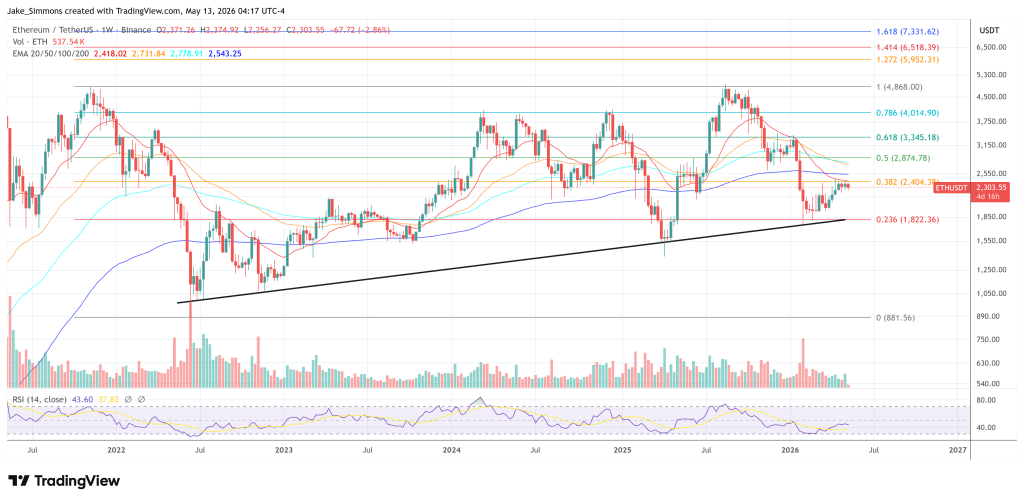
XRP bulls must break the 0.382 Fib, 1-week chart | Source: ETHUSDT on TradingView.com

Trending Cryptos

Related Questions

QWhat is JPMorgan launching on the Ethereum blockchain?

AJPMorgan is launching a tokenized money market fund called the JPMorgan OnChain Liquidity-Token Money Market Fund.

QWhat is the ticker symbol for the token class shares of JPMorgan's new fund?

AThe ticker symbol for the Token Class shares is JLTXX.

QAccording to the filing, what types of assets will the JPMorgan tokenized money market fund primarily invest in?

AUnder normal conditions, the fund will invest exclusively in US Treasury bills, bonds and notes, along with overnight repurchase agreements fully collateralized by Treasury securities and/or cash.

QIn the fund's structure, what is determinative for legal ownership of shares: the blockchain balance or the Investor Register?

AThe Investor Register, not the blockchain balance, is determinative for legal ownership of fund shares.

QWhich company maintains the blockchain system for JPMorgan's tokenized fund?

AThe blockchain system is designed, deployed, and maintained by Kinexys Digital Assets, a business unit within JPMorgan Chase Bank.

Related Reads

The Verdict in Choi Tae-won's Divorce Case: Revealing the Inheritance Undercurrent Behind SK Hynix's Trillion-Won Empire

SK Group Chairman Chey Tae-won's high-profile divorce case, involving a record 1.38 trillion won settlement, has drawn attention to the succession plans for Korea's second-largest conglomerate, especially its crown jewel, SK hynix. Unlike traditional chaebol scripts centered on the eldest son, Chey's three children from his marriage to former President Roh Tae-woo's daughter, Roh Soh-yeong, are carving distinct, non-traditional paths. Eldest daughter Chey Yun-jung (b. 1989) is seen as the most evident successor. With a scientific and consulting background, she holds executive roles at SK bioscience and SK Inc.'s growth support department, focusing on future strategy and biopharma. Her marriage is to an AI infrastructure entrepreneur, not a traditional business alliance. Second daughter Chey Min-jung (b. 1991) took a unique route, voluntarily serving as a South Korean naval officer, including an anti-piracy deployment. She later worked on policy and strategy for SK hynix in Washington D.C. before co-founding an AI-driven healthcare startup. She married a former U.S. Marine Corps officer, connecting her to U.S. defense and policy circles—networks crucial for a global semiconductor giant. The only son, Chey In-geun (b. 1995), who studied physics like his father, worked briefly at SK E&S before joining McKinsey. Despite fitting the traditional "heir" profile as the eldest son, he remains silent and holds no public position or shares in SK, suggesting the old succession playbook is obsolete. As SK hynix's valuation soars, becoming a geopolitical asset in the AI era, the heirs' legitimacy is no longer automatic. They must prove themselves in fields like AI biotech, global policy, and strategic consulting. Their marriages also reflect new elite networks in tech and defense, not old political alliances. Their inheritance is the complex challenge of navigating a globalized, tech-driven world, not just a corporate throne.

marsbit4h ago

The Verdict in Choi Tae-won's Divorce Case: Revealing the Inheritance Undercurrent Behind SK Hynix's Trillion-Won Empire

marsbit4h ago

From OpenSea to OpenRouter: Is Alex Atallah Repeating His 'Exit at the Peak' Playbook?

From OpenSea to OpenRouter: Is Alex Atallah Repeating His "Exit at the Peak" Playbook? According to the Wall Street Journal, payments giant Stripe is in talks to acquire the AI model aggregation platform OpenRouter in a potential deal valuing the company near $100 billion. This would mark founder Alex Atallah's second creation of a company reaching a $100 billion valuation, following his co-founding of NFT marketplace OpenSea. OpenRouter, founded just over three years ago, has grown rapidly by acting as a unified gateway for developers to access over 400 AI models. It currently has about 10 million users and processes over 200 trillion tokens monthly. While the platform's annualized revenue is around $50 million, its valuation has skyrocketed from $1.3 billion in March 2026. The potential acquisition by Stripe, a company OpenRouter's founder once likened it to, represents a major expansion into AI infrastructure for the payments leader. This move echoes Atallah's previous timing with OpenSea, where he departed before the NFT market's significant downturn. For OpenRouter, selling now may be strategic. Despite its scale, its business model—charging a 5-5.5% fee on AI inference calls—faces pressure from competition, open-source models, and potential price wars among model providers, limiting its profitability narrative for an IPO. A key asset for potential acquirers like Stripe is OpenRouter's vast repository of real-world AI usage data, which offers unique insights into model performance and developer preferences that are difficult to replicate. Whether this potential deal signifies a new valuation benchmark for AI infrastructure or another market peak signal remains to be seen.

链捕手5h ago

From OpenSea to OpenRouter: Is Alex Atallah Repeating His 'Exit at the Peak' Playbook?

链捕手5h ago

Trading

Spot

Hot Articles

Discussions

Welcome to the HTX Community. Here, you can stay informed about the latest platform developments and gain access to professional market insights. Users' opinions on the price of ETH (ETH) are presented below.

活动图片