Ethereum Lands JPMorgan’s New Tokenized Money Market Fund

bitcoinistPublished on 2026-05-13Last updated on 2026-05-13

Abstract

JPMorgan is launching a tokenized money market fund on the Ethereum blockchain, offering shares under the ticker JLTXX. The fund is a conservative government money market fund investing primarily in U.S. Treasury securities with maturities of 93 days or less. It aims to maintain a $1.00 net asset value (NAV) and carries a 0.16% net expense ratio. The launch marks a significant step by a major Wall Street institution into public blockchain-based financial infrastructure. While the fund uses blockchain technology to process investor transactions, the legal record of ownership remains with a traditional transfer agent, not the blockchain itself. The system, built and maintained by JPMorgan's Kinexys Digital Assets unit, operates as a permissioned framework on top of the public Ethereum blockchain, requiring approved wallet addresses. Currently, Ethereum is the only supported blockchain, though expansion to others is anticipated. This move follows similar institutional activity, such as BlackRock's tokenized funds, reinforcing Ethereum's growing role as a settlement layer for institutional tokenized products.

JPMorgan is launching a tokenized money market fund on Ethereum, marking another step by a major Wall Street institution into public-blockchain-based fund infrastructure. The new JPMorgan OnChain Liquidity-Token Money Market Fund will offer Token Class shares under the ticker JLTXX, according to a registration filing for JPMorgan Trust IV.

The filing positions the product as a government money market fund seeking current income while maintaining liquidity and stability of principal. Its Token Class carries a 0.16% net expense ratio after fee waivers and reimbursements, with gross annual operating expenses listed at 0.71%. Those waivers are scheduled to remain in effect through June 30, 2028, unless renewed or revised.

Bloomberg ETF analyst Eric Balchunas framed the fee structure as a notable part of the launch. “JPMorgan filed for a tokenized money market fund,” he wrote on X. “Big deal bc JPM inching further into crypto and big deal bc fee is pretty low 16bps for a stable NAV (imposs to do in ETF). Cheaper than most money funds altho Vanguard’s is like 11bps.”

JPMorgan Taps Ethereum For Tokenized Treasury Fund

The fund’s strategy is conservative by design. Under normal conditions, it will invest exclusively in US Treasury bills, bonds and notes, along with overnight repurchase agreements fully collateralized by Treasury securities and/or cash. JPMorgan says the fund will seek to maintain a $1.00 NAV, buy only Treasury securities with remaining maturities of 93 days or less, keep dollar-weighted average maturity at 60 days or less, and invest only in US dollar-denominated securities.

Related Reading: Ethereum Leverage Ratio Sees Sharp Drop: What It Means

The crypto relevance sits less in the portfolio and more in the rail. The filing says the fund will use blockchain technology to let investors submit transaction instructions for fund shares, while the official record of ownership remains the transfer agent’s traditional book-entry register. Token balances attributed to an investor’s blockchain address are intended to correspond one-for-one with fund shares, but JPMorgan makes clear that the Investor Register, not the blockchain balance, is determinative for legal ownership.

That structure reflects the institutional compromise now forming around tokenization: public-chain connectivity, but within controlled market infrastructure. JPMorgan says the blockchain system is designed, deployed and maintained by Kinexys Digital Assets, a business unit within JPMorgan Chase Bank. The system runs as a permissioned framework on top of public blockchains, requiring approved wallet addresses and allow-listing before investors can purchase, redeem or transfer token balances.

Ethereum is currently the only blockchain available for investors, though the filing says expansion to other blockchains is anticipated: “The Ethereum blockchain, a public blockchain network, is currently the only available blockchain for use by investors, although expansion to other blockchains is anticipated in the future.”

That detail drew attention from CEO and co-founder of Etherealize Vivek Raman who wrote via X: “Five months after MONY, JP Morgan is launching a second tokenized money market fund — on the biggest, most institutional public blockchain: Ethereum. Blackrock and JPM issuing on Ethereum in the same week...”

BlackRock is preparing two tokenized money-market funds aimed at investors holding cash in stablecoins, including a digital share class tied to the roughly $6.1 billion BlackRock Select Treasury Based Liquidity Fund. After the success of BUIDL, those tokenized shares are also set to run on Ethereum alongside traditional share classes, reinforcing the chain’s role as the preferred public settlement venue for a growing set of institutional cash-management products.

At press time, Ethereum traded at $2,303.
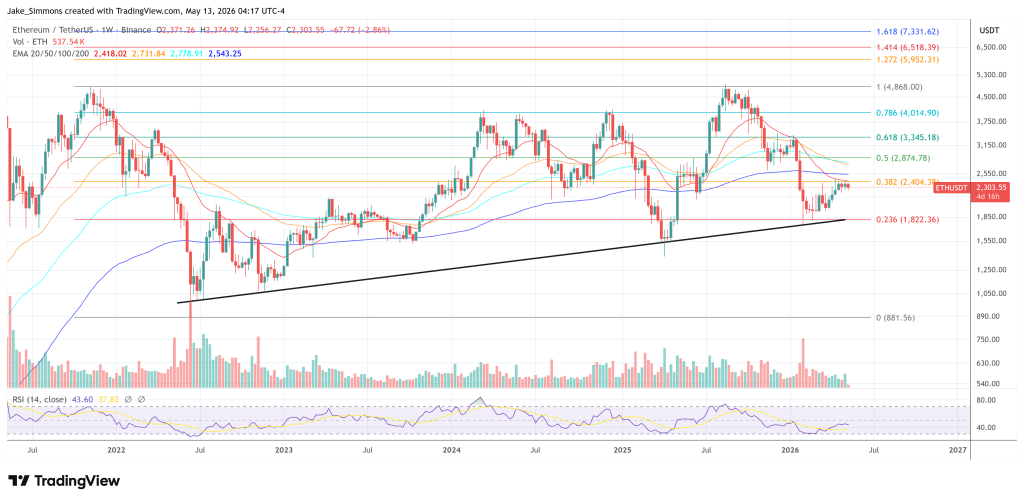
XRP bulls must break the 0.382 Fib, 1-week chart | Source: ETHUSDT on TradingView.com

Related Questions

QWhat is JPMorgan launching on the Ethereum blockchain?

AJPMorgan is launching a tokenized money market fund called the JPMorgan OnChain Liquidity-Token Money Market Fund.

QWhat is the ticker symbol for the token class shares of JPMorgan's new fund?

AThe ticker symbol for the Token Class shares is JLTXX.

QAccording to the filing, what types of assets will the JPMorgan tokenized money market fund primarily invest in?

AUnder normal conditions, the fund will invest exclusively in US Treasury bills, bonds and notes, along with overnight repurchase agreements fully collateralized by Treasury securities and/or cash.

QIn the fund's structure, what is determinative for legal ownership of shares: the blockchain balance or the Investor Register?

AThe Investor Register, not the blockchain balance, is determinative for legal ownership of fund shares.

QWhich company maintains the blockchain system for JPMorgan's tokenized fund?

AThe blockchain system is designed, deployed, and maintained by Kinexys Digital Assets, a business unit within JPMorgan Chase Bank.

Related Reads

Winter for Crypto IPOs: Consensys and Ledger Withdraw Applications

The crypto IPO window is tightening significantly in 2026, marked by prominent companies delaying or pausing their public listing plans. Following a successful 2025 "harvest year" that saw Circle, Bullish, and Gemini go public amidst a bull market, the tide has turned. Consensys, developer of MetaMask, recently postponed its IPO until at least fall 2026. Hardware wallet leader Ledger also suspended its planned US listing due to unfavorable market conditions, with Kraken having previously delayed its own plans. This shift is driven by a cooling market in 2026, characterized by a significant Bitcoin price correction, declining trading volumes, and reduced investor risk appetite for crypto stocks. The poor post-IPO performance of 2025 listings like Circle and Bullish, which saw major share price declines, has heightened investor caution. This contrasts sharply with the current AI sector, where companies like SpaceX, OpenAI, and Anthropic are commanding massive valuations and investor enthusiasm based on narratives of stable, exponential growth. Crypto companies now face pressure to transition from hype-driven models to demonstrating reliable cash flows and robust compliance. While the paused IPO plans may lead to valuation resets and affect ecosystem liquidity, they also accelerate industry consolidation toward stronger, more compliant infrastructure players. A potential recovery in Bitcoin's price and clearer regulations could reopen the IPO window in the latter half of 2026.

marsbit53m ago

Winter for Crypto IPOs: Consensys and Ledger Withdraw Applications

marsbit53m ago

ChatGPT Can Manage Your Money for You. Would You Trust It with Your Bank Account?

OpenAI has launched a personal finance tool for ChatGPT, currently in preview for US-based ChatGPT Pro users. This feature allows users to connect their bank and investment accounts (via Plaid, supporting over 12,000 institutions) directly to ChatGPT. It analyzes transactions, generates visual dashboards, and offers conversational financial advice—such as budgeting or planning for major purchases—based on the user's actual data. This move follows OpenAI's acquisitions of fintech startups Roi and Hiro Finance, signaling a strategic push into vertical "super assistant" applications, similar to its earlier health-focused feature. However, the launch has sparked significant privacy concerns. Critics question the safety of granting such sensitive financial access to an AI, especially amid ongoing lawsuits alleging OpenAI shared user chat data with third parties like Meta and Google. OpenAI emphasizes that ChatGPT only reads data (no transaction capabilities), deletes it within 30 days if disconnected, and offers opt-out options for model training. Yet, trust remains a major hurdle. The trend reflects a broader industry shift: AI companies like Anthropic and Perplexity are also targeting high-value, data-rich domains like finance and health. While technically promising, the tool operates in a regulatory gray area—it provides personalized guidance but disclaims formal financial advice or liability. Ultimately, OpenAI's challenge is convincing users to trust an AI with their most private financial information.

marsbit54m ago

ChatGPT Can Manage Your Money for You. Would You Trust It with Your Bank Account?

marsbit54m ago

Trading

Spot
Futures

Hot Articles

Discussions

Welcome to the HTX Community. Here, you can stay informed about the latest platform developments and gain access to professional market insights. Users' opinions on the price of ETH (ETH) are presented below.

活动图片