Ethereum Foundation Warns of Potential Cryptocurrency Wallet Disruptions

cryptonews.ruPublished on 2026-08-18Last updated on 2026-08-18

Abstract

The Ethereum Foundation (EF) has warned of potential disruptions to crypto wallets and related software due to the upcoming "Glamsterdam" network upgrade, which will change Ethereum's gas fee model. In an August 17 announcement, developers cautioned that wallets, indexers, and fee estimation tools, particularly those with hardcoded maximum gas limits, risk breaking and will require updates. The issue stems from EIP-8037, introducing a new "state-gas" dimension for operations that create new state, such as sending ETH to a new address. While a standard transfer to an existing address will remain 21,000 gas, sending to a new address will incur an additional cost. Developers urged a review of smart contracts and code that assume 21,000 gas covers any ETH transfer or that calculate fees based solely on gas quantity. Developers are advised to test their systems on the public testnet "Plataberget," launched on August 13, 2026, where the Glamsterdam activation is scheduled for August 20. A one-month feedback and client software update phase will precede testing on the Sepolia and Holesky testnets before the mainnet launch.

The upcoming Glamsterdam upgrade will change the gas model, and some software risks malfunctioning. The Ethereum Foundation (EF) team warned about this on August 17.

According to the developers, wallets, indexers, and fee estimation tools could be at risk. Programmers were advised to test their systems on the public testnet Plataberget.

The EF emphasized tools with a "hard-coded maximum gas limit": such solutions, they stated, will stop working and require an update.

The issue is related to EIP-8037. The proposal adds a separate state-gas dimension for operations that create new state. A regular $ETH transfer to an existing address will keep its cost at 21,000 units, but sending coins to a new address will incur an additional charge.

Developers urged a review of smart contracts that assume the logic that 21,000 units covers any $ETH transfer, as well as code that calculates fees based solely on gas quantity.

According to Forkcast, Plataberget was launched on August 13, 2026. The activation of Glamsterdam on this testnet is scheduled for August 20. Before the mainnet launch, there will be a feedback and client software update phase, estimated to last one month, followed by testing on Sepolia and Hoodi.
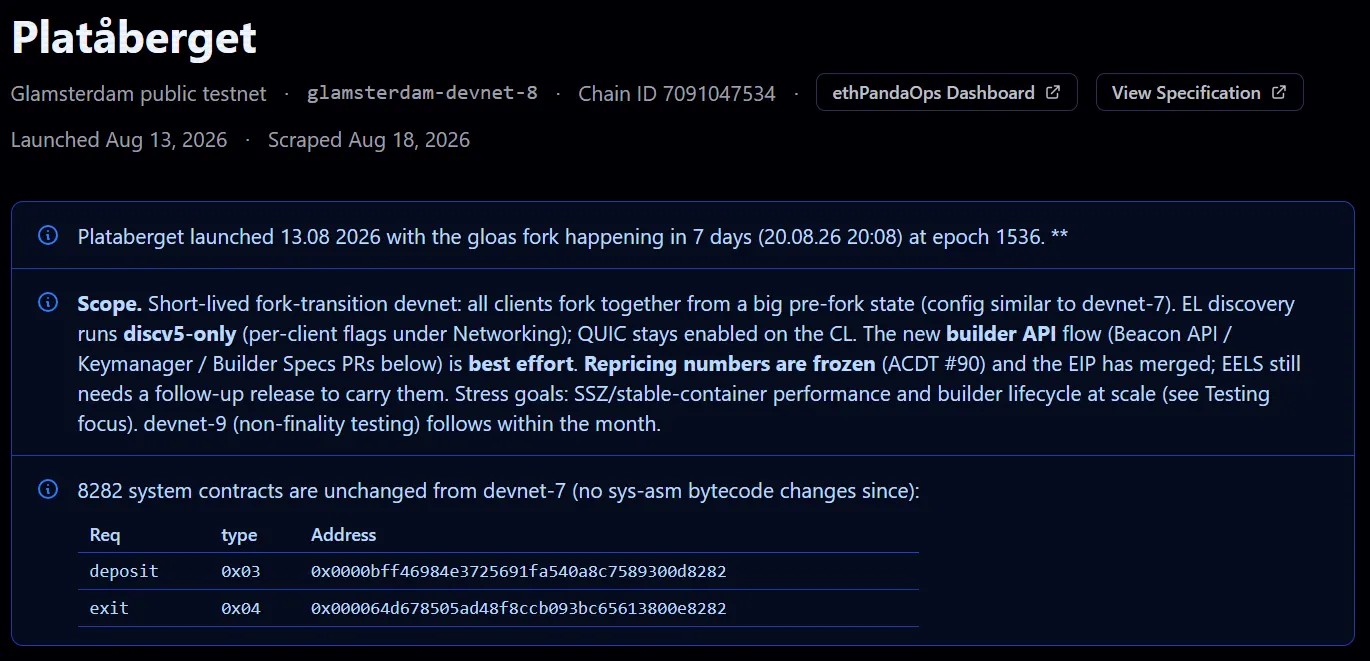
Source: Forkcast.

Recall that in August, Buterin named quantum resistance and AI as priorities for Ethereum.

The Quiet Evolution: Why Whales Are Accumulating Ethereum in Anticipation of Glamsterdam and Hegota
end-content

Trending Cryptos

Related Questions

QWhat upcoming Ethereum update has the Ethereum Foundation warned might cause wallet and software failures?

AThe upcoming Ethereum update named 'Glamsterdam'.

QAccording to the Ethereum Foundation, which specific types of software tools are most at risk from the Glamsterdam update?

AWallets, indexers, and fee estimation tools, especially those with a 'rigidly set maximum gas limit', are at risk.

QWhat key change does the EIP-8037 proposal introduce that necessitates updates to some software?

AEIP-8037 introduces a separate 'state-gas' dimension for operations that create new state, meaning sending ETH to a new address will incur an additional charge beyond the standard 21,000-unit base cost.

QOn what date was the Plataberget testnet, where developers are urged to test their systems, launched?

AThe Plataberget testnet was launched on August 13, 2026.

QWhat are the two priorities for Ethereum that Vitalik Buterin named in August, as mentioned in the article?

AVitalik Buterin named quantum resistance and AI as priorities for Ethereum.

Related Reads

Bitwise Names Three Mistakes Investors Make When Assessing the Cryptocurrency Market

Bitwise's chief investment officer, Matt Hougan, identifies three common mistakes investors make when evaluating the cryptocurrency market, all stemming from a disconnect between its current perception and potential evolution. First, investors often view crypto applications like Uniswap or Aave solely through the lens of the $2 trillion crypto market. However, with the tokenization of traditional assets (like $150 trillion in equities and $350 trillion in bonds), the potential market for these platforms could become 100 times larger. Second, there's an underestimation of crypto-native companies. Despite entry by major financial firms (e.g., PayPal in stablecoins, Fidelity in custody), native players like Tether, Circle, and Coinbase retain dominant market shares due to speed, focus, and established user bases (though exceptions like BlackRock's Bitcoin ETF success exist). Third, future blockchain transaction volumes are underestimated. Tokenized securities could trade 24/7, not just 33 hours per week, and the rise of AI agents managing portfolios could increase transaction activity by 50-100 times. Hougan concludes that investors assess the sector based on its present state while the underlying infrastructure is rapidly changing through tokenization, expanding use cases, and increased operational scale. This gap between current perception and future potential creates significant investment opportunities.

cryptonews.ru4m ago

Bitwise Names Three Mistakes Investors Make When Assessing the Cryptocurrency Market

cryptonews.ru4m ago

Grayscale Submits Fourth Amendment to Agreement for Zcash Trust, Whose Shares Will Be Listed on the NYSE Arca

Grayscale has submitted a fourth amendment to its S-3 registration form for the Grayscale Zcash Trust, a key step toward converting it into a U.S. exchange-traded fund (ETF) listed on NYSE Arca under the ticker ZCSH. This would be the first U.S. ETF providing regulated stock market access to the privacy-focused cryptocurrency ZEC ($ZEC). The amendment details the creation and redemption of shares, primarily through cash, though authorized participants can create shares in-kind by depositing ZEC. The trust is sponsored by Grayscale Investments, with Coinbase as the prime broker and custodian, and Bank of New York Mellon as administrator. The filing also notes non-binding discussions where Digital Currency Group's DCG International Investments could acquire shares by contributing 200,000 ZEC. A ZEC ETF is seen as a breakthrough due to regulatory caution around privacy-enhancing tokens. Following the filing, ZEC's price rose over 9% in 24 hours. Demand for the existing trust product has grown, with its average daily trading volume doubling from March to April, and shielded ZEC balances reaching a record ~30% of the circulating supply. Despite this momentum, Zcash has faced challenges in 2026, including a vulnerability discovered in its shielded Orchard pool that briefly caused its price to drop significantly. Developers quickly patched the issue. A regulated ETF would offer traditional investors exposure to this dual-faceted privacy asset.

cryptonews.ru4m ago

Grayscale Submits Fourth Amendment to Agreement for Zcash Trust, Whose Shares Will Be Listed on the NYSE Arca

cryptonews.ru4m ago

Pro-Cryptocurrency PAC Wins Primaries but Loses $2M Race in Florida

A pro-cryptocurrency political action committee (PAC), Fairshake, achieved mixed results in recent U.S. primary elections, spending millions to influence races ahead of the 2026 midterms. Fairshake's affiliated PACs, Protect Progress and Defend American Jobs, supported candidates in Alaska, Florida, and Wyoming, spending approximately $3.6 million. Four out of five candidates backed by their ads won their primaries or advanced. These included Democrat Lois Frankel in Florida, Republican Nick Begich in Alaska, Republican Sydney Gruters in Florida, and Representative Harriet Hageman in Wyoming's Senate race. However, a high-profile $2 million negative ad campaign by Protect Progress failed to defeat Democrat Oliver Gilbert in Florida's 24th District. Gilbert won despite the ads, which he attributed to "Trump's techie-billionaire friends" and "crypto-scammers trying to buy a Democratic primary." A PAC representative defended the ads' factual accuracy. Fairshake, with a reported $193 million war chest, has spent over $130 million in the 2024 cycle supporting pro-crypto candidates and opposing critics. A spokesperson stated the PAC is "just getting started" to build the largest pro-crypto Congress in history. The outcomes could impact future crypto legislation, such as the pending CLARITY Act, as the 2026 elections may shift congressional control and determine which parties advance or block industry-related bills.

cryptonews.ru7m ago

Pro-Cryptocurrency PAC Wins Primaries but Loses $2M Race in Florida

cryptonews.ru7m ago

Trading

Spot

Hot Articles

Discussions

Welcome to the HTX Community. Here, you can stay informed about the latest platform developments and gain access to professional market insights. Users' opinions on the price of ETH (ETH) are presented below.

活动图片