Ethereum Foundation President Breaks Silence On New Mandate And Internal Tensions

bitcoinistPublished on 2026-06-02Last updated on 2026-06-02

Abstract

Ethereum Foundation (EF) President Aya Miyaguchi has outlined the organization's new, more focused mandate, framing it as a necessary reset after internal debates became strained and the EF faced competing expectations. She explained the shift is not a retreat but reflects Ethereum's maturity beyond its original institution. The EF, holding less than 0.2% of all ETH, will now concentrate on preserving Ethereum's core properties like user self-sovereignty and coordination, acting as one node among many rather than a central command. Miyaguchi's comments follow co-founder Vitalik Buterin's own post on the EF's direction. She acknowledged a wave of high-profile departures in 2026, stating that a more focused EF naturally leads to a smaller, more concentrated team, with new leaders stepping in. The restructuring aims to ensure the EF accelerates what makes Ethereum uniquely valuable, while coordinating with allies who share that mission.

Ethereum Foundation President Aya Miyaguchi has laid out her view of the organization’s new mandate, framing the shift as a necessary reset after internal debates became increasingly strained and the Foundation faced pressure to be too many things at once.

Her comments, posted on X after Vitalik Buterin shared his own view of the Foundation’s direction, arrive during a sensitive period for Ethereum’s core nonprofit. The EF is moving toward a smaller, more focused structure while the broader ecosystem debates its governance role, technical priorities and a wave of high-profile departures.

Ethereum Foundation Enters New Power Era

Miyaguchi said the mandate came from the board, but that she proposed it late last year. The trigger, in her telling, was not a single dispute but a structural problem: EF had become a focal point for competing expectations.

“First, debates that were meant to be technical had started to become political and personal, and at times shaped by quieter incentives,” she wrote. “Second, as EF grew, more and more versions of ‘what EF should be’ began pulling at the core of the organization from every direction at once. I became convinced that trying to satisfy all of them would leave us achieving nothing at all.”

That line goes to the center of the Foundation’s dilemma. Ethereum has long relied on EF for research funding, coordination and stewardship, but its culture has also resisted the idea that any single entity should become Ethereum’s command center. Miyaguchi leaned heavily into that tension, arguing that EF’s reduced centrality is not a retreat from responsibility but proof that Ethereum has matured beyond its first institution.

“We have said it many times: EF is one of many nodes in Ethereum,” she wrote. “I know that is hard to hear for some, because EF was the first group, and in the early years it was essential for making things happen. But it was never meant to stay that way.”

Miyaguchi connected that philosophy to her own history in crypto, noting that she has been in the sector since 2012 and joined Kraken in 2013 shortly before the collapse of Mt. Gox, which she said she helped clean up. That experience, she argued, shaped her understanding of both growth and centralization risk. When she became executive director in 2018, her goal was to help Ethereum grow beyond EF.

The Foundation, she said, made deliberate choices to distribute power rather than retain control. Miyaguchi pointed to EF’s role in incubating and releasing projects such as Uniswap and ENS, supporting ETHGlobal and hackathons, and “funding the funders” through groups such as Gitcoin and Moloch. The guiding question, she said, was always: “how does this stand on its own, without us?”

That strategy, according to Miyaguchi, has left EF with less than 0.2% of all ETH and a role that is now narrower by design. The mandate, she said, is to preserve and accelerate the properties and goals that make Ethereum “uniquely valuable, competitive, and worth building on,” centered on what she called CROPS and “inalienable user self-sovereignty and self-sovereign coordination.”

“We cannot do it alone, and we do not intend to,” she wrote. “But defining this as the north star for the mission, and coordinating with the allies who share it, is the responsibility we are keeping.”

Miyaguchi also pushed back against the idea that a sharper EF means less concern for adoption. She said the opposite is true, arguing that everyday users and institutions both depend on Ethereum’s underlying value proposition. Adoption, including institutional adoption, remains part of EF’s work, she said, but only in ways that fit the mission.

The comments come as EF has seen a notable exodus of senior and high-profile contributors in 2026, including researchers and ecosystem figures such as Carl Beekhuizen, Julian Ma, Barnabé Monnot, Tim Beiko, Trent Van Epps, Josh Stark and former co-executive director Tomasz Stańczak. That turnover has intensified scrutiny over whether the Foundation’s restructuring is a sign of healthy decentralization, internal strain, or both.

Miyaguchi acknowledged the personnel implications directly. “As EF becomes more focused and more opinionated, the team naturally becomes smaller and more concentrated. That is part of the choice,” she wrote, adding that new leaders are already stepping into the mission and that management will provide more details on the new structure and strategy in the coming weeks.

Buterin’s May 24 post set the stage for Miyaguchi’s remarks. He described the EF as still being in transition, emphasized that he does not hold special power over the board, and said another leader is executing much of the current transition. He also framed the Foundation’s future as leaner and more focused, with less emphasis on being the center of Ethereum and more emphasis on preserving the network’s long-term properties.

At press time, ETH traded at $1,986.
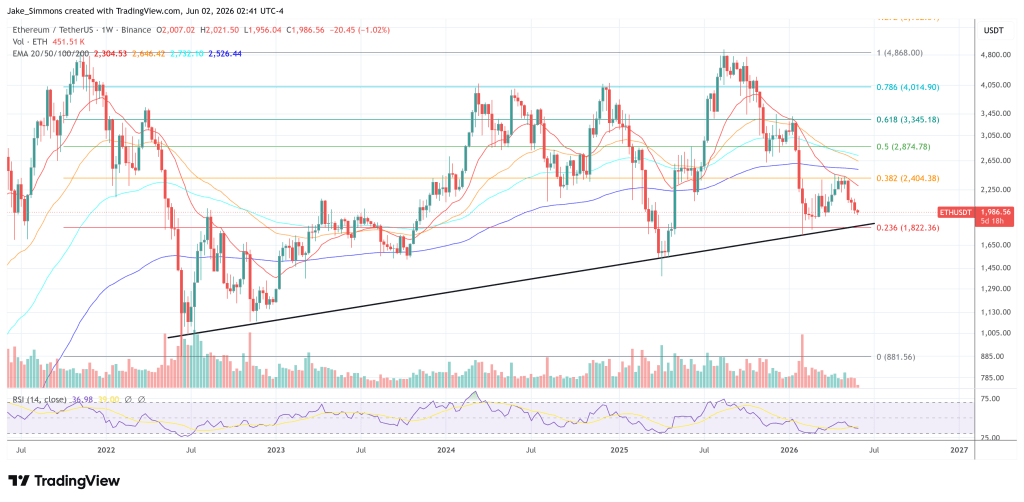
ETH uptrend remains intact, 1-week chart | Source: ETHUSDT on TradingView.com

Related Questions

QWhat is the new mandate of the Ethereum Foundation, according to Aya Miyaguchi, and why was it necessary?

AThe new mandate is for the Ethereum Foundation (EF) to become a smaller, more focused organization. Its role is to preserve and accelerate the properties and goals that make Ethereum 'uniquely valuable, competitive, and worth building on,' centered on concepts like CROPS and 'inalienable user self-sovereignty and self-sovereign coordination.' This shift was necessary because internal debates had become overly political and personal, and the EF was facing conflicting expectations, trying to be too many things at once, which risked achieving nothing.

QHow does Miyaguchi respond to the idea that a more focused EF means less concern for adoption?

AMiyaguchi pushes back against this idea, arguing the opposite is true. She states that both everyday users and institutions depend on Ethereum's underlying value proposition. Adoption, including institutional adoption, remains part of the EF's work, but only in ways that align with its newly defined, more focused mission.

QWhat is Miyaguchi's explanation for the wave of high-profile departures from the Ethereum Foundation?

AMiyaguchi acknowledges the departures are a direct consequence of the Foundation's strategic shift. She states, 'As EF becomes more focused and more opinionated, the team naturally becomes smaller and more concentrated. That is part of the choice.' She adds that new leaders are stepping into the mission and more details on the new structure will be provided soon.

QHow does Miyaguchi describe the historical and intended role of the Ethereum Foundation within the ecosystem?

AMiyaguchi describes the EF as 'one of many nodes in Ethereum.' While it was the first group and essential for making things happen in the early years, it was never meant to stay as the central command center. The goal was always to help Ethereum grow beyond the EF by distributing power, such as by incubating projects like Uniswap and ENS, and 'funding the funders' to ensure they could stand on their own.

QWhat was the trigger for proposing the new mandate, according to Miyaguchi's account?

AAccording to Miyaguchi, the trigger was not a single dispute but a structural problem. She identified two main issues: first, technical debates had become political and personal; second, as the EF grew, it was being pulled in too many directions by competing visions of 'what EF should be,' which threatened its effectiveness.

Related Reads

ETH Bull and Bear Views Compilation: Can Ethereum's Value Flow Back to ETH?

Titled "ETH Bull and Bear Views: Can Ethereum's Value Flow Back to ETH?", this article synthesizes the current heated debate around Ethereum's native token, ETH, following Bankless co-founder David Hoffman's decision to sell his entire ETH holdings. The **bullish case**, represented by figures like Tom Lee (BitMine CEO) and Raoul Pal, argues that ETH's core thesis remains intact. They contend Ethereum is the essential, secure, and neutral foundational layer for future finance—encompassing stablecoins, RWA, DeFi, L2s, and Agentic AI. Bulls bet on ETH's long-term revaluation as institutional adoption of on-chain finance grows, with significant buying activity from entities like BitMine and Consensys cited as evidence. Conversely, the **bearish perspective**, led by Hoffman and analysts like Markus Thielen, questions ETH's value capture mechanism. They acknowledge Ethereum's network success but argue that the value created by L2s, DeFi, and applications does not sufficiently accrue to the ETH token itself. Bears point to ETH's prolonged underperformance versus the broader crypto market, lack of traditional cash flows, weakening "ultrasound money" narrative, and apparent institutional retreat (e.g., Harvard Management Company exiting its ETH ETF position) as key concerns. The debate highlights a pivotal shift: ETH is no longer just a community belief asset. The central question is whether ETH can transition from being a "**used infrastructure**" to a "**continuously bought and held core asset**" as more value enters the Ethereum ecosystem. The market is now critically examining the direct link between network growth and ETH's value.

marsbit43m ago

ETH Bull and Bear Views Compilation: Can Ethereum's Value Flow Back to ETH?

marsbit43m ago

Crypto is dead, Perps are forever

The crypto industry is shifting from a focus on creating native assets (like altcoins and protocol tokens) to becoming a "global asset pipeline." Native cryptocurrencies, except for Bitcoin, are seen as failing in their value storage and utility promises, with demand driven largely by speculation. Attention and liquidity are now moving toward real-world assets (RWAs) like U.S. stocks, bonds, gold, and oil traded on-chain via perpetual contracts (Perps). Stablecoins like USDT and USDC set the precedent, proving blockchain's core strength is efficient global settlement and transfer, not inventing new monetary systems. Meanwhile, assets like Ethereum and many DeFi tokens struggle as their narratives weaken against tangible traditional assets and the rapid real-world progress of AI. Perpetual contracts have emerged as a pivotal innovation. They simplify trading by offering pure price exposure to any asset, bypassing complexities of ownership, custody, and traditional market hours. Projects like Hyperliquid gained traction by combining CEX-like efficiency with on-chain transparency, capitalizing on post-FTX distrust, macroeconomic volatility, and the surge in demand for 24/7 stock trading. In conclusion, while the era of speculative native "crypto assets" may be over, perpetual contracts persist as the industry's most potent financial instrument—transforming all assets into globally accessible, constantly tradable instruments centered on price speculation.

marsbit49m ago

Crypto is dead, Perps are forever

marsbit49m ago

Tencent, Alibaba, ByteDance in a Battle for the Skill Store

Skill is becoming a key concept in the AI field, essentially serving as a structured "instruction manual" for AI Agents that specifies tool calls, decision logic, and output standards. This allows Agents to execute predefined tasks. As the number of Skills grows, distribution platforms have emerged. Major tech companies are swiftly entering this space. In March, Tencent, Alibaba, and ByteDance launched Skill stores within their respective Agent platforms. Subsequently, players like Zhipu AI, Meituan, and Xiaohongshu joined the fray. This competition for the "Skill store" is fundamentally a battle for the AI-era user entry point; whoever controls distribution controls the users. While ByteDance's Coze has experimented with paid Skills, most platforms offer them for free. The real value lies not in the stores themselves but in using them to attract and retain users within an ecosystem, driving revenue from services like cloud computing, model calls, or advertising. The landscape features three main player types: 1) **Internet giants** (e.g., Alibaba, ByteDance, Tencent, Meituan), leveraging Skills to drive traffic and monetize through their broader ecosystems (cloud services, transactions, ads). 2) **Large model companies** (e.g., Zhipu AI, Moonshot AI), using Skill stores to increase user engagement and monetize model API calls. 3) **Content platforms** (e.g., Xiaohongshu), treating Skills as a new content format to generate traffic and ad revenue. However, transforming Skill stores into a sustainable business faces significant hurdles. Key challenges include: the **difficulty in pricing Skills** due to inconsistent outputs across different models and contexts; **lack of cost transparency** (varying token consumption); **security risks** like Skill poisoning; and the **absence of standardized protocols** for development and evaluation. Unlike standardized mobile apps, Skills are often personalized workflows resistant to uniformity, which hinders the establishment of a reliable review and monetization system akin to the App Store. While there is genuine user demand for paid Skills—particularly in enterprise (e.g., contract review) and certain personal productivity scenarios—current platforms offer developers limited and unpredictable distribution. The future of Skill stores depends on overcoming these standardization, evaluation, and safety challenges to make acquiring a Skill as straightforward as downloading an app. For now, the stores function more as display shelves than robust marketplaces.

marsbit49m ago

Tencent, Alibaba, ByteDance in a Battle for the Skill Store

marsbit49m ago

The Crypto Scene Is Dead, Perpetual Swaps Are Eternal

The crypto industry is undergoing a fundamental shift. The era defined by minting novel, native digital assets (altcoins) is fading. These assets, lacking real-world cash flows or clear value, are losing relevance as attention and capital flow elsewhere. Two powerful external forces are reshaping the space. First, traditional assets like U.S. stocks, bonds, gold, and oil are being tokenized and traded on-chain. Second, the explosive growth of AI, with its tangible products, has overshadowed crypto's once-dominant "future narrative." This marks a critical pivot: crypto is transitioning from being a "factory for new assets" to becoming a "global conduit for existing assets." Its validated utility is not complex financial reinvention but efficient global settlement, transfer, and trading—the original promise of blockchain. Stablecoins like USDT and USDC exemplify this, offering faster dollar movement rather than replacing it. Consequently, native ecosystems like Ethereum face profound challenges. While still crucial infrastructure, ETH struggles to capture value as users interact with Layer 2s or trade traditional assets without needing to hold it. DeFi's grand narrative of rebuilding finance has narrowed to core needs like cheap transfers and deep liquidity. The true breakout innovation is the perpetual contract (Perp). It brilliantly bypasses the complexities of direct asset ownership (custody, compliance, dividends) by creating pure price exposure. Users can speculate on the price movement of *any* asset—NVIDIA, gold, oil—24/7, globally, and with leverage. This "price casino" model, while risky and ethically fraught, delivers unmatched liquidity and accessibility. Projects like Hyperliquid succeeded not by inventing new mechanics but by perfecting the timing and execution of this model. Key drivers included making on-chain Perps feel like centralized exchanges, post-FTX trust migration towards transparency, and rising demand to trade macro assets and equities round-the-clock. In conclusion, the crypto world's most enduring successes are the dollar (via stablecoins), Bitcoin, and trading. Its new frontier is not creating alternative assets but providing a seamless, perpetual trading layer—a new API—for the world's existing financial system. The age of native altcoins is over; the age of perpetual synthetic exposure has begun.

Odaily星球日报58m ago

The Crypto Scene Is Dead, Perpetual Swaps Are Eternal

Odaily星球日报58m ago

Trading

Spot
Futures

Hot Articles

Discussions

Welcome to the HTX Community. Here, you can stay informed about the latest platform developments and gain access to professional market insights. Users' opinions on the price of ETH (ETH) are presented below.

活动图片















