Ethereum Foundation President Breaks Silence On New Mandate And Internal Tensions

bitcoinistPublished on 2026-06-02Last updated on 2026-06-02

Abstract

Ethereum Foundation (EF) President Aya Miyaguchi has outlined the organization's new, more focused mandate, framing it as a necessary reset after internal debates became strained and the EF faced competing expectations. She explained the shift is not a retreat but reflects Ethereum's maturity beyond its original institution. The EF, holding less than 0.2% of all ETH, will now concentrate on preserving Ethereum's core properties like user self-sovereignty and coordination, acting as one node among many rather than a central command. Miyaguchi's comments follow co-founder Vitalik Buterin's own post on the EF's direction. She acknowledged a wave of high-profile departures in 2026, stating that a more focused EF naturally leads to a smaller, more concentrated team, with new leaders stepping in. The restructuring aims to ensure the EF accelerates what makes Ethereum uniquely valuable, while coordinating with allies who share that mission.

Ethereum Foundation President Aya Miyaguchi has laid out her view of the organization’s new mandate, framing the shift as a necessary reset after internal debates became increasingly strained and the Foundation faced pressure to be too many things at once.

Her comments, posted on X after Vitalik Buterin shared his own view of the Foundation’s direction, arrive during a sensitive period for Ethereum’s core nonprofit. The EF is moving toward a smaller, more focused structure while the broader ecosystem debates its governance role, technical priorities and a wave of high-profile departures.

Ethereum Foundation Enters New Power Era

Miyaguchi said the mandate came from the board, but that she proposed it late last year. The trigger, in her telling, was not a single dispute but a structural problem: EF had become a focal point for competing expectations.

“First, debates that were meant to be technical had started to become political and personal, and at times shaped by quieter incentives,” she wrote. “Second, as EF grew, more and more versions of ‘what EF should be’ began pulling at the core of the organization from every direction at once. I became convinced that trying to satisfy all of them would leave us achieving nothing at all.”

That line goes to the center of the Foundation’s dilemma. Ethereum has long relied on EF for research funding, coordination and stewardship, but its culture has also resisted the idea that any single entity should become Ethereum’s command center. Miyaguchi leaned heavily into that tension, arguing that EF’s reduced centrality is not a retreat from responsibility but proof that Ethereum has matured beyond its first institution.

“We have said it many times: EF is one of many nodes in Ethereum,” she wrote. “I know that is hard to hear for some, because EF was the first group, and in the early years it was essential for making things happen. But it was never meant to stay that way.”

Miyaguchi connected that philosophy to her own history in crypto, noting that she has been in the sector since 2012 and joined Kraken in 2013 shortly before the collapse of Mt. Gox, which she said she helped clean up. That experience, she argued, shaped her understanding of both growth and centralization risk. When she became executive director in 2018, her goal was to help Ethereum grow beyond EF.

The Foundation, she said, made deliberate choices to distribute power rather than retain control. Miyaguchi pointed to EF’s role in incubating and releasing projects such as Uniswap and ENS, supporting ETHGlobal and hackathons, and “funding the funders” through groups such as Gitcoin and Moloch. The guiding question, she said, was always: “how does this stand on its own, without us?”

That strategy, according to Miyaguchi, has left EF with less than 0.2% of all ETH and a role that is now narrower by design. The mandate, she said, is to preserve and accelerate the properties and goals that make Ethereum “uniquely valuable, competitive, and worth building on,” centered on what she called CROPS and “inalienable user self-sovereignty and self-sovereign coordination.”

“We cannot do it alone, and we do not intend to,” she wrote. “But defining this as the north star for the mission, and coordinating with the allies who share it, is the responsibility we are keeping.”

Miyaguchi also pushed back against the idea that a sharper EF means less concern for adoption. She said the opposite is true, arguing that everyday users and institutions both depend on Ethereum’s underlying value proposition. Adoption, including institutional adoption, remains part of EF’s work, she said, but only in ways that fit the mission.

The comments come as EF has seen a notable exodus of senior and high-profile contributors in 2026, including researchers and ecosystem figures such as Carl Beekhuizen, Julian Ma, Barnabé Monnot, Tim Beiko, Trent Van Epps, Josh Stark and former co-executive director Tomasz Stańczak. That turnover has intensified scrutiny over whether the Foundation’s restructuring is a sign of healthy decentralization, internal strain, or both.

Miyaguchi acknowledged the personnel implications directly. “As EF becomes more focused and more opinionated, the team naturally becomes smaller and more concentrated. That is part of the choice,” she wrote, adding that new leaders are already stepping into the mission and that management will provide more details on the new structure and strategy in the coming weeks.

Buterin’s May 24 post set the stage for Miyaguchi’s remarks. He described the EF as still being in transition, emphasized that he does not hold special power over the board, and said another leader is executing much of the current transition. He also framed the Foundation’s future as leaner and more focused, with less emphasis on being the center of Ethereum and more emphasis on preserving the network’s long-term properties.

At press time, ETH traded at $1,986.
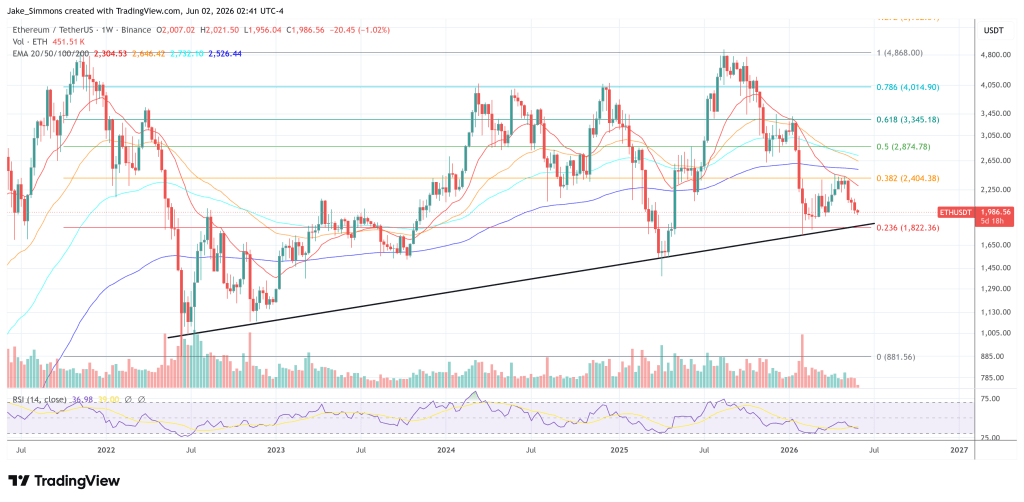
ETH uptrend remains intact, 1-week chart | Source: ETHUSDT on TradingView.com

Trending Cryptos

Related Questions

QWhat is the new mandate of the Ethereum Foundation, according to Aya Miyaguchi, and why was it necessary?

AThe new mandate is for the Ethereum Foundation (EF) to become a smaller, more focused organization. Its role is to preserve and accelerate the properties and goals that make Ethereum 'uniquely valuable, competitive, and worth building on,' centered on concepts like CROPS and 'inalienable user self-sovereignty and self-sovereign coordination.' This shift was necessary because internal debates had become overly political and personal, and the EF was facing conflicting expectations, trying to be too many things at once, which risked achieving nothing.

QHow does Miyaguchi respond to the idea that a more focused EF means less concern for adoption?

AMiyaguchi pushes back against this idea, arguing the opposite is true. She states that both everyday users and institutions depend on Ethereum's underlying value proposition. Adoption, including institutional adoption, remains part of the EF's work, but only in ways that align with its newly defined, more focused mission.

QWhat is Miyaguchi's explanation for the wave of high-profile departures from the Ethereum Foundation?

AMiyaguchi acknowledges the departures are a direct consequence of the Foundation's strategic shift. She states, 'As EF becomes more focused and more opinionated, the team naturally becomes smaller and more concentrated. That is part of the choice.' She adds that new leaders are stepping into the mission and more details on the new structure will be provided soon.

QHow does Miyaguchi describe the historical and intended role of the Ethereum Foundation within the ecosystem?

AMiyaguchi describes the EF as 'one of many nodes in Ethereum.' While it was the first group and essential for making things happen in the early years, it was never meant to stay as the central command center. The goal was always to help Ethereum grow beyond the EF by distributing power, such as by incubating projects like Uniswap and ENS, and 'funding the funders' to ensure they could stand on their own.

QWhat was the trigger for proposing the new mandate, according to Miyaguchi's account?

AAccording to Miyaguchi, the trigger was not a single dispute but a structural problem. She identified two main issues: first, technical debates had become political and personal; second, as the EF grew, it was being pulled in too many directions by competing visions of 'what EF should be,' which threatened its effectiveness.

Related Reads

The Verdict in Choi Tae-won's Divorce Case: Revealing the Inheritance Undercurrent Behind SK Hynix's Trillion-Won Empire

SK Group Chairman Chey Tae-won's high-profile divorce case, involving a record 1.38 trillion won settlement, has drawn attention to the succession plans for Korea's second-largest conglomerate, especially its crown jewel, SK hynix. Unlike traditional chaebol scripts centered on the eldest son, Chey's three children from his marriage to former President Roh Tae-woo's daughter, Roh Soh-yeong, are carving distinct, non-traditional paths. Eldest daughter Chey Yun-jung (b. 1989) is seen as the most evident successor. With a scientific and consulting background, she holds executive roles at SK bioscience and SK Inc.'s growth support department, focusing on future strategy and biopharma. Her marriage is to an AI infrastructure entrepreneur, not a traditional business alliance. Second daughter Chey Min-jung (b. 1991) took a unique route, voluntarily serving as a South Korean naval officer, including an anti-piracy deployment. She later worked on policy and strategy for SK hynix in Washington D.C. before co-founding an AI-driven healthcare startup. She married a former U.S. Marine Corps officer, connecting her to U.S. defense and policy circles—networks crucial for a global semiconductor giant. The only son, Chey In-geun (b. 1995), who studied physics like his father, worked briefly at SK E&S before joining McKinsey. Despite fitting the traditional "heir" profile as the eldest son, he remains silent and holds no public position or shares in SK, suggesting the old succession playbook is obsolete. As SK hynix's valuation soars, becoming a geopolitical asset in the AI era, the heirs' legitimacy is no longer automatic. They must prove themselves in fields like AI biotech, global policy, and strategic consulting. Their marriages also reflect new elite networks in tech and defense, not old political alliances. Their inheritance is the complex challenge of navigating a globalized, tech-driven world, not just a corporate throne.

marsbitYesterday 09:06

The Verdict in Choi Tae-won's Divorce Case: Revealing the Inheritance Undercurrent Behind SK Hynix's Trillion-Won Empire

marsbitYesterday 09:06

From OpenSea to OpenRouter: Is Alex Atallah Repeating His 'Exit at the Peak' Playbook?

From OpenSea to OpenRouter: Is Alex Atallah Repeating His "Exit at the Peak" Playbook? According to the Wall Street Journal, payments giant Stripe is in talks to acquire the AI model aggregation platform OpenRouter in a potential deal valuing the company near $100 billion. This would mark founder Alex Atallah's second creation of a company reaching a $100 billion valuation, following his co-founding of NFT marketplace OpenSea. OpenRouter, founded just over three years ago, has grown rapidly by acting as a unified gateway for developers to access over 400 AI models. It currently has about 10 million users and processes over 200 trillion tokens monthly. While the platform's annualized revenue is around $50 million, its valuation has skyrocketed from $1.3 billion in March 2026. The potential acquisition by Stripe, a company OpenRouter's founder once likened it to, represents a major expansion into AI infrastructure for the payments leader. This move echoes Atallah's previous timing with OpenSea, where he departed before the NFT market's significant downturn. For OpenRouter, selling now may be strategic. Despite its scale, its business model—charging a 5-5.5% fee on AI inference calls—faces pressure from competition, open-source models, and potential price wars among model providers, limiting its profitability narrative for an IPO. A key asset for potential acquirers like Stripe is OpenRouter's vast repository of real-world AI usage data, which offers unique insights into model performance and developer preferences that are difficult to replicate. Whether this potential deal signifies a new valuation benchmark for AI infrastructure or another market peak signal remains to be seen.

链捕手Yesterday 08:42

From OpenSea to OpenRouter: Is Alex Atallah Repeating His 'Exit at the Peak' Playbook?

链捕手Yesterday 08:42

Trading

Spot

Hot Articles

Discussions

Welcome to the HTX Community. Here, you can stay informed about the latest platform developments and gain access to professional market insights. Users' opinions on the price of ETH (ETH) are presented below.

活动图片
















