Ethereum Foundation Maps 2026 Protocol Priorities as Major Upgrades Near

bitcoinistPublished on 2026-02-19Last updated on 2026-02-19

Abstract

The Ethereum Foundation has released its protocol priorities for 2026, outlining a structured roadmap organized into three key tracks: Scale, Improve UX, and Harden the L1. The Scale track, a consolidation of previous initiatives, focuses on increasing the gas limit toward and beyond 100 million, implementing EIP-7928 for block-level access lists, and advancing the scaling components of the upcoming "Glamsterdam" upgrade. This includes enshrined Proposer-Builder Separation (EIP-7732), further blob parameter increases, and progressing zkEVM and long-term state scaling work. The Improve UX track is centered on native account abstraction and interoperability. Key proposals like EIP-7702 aim to make smart contract wallets the default without extra overhead, while the Open Intents Framework seeks to enable seamless cross-L2 interactions. This work is also tied to improving security and migrating toward quantum-resistant signatures. The new Harden the L1 track is described as an insurance policy, focusing on post-quantum readiness, execution-layer safeguards, and enhancing censorship resistance through proposals like EIP-7805 (FOCIL). It also includes critical devnet and testnet coordination. The foundation is targeting the Glamsterdam upgrade for the first half of 2026, bundling these priorities, with another upgrade, Hegotá, planned for later in the year.

The Ethereum Foundation’s protocol track leads published a new “Protocol Priorities Update for 2026” on Feb. 18, outlining how core R&D will be organized this year and what the next upgrade cycle is expected to emphasize.

Ethereum’s Priorities In 2026

The update looks back at 2025 as a high-throughput year for mainnet changes, anchored by two network upgrades. Pectra shipped in May, Fusaka followed in December with PeerDAS on mainnet. Alongside those upgrades, the community increased the mainnet gas limit from 30 million to 60 million, calling it the first significant jump since 2021.

The main change is organizational. “Now that those milestones are behind us, we have the opportunity to think about how we organize our work at a slightly higher level,” the authors wrote. For 2026, Protocol work is grouped into three tracks: Scale, Improve UX, and Harden the L1, each with named leads.

The Scale track, led by Ansgar Dietrichs, Marius van der Wijden, and Raúl Kripalani, merges last year’s “Scale L1” and “Scale Blobs” initiatives into one effort. The foundation frames this as a pragmatic consolidation, because execution capacity, networking, and consensus changes tend to land in the same client code and influence each other.

On the roadmap, the update highlights continued gas limit increases “toward and beyond 100M,” supported by block-level access lists via EIP-7928 and ongoing client benchmarking. It also flags “the scaling components of Glamsterdam,” including enshrined PBS through EIP-7732, repricings, and further blob parameter increases.

Beyond that, the Scale track includes pushing a zkEVM attester client from prototype toward production readiness, and longer-run state scaling work that spans near-term repricing and history expiry through to binary trees and statelessness.

The Improve UX track, led by Barnabé Monnot and Matt Garnett, narrows in on two areas the foundation calls the most leverage for 2026 usability: native account abstraction and interoperability.

On account abstraction, the update positions EIP-7702 as a step toward an endpoint where smart contract wallets become the default without bundlers, relayers, or extra gas overhead. It points to proposals including EIP-7701 and EIP-8141, described as “Frame Transactions,” as work that moves smart account logic deeper into the protocol itself.

That UX roadmap is also tied to security direction. The foundation argues native account abstraction provides a cleaner migration path away from ECDSA-based authentication, and says parallel proposals aim to make quantum-resistant signature verification meaningfully cheaper inside the EVM.

Interoperability work builds on the Open Intents Framework with the stated goal of “seamless, trust-minimized cross-L2 interactions,” supported by faster L1 confirmations and shorter L2 settlement times.

The new Harden the L1 track, led by Fredrik Svantes, Parithosh Jayanthi, and Thomas Thiery, is framed as insurance policy work that preserves Ethereum’s core properties while scaling continues.

The update ties security efforts to Svantes’ Trillion Dollar Security Initiative, including post-quantum readiness and execution-layer safeguards like post-execution transaction assertions and “trustless RPCs.”

On censorship resistance, Thiery’s scope includes FOCIL via EIP-7805 and extensions that touch censorship resistance for blobs, statelessness work labeled VOPS, and the development of measurable censorship-resistance metrics. Jayanthi’s remit covers devnets, testnets, and client interoperability testing, which the foundation says becomes more critical if Ethereum moves into a faster fork cadence.

Looking ahead, the foundation targets Glamsterdam for the first half of 2026, with Hegotá planned later in the year. The stated ambition bundles parallel execution, significantly higher gas limits, enshrined PBS, continued blob scaling, and progress on censorship resistance, native account abstraction, and post-quantum security, with more track-level updates promised as the year unfolds.

At press time, Ethereum traded at $1,968.
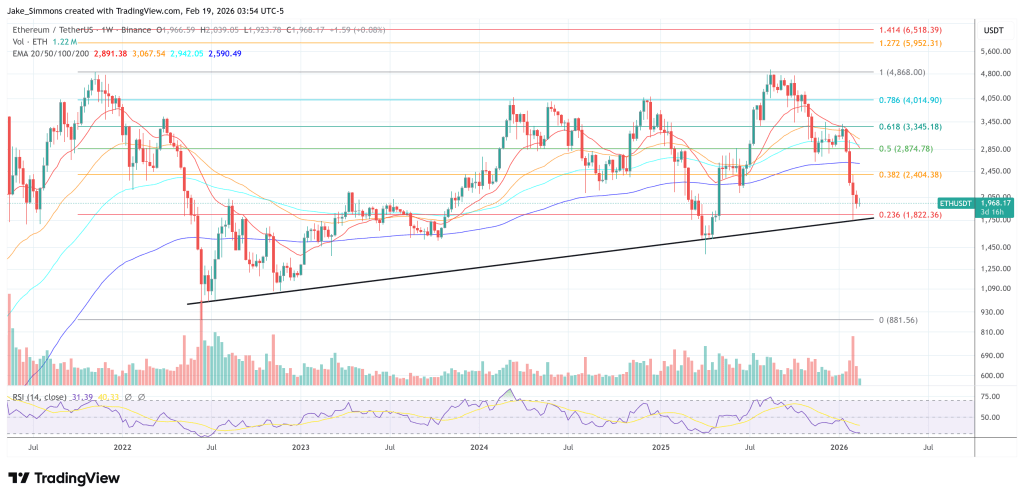
Ethereum remains below the 200-week EMA, 1-week chart | Source: ETHUSDT on TradingView.com

Trending Cryptos

Related Questions

QWhat are the three main tracks for Ethereum's protocol work in 2026 as outlined by the Ethereum Foundation?

AThe three main tracks are: Scale (led by Ansgar Dietrichs, Marius van der Wijden, and Raúl Kripalani), Improve UX (led by Barnabé Monnot and Matt Garnett), and Harden the L1 (led by Fredrik Svantes, Parithosh Jayanthi, and Thomas Thiery).

QWhat is the goal of the mainnet gas limit increases mentioned in the 2026 priorities, and what EIP supports this effort?

AThe goal is to increase the gas limit 'toward and beyond 100M.' This effort is supported by EIP-7928, which introduces block-level access lists.

QAccording to the update, what is EIP-7702 and what long-term goal does it serve for user experience?

AEIP-7702 is a proposal that is a step toward making smart contract wallets the default without requiring bundlers, relayers, or extra gas overhead. It serves the long-term goal of native account abstraction.

QWhat are the two major network upgrades planned for 2026, and when are they targeted?

AThe two major upgrades are Glamsterdam, targeted for the first half of 2026, and Hegotá, planned for later in the year.

QWhich initiative is the new 'Harden the L1' security track tied to, and what are two specific areas of focus within it?

AThe security track is tied to Fredrik Svantes' Trillion Dollar Security Initiative. Two specific areas of focus are post-quantum readiness and execution-layer safeguards like post-execution transaction assertions and 'trustless RPCs'.

Related Reads

The Verdict in Choi Tae-won's Divorce Case: Revealing the Inheritance Undercurrent Behind SK Hynix's Trillion-Won Empire

SK Group Chairman Chey Tae-won's high-profile divorce case, involving a record 1.38 trillion won settlement, has drawn attention to the succession plans for Korea's second-largest conglomerate, especially its crown jewel, SK hynix. Unlike traditional chaebol scripts centered on the eldest son, Chey's three children from his marriage to former President Roh Tae-woo's daughter, Roh Soh-yeong, are carving distinct, non-traditional paths. Eldest daughter Chey Yun-jung (b. 1989) is seen as the most evident successor. With a scientific and consulting background, she holds executive roles at SK bioscience and SK Inc.'s growth support department, focusing on future strategy and biopharma. Her marriage is to an AI infrastructure entrepreneur, not a traditional business alliance. Second daughter Chey Min-jung (b. 1991) took a unique route, voluntarily serving as a South Korean naval officer, including an anti-piracy deployment. She later worked on policy and strategy for SK hynix in Washington D.C. before co-founding an AI-driven healthcare startup. She married a former U.S. Marine Corps officer, connecting her to U.S. defense and policy circles—networks crucial for a global semiconductor giant. The only son, Chey In-geun (b. 1995), who studied physics like his father, worked briefly at SK E&S before joining McKinsey. Despite fitting the traditional "heir" profile as the eldest son, he remains silent and holds no public position or shares in SK, suggesting the old succession playbook is obsolete. As SK hynix's valuation soars, becoming a geopolitical asset in the AI era, the heirs' legitimacy is no longer automatic. They must prove themselves in fields like AI biotech, global policy, and strategic consulting. Their marriages also reflect new elite networks in tech and defense, not old political alliances. Their inheritance is the complex challenge of navigating a globalized, tech-driven world, not just a corporate throne.

marsbit16h ago

The Verdict in Choi Tae-won's Divorce Case: Revealing the Inheritance Undercurrent Behind SK Hynix's Trillion-Won Empire

marsbit16h ago

From OpenSea to OpenRouter: Is Alex Atallah Repeating His 'Exit at the Peak' Playbook?

From OpenSea to OpenRouter: Is Alex Atallah Repeating His "Exit at the Peak" Playbook? According to the Wall Street Journal, payments giant Stripe is in talks to acquire the AI model aggregation platform OpenRouter in a potential deal valuing the company near $100 billion. This would mark founder Alex Atallah's second creation of a company reaching a $100 billion valuation, following his co-founding of NFT marketplace OpenSea. OpenRouter, founded just over three years ago, has grown rapidly by acting as a unified gateway for developers to access over 400 AI models. It currently has about 10 million users and processes over 200 trillion tokens monthly. While the platform's annualized revenue is around $50 million, its valuation has skyrocketed from $1.3 billion in March 2026. The potential acquisition by Stripe, a company OpenRouter's founder once likened it to, represents a major expansion into AI infrastructure for the payments leader. This move echoes Atallah's previous timing with OpenSea, where he departed before the NFT market's significant downturn. For OpenRouter, selling now may be strategic. Despite its scale, its business model—charging a 5-5.5% fee on AI inference calls—faces pressure from competition, open-source models, and potential price wars among model providers, limiting its profitability narrative for an IPO. A key asset for potential acquirers like Stripe is OpenRouter's vast repository of real-world AI usage data, which offers unique insights into model performance and developer preferences that are difficult to replicate. Whether this potential deal signifies a new valuation benchmark for AI infrastructure or another market peak signal remains to be seen.

链捕手16h ago

From OpenSea to OpenRouter: Is Alex Atallah Repeating His 'Exit at the Peak' Playbook?

链捕手16h ago

Trading

Spot

Hot Articles

Discussions

Welcome to the HTX Community. Here, you can stay informed about the latest platform developments and gain access to professional market insights. Users' opinions on the price of ETH (ETH) are presented below.

活动图片
















