Ethereum Foundation Cuts 20% of Staff, 54 Depart: The Survival Logic Behind the Restructuring

marsbitPublished on 2026-06-24Last updated on 2026-06-24

Abstract

The Ethereum Foundation (EF) has announced a major restructuring, resulting in the departure of 54 staff members, representing approximately 20% of its workforce. This reorganization is not merely a cost-cutting measure but a strategic refocusing. The EF will now concentrate its resources on what it deems critical and unique tasks, structured around five new operational clusters. The new structure comprises clusters dedicated to: the Protocol Layer (ensuring Ethereum's core properties like censorship resistance and security); the Access Layer (enabling trusted, non-intermediated user interactions); the User Layer (grounding decisions in real user needs and constraints); the Community Layer (representing EF's stance and building alliances); and the Institutional Layer (engaging with enterprises, governments, and academia to promote principled adoption). The foundation stated that the layoffs were a difficult but necessary step to align its organization and spending with its long-term mandate, insulating its core work from short-term market fluctuations. Affected employees were offered a severance package and transition support. The restructured EF emerges as a leaner and more focused organization, poised to prioritize the development and preservation of Ethereum's foundational promise of self-sovereignty. Further details on the new operational model are expected in the coming weeks.

Author: Ethereum Foundation

Compilation: Deep Chao TechFlow

Deep Chao Intro: The Ethereum Foundation (EF) has announced a 20% reduction in staff, with 54 people leaving, and has completed a months-long organizational restructuring. This is not a simple cost-cutting measure, but a strategic contraction—the Foundation is concentrating resources on the critical tasks that "only EF can and must do," reorganized into five major clusters. For investors, this signals Ethereum's shift from broad-scatter efforts to focusing on the protocol layer and sovereignty guarantees, but also exposes the financial pressure on non-profit organizations during the bear market.

Today, the Ethereum Foundation (EF) is changing form, concluding a months-long restructuring process, part of implementing our Mandate and treasury management policies.

The restructured EF has the structure, activities, and personnel needed to execute critical future missions. However, 54 colleagues have also departed, representing about 20% of EF's total staff. Many of them will continue contributing to Ethereum in other ways in the coming weeks.

This article briefly introduces the new structure and details how we are supporting those leaving.

New Structure

EF now has five clusters, each responsible for a different work area—Protocol Layer, Access Layer, User Layer, Community Layer, and Institutional Layer—plus a cluster focused on operations and a cluster comprising management and teams directly supporting management.

Each work area requires different approaches, is accountable for different types of outcomes, and has a different internal structure tailored to the required workload. We will share more details next month; today, only the highest-level overview is provided.
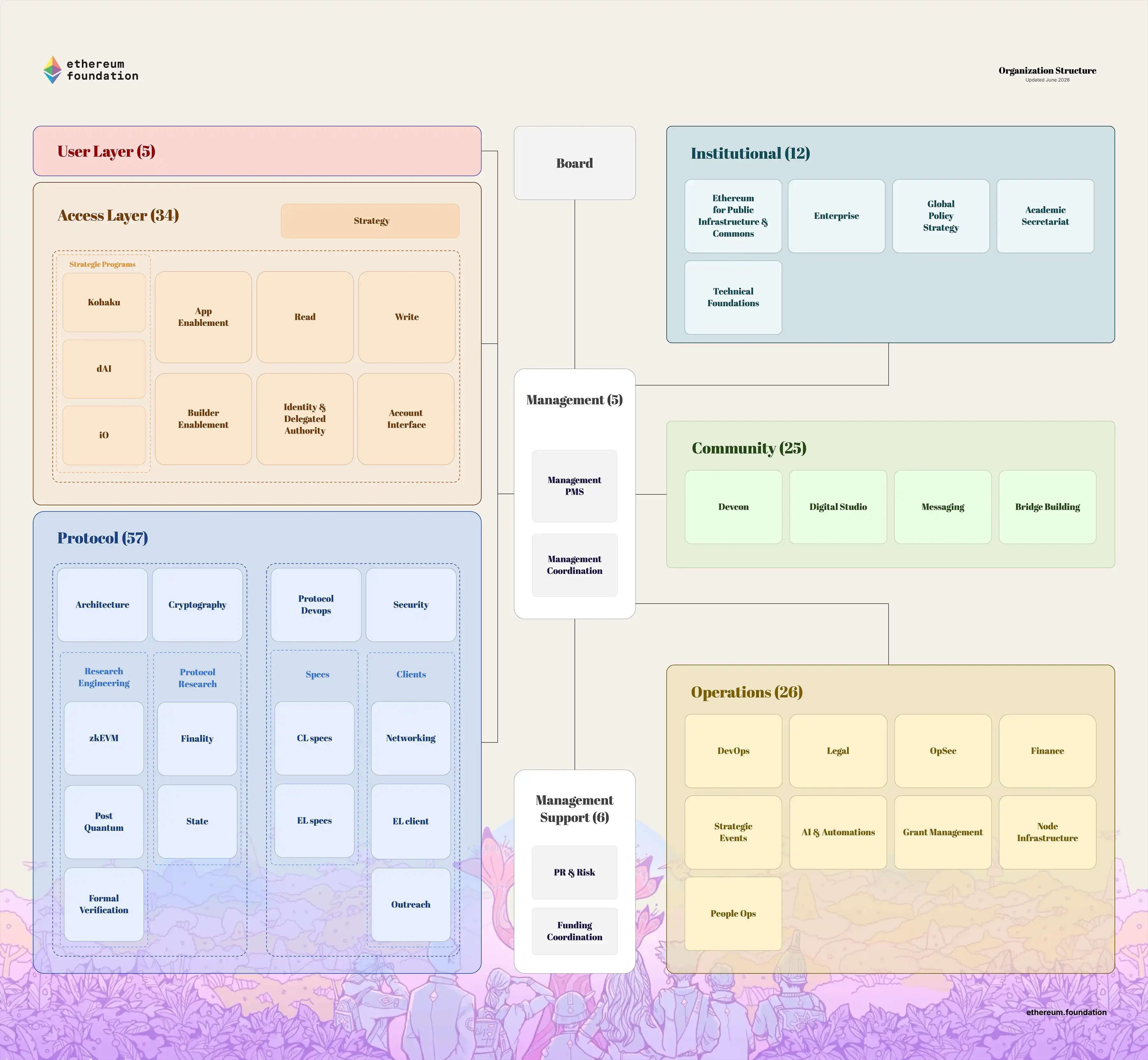
Protocol Layer

The Protocol cluster carries EF's legacy and responsibility, ensuring Ethereum delivers on its fundamental promise to scale self-sovereignty. It does this by laying the groundwork for strengthening and scaling the Ethereum protocol itself. Its goal is to ensure the Ethereum protocol continues to execute on the properties worth defending: censorship and capture resistance, openness and openness-source, and privacy and security as non-negotiable protocol guarantees.

The Protocol cluster exists to ensure the core protocol advances without compromising sovereignty guarantees. It does not exist to make Ethereum more marketable or focused on short-term interests, nor to make it easier to become another financial rail controlled by intermediaries. Its work is to make Ethereum harder to corrupt or capture, and easier to rely on when counterparties fail, platforms censor, governments overreach, or intermediaries extract rent. This means safely delivering forks, reducing unnecessary complexity, minimizing trusted dependencies, protecting transaction pipelines from harmful MEV and privileged order flow, and accelerating and translating long-term research like post-quantum security, zkEVM, and L1 privacy into protocol changes that preserve and improve sovereignty at scale.

Access Layer

The Access layer is where Ethereum serves—or fails—individuals who actually need CROPS properties. This cluster's work is to make self-sovereignty usable, understandable, and sustainable in critical operations: reading the chain, transacting, proving, delegating, and exiting. These operations must support users, and increasingly agents acting on their behalf, who must be able to read current state, history, and related data without relying on unverifiable intermediaries. They should be able to transact privately and without censorship risk, with outcomes either guaranteed or failing for free if conditions aren't met. As more work shifts to agents, users must retain control, grant limited permissions and revoke at will, and keep custody of their intent rather than exposing it to intermediaries. The interface, from silicon to front-end, must be verifiable, understandable, and recoverable, regardless of frequency of use or depth of technical knowledge.

The principle applied by this cluster is zero option: for every intermediated path, a credible, non-intermediated path must exist and remain accessible. Strategically, this means identifying where stronger CROPS properties can be applied to current infrastructure, and acknowledging that credible alternatives are necessary where economic incentives tend toward aggregation, identification, and control.

User Layer

The User Layer cluster grounds EF's work in the users and organizations with a material interest in using Ethereum self-sovereignly, and extends the tools and norms of such use as broadly as possible. It helps EF understand the most important capabilities, the most severe failure modes, and the trade-offs that are acceptable when necessary.

Its work includes user segmentation, roles, educational materials, use case studies, and impact assessments. The goal is not for EF to become a product studio, but to ensure decisions at the Protocol and Access layers are shaped by real current and potential users, real constraints, and real measures of sovereignty.

Community Layer

The Community cluster is responsible for how EF shows up in the world, both within and outside the Ethereum ecosystem. Its work is to make clear the positions EF represents, and how this differs substantively from zero-sum financial crypto, from crypto compromised by corporations, and from the mundane, status-quo-preserving, incentive-distorted, geostrategic-interest-laundering parts of non-profit grant management. EF commits to maximizing its community value by remaining independent from these and other counterproductive entanglements.

This cluster also builds EF's relationships beyond crypto. Self-sovereignty has natural allies in free and open source, security and local-first software and hardware, privacy and cryptography research and advocacy, and civil liberties, decentralized web, and public interest technology spaces. The cluster works to ensure the overlap between Ethereum and these fields is productive, non-coercive, and high-quality.

Institutional Layer

This cluster is responsible for EF's collaboration with institutions that shape how end users interact with Ethereum through institutional intermediary paths. This can include financial institutions, whether consumer payments, insurance, or others. It can include non-financial enterprises, covering manufacturing, social, publishing, and many other industries. It can include government applications. It can include universities or other non-profits.

In all cases, the goal is to prioritize creating showcase examples of Ethereum and crypto integration that maximize CROPS properties and the guarantees offered to both institutions and users—such as guaranteeing fair and correct execution, ensuring data portability and more generally practical exit capabilities, protecting all participants' privacy, proving data authenticity, better detecting or even preventing malfeasance, and so on. We believe many businesses, governments, and non-profits will realize their incentives align with serving users in ways that strengthen sovereignty, while retaining the guarantees they need to create value or fulfill their mission, and that Ethereum and crypto can be part of achieving this. Beyond direct engagements, the Institutional cluster will pursue these goals by helping establish and thoughtfully communicate best practices, standards, reference architectures, and educational materials for institutional adoption.

The Institutional cluster also works upstream with academia and allied advocacy organizations worldwide to ensure Ethereum is understood correctly in its current form and potential, and to track and respond to policy and regulatory developments that might impact Ethereum's commitment to sovereign use and its core principles of censorship (and capture) resistance, open source, privacy, and security.

Departing Personnel

As part of changing EF's structure, activities, and spending shape, we parted ways with 54 colleagues today.

These decisions were difficult but necessary. We must configure resources and organize in a way that allows us to focus for years ahead on the critical work that only EF can—and therefore must—do, without excessive distraction from short-term market fluctuations.

To ensure leavers are prepared for the transition, the package offered includes severance and transition support. Severance is the higher of one month's salary per year worked at EF or the amount specified by local regulations in the individual's jurisdiction. This matches the severance we've provided to colleagues leaving EF over recent months. Transition support includes assistance finding new contributing positions in the ecosystem and a small transition grant specifically for individual transition costs (career coaching, etc.).

We are grateful to each of them for the talent, dedication, and time they contributed to Ethereum at EF and look forward to continuing to work alongside those who find a home elsewhere in the ecosystem.

What's Next

The EF that emerges from this change is leaner and more focused. We'll share more in the coming weeks and months about how our work is changing and how the ecosystem can best engage with the new structure.


Trending Cryptos

Related Questions

QWhat is the main reason behind the Ethereum Foundation's 20% staff reduction and organizational restructuring?

AThe main reason is a strategic contraction to focus the Foundation's limited resources on critical tasks that 'only the EF can do and must do.' This involves shifting from a broad-scope approach to concentrating on the protocol layer and self-custody guarantees. The restructuring aims to ensure the EF can fulfill its core mission despite financial pressures in a bear market, reorganizing into five key clusters.

QWhat are the five new operational clusters within the restructured Ethereum Foundation?

AThe five new clusters are: 1) Protocol Layer, 2) Access Layer, 3) User Layer, 4) Community Layer, and 5) Institutional Layer. Additionally, there is an Operations cluster and a management cluster.

QAccording to the article, what is the primary mission of the Protocol Layer cluster?

AThe Protocol Layer cluster's primary mission is to ensure the Ethereum protocol fulfills its fundamental promise of scaling self-custody and upholds its core properties: censorship and capture resistance, open source, and privacy and security as non-negotiable protocol guarantees. Its work focuses on delivering safe protocol upgrades and long-term research like zkEVM and post-quantum security.

QHow is the Ethereum Foundation supporting the 54 employees who are leaving?

AThe Foundation is providing a severance package and transition support. The severance pay is the greater of one month's salary per year of service or the local statutory requirement. Transition support includes assistance finding new roles within the ecosystem and a small transition grant for expenses like career coaching.

QWhat does the 'zero-option' principle mentioned for the Access Layer cluster refer to?

AThe 'zero-option' principle means that for every intermediary-dependent path for users to interact with Ethereum, there must be a trustworthy, non-intermediated path available and accessible. This ensures users always have an option that preserves the core CROPS properties (likely related to censorship-resistance, openness, privacy, security).

Related Reads

Warsh Concludes Capitol Hill Visit! A Breakdown: What Did He Say Over These Two Days?

Walsh Concludes Capitol Hill Testimony: Key Takeaways on Independence, Inflation, and AI In his first congressional hearings as Fed Chair, Kevin Walsh faced intense scrutiny over the central bank's independence, internal reforms, and policy transparency. Over two days before House and Senate committees, lawmakers, particularly Democrats, questioned his ties to the Trump administration and recent initiatives like an AI task force led by venture capitalist Marc Andreessen. Walsh staunchly defended the Fed's independence, stating, "Trump selected an independent person to do an independent job," and vowed to ignore political pressure on interest rates. He emphasized a "zero tolerance" approach to inflation, downplaying the significance of a single favorable CPI report and signaling that rate hikes remain an option to restore price stability. He addressed criticism of the Andreessen-led AI working group by clarifying it only has an advisory role. On AI's economic impact, Walsh suggested the investment boom might not be inherently inflationary and could boost productivity and wages over time. Regarding policy, Walsh reiterated his preference to move away from detailed forward guidance, promising all decisions would be released publicly and simultaneously. He framed his internal reform efforts, including five new working groups starting "from a blank slate," as necessary because past Fed policy contributed to current inflation. The hearings ended with a mix of skepticism and a "wait-and-see" attitude from Washington. While Walsh navigated the initial challenge through hawkish rhetoric and debate skills, observers noted his credibility will ultimately depend on concrete actions to fight inflation and safeguard the Fed's autonomy.

marsbit9m ago

Warsh Concludes Capitol Hill Visit! A Breakdown: What Did He Say Over These Two Days?

marsbit9m ago

Understanding the Q2 Crypto Market in 5 Charts: RWA Booms, Fundamentals Continue to Improve

"5 Charts to Decrypt the Crypto Market in Q2: RWA Explosion and Fundamentals Rebound" In Q2 2026, the crypto market presented a complex picture. While major cryptocurrencies fell 36% in H1, underperforming most major asset classes except gold, crypto-related equities surged 23%, doubling the S&P 500's return. This highlights diverse investment opportunities within the sector, from AI-benefiting miners to Wall Street-linked tokenization platforms. Key takeaways from five crucial charts: 1. **Divergence:** A significant performance gap emerged between crypto assets and publicly traded crypto companies. 2. **Robust Fundamentals:** The top 10 crypto applications generated $5.9B in revenue over the past year, with leaders like PancakeSwap nearing $1B, demonstrating real business traction. 3. **RWA Boom:** Tokenized real-world assets (RWA) reached a record $33B, up 12% QoQ and 45% YTD, fueled by tokenized treasuries, credit, and equities. 4. **Prediction Market Growth:** Prediction market open interest hit a new high of $1.8B, with Q2 volume reaching $43B, driven largely by sports and upcoming political events. 5. **Attractive Correlations:** The Bitwise Crypto Innovators 30 Index showed low or negative 90-day rolling correlations with most major assets (like stocks, bonds, gold), offering potential diversification benefits alongside high returns. Overall, despite bearish price action, the data reveals resilient industry fundamentals with continued growth in users, revenue, and institutional adoption, laying groundwork for future cycles.

marsbit36m ago

Understanding the Q2 Crypto Market in 5 Charts: RWA Booms, Fundamentals Continue to Improve

marsbit36m ago

Bitcoin's Anti-Spam Data Soft Fork BIP110: Miner Collective Boycott, Already Doomed to Fail?

The article discusses the controversial Bitcoin Improvement Proposal (BIP) 110, a "data reduction" soft fork aimed at limiting non-monetary data, such as certain scripts, within Bitcoin transactions. Proponents argue this data violates network principles, but the author strongly disagrees. The core argument is that Bitcoin's fundamental value lies in its open-access, censorship-resistant ledger. Anyone can write data by paying fees, and attempting to police how data is interpreted externally is both impossible and contrary to Bitcoin's ethos. The author compares this to free speech and notes that Bitcoin's existing protocol limits (block size, sigops) already manage network load effectively, even spurring layer-2 innovation. Technically, BIP110 would impose significant new restrictions on script size, Taproot features, and upgradability, applying to UTXOs created within about a year of activation. Its deployment mechanism is criticized for having an unusually low 55% miner signaling threshold and a forced activation timeline, representing the most aggressive script limitations since 2010. The author finds the rationale weak, stating the "problem" it addresses is already managed, and the fork's rushed process ignores broader ecosystem consensus. Importantly, they note that users of so-called unwanted data have already adapted their software to work around the proposed rules. The conclusion is that BIP110 is destined to fail. It attempts the impossible—controlling how an open ledger is used—based on flawed reasoning and via a reckless process. The article reports that miners, developers, and the broader community have rejected it, and Bitcoin will emerge stronger by continuing its normal operation without this change.

marsbit49m ago

Bitcoin's Anti-Spam Data Soft Fork BIP110: Miner Collective Boycott, Already Doomed to Fail?

marsbit49m ago

Breaking the Offer Price! SpaceX's Stock Price Falls Below the $135 IPO Price for the First Time, Company Bonds Decline Continuously, Yield Reaches 7.5%, Comparable to Junk Bonds

SpaceX's stock price fell below its $135 IPO price for the first time, trading as low as $132.15 before closing slightly above the offering price. The stock has experienced high volatility typical of new listings, surrendering nearly all its initial 50% surge. Compounding equity pressures, the company's newly issued $25 billion bond due 2056 has also declined in price, pushing its yield to a junk-bond-like 7.5%. Analysts note investor skepticism is growing regarding the costs and distant timeline of SpaceX's xAI and large infrastructure ambitions. A significant 20% of the IPO's $75 billion raise went to retail investors, making the price decline a notable blow to market confidence. Further downside risk looms as lock-up periods for early investors expire soon, potentially triggering significant selling pressure alongside the company's first quarterly earnings report. Initial upward momentum was partly fueled by an estimated $5.4 billion in mandatory buying from index funds after SpaceX's rapid inclusion in major indices like the Nasdaq 100. Despite the current weakness, Wall Street sentiment remains broadly positive. With bank analyst quiet periods ending, over 80% of coverage initiates with a "Buy" rating, and the average price target implies roughly 78% upside from current levels.

链捕手1h ago

Breaking the Offer Price! SpaceX's Stock Price Falls Below the $135 IPO Price for the First Time, Company Bonds Decline Continuously, Yield Reaches 7.5%, Comparable to Junk Bonds

链捕手1h ago

Trading

Spot

Hot Articles

Discussions

Welcome to the HTX Community. Here, you can stay informed about the latest platform developments and gain access to professional market insights. Users' opinions on the price of ETH (ETH) are presented below.

活动图片