Ethereum Exodus Continues: Supply On Crypto Exchanges Dries Up To Years-Long Low

bitcoinistPublished on 2026-03-04Last updated on 2026-03-04

Abstract

Ethereum's supply on cryptocurrency exchanges has plummeted to a multi-year low, with only 16 million ETH remaining, down from 23 million in 2023. This significant withdrawal indicates that holders are choosing to hold or stake their assets rather than sell, despite recent price declines. This trend reduces immediate sell pressure and suggests a silent accumulation phase, potentially setting the stage for a supply shock. Concurrently, Ethereum's network activity has surged to record highs, with daily transactions nearing 3 million, driven by increased DeFi usage, stablecoin transfers, and NFT interactions. This heightened on-chain demand points to substantial utility growth and adoption, even as the price hovers around $2,000.

With the Ethereum price slowly demonstrating bullish traction after reclaiming the $2,000 mark, sentiment is turning positive once again. During this price action, investors are choosing to hold the leading altcoin rather than sell, which is indicated by a significant drop in crypto exchanges’ reserves.

Available Ethereum On Exchanges Hits New Lows

Following the bounce in Ethereum’s price, the supply of ETH sitting on cryptocurrency exchanges has experienced a sharp decline. According to the report, the number of the coin available on crypto exchanges has fallen to new lows, signaling a notable shift in market structure and sentiment.

As per the chart shared by Leon Waidmann, an optimist and the head of research at Lisk, the metric is currently sitting at a multi-year low. As coins continue to migrate from trading platforms into private wallets or long-term storage, the amount of liquid accessible for instant sale is gradually decreasing.

Currently, over 16 million ETH is left on cryptocurrency exchanges, falling from about 23 million ETH in 2023. Even though the price of ETH has declined sharply from a new all-time high, holders kept withdrawing their coins from platforms. This is considered a positive development for Ethereum as fewer ETH reserves on exchanges means less immediate sell pressure on the altcoin.
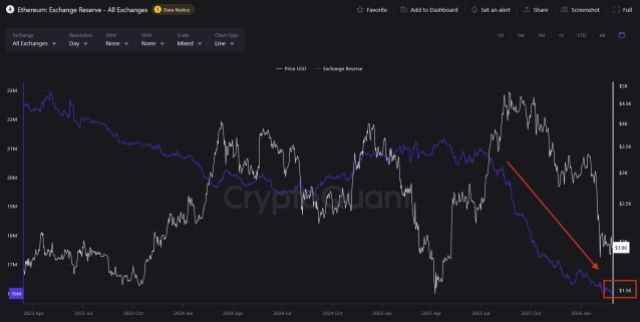
Source: Chart from Leon Waidmann on X

When reserves drop during a price crash, this is an interesting trend as it implies that holders are not panic-selling. Waidmann highlighted that these holders are deliberately moving ETH off cryptocurrency exchanges to staking contracts, cold storage, and Decentralized Finance (DeFi).

These investors are making an active choice to hold, and this is historically how supply shocks are started without a price pump. While everyone else is preoccupied with the red candles, there is a silent accumulation. The market may be scared currently, but on-chain data is telling a different story.

ETH Is Attracting A Massive Wave Of Adoption

Ethereum adoption is picking up pace at a significant rate, as evidenced by its mainnet activity. The network’s activity has spiked to unprecedented levels, with its daily transactions climbing to an all-time high despite the bear market. The milestone shows a significant rise in on-chain demand, which is fueled by increased DeFi activity, stablecoin transfers, NFT interactions, and the emergence of AI and real-world asset protocols.

Data shows that the mainnet transactions per day have surged to nearly 3 million. This is a notable number when compared to levels seen in previous cycles, especially during a bull run. Waidmann noted that the current number of daily transactions is more than the ones seen in the 2021 bull run and in the 2023 recovery.

Despite the fact that the price of ETH is down, the network is experiencing its busiest period, signaling sustained engagement beneath the surface. Record-breaking transaction counts frequently indicate increasing utility rather than being pure speculation.

ETH trading at $1,995 on the 1D chart | Source: ETHUSDT on Tradingview.com

Related Questions

QWhat is the current trend in Ethereum supply on cryptocurrency exchanges and why is it significant?

AThe supply of Ethereum on cryptocurrency exchanges has dropped to a multi-year low, with only over 16 million ETH left, down from about 23 million in 2023. This is significant because it indicates that investors are choosing to hold rather than sell, reducing immediate sell pressure and potentially signaling the start of a supply shock.

QAccording to Leon Waidmann, where are Ethereum holders moving their coins instead of keeping them on exchanges?

AAccording to Leon Waidmann, Ethereum holders are deliberately moving their ETH off exchanges to staking contracts, cold storage, and Decentralized Finance (DeFi) protocols.

QHow does the current on-chain activity on the Ethereum network compare to previous market cycles?

AThe Ethereum network is experiencing unprecedented on-chain activity, with daily transactions surging to nearly 3 million. This number is higher than the levels seen during the 2021 bull run and the 2023 recovery, indicating sustained engagement and increasing utility.

QWhat does a decrease in exchange reserves during a price crash typically suggest about investor behavior?

AA decrease in exchange reserves during a price crash suggests that investors are not panic-selling. Instead, they are actively choosing to hold and withdraw their coins to long-term storage, which is a bullish signal for the asset.

QWhat are the main factors driving the increased demand and transaction activity on the Ethereum network?

AThe increased demand and transaction activity on the Ethereum network are fueled by heightened DeFi activity, stablecoin transfers, NFT interactions, and the emergence of AI and real-world asset protocols.

Related Reads

In-Depth Report on the On-Chain Lending Market: When Off-Chain Credit Meets On-Chain Liquidation

The on-chain lending market has evolved from a peripheral DeFi niche into core financial infrastructure. As of early 2026, total value locked (TVL) in on-chain lending protocols has reached $64.3 billion, accounting for 53.54% of total DeFi TVL, making it the largest and most mature vertical within decentralized finance. Aave dominates the sector with approximately $32.9 billion in TVL, commanding nearly half of the market—a leadership position that is unlikely to be challenged in the foreseeable future. However, the path of on-chain lending forward is not without risk. Liquidation cascades, credit defaults, and cross-chain vulnerabilities remain systemic threats hanging over the industry. At the same time, a deeper structural transformation is underway: on-chain lending is shifting from a “leverage tool for crypto-native users” to a “compliant gateway for institutional capital”. The scale of RWA (Real World Asset) lending has surpassed $18.5 billion, with U.S. Treasuries and government securities increasingly serving as core collateral. Institutional capital inflows are reshaping both the user base and risk appetite of the sector. This report systematically analyzes the evolution of on-chain lending definitions, competitive dynamics, core risks, and future trends, providing a comprehensive industry outlook for investors and trade practitioners. Key findings suggest that the “one dominant player with several strong challengers” structure will persist in the short term, while fixed-rate lending, compliant collateral, and institutional credit underwriting will define the next phase of competition. For investors focused on DeFi infrastructure, three key opportunity tracks stand out, namely, the Aave ecosystem (Morpho, Spark), RWA lending protocols (Ondo, Maple) and fixed-rate innovation (Notional, Pendle).

HTX Learn1h ago

In-Depth Report on the On-Chain Lending Market: When Off-Chain Credit Meets On-Chain Liquidation

HTX Learn1h ago

Fu Peng's First Public Speech in 2026: What Exactly Are Crypto Assets? Why Did I Join the Crypto Asset Industry?

Fu Peng, a renowned macroeconomist and now Chief Economist at New火 Group, delivered his first public speech of 2026 at the Hong Kong Web3 Festival. He explained his perspective on crypto assets and why he joined the industry, framing it within the context of macroeconomic trends and financial evolution. Fu emphasized that crypto assets are transitioning from an early, belief-driven phase to a mature, institutionally integrated asset class. He drew parallels to the 1970s-80s, when technological advances (like computing) revolutionized traditional finance, leading to the rise of FICC (Fixed Income, Currencies, and Commodities). Similarly, current advancements in AI, data, and blockchain are reshaping finance, with crypto assets becoming part of a new "FICC + C" (C for Crypto) framework. He noted that institutional capital, including traditional hedge funds, avoided early crypto due to its speculative nature but are now engaging as regulatory clarity emerges (e.g., stablecoin laws, CFTC classifying crypto as a commodity). Fu predicted that 2025-2026 marks a turning point where crypto becomes a standardized, financially viable asset for diversified portfolios, akin to commodities or derivatives in traditional finance. Fu defined Bitcoin not as "digital gold" in a simplistic sense but as a value-preserving, financially tradable asset. He highlighted that crypto's future lies in regulated, institutional adoption, moving away from retail-dominated trading. His entry into crypto signals this maturation, where traditional finance integrates crypto into mainstream asset management.

marsbit2h ago

Fu Peng's First Public Speech in 2026: What Exactly Are Crypto Assets? Why Did I Join the Crypto Asset Industry?

marsbit2h ago

Justin Sun Sues Trump Family: What $75 Million Bought Was Only a Blacklist

Justin Sun, founder of Tron, has filed a lawsuit in federal court against World Liberty Financial (WLF), alleging he was made the "primary target of a fraudulent scheme" after investing $75 million. Sun claims the investment secured him an advisor title and WLFI tokens, which were later frozen by WLF, causing "hundreds of millions in losses." The dispute began in late 2024 when Sun's investment helped revive WLF's struggling token sale, which ultimately raised $550 million. Shortly after, the SEC dropped its lawsuit against Sun following Donald Trump's inauguration. However, relations soured when Sun refused WLF's demands for additional funding. In August 2025, WLF added a "blacklist" function to its smart contract, allowing it to unilaterally freeze tokens. Sun's holdings, worth approximately $107 million, were frozen, and he was threatened with token destruction. The lawsuit highlights WLF's structure, which directs 75% of token sale profits to the Trump family, who had earned $1 billion by December 2025. WLF's CEO is Zach Witkoff, son of U.S. Middle East envoy Steve Witkoff. The project faces scrutiny for opaque operations, including a controversial loan arrangement on the Dolomite platform, co-founded by a WLF advisor. Despite Sun's history with the SEC, the case underscores centralization risks within DeFi, as WLF controls governance and holds powers to freeze assets arbitrarily. Sun's tokens remain frozen as legal proceedings begin.

marsbit2h ago

Justin Sun Sues Trump Family: What $75 Million Bought Was Only a Blacklist

marsbit2h ago

Trading

Spot
Futures

Hot Articles

Discussions

Welcome to the HTX Community. Here, you can stay informed about the latest platform developments and gain access to professional market insights. Users' opinions on the price of ETH (ETH) are presented below.

活动图片