Ethereum Exchange Supply Falls To 2016 Lows – Long-Term Holding Dominates

bitcoinistPublished on 2025-12-19Last updated on 2025-12-19

Abstract

Ethereum is facing a deteriorating market sentiment with its price struggling to maintain bullish momentum, as analysts increasingly consider a transition into a broader bear market. Despite this, a significant structural shift is occurring beneath the surface: Ethereum’s Exchange Supply Ratio (ESR) has fallen to around 0.137, one of its lowest levels since 2016, indicating a declining proportion of ETH held on exchanges. This suggests reduced immediate selling pressure, as more investors move assets into long-term storage rather than keeping them available for quick liquidation. On Binance, the ESR has dropped to approximately 0.0325, reinforcing a reduction in sellable supply. Price action remains fragile, with ETH trading near $2,960 and unable to hold above the $3,200–$3,300 resistance zone. It continues to form lower highs and remains below key moving averages, indicating a loss of bullish momentum since late October. While the market shows signs of short-term equilibrium, the lack of strong buying volume and the failure to reclaim higher price levels keep the risk tilted toward further consolidation or a deeper correction. The combination of falling exchange supply and stable pricing points to a phase of liquidity absorption and strategic repositioning among market participants.

Ethereum is increasingly struggling to maintain a convincing bullish narrative as market sentiment continues to deteriorate. Price action remains fragile, and a growing number of analysts are openly discussing the possibility that Ethereum is transitioning into a broader bear market phase.

Repeated failures to sustain upside momentum have weakened confidence, while risk appetite across the crypto market continues to fade. As volatility persists and capital rotates defensively, ETH finds itself at the center of a debate between structural weakness in price and resilience beneath the surface.

According to a recent CryptoQuant report, Ethereum’s current state reflects a notable shift in supply behavior across exchanges. The Exchange Supply Ratio (ESR), which tracks the proportion of ETH held on centralized trading platforms, has been steadily declining across all major exchanges.

This trend signals that a smaller share of the circulating supply is readily available for immediate sale, a critical factor when evaluating supply-and-demand dynamics.

Historically, declining exchange balances suggest reduced selling pressure, as investors move assets into self-custody or long-term storage rather than preparing to liquidate. In the current environment, this structural change adds nuance to the bearish narrative.

Exchange Supply Declines Signal Structural Shift

The report highlights a pronounced decline in Ethereum’s Exchange Supply Ratio (ESR), reinforcing the view that supply dynamics are quietly shifting beneath the surface. Across all platforms, the ESR has fallen to approximately 0.137, one of its lowest readings since 2016.
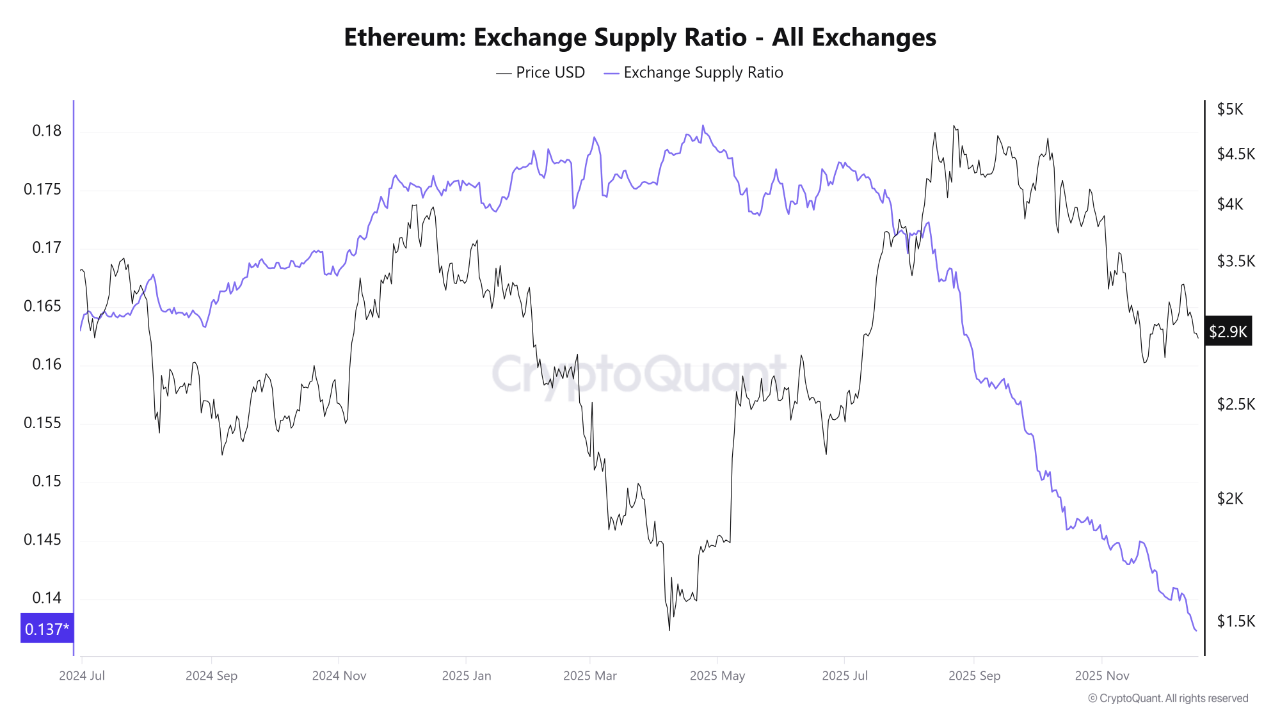
Ethereum Exchange Supply Ratio | Source: CryptoQuant

This sustained drop reflects a steady outflow of ETH from exchanges into external wallets, signaling a reduced inclination toward immediate selling and a growing preference for long-term holding. Historically, similar patterns have emerged during re-accumulation phases or in transitional periods that follow extended volatility, often preceding more stable price behavior.

The trend is even more evident on Binance, where the ESR has declined to roughly 0.0325. As the exchange with the deepest liquidity, Binance’s balances serve as a key barometer for short-term supply conditions. The ongoing withdrawal of ETH from its wallets suggests a meaningful reduction in spot-side sellable supply, pointing to increased trader caution rather than aggressive distribution.

At the same time, Ethereum is trading near $2,960, a mid-range level that reflects a temporary equilibrium between buyers and sellers. The combination of falling exchange supply and relatively stable pricing indicates that the market is not under heavy selling pressure.

Instead, it appears to be entering a phase of liquidity absorption and strategic repositioning, where participants reduce exposure to short-term trades while preparing for a potential shift in market structure.

Ethereum Price Struggles Below Key Trend Levels

The daily ETH chart highlights a market that remains structurally fragile despite short-term stabilization. After failing to hold above the $3,200–$3,300 region, Ethereum has continued to print lower highs, confirming a loss of bullish momentum since late October. Price is currently trading around the $2,850–$2,900 area, a zone that has acted as a short-term demand pocket but lacks strong follow-through from buyers.
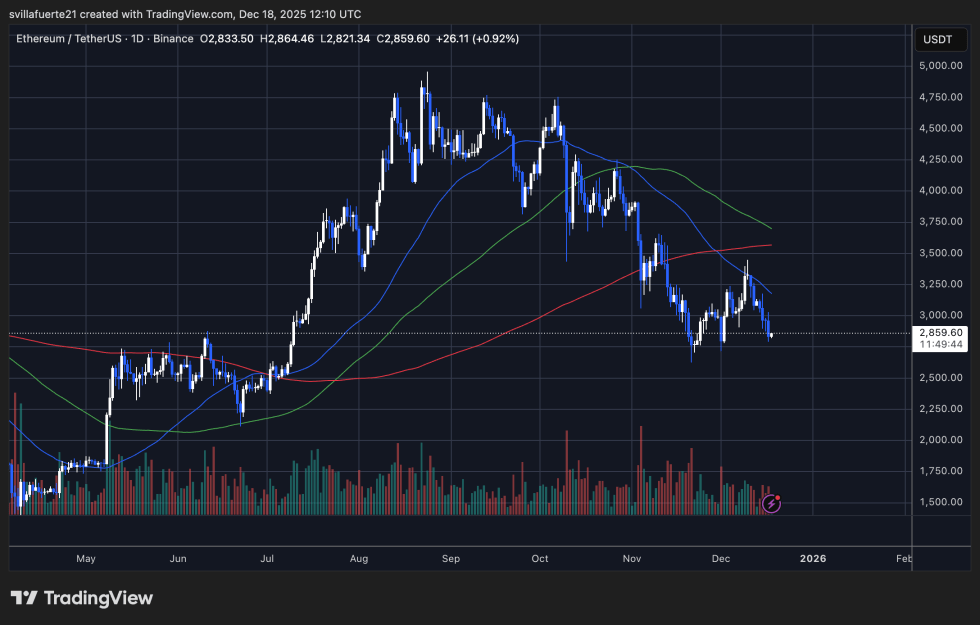
ETH consolidates around a key level | Source: ETHUSDT chart on TradingView

From a trend perspective, ETH remains below its short- and medium-term moving averages. The 50-day moving average has rolled over and is now acting as dynamic resistance, while the 100-day moving average is also trending lower.

The 200-day moving average sits higher, reinforcing the idea that Ethereum has shifted from a trending market into a corrective or distribution phase. As long as price remains capped below these levels, rallies are likely to be sold into rather than extended.

Volume dynamics reinforce this view. Recent rebounds have occurred on relatively muted volume compared to the heavy selling seen during prior breakdowns, suggesting reactive short covering rather than fresh demand.

Structurally, ETH needs to reclaim and hold above the $3,100–$3,200 range to rebuild a bullish case. Failure to do so keeps the risk tilted toward continued consolidation or a deeper corrective leg toward lower support levels.

Featured image from ChatGPT, chart from TradingView.com

Related Questions

QWhat does the decline in Ethereum's Exchange Supply Ratio (ESR) indicate about investor behavior?

AThe decline in Ethereum's Exchange Supply Ratio (ESR) indicates that investors are moving ETH off exchanges into self-custody or long-term storage, signaling reduced selling pressure and a preference for long-term holding rather than immediate liquidation.

QWhat is the current level of Ethereum's Exchange Supply Ratio (ESR) and why is it significant?

AEthereum's Exchange Supply Ratio (ESR) has fallen to approximately 0.137, one of its lowest readings since 2016. This is significant because it shows a structural shift in supply dynamics with a reduced amount of ETH available for immediate sale on exchanges.

QHow is the price of Ethereum performing in relation to its key moving averages?

AEthereum's price is trading below its short- and medium-term moving averages. The 50-day moving average is acting as dynamic resistance and has rolled over, while the 100-day and 200-day moving averages are also trending lower, indicating a corrective or distribution phase.

QWhat price level does Ethereum need to reclaim to rebuild a bullish case according to the article?

AAccording to the article, Ethereum needs to reclaim and hold above the $3,100–$3,200 price range to rebuild a bullish case and signal a potential shift in market structure.

QWhat does the declining ESR on Binance specifically suggest about market conditions?

AThe declining ESR on Binance, which has fallen to roughly 0.0325, suggests a meaningful reduction in spot-side sellable supply. As the exchange with the deepest liquidity, this points to increased trader caution and a reduction in aggressive selling rather than distribution.

Related Reads

Musk Posted a Recruitment Ad for SpaceX, and After Reading the Comments Section, I Understood

On May 20th, SpaceX filed for a landmark IPO with a $1.75 trillion valuation. Shortly after, Elon Musk posted a recruitment call on X, seeking "world-class engineers and physicists" for SpaceX. The application process was starkly simple: email with three bullet points proving "exceptional ability," with real, complex projects as a plus. Musk promised to review qualifying emails himself. The post garnered millions of views and thousands of replies, revealing a spectrum of responses. Most comments, including a highly-upvoted humorous one listing absurd "skills," merely listed credentials or experiences in a conventional, non-differentiating way. This highlighted a key insight: a traditional resume listing degrees and skills often fails to demonstrate true exceptionalism. Effective self-presentation requires "performance efficiency." A standout reply came from an OpenAI engineering lead, who simply stated "codex." This demonstrated that for those who have built significant, recognized products, the product itself becomes the ultimate resume. The article argues that in the AI era, any tangible, shareable output—a tool, research, or online project—serves as a living, self-evident credential more powerful than a list of attributes. However, a twist emerged when applicants found the provided email address non-functional, leading to speculation that the post might also serve as an IPO publicity stunt, projecting an image of aggressive talent acquisition to investors. Ultimately, the episode served as a microcosm: some participate through performance, others through proof of work, while some question the reality of the stage itself. It underscores the enduring challenge of defining and demonstrating value in an age of abundant, yet often superficial, content.

marsbit50m ago

Musk Posted a Recruitment Ad for SpaceX, and After Reading the Comments Section, I Understood

marsbit50m ago

Cutting Off OpenAI, Anthropic Acquires the Tool Provider Used by a Quarter of Global Developers

Anthropic has acquired Stainless, a developer tool company that automatically generated official SDKs (Software Development Kits) for AI giants including OpenAI, Anthropic, Meta, and Cloudflare. The deal, reportedly valued at around $300 million, marks a strategic shift for Anthropic as it builds its "AI agent" infrastructure. Stainless acted as a "translator," converting complex API specifications into ready-to-use code libraries for developers. Its tools indirectly reached about a quarter of professional software developers globally. Following the acquisition, Stainless will shut down its public products and its team will join Anthropic to focus on internal platform development, notably for the Claude Platform. Existing SDKs remain with their respective client companies but will no longer receive updates from Stainless. This move is part of Anthropic's broader 18-month strategy to assemble a complete "agent stack." The stack consists of the Claude model at its core, the newly acquired Stainless for standardized API interfaces, and the Model Context Protocol (MCP), an open standard for connecting agents to external tools and data. This contrasts with OpenAI's focus on model generations and consumer-scale compute. Anthropic believes an agent's ultimate utility depends on its ability to connect to external systems. By internalizing the SDK layer and promoting MCP as a connection standard, Anthropic aims to lock in long-term ecosystem advantages and create path dependency, moving beyond the transient lead provided by any single model generation.

marsbit52m ago

Cutting Off OpenAI, Anthropic Acquires the Tool Provider Used by a Quarter of Global Developers

marsbit52m ago

Bankless Founder Sells Off ETH, Collective Collapse of Ethereum Faith

Ethereum faces a "crisis of faith" as David Hoffman, co-founder of the prominent pro-Ethereum media outlet Bankless, announces he has sold all his ETH. This move, coupled with reports of major layoffs at Bankless, signals a potential retreat of Ethereum's staunchest supporters. Hoffman and co-founder Ryan Sean Adams confirm Bankless is entering a "second era," with Adams stepping back and Hoffman exploring new frontiers. Hoffman sharply criticizes the Ethereum Foundation, stating that ETH's poor price performance cannot be separated from its leadership. He has a history of public dissatisfaction, citing the Foundation's failure to drive market growth and its "endless manifestos." His frustration coincides with ETH/BTC hitting multi-month lows and a significant exodus of senior researchers and executives from the Ethereum Foundation, partly attributed to controversial "loyalty oaths." The article contrasts Ethereum's current predicament—with its Layer-2 narrative discredited and ecosystem stagnant—against what should have been a highlight year in 2026 amid tokenization trends. While a previous surge to near $5,000 was driven by corporate buybacks (DAT热潮), ETH has since fallen over 50%. The core question remains: with fading faith and intense competition, what is Ethereum's next solution? Hoffman's divestment symbolizes a growing disconnect between the community and the ecosystem's direction.

Odaily星球日报1h ago

Bankless Founder Sells Off ETH, Collective Collapse of Ethereum Faith

Odaily星球日报1h ago

Trading

Spot
Futures

Hot Articles

Discussions

Welcome to the HTX Community. Here, you can stay informed about the latest platform developments and gain access to professional market insights. Users' opinions on the price of ETH (ETH) are presented below.

活动图片