Ethereum Exchange Deposits Hit A Six-Month High: Panic Selling Or Structural Reset?

bitcoinistPublished on 2026-02-26Last updated on 2026-02-26

Abstract

Ethereum is experiencing sustained selling pressure amid a broader shift toward caution and panic in crypto markets. A key on-chain metric shows the number of unique deposit addresses to Binance surged to a six-month high, rising from 360,000 to over 450,000. This often signals potential selling intent, as assets moved to exchanges are easier to liquidate. However, such spikes can also reflect hedging, margin replenishment, or derivatives activity rather than outright selling. The increase coincides with a sharp price decline from October's peak near $4,900 to around $1,900. This may indicate retail capitulation or traders adding collateral to avoid liquidations. While elevated deposits raise near-term volatility and selling risk, such spikes have historically occurred near market bottoms. Technically, ETH is testing key support near $1,900 and the 200-week moving average—a level critical for medium-term direction. The market remains fragile, with resistance overhead and volume patterns suggesting distribution rather than accumulation. A breakdown below support could lead to further declines, while stabilization may signal accumulation. Confirmation of a reversal requires reclaiming resistance levels and improved market participation.

Ethereum continues to face sustained selling pressure as broader crypto market sentiment shifts toward caution and, in some segments, outright panic. Price action has struggled to regain stability in recent weeks, with repeated rebound attempts failing to produce sustained upside momentum. Elevated volatility, tightening liquidity conditions, and persistent macro uncertainty have reinforced a defensive posture among both retail and institutional participants, leaving Ethereum vulnerable to further short-term weakness.

A recent CryptoQuant report provides additional context through on-chain activity. According to the data, the ETH Binance User Deposit Address metric has recorded a sharp increase. The number of unique addresses depositing Ethereum to Binance has surged from roughly 360,000 to more than 450,000, representing the highest level observed since August 2025. Metrics tracking deposit addresses often serve as a proxy for potential sell-side intent, since assets transferred to exchanges are typically more accessible for liquidation, collateral usage, or portfolio rebalancing.

However, such spikes do not automatically translate into immediate selling. In some cases, they reflect positioning adjustments, hedging activity, or preparation for derivatives trading. Even so, the scale of the recent increase suggests heightened market anxiety and warrants close monitoring as Ethereum navigates an increasingly fragile market environment.

Exchange Deposits Surge As Price Correction Deepens

The report highlights that this metric breakout has occurred alongside a severe price correction. Ethereum has declined sharply from its October peak near $4,900 to roughly the $1,900 region. The simultaneous drop in price and surge in exchange deposit addresses suggests two primary on-chain interpretations that merit careful consideration.
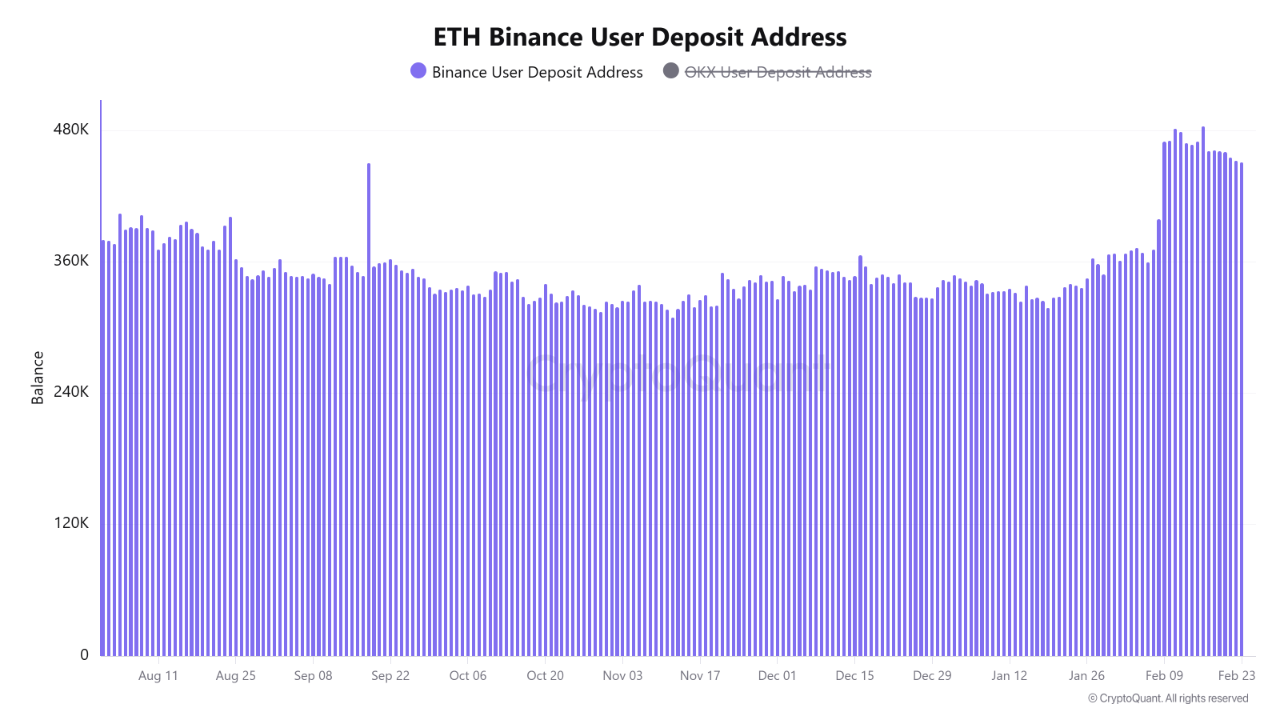
Ethereum Binance User Deposit Address | Source: CryptoQuant

The first scenario points to retail capitulation. A rapid increase in unique depositing addresses often reflects panic behavior among smaller investors. Participants who held through earlier stages of the decline may now be transferring assets to exchanges to exit positions, reinforcing short-term sell-side pressure.

The second interpretation relates to derivatives market positioning. With ETH trading below the $2,000 threshold, some deposits likely represent collateral replenishment. Traders facing liquidation risk may be adding margin to maintain leveraged long positions rather than outright selling their holdings.

In the near term, increased deposits elevate potential supply on exchanges, which can intensify volatility if selling materializes. However, historically, extreme spikes in deposit activity have frequently appeared during late-stage corrective phases. Such conditions sometimes precede seller exhaustion.

Monitoring exchange outflows, spot volume absorption, and derivatives positioning will be critical to determine whether this activity signals continued downside risk or the early formation of a local market bottom.

Ethereum Tests Structural Support As Downtrend Persists

Ethereum continues to trade under sustained pressure, with the weekly chart showing a clear loss of bullish momentum following the rejection near the $4,800–$5,000 region. Price has now retraced toward the $1,900 area, a zone that previously acted as consolidation support during earlier cycle phases. The inability to hold above the mid-cycle moving averages suggests that sellers still maintain structural control.
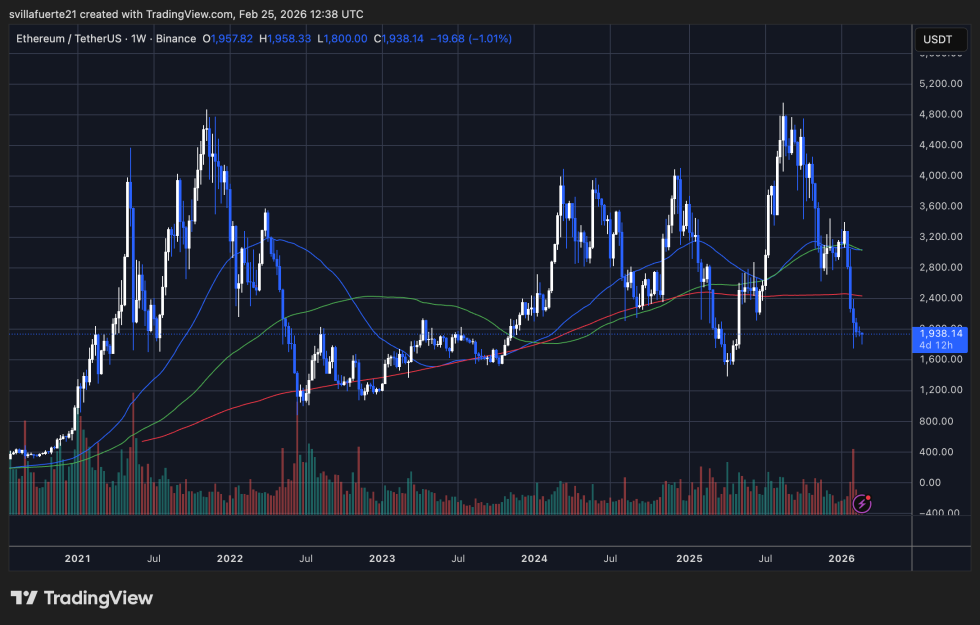
ETH testing critical price level | Source: ETHUSDT chart on TradingView

The 50-week moving average has rolled over and now acts as overhead resistance, while the 100-week average appears to be flattening. Meanwhile, price is approaching the longer-term 200-week moving average, a level historically associated with major cyclical support. A decisive breakdown below this region could expose deeper downside, whereas stabilization here may encourage medium-term accumulation.

Volume patterns indicate intermittent spikes during declines, which typically reflect distribution rather than sustained buying interest. This reinforces the interpretation of a defensive market phase rather than a confirmed recovery trend.

Despite the weakness, volatility compression near long-term averages sometimes precedes transitional periods. Confirmation, however, would require sustained closes above reclaimable resistance levels and improving participation metrics. Until then, Ethereum remains in a fragile technical posture with risk skewed toward continued consolidation or downside drift rather than immediate bullish continuation.

Featured image from ChatGPT, chart from TradingView.com

Trending Cryptos

Related Questions

QWhat does the sharp increase in Ethereum Binance User Deposit Addresses suggest about market sentiment?

AThe sharp increase in Ethereum Binance User Deposit Addresses, which surged from roughly 360,000 to over 450,000, suggests heightened market anxiety and potential sell-side intent, as assets moved to exchanges are often more accessible for liquidation or portfolio rebalancing.

QWhat are the two primary on-chain interpretations for the simultaneous drop in Ethereum's price and surge in exchange deposits?

AThe two primary interpretations are: 1) Retail capitulation, where smaller investors panic and transfer assets to exchanges to exit positions, and 2) Derivatives market positioning, where traders deposit ETH as collateral to maintain leveraged long positions amid liquidation risks.

QWhat critical support level is Ethereum approaching on the weekly chart, and why is it significant?

AEthereum is approaching the 200-week moving average, a level historically associated with major cyclical support. A breakdown below this could expose deeper downside, while stabilization here might encourage medium-term accumulation.

QHow do volume patterns during Ethereum's decline reinforce the current market phase?

AVolume patterns show intermittent spikes during declines, which typically reflect distribution rather than sustained buying interest, reinforcing the interpretation of a defensive market phase rather than a confirmed recovery trend.

QWhat factors will be critical to determine whether the increased deposit activity signals continued downside risk or a potential market bottom?

AMonitoring exchange outflows, spot volume absorption, and derivatives positioning will be critical to determine if this activity signals continued downside risk or the early formation of a local market bottom.

Related Reads

The Verdict in Choi Tae-won's Divorce Case: Revealing the Inheritance Undercurrent Behind SK Hynix's Trillion-Won Empire

SK Group Chairman Chey Tae-won's high-profile divorce case, involving a record 1.38 trillion won settlement, has drawn attention to the succession plans for Korea's second-largest conglomerate, especially its crown jewel, SK hynix. Unlike traditional chaebol scripts centered on the eldest son, Chey's three children from his marriage to former President Roh Tae-woo's daughter, Roh Soh-yeong, are carving distinct, non-traditional paths. Eldest daughter Chey Yun-jung (b. 1989) is seen as the most evident successor. With a scientific and consulting background, she holds executive roles at SK bioscience and SK Inc.'s growth support department, focusing on future strategy and biopharma. Her marriage is to an AI infrastructure entrepreneur, not a traditional business alliance. Second daughter Chey Min-jung (b. 1991) took a unique route, voluntarily serving as a South Korean naval officer, including an anti-piracy deployment. She later worked on policy and strategy for SK hynix in Washington D.C. before co-founding an AI-driven healthcare startup. She married a former U.S. Marine Corps officer, connecting her to U.S. defense and policy circles—networks crucial for a global semiconductor giant. The only son, Chey In-geun (b. 1995), who studied physics like his father, worked briefly at SK E&S before joining McKinsey. Despite fitting the traditional "heir" profile as the eldest son, he remains silent and holds no public position or shares in SK, suggesting the old succession playbook is obsolete. As SK hynix's valuation soars, becoming a geopolitical asset in the AI era, the heirs' legitimacy is no longer automatic. They must prove themselves in fields like AI biotech, global policy, and strategic consulting. Their marriages also reflect new elite networks in tech and defense, not old political alliances. Their inheritance is the complex challenge of navigating a globalized, tech-driven world, not just a corporate throne.

marsbitYesterday 09:06

The Verdict in Choi Tae-won's Divorce Case: Revealing the Inheritance Undercurrent Behind SK Hynix's Trillion-Won Empire

marsbitYesterday 09:06

From OpenSea to OpenRouter: Is Alex Atallah Repeating His 'Exit at the Peak' Playbook?

From OpenSea to OpenRouter: Is Alex Atallah Repeating His "Exit at the Peak" Playbook? According to the Wall Street Journal, payments giant Stripe is in talks to acquire the AI model aggregation platform OpenRouter in a potential deal valuing the company near $100 billion. This would mark founder Alex Atallah's second creation of a company reaching a $100 billion valuation, following his co-founding of NFT marketplace OpenSea. OpenRouter, founded just over three years ago, has grown rapidly by acting as a unified gateway for developers to access over 400 AI models. It currently has about 10 million users and processes over 200 trillion tokens monthly. While the platform's annualized revenue is around $50 million, its valuation has skyrocketed from $1.3 billion in March 2026. The potential acquisition by Stripe, a company OpenRouter's founder once likened it to, represents a major expansion into AI infrastructure for the payments leader. This move echoes Atallah's previous timing with OpenSea, where he departed before the NFT market's significant downturn. For OpenRouter, selling now may be strategic. Despite its scale, its business model—charging a 5-5.5% fee on AI inference calls—faces pressure from competition, open-source models, and potential price wars among model providers, limiting its profitability narrative for an IPO. A key asset for potential acquirers like Stripe is OpenRouter's vast repository of real-world AI usage data, which offers unique insights into model performance and developer preferences that are difficult to replicate. Whether this potential deal signifies a new valuation benchmark for AI infrastructure or another market peak signal remains to be seen.

链捕手Yesterday 08:42

From OpenSea to OpenRouter: Is Alex Atallah Repeating His 'Exit at the Peak' Playbook?

链捕手Yesterday 08:42

Trading

Spot

Hot Articles

Discussions

Welcome to the HTX Community. Here, you can stay informed about the latest platform developments and gain access to professional market insights. Users' opinions on the price of ETH (ETH) are presented below.

活动图片
















