Ethereum (ETH) Faces Crosscurrents as Scalability Upgrades Clash With Whale Selling Pressure

bitcoinistPublished on 2026-01-08Last updated on 2026-01-08

Abstract

Ethereum (ETH) is experiencing a clash between positive structural developments and market headwinds. While developers are advancing scalability upgrades, such as increasing the blob limit to enhance network capacity and reduce fees, large holders are selling significant amounts of ETH, creating near-term downward pressure. Over 300,000 ETH was sold by whales in a short period, despite growing institutional staking activity that continues to lock supply and reduce exchange reserves. These opposing forces are shaping ETH’s outlook as it trades above $3,200, with the market assessing whether demand can outweigh the selling pressure amid ongoing protocol improvements.

The Ethereum (ETH) ecosystem is facing a mix of structural progress and market uncertainty. On one side, developers are pushing forward with a series of scalability upgrades aimed at lowering fees and expanding capacity across the network.

Related Reading: South Korea Explores Crypto Account Freezing Measure To Prevent Market Manipulation

On the other hand, large holders are using recent price strength to reduce exposure, introducing short-term selling pressure. Together, these opposing forces are building Ethereum’s near-term outlook as ETH trades above the $3,200 level.

The contrast is clear, while the protocol is absorbing more capital through staking and infrastructure improvements, parts of the market are testing how much supply and demand can absorb during a renewed rally.
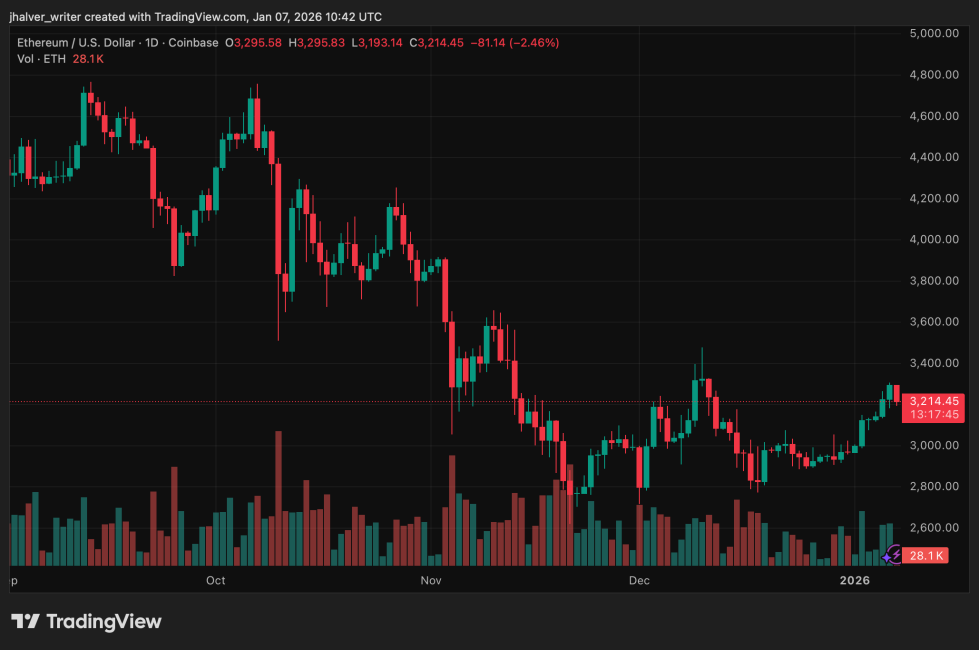
ETH's price moving sideways on the daily chart. Source: ETHUSD on Tradingview

Scalability Roadmap Moves Forward

Ethereum developers activated the second Blob Parameter-Only (BPO) hard fork this week, raising the blob limit from 15 to 21 and increasing the blob target from 10 to 14.

Blobs are temporary data containers used primarily by rollups to batch transactions more efficiently. With each blob holding 128 kilobytes, the network can now process roughly 2.6 megabytes of blob data per block.

The upgrade is part of a broader effort to scale Ethereum through layer-2 networks rather than pushing all activity onto the main chain. Since the first BPO fork in December, transaction fees on Ethereum have shown reduced volatility, reflecting lower congestion as rollups move data off-chain.

Developers are already discussing additional changes, including raising the gas limit from 60 million to 80 million, and later up to 200 million under the planned Glamsterdam hard fork in 2026. That upgrade is expected to introduce parallel transaction processing, further increasing throughput.

Ethereum’s (ETH) Staking Growth Tightens Liquid Supply

At the same time, staking activity is reshaping Ethereum’s supply dynamics. Institutional participation has increased, highlighted by BitMine’s latest deposits, which pushed its total staked ETH close to 780,000 tokens, worth over $2.5 billion.

Network-wide data indicates that more than 1.3 million ETH are waiting to enter staking, while the validator exit queue has dropped to zero. This imbalance suggests that fewer validators are choosing to exit, even amid market volatility.

As more ETH is locked into consensus contracts, circulating supply on exchanges continues to decline, potentially limiting downside pressure over the medium term.

Whale Selling Adds Near-Term Pressure

Despite these fundamentals, large holders have recently turned into net sellers. Whale wallets holding between 100,000 and 1 million ETH sold roughly 300,000 ETH over three days, valued at about $970 million.

This selling coincided with ETH’s breakout from a multi-week descending wedge, indicating that some whales are using the rally to take profits.

Related Reading: Scudo Announced: Tether’s Newest Crypto And Gold Unit – Here’s The Breakdown

While long-term holders remain largely inactive, helping to stabilize the broader structure, continued distribution by whales could slow upside momentum. Ethereum now sits at a crossroads, balancing protocol-level progress against market-driven supply pressure as traders assess whether demand can sustain the next leg higher.

Cover image from ChatGPT, ETHUSD chart from Tradingview

Trending Cryptos

Related Reads

Podcast Notes | Conversation with GSR Asset Management Head: To Determine if This Crypto Rally is Real, Just Watch the Lending Rates on Aave

Podcast Summary: Dialogue with GSR's Head of Asset Management: To Determine if This Crypto Rally is Real, Just Check Lending Rates on Aave Andy Baehr, Managing Director of Asset Management at GSR, discusses the current crypto market, characterizing it as stuck in a state of "ambivalence" with short-lived, unsustainable rallies. He outlines a simple framework: the market moves between "ambivalence" and "conviction" (sustained upward momentum). Currently, every rally resembles a single-stage rocket booster that quickly fizzles out. Baehr identifies three key signals to watch: 1) DeFi lending rates, 2) the potential passage of the CLARITY Act, and 3) the market forming a consensus on the "Fed hawkish peak." He emphasizes that the most immediate indicator for the sustainability of the recent CPI-triggered rally is the USDC borrowing rate on Aave, currently around 3.75%—close to U.S. Treasury yields. The absence of a credit spread indicates low leverage demand and a lack of market energy. He explains that a healthy, sustained rally requires layered buying pressure. Last year's rally progressed from an ETH short squeeze to crypto-native trader influx and finally to ETF inflows. Currently, this structure is missing. Other potential structural buyers like Digital Asset Treasury (DAT) companies are absent, and ETF flows have proven transient. Baehr notes that while small-cap crypto tokens outperformed large caps in Q2—a potential sign of capitation in major assets—capital is also flowing to more exciting opportunities like AI stocks and tech IPOs, leaving crypto sidelined. Regarding DeFi, he highlights that platforms like Aave provide a clear, real-time signal of leverage demand through their supply/demand-driven interest rates. A significant, sustained rate increase would signal genuine market conviction. He also observes the quiet emergence of fixed-income-like products and vaults in DeFi. On regulation, the probability of the CLARITY Act passing before the August 7th deadline has dropped linearly from 75% to below 40% on Polymarket. Baehr suggests its passage would be treated as a bullish surprise, a potent driver for price movement. However, political hurdles, including ethical clause debates and disclosures about the First Family's crypto profits, remain significant obstacles. Ultimately, the market awaits clarity on the Fed's terminal rate under Chair Warsh. Until the "Fed Solstice"—the point where the market collectively understands the peak of hawkish policy—sustained conviction will be difficult to achieve.

marsbit5m ago

Podcast Notes | Conversation with GSR Asset Management Head: To Determine if This Crypto Rally is Real, Just Watch the Lending Rates on Aave

marsbit5m ago

7 Months After the Collapse of Huiwang, Southeast Asia's Escrow Platforms Undergo a Major Reshuffle

Following the collapse of Huione Pay—dubbed the "Alipay of Southeast Asia"—seven months ago, the region's underground financial guarantee platform sector is undergoing a significant reshuffle. This power vacuum has been swiftly filled by emerging platforms such as XinBi, Tiger/Navigator, JinBei (renamed JinBo), Dali/Tiancheng, and FullyLight. These platforms, operating largely via Telegram and offering services like escrow for illicit transactions, have absorbed the vast user base and markets left behind by Huione. While positioning themselves as "trust intermediaries," their primary clientele consists of networks involved in online scams, money laundering, illegal gambling, and even human trafficking. For instance, the Tiger/Navigator platform explicitly provides "escrow" services for kidnapping-for-ransom operations ("强押车交易"). Data underscores the immense scale: Huione alone processed over $103 billion in cryptocurrency payments and facilitated over $31 billion through its escrow market before its downfall, linking it to Cambodia's notorious Prince Group. Since its collapse, competitors have seen explosive growth. For example, the XinBi platform has accumulated over $1.6 billion in total USDT revenue, while platforms like NewPay, OkPay (under Dali), and FullyLight Wallet collectively processed over $4.8 billion in USDT in a single year. This ecosystem thrives in regions like Cambodia and Myanmar, where regulatory gaps allow these platforms to act as critical financial infrastructure for sprawling cybercrime industries, from scam compounds to online casinos. The article concludes that the moniker "Southeast Asian Alipay" is a misnomer, obscuring the platforms' fundamental role in enabling serious criminal enterprises rather than representing legitimate financial innovation.

Odaily星球日报1h ago

7 Months After the Collapse of Huiwang, Southeast Asia's Escrow Platforms Undergo a Major Reshuffle

Odaily星球日报1h ago

The Changing Landscape: What Are Crypto VCs Experiencing?

Title: The Shifting Landscape of Crypto Venture Capital The era of dedicated crypto venture capital funds is undergoing a significant transformation. Once essential for navigating the sector's complexity and high risk, these specialized funds are now facing an identity crisis as the market matures. This shift mirrors historical patterns in other specialized investment classes like cleantech and SPACs, where initial information advantages dissipate as technologies become mainstream and integrated into existing industry frameworks. The article argues that crypto is reaching a critical inflection point, transitioning from a "building phase" to an "integration phase." Major players like Stripe, BlackRock, and Visa now engage with crypto not for its novel mechanics but as a foundational financial infrastructure. Their needs—regulatory compliance, banking partnerships, distribution channels—align with traditional fintech, a domain easily understood by large, generalist funds like Sequoia and Founders Fund. This evolution creates a "barbell effect" within the VC landscape. On one end are massive, diversified platforms that can incorporate crypto as one vertical among many. On the other are small, nimble funds focused on niche, experimental projects. The middle ground—medium-sized dedicated crypto funds—is being squeezed out. Their typical fund size makes it impossible to generate sufficient returns solely from early-stage crypto bets, yet they cannot compete with giants for later-stage deals. Consequently, leading crypto-native firms like Paradigm and Framework Ventures are expanding into AI, robotics, and other sectors, driven partly by LP pressure for better returns amid a broader VC DPI crisis. Others, like Dragonfly and a16z, have narrowed their crypto focus predominantly to financial infrastructure like stablecoins, reframing the sector's core narrative. For crypto entrepreneurs, this consolidation presents challenges. While generalist funds offer larger checks and broader resources, crypto projects now compete fiercely with AI for attention and capital within these firms. Furthermore, the long-term, non-commercial foundational work that built the ecosystem—funded by dedicated crypto VCs—is less likely to attract generalist capital focused on direct returns. The conclusion is that "crypto investor" as a standalone category is becoming obsolete, akin to "internet investor." Crypto is becoming a baseline infrastructure layer. The future will see a barbell structure: large-scale growth financing handled by generalist funds, while pioneering, speculative projects are funded by small, specialized vehicles. The dedicated crypto funds of the 2017-2021 boom, which incubated core infrastructure, are giving way to this new, bifurcated reality.

Foresight News1h ago

The Changing Landscape: What Are Crypto VCs Experiencing?

Foresight News1h ago

Trading

Spot

Hot Articles

Discussions

Welcome to the HTX Community. Here, you can stay informed about the latest platform developments and gain access to professional market insights. Users' opinions on the price of ETH (ETH) are presented below.

活动图片















