Ethereum Drops After Vitalik Buterin Sells Again: Is History Repeating?

bitcoinistPublished on 2026-02-23Last updated on 2026-02-23

Abstract

Ethereum's price declined over 5% in two days, dropping from $1,988 to $1,875, as on-chain trackers identified renewed selling activity from wallets associated with co-founder Vitalik Buterin. According to Lookonchain, Buterin sold 1,869 ETH (worth approximately $3.67 million) during this period. This has drawn comparisons to a previous instance where his reported sale of 6,958 ETH was followed by a significant market drop. The activity appears intentional, with ETH being withdrawn from Aave before being sold, suggesting active distribution rather than simple wallet management. While causation isn't proven, such founder-linked selling often impacts trader sentiment and market flows. At the time of reporting, Ethereum was trading at $1,884.

Ethereum slipped over the past two days as on-chain trackers flagged another burst of selling tied to Vitalik Buterin’s wallets, reviving a familiar narrative for traders: founder-linked distribution showing up alongside spot weakness.

Ethereum Pullback Coincides With Fresh Vitalik Sales

Lookonchain said Buterin has sold 1,869 ETH (about $3.67 million) over the past two days, a window in which ETH fell from $1,988 to $1,875, a 5.7% drawdown based on the figures cited in the post. The account framed the move as an acceleration: “vitalik.eth(@VitalikButerin) is selling ETH faster again. In the past 2 days, he has sold 1,869 ETH($3.67M). During that time, ETH fell from $1,988 to $1,875, down 5.7%.”
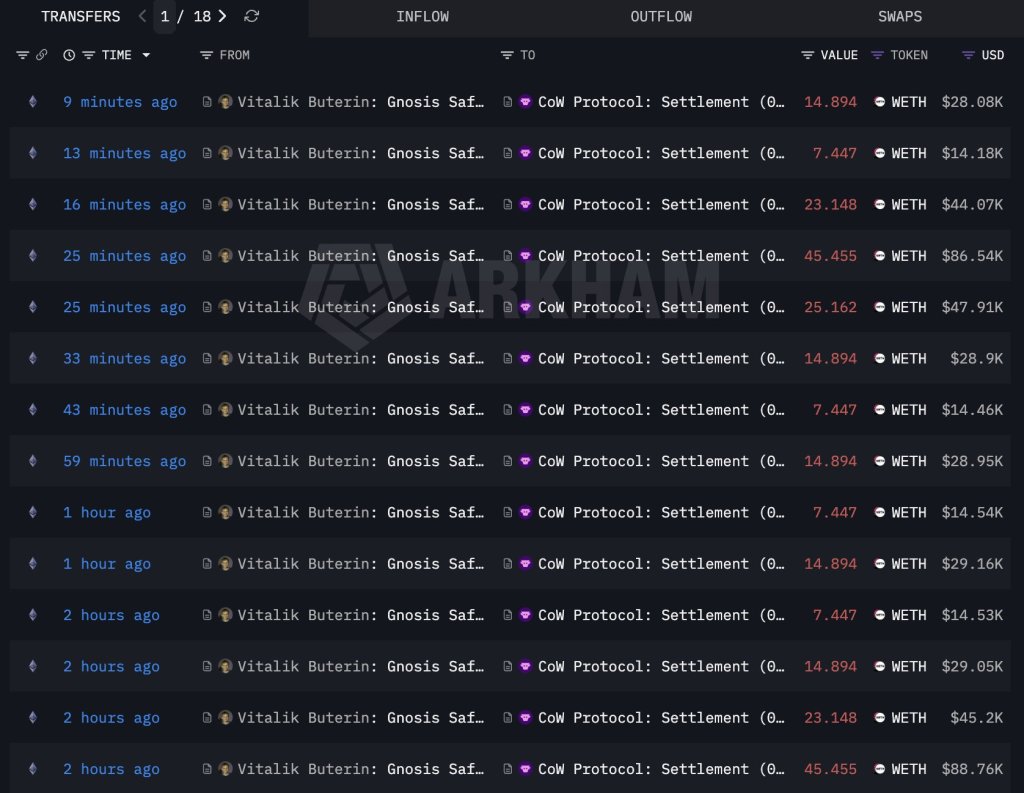
Vitalik Buterin on Arkham | Source: X @lookonchain

The sharper edge of the thread was the historical comparison. Lookonchain pointed to a previous episode when it said Buterin sold 6,958 ETH (about $14.78 million) and ETH subsequently fell from $2,360 to $1,825, a 22.7% decline. “Last time he sold 6,958 ETH($14.78M), $ETH dropped from $2,360 to $1,825 — a 22.7% fall,” the post added, linking to an Arkham entity page attributed to Buterin.

The comparison does not prove causation, but it’s exactly the kind of pattern-matching that can matter at the margin in a market primed to trade flows. Founder wallets are heavily monitored, and any hint of renewed supply can become a focal point for positioning—especially when price is already drifting lower.

Lookonchain’s earlier post dated Feb. 22 described the sequence as a return to activity after a pause. “After a two-week break, vitalik.eth(@VitalikButerin) is selling ETH again! 8 hours ago, he withdrew 3,500 ETH($6.95M) from Aave to sell. So far, he has already sold 571 ETH($1.13M),” the account wrote.

That detail matters because it frames the selling as an intentional unwind rather than passive movement between wallets. Pulling ETH from Aave, then selling portions, is the sort of breadcrumb traders look for when trying to distinguish “wallet housekeeping” from outright distribution.

The Feb. 22 posts also land on top of another Lookonchain note from Feb. 5, which described sustained selling over multiple days. “vitalik.eth(@VitalikButerin) is dumping ETH fast!” it said, adding: “Over the past 3 days, Vitalik has sold 2,961.5 $ETH($6.6M) at an average price of $2,228 — and the selling is still ongoing.”

For markets, the immediate question is whether this remains a contained, trackable flow or whether it becomes the kind of recurring headline that pulls liquidity and sentiment lower simply by staying in the tape. If additional wallet-linked sales surface, traders will likely keep stress-testing the “history repeating” narrative against price, rather than assuming the selling is the sole driver.

At press time, Ethereum traded at $1,884.
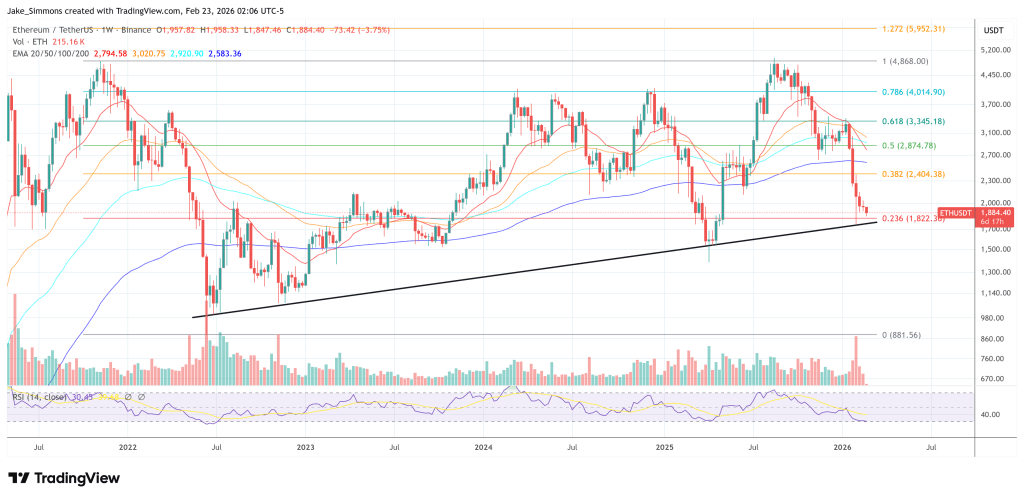
Ethereum continues to fall towards the black trendline, 1-week chart | Source: ETHUSDT on TradingView.com

Trending Cryptos

Related Questions

QWhat is the main reason for Ethereum's recent price drop according to the article?

AThe article attributes Ethereum's recent price drop to on-chain trackers flagging another burst of selling activity from wallets linked to its co-founder, Vitalik Buterin.

QHow much ETH did Vitalik Buterin sell in the past two days, and what was its approximate USD value?

AVitalik Buterin sold 1,869 ETH, which was valued at approximately $3.67 million.

QWhat historical event does Lookonchain compare the current selling activity to?

ALookonchain compares it to a previous episode where Buterin sold 6,958 ETH (worth ~$14.78M), after which the price fell from $2,360 to $1,825, a decline of 22.7%.

QWhy does the article state that pulling ETH from Aave to sell is a notable detail?

AIt frames the selling as an intentional unwind or distribution rather than simple 'wallet housekeeping' or passive movement between wallets, which traders see as a more significant signal.

QWhat is the price of Ethereum at the time the article was published?

AAt press time, Ethereum traded at $1,884.

Related Reads

Bitcoin Withdrawals Continue: 8 Years of Storage in a Coldcard Cold Wallet Ended in Zero

Coldcard Hardware Wallet Hacked: Losses Mount Due to Vulnerable Seed Generation A critical vulnerability in Coldcard hardware wallets has led to a continued wave of fund thefts. According to Galaxy Research, the total stolen has reached 1,367.05 BTC (approx. $88.6 million) from 4,585 addresses, a significant increase from the initial 594.5 BTC reported on July 30, 2026. Most of the stolen funds remain on the attackers' addresses. The issue is not with the current firmware, which Coinkite has updated, but with seed phrases generated on vulnerable devices between March 2021 and the release of fixed firmware versions. Due to a programmer error, devices switched from using a hardware random number generator to the software-based Yasmarang generator, which was initialized with publicly accessible data like the chip's serial number. This made the seed phrases predictable through offline brute-force attacks, meaning wallets remain at risk until funds are moved to a new wallet generated with the patched firmware. Affected devices include Mk2/Mk3 with firmware 4.0.1–4.1.9 (and up to 5.0.3), Mk4/Mk5 up to version 5.6.0, and Q models up to 1.5.0Q. The only exceptions are seeds created with a high-entropy method like at least 50 independent dice rolls or a strong unique BIP-39 passphrase. All other owners must generate a new seed on the fixed firmware and transfer their assets. A case highlighting the human impact involves a 39-year-old long-term investor who lost 2 BTC (approx. $130,000) in minutes. He had accumulated the Bitcoin over eight years through physical labor, viewing it as a financial lifeline and a retirement plan in a country suffering from hyperinflation. His story underscores that even conservative "buy and hold in cold storage" strategies can be compromised by such underlying technical flaws. From a technical perspective, this incident echoes historical failures where weak random number generators undermined cryptographic security, challenging the assumption that offline storage is automatically foolproof.

cryptonews.ru3h ago

Bitcoin Withdrawals Continue: 8 Years of Storage in a Coldcard Cold Wallet Ended in Zero

cryptonews.ru3h ago

Trading

Spot

Hot Articles

Discussions

Welcome to the HTX Community. Here, you can stay informed about the latest platform developments and gain access to professional market insights. Users' opinions on the price of ETH (ETH) are presented below.

活动图片















