Ethereum down 45% YTD – So why do SharpLink and whales keep buying?

ambcryptoPublished on 2026-06-27Last updated on 2026-06-27

Abstract

Despite Ethereum (ETH) being down 20-45% year-to-date amid broader crypto weakness, institutional and whale buying activity suggests growing long-term conviction. SharpLink, after an eight-month pause, purchased 5,000 ETH and later added $45.54 million in LSETH, increasing its total holdings significantly despite substantial unrealized losses. Similarly, a new whale wallet accumulated over 18,000 ETH worth $28.9 million in nine days, indicating strategic positioning for future price movements rather than short-term trading. However, this accumulation contrasts with spot Ethereum ETFs, which saw net outflows of $12.85 million recently, highlighting a divergence between direct treasury/whale buyers and ETF investors. While the persistent buying from these large holders may gradually ease selling pressure, a sustained recovery for Ethereum still depends on a reversal in ETF flows and a broader improvement in network demand and market sentiment.

Amid the ongoing crypto weakness, Ethereum [ETH] remains underwater, down 20%-45% YTD. Despite this drawdown, the leading altcoin continues to draw institutional interest.

SharpLink resumed purchases after eight months, adding 5,000 ETH, worth roughly $7.88 million at an average price of $1,576, through FalconX.

Moments later, the crypto treasury reinforced the inflow with another 26.324K LSETH worth $45.54 million. These purchases pushed Sharplink’s total holdings to 876,285 ETH, including 22,102 staked tokens.
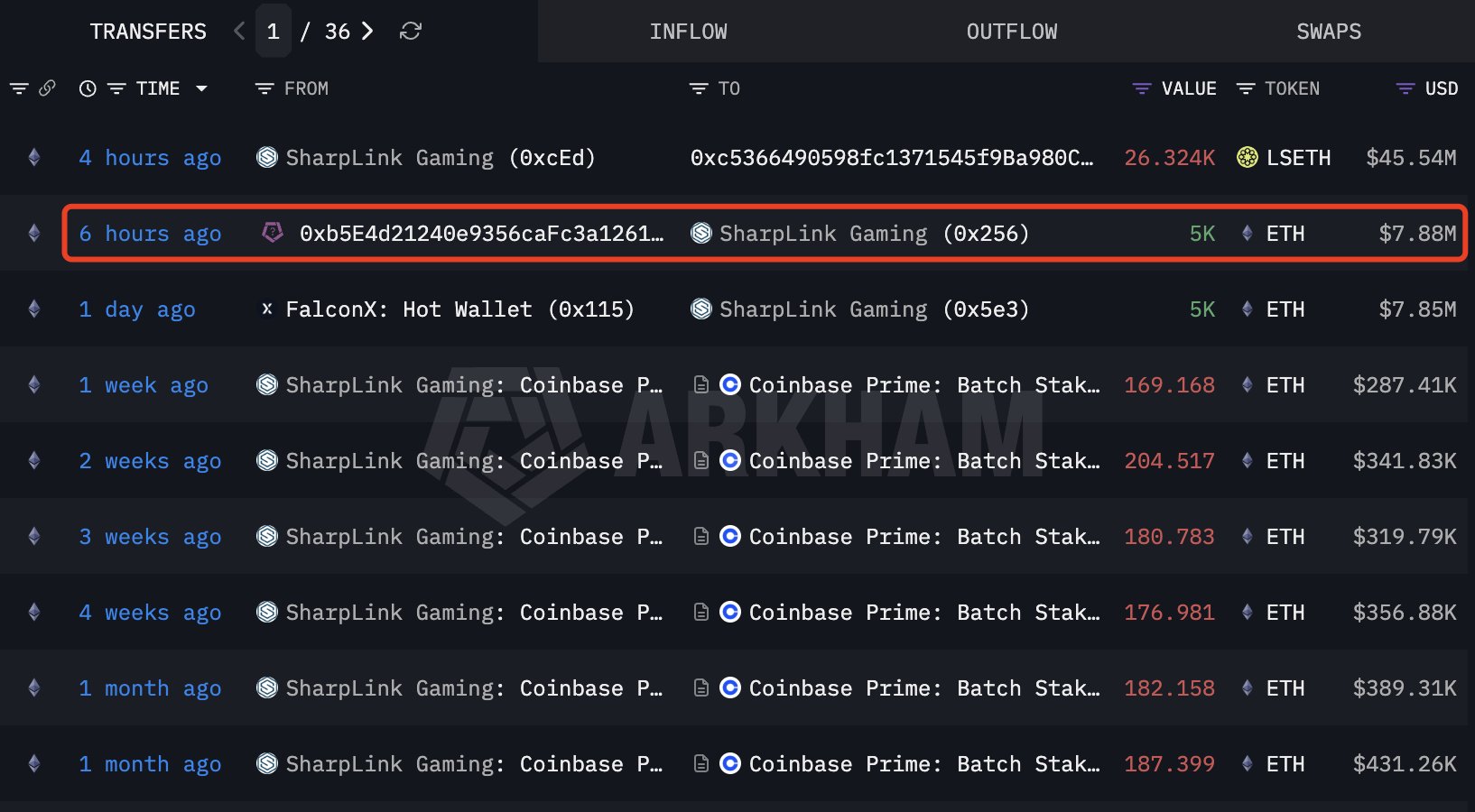
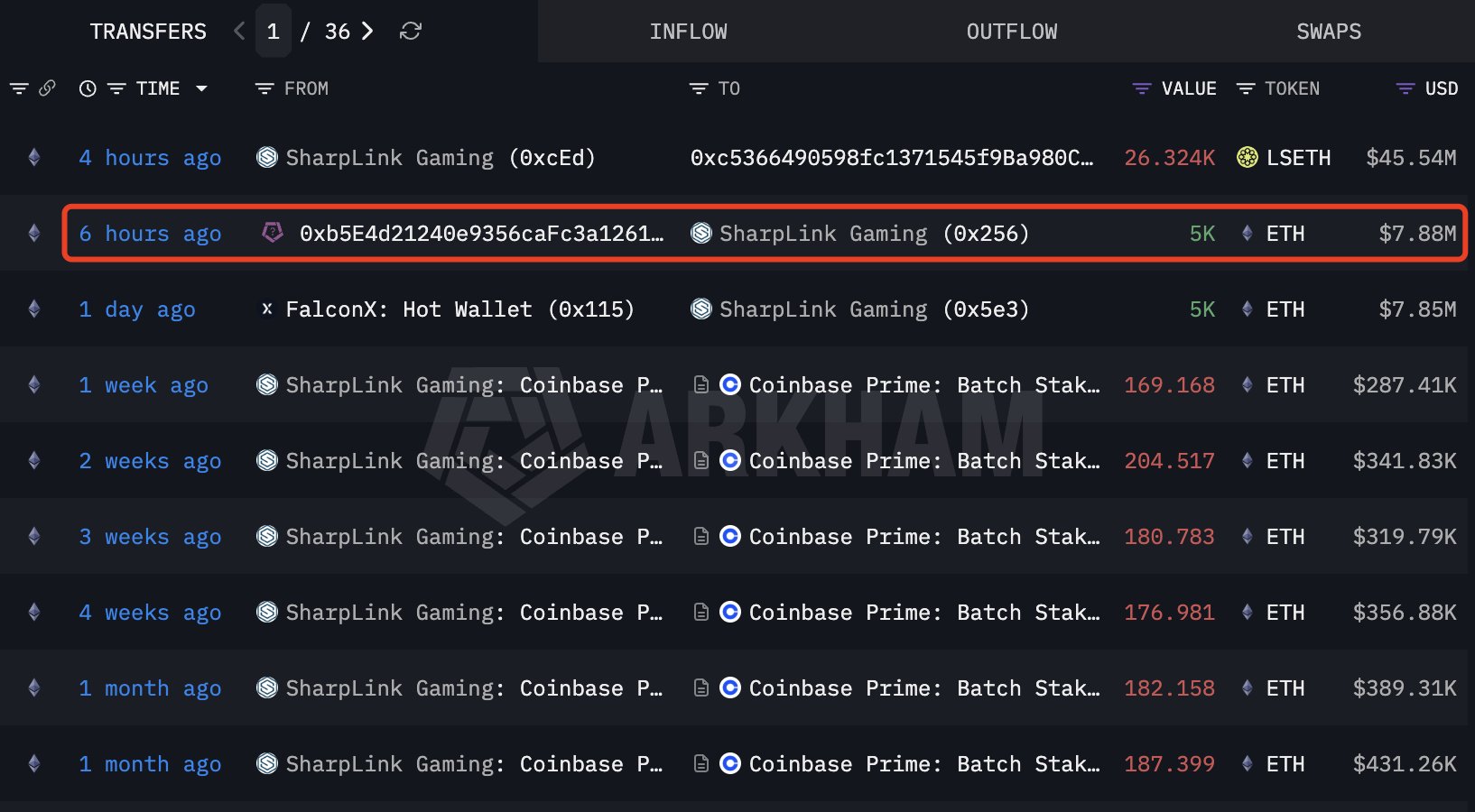
Source: Arkham

Although the treasury holds nearly $1.71 billion in unrealized losses, accumulation suggests conviction in Ethereum’s long-term utility and staking income.

If broader institutions continue absorbing weakness, selling pressure could gradually ease. However, sustained recovery still depends on renewed network demand and improving market sentiment.

Whales increase Ethereum exposure

That institutional conviction is no longer limited to corporate treasuries. Instead, whale wallets are beginning to mirror the same accumulation pattern despite lingering market uncertainty.

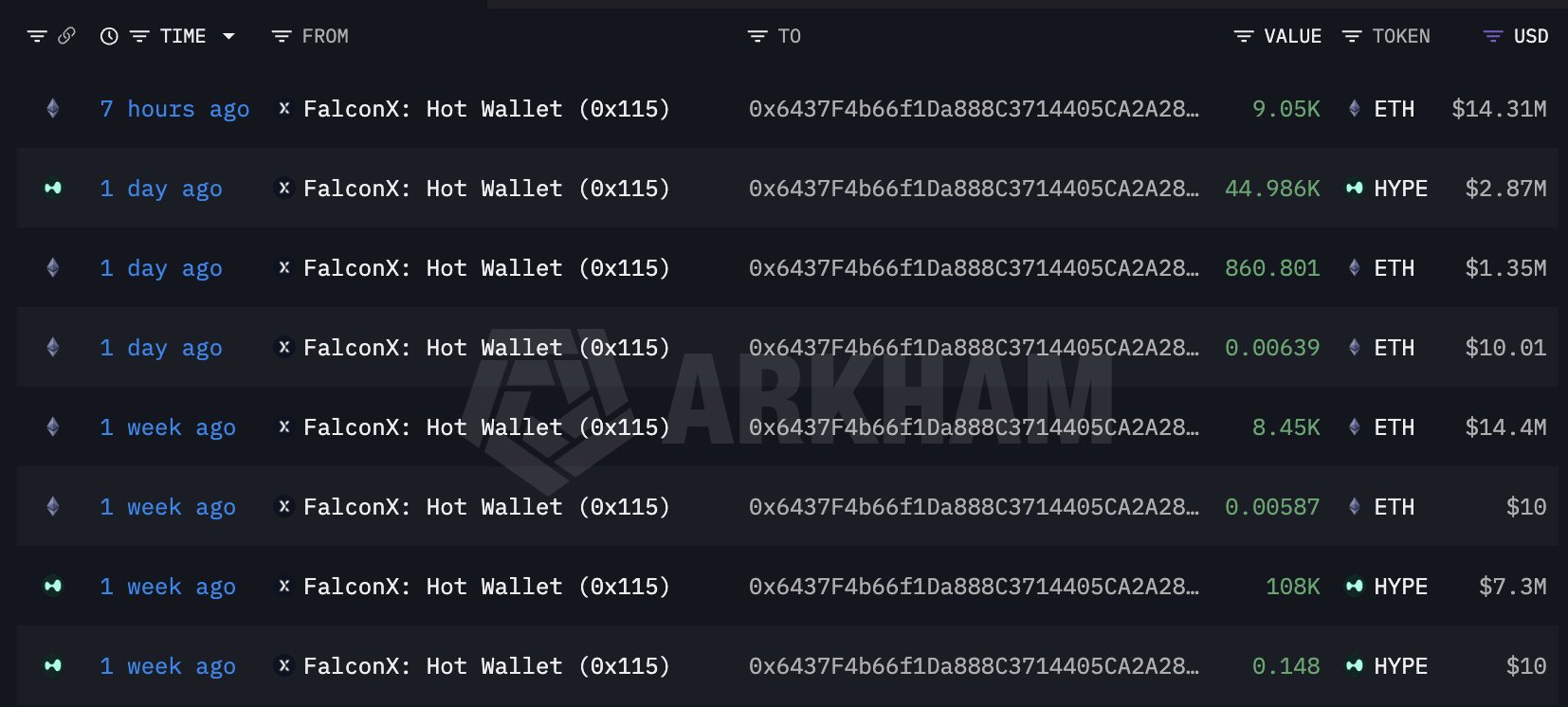
In the last nine days, a newly created wallet accumulated 18,361 ETH worth $28.9 million, alongside 152,986 Hyperliquid [HYPE] worth $9.73 million through FalconX.
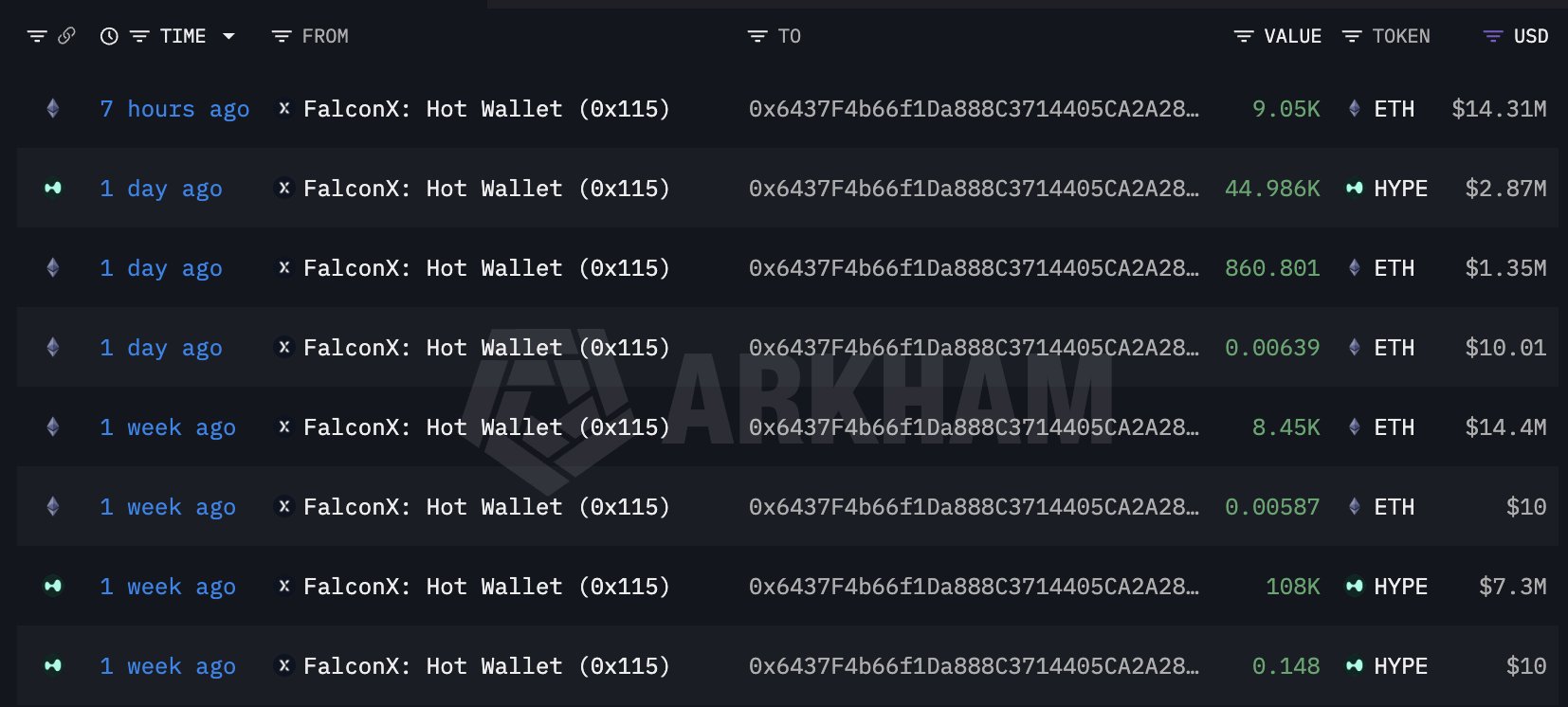
Source: Arkham

The consistent buildup of assets by this whale indicates that these larger whales are creating exposures for future price swings instead of trying to react to each day’s price movement.

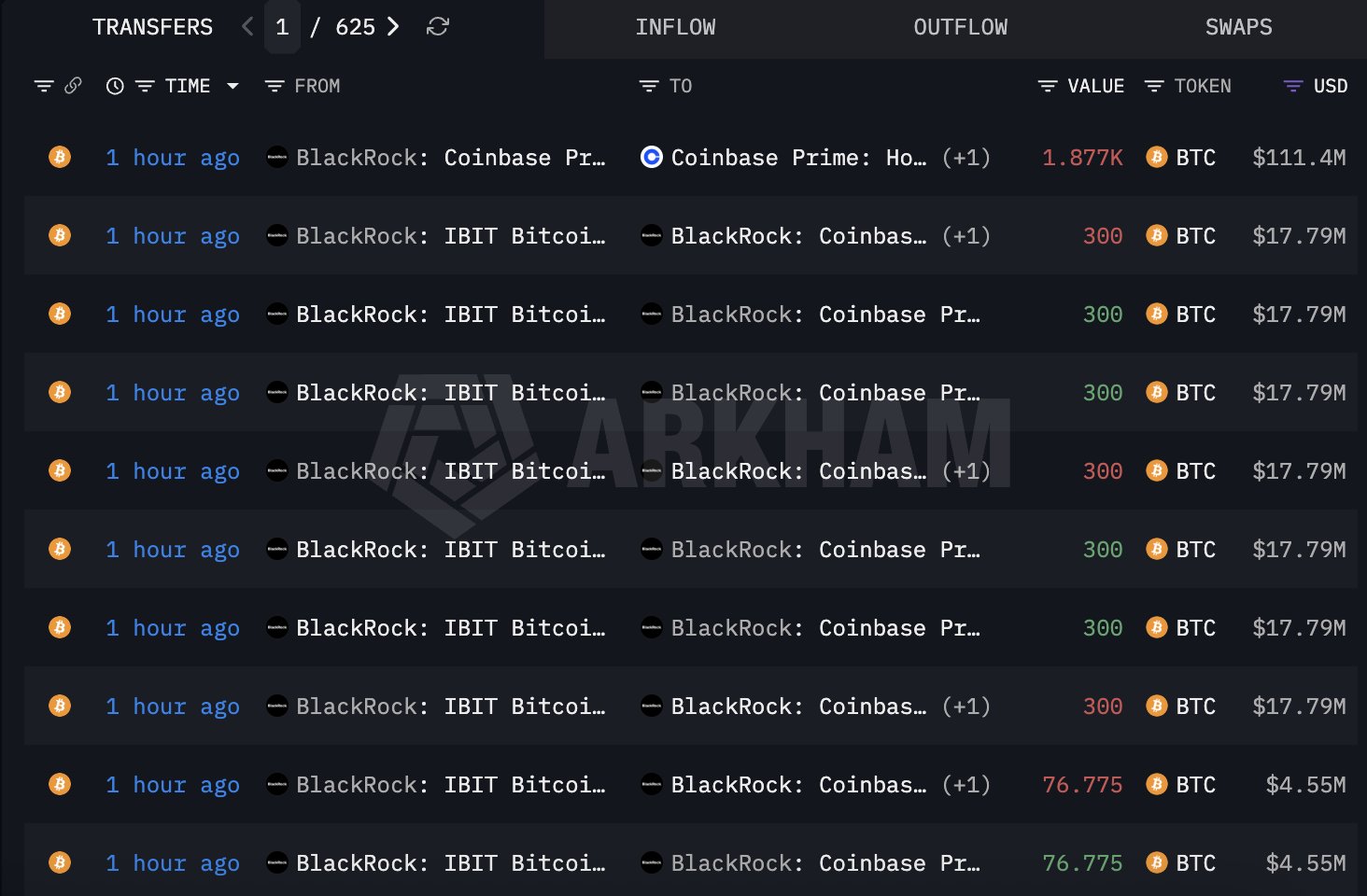
At the same time, BlackRock moved 2,700 Bitcoin [BTC] and 41,996 ETH to Coinbase, totaling $226 million. These moves are usually related to either ETFs settling transactions, adjusting custodial services, or managing liquidity.
Source: Arkham

However, they do not directly represent a sale. Whether whales continue to accumulate Ethereum or institutions become active will be key to determining the long-term outlook of Ethereum.

All in all, whale accumulation and institutional activity suggest confidence is gradually rebuilding, even as broader market demand still needs to strengthen.

ETF outflows cap Ethereum’s recovery

Yet that rebuilding confidence has not translated into broader institutional demand. According to SosoValue data, Spot ETFs have experienced heavy outflow, recording a $12.85 million net withdrawal on June 26th.

Earlier inflows of $22.50 million and $9.59 million briefly suggested sentiment was stabilizing before sellers regained control. This divergence indicates that direct treasury buyers and ETF investors are responding to different market conditions.

This divergence by treasuries and ETF investors reflects differing market conditions. Although the huge amount of capital withdrawn from these accounts has resulted in cumulative net inflows being a high $10.90 billion.

Meanwhile, ETF issuers still hold over $8.38 billion, representing 4.42% of Ethereum’s market value, with a daily trading volume of $491.73 million, suggesting that institutions will continue to realign positions rather than abandon ETH entirely.


Final Summary

  • Ethereum [ETH] treasury and whale buying continue despite weak prices, reinforcing long-term institutional conviction.
  • Ethereum recovery still requires stronger ETF inflows to offset persistent institutional outflows.


Trending Cryptos

Related Questions

QDespite the price decline, what recent action did SharpLink take regarding Ethereum, and what does it suggest about their long-term view?

ASharpLink resumed purchasing Ethereum after eight months, adding 5,000 ETH worth roughly $7.88 million and later 26,324 LSETH worth $45.54 million. This accumulation, despite holding nearly $1.71 billion in unrealized losses, suggests strong conviction in Ethereum's long-term utility and staking income.

QWhat pattern of behavior are whale wallets showing, according to the article, and what does it indicate about their strategy?

AWhale wallets are showing an accumulation pattern, with one newly created wallet accumulating 18,361 ETH worth $28.9 million over nine days. This indicates that larger whales are building positions for future price swings rather than trying to react to daily price movements, reflecting a strategic, long-term approach.

QHow have Spot Ethereum ETFs performed recently, and what does this divergence from treasury buying indicate?

ASpot Ethereum ETFs have experienced heavy outflows, with a net withdrawal of $12.85 million on June 26th. This divergence from direct treasury buying by entities like SharpLink indicates that ETF investors and direct treasury buyers are responding to different market conditions or have differing time horizons.

QWhat was the significance of BlackRock moving 2,700 BTC and 41,996 ETH to Coinbase, according to the article?

ABlackRock's movement of assets to Coinbase, totaling $226 million, is typically related to ETF settlement transactions, adjusting custodial services, or managing liquidity. The article clarifies that these moves do not directly represent a sale of the assets.

QWhat two key factors does the article suggest are necessary for Ethereum's sustained recovery?

AThe article suggests that for Ethereum's sustained recovery, there needs to be: 1) renewed network demand and improving market sentiment, and 2) stronger ETF inflows to offset the persistent institutional outflows currently being observed.

Related Reads

Unitree's IPO Frenzy: The Real Mystery is How It Will Spend the 42 Billion Raised

Unitree, a Chinese robotics company, is set for a public listing after its IPO registration was approved by regulators. The company, which started with quadruped robots and has expanded into humanoids, plans to raise approximately 4.2 billion yuan through its offering. The article traces Unitree's rapid growth from its founding in 2016 to its current status. It highlights key milestones like the 2021 CCTV Spring Festival Gala performance, the 2023 launch of its affordable Go2 robot dog and the H1 humanoid robot, and a series of subsequent product launches. By 2025, the company reported revenue of 1.71 billion yuan, profitability, and sales exceeding 5,500 humanoid robots. As the first publicly-listed humanoid robot company on China's STAR Market, Unitree's main challenges are sustaining growth and deploying its newly raised capital effectively. The humanoid robot sector in China is crowded, with over 140 companies. Competitors include UBTech (focusing on industrial and consumer markets), Fourier, and international players like Tesla Optimus and 1X NEO. The article outlines three critical challenges for Unitree: establishing a strong second product line beyond its quadruped robots, maintaining its price advantage while ensuring quality, and successfully advancing its embodied AI capabilities through partnerships like the one with NVIDIA for the H2 Plus platform. Unitree's likely strategy involves a "developer tools + industry benchmarks" approach: using low-cost models like the R1 and G1 to build developer adoption and volume, leveraging high-end platforms for AI training, and securing pilot projects in sectors like logistics and manufacturing to build case studies. The company's future success hinges on converting its current momentum in shipments and pilot programs into sustainable, large-scale commercial contracts as the broader market evolves.

marsbit1h ago

Unitree's IPO Frenzy: The Real Mystery is How It Will Spend the 42 Billion Raised

marsbit1h ago

Examining the Open USD Partner Lineup: Follow Who's Joining to See Where the Money Flows

**Title: Deciphering the Open USD Partner Roster: Following the Money** The launch of Open USD is notable less for the stablecoin itself and more for its expansive list of over 140 founding partners, which reads like a "who's who" of global finance and tech. This coalition, including asset managers like BlackRock, card networks Visa and Mastercard, banks (BNY Mellon, Standard Chartered, etc.), tech giants (Google, IBM), merchants (Shopify), and crypto firms (Coinbase, Ripple, Aave, MetaMask), signals a strategic shift. The diverse membership reveals that stablecoins are increasingly viewed not as products to compete over, but as shared infrastructure too critical to be left to any single entity. Each partner category has distinct motives. Asset managers like BlackRock seek to manage the large, sticky cash reserves, a lucrative fee-generating opportunity. Merchants like Shopify aim for lower-cost settlement and potential yield on balances. Banks join defensively to retain custody and settlement roles, fearing deposit outflows to stablecoins. Tech companies bet on programmable money for future machine-to-machine commerce. Crypto firms gain mainstream legitimacy and distribution channels. Remarkably, the consortium includes direct competitors (Visa vs. Mastercard, Coinbase vs. Ripple), indicating that the fear of exclusion from this emerging financial layer outweighs competitive rivalries. However, this shared governance could also lead to slow decision-making. The roster's composition is the real message: it represents a collective bet that a widely accepted, consortium-owned stablecoin is preferable to proprietary versions or having none at all. For incumbents like Circle and Tether, this alliance poses a significant threat, as potential clients have collectively chosen to build their own alternative. The absence of major U.S. retail banks (busy with their own tokenized deposit networks) is equally telling. In essence, the partner list maps where the industry believes value and risk will flow in a tokenized dollar future, marking stablecoin's evolution from a product to a utility.

Foresight News1h ago

Examining the Open USD Partner Lineup: Follow Who's Joining to See Where the Money Flows

Foresight News1h ago

Trading

Spot

Hot Articles

Discussions

Welcome to the HTX Community. Here, you can stay informed about the latest platform developments and gain access to professional market insights. Users' opinions on the price of ETH (ETH) are presented below.

活动图片