Ethereum Co-Founder Buterin Netted $70,000 On Polymarket Last Year, Here’s How

bitcoinistPublished on 2026-01-28Last updated on 2026-01-28

Abstract

Ethereum co-founder Vitalik Buterin revealed he earned $70,000 trading on Polymarket in the past year by betting against what he termed collective "madness." With an initial investment of $440,000, his strategy focused on mean reversion in irrational markets, such as betting against extreme predictions like Trump winning a Nobel Prize or the dollar collapsing. Buterin primarily trades in politics and tech, targeting areas prone to hype. He also highlighted significant oracle vulnerabilities, citing an example where a faulty update from a data source (ISW) caused a market to settle incorrectly, emphasizing that low security standards in Web2 oracles pose a major risk to prediction markets. Buterin discussed centralized and decentralized (e.g., UMA) solutions but noted concerns about vote manipulation in the latter.

Ethereum co-founder Vitalik Buterin says he made $70,000 trading prediction markets on Polymarket last year, not by chasing hot narratives, but by fading what he calls collective “madness.” The Ethereum co-founder framed the profit as a function of behavioral reflexes in thin, hype-prone markets, and used the conversation to surface a separate concern: oracle fragility in real-world event settlement.

Here’s How Ethereum’s Buterin Netted $70,000

In an interview posted by Foresight News reporter Joe Zhou on X, Zhou asked whether Buterin still used Polymarket after being active last year. “Yes, I made $70,000 on Polymarket last year,” Buterin replied. When pressed on sizing, he said his initial investment was $440,000, implying a mid-teens return that sits in sharp contrast to the more common retail experience of getting chopped up by headline-driven probability swings.

Buterin described his playbook as opportunistic mean reversion on sentiment rather than prediction as such. “My method is simple: I look for markets that are in ‘madness mode’ and then bet that ‘madness won’t happen,’” he said.

“For example, there’s a market betting on whether Trump will win the Nobel Peace Prize. Or some markets predict the dollar will go to zero next year during periods of extreme panic. When market sentiment enters this irrational ‘madness mode,’ I bet on the opposite, and this usually makes money.”

When Zhou asked where he tends to focus on Polymarket (crypto, politics, entertainment, economics), Buterin said his attention clusters around politics and technology, and reiterated that the edge, in his view, comes from arenas where participants are “caught up in a frenzy and irrationality.”

The more consequential part of the thread moved from trading style to settlement integrity. Zhou raised the question of informational asymmetries and “advance knowledge”, referencing online chatter around a Venezuela-related market and asked whether Buterin had seen similar dynamics. Buterin steered the answer toward oracle vulnerabilities, citing a wartime contract whose outcome hinged on a narrow operational definition.

He described a market on the Ukraine war that settled based on whether Russia “controlled a certain city,” where the smart contract defined “control” as control of the city’s most important train station. The oracle source, he said, was anchored to Institute for the Study of War (ISW) tweets and maps.

Then came the failure mode: “ISW employees, perhaps by mistake, or perhaps intentionally, hacked their own company’s system; their maps suddenly updated to show that the Russian army controlled the train station,” Buterin said. “This caused something that everyone thought had only a 5% probability (almost impossible) to instantly become 100% in the prediction market. Although ISW retracted the update the next day, the money may have already been paid out.”

For Buterin, the lesson is not merely that prediction markets can be wrong, but that the data supply chain they outsource to can be brittle in ways crypto participants systematically underestimate. “This reveals a huge problem: the security standards of current oracle data sources (such as Web2 news websites and Twitter) are too low,” he said. “They never imagined that a single message they posted would determine the ownership of $1 million on the blockchain.”

Asked how to solve the oracle problem, Buterin sketched two broad approaches. The first is a centralized trust model, effectively designating an authoritative publisher like Bloomberg. The second is token voting, a decentralized mechanism he associated with UMA. Buterin said confidence in UMA has been slipping due to a perceived game-theoretic weakness: if a whale coalition can dominate voting, minority “truth” voters can be punished economically, pressuring participants to mirror power rather than reality.

At press time, Ethereum traded at $3,010.
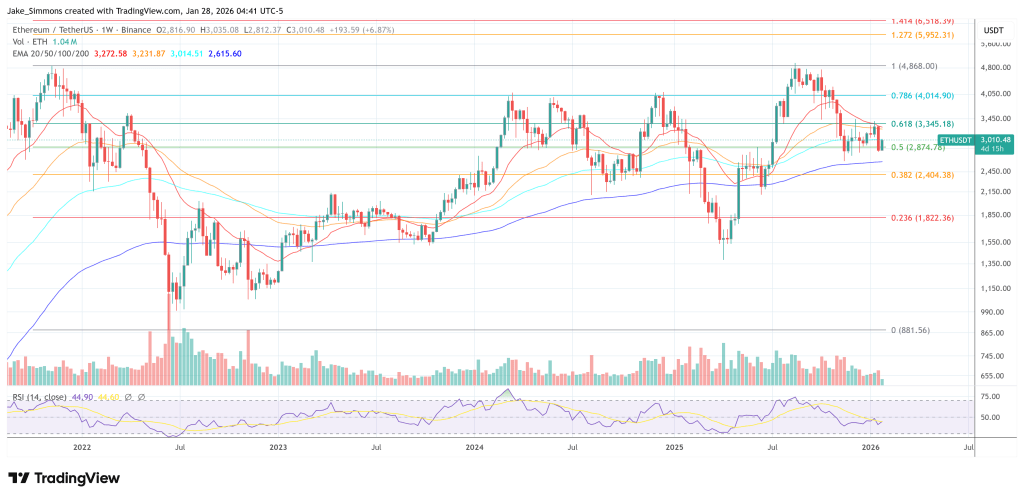
Ethereum remains stuck between the 0.618 and 0.5 Fib, 1-week chart | Source: ETHUSDT on TradingView.com

Related Questions

QHow did Vitalik Buterin make $70,000 on Polymarket last year?

AHe made $70,000 by betting against what he called collective 'madness' in prediction markets, employing an opportunistic mean reversion strategy on sentiment rather than making direct predictions.

QWhat was Vitalik Buterin's initial investment on Polymarket that resulted in a $70,000 profit?

AHis initial investment was $440,000.

QAccording to Buterin, what is the main problem with current oracle data sources for prediction markets?

AHe stated that the security standards of current oracle data sources (like Web2 news websites and Twitter) are too low, as they are not designed to handle the financial consequences of their information determining the settlement of large sums of money on the blockchain.

QWhat specific example did Buterin use to illustrate oracle fragility in real-world event settlement?

AHe cited a market on the Ukraine war that settled based on whether Russia controlled a specific city, with 'control' defined by a single train station. The oracle, which used ISW tweets and maps, failed when an ISW update (later retracted) incorrectly showed Russian control, causing a 5% probability event to instantly settle at 100%.

QWhat two broad approaches did Buterin suggest for solving the oracle problem?

AHe suggested a centralized trust model (designating an authoritative publisher like Bloomberg) and a decentralized token voting mechanism (like UMA's), though he noted concerns that the latter can be vulnerable to whale coalitions dominating the vote.

Related Reads

380,000 Apps Exposed, 2,000+ Apps Leaked Secrets: AI Programming Turns 'Intranet' into Public Internet

Israeli cybersecurity firm RedAccess uncovered a severe data exposure trend linked to "vibe coding" or AI-powered software development tools. Their research found approximately 38,000 publicly accessible web applications built with platforms like Lovable, Base44, Netlify, and Replit. Of these, an estimated 2,000 apps exposed sensitive corporate and personal data, including medical records, financial information, internal strategic documents, and customer chat logs. In some cases, access even granted administrative privileges. The core issue stems from default privacy settings that make applications public by default, combined with a lack of built-in security controls (like authentication) in the AI-generated code. This allows employees without security expertise—"citizen developers"—to easily create and deploy applications that bypass standard corporate security reviews. The exposed apps, often indexed by search engines, are trivially discoverable. While some platform providers (Replit, Lovable, Wix/Base44) argue that security configuration is the user's responsibility and question the validity of some findings, security researchers confirm the widespread reality of such exposures. This pattern, also noted in prior studies, highlights a critical security gap as AI democratizes app creation, potentially leading to massive, unintentional data leaks.

marsbit29m ago

380,000 Apps Exposed, 2,000+ Apps Leaked Secrets: AI Programming Turns 'Intranet' into Public Internet

marsbit29m ago

Attracting Global Capital, Asia's New 'Super Cycle' Is Unfolding

Investors are turning to Asia as the next frontier for global equity growth, with a new "super cycle" unfolding across the region. Driven by the AI revolution, Asian markets, particularly South Korea, have seen significant rallies. According to Morgan Stanley analysis, the underlying drivers of Asia's industrial cycle are shifting from traditional sectors like real estate and manufacturing to massive investments in AI infrastructure, energy security and transition, and supply chain resilience. Fixed asset investment in Asia is projected to grow from around $11 trillion in 2025 to $16 trillion by 2030, with a 7% annual growth rate from 2026-2030. The AI wave is a primary catalyst, driving immense capital expenditure for chips, servers, data centers, and power systems. Asia is central to this hardware supply chain. In China, AI investment is focused on building a full-system domestic capability, with the local AI chip market potentially reaching $86 billion by 2030. Beyond AI, China's export story is expanding from EVs and batteries to robotics. The country already captures about half of new global industrial robot demand and over 90% of humanoid robot shipments. This growth phase mirrors the early stages of China's EV export boom. Simultaneously, energy security investments, spurred by AI's massive power needs, are rising, with China benefiting from its leadership in solar, batteries, and EVs. Regional defense spending is also increasing structurally, supporting demand for advanced manufacturing. The main beneficiaries are China, South Korea, and Japan, positioned in core supply chain areas. However, risks remain, including potential overcapacity, profit margin pressures from competition, persistent technological restrictions, geopolitical friction, and workforce displacement due to AI-driven automation. Market volatility is also expected to increase as investor expectations diverge on the realization of these capital investment and export themes.

marsbit29m ago

Attracting Global Capital, Asia's New 'Super Cycle' Is Unfolding

marsbit29m ago

Funding Weekly Report | 14 Public Funding Events, Kalshi Completes $10B New Funding Round at $220B Valuation Led by Coatue Management

Weekly Funding Roundup: 14 Deals and $10.49B+ in Total Funding, Led by Kalshi's $1B Round Last week (5.4-5.10) saw 14 notable funding events in the global blockchain ecosystem, raising over $10.49 billion in total. Key highlights include Kalshi, a prediction market platform, securing a $1 billion round led by Coatue Management, reaching a $22 billion valuation. The platform now boasts ~2 million MAUs and $178B in annualized trading volume. In DeFi, regulated on-chain reinsurer OnRe raised $5 million in Series A funding, and Bitcoin-backed credit protocol Saturn Credit completed a $2 million seed round. For Infrastructure & Tools, OpenTrade raised $17 million to expand its stablecoin yield infrastructure, and RWA platform Balcony secured $12.7 million to deploy its property settlement service in the US. Centralized Finance saw one deal: AI-driven trading platform Stockcoin.ai completed a seed round led by Amber Group. In the prediction market sector alongside Kalshi, AI-powered platform Elastics raised $2 million. Other notable deals include SC Ventures' strategic investment in crypto market maker GSR and Centrifuge securing a "seven-figure" investment from Coinbase to become a core RWA partner for Base. On the investor side, Haun Ventures raised a new $1 billion fund targeting crypto and AI, and Multi Investment raised ~$616 million to focus on blockchain and Web3 investments.

marsbit1h ago

Funding Weekly Report | 14 Public Funding Events, Kalshi Completes $10B New Funding Round at $220B Valuation Led by Coatue Management

marsbit1h ago

Trading

Spot
Futures

Hot Articles

Discussions

Welcome to the HTX Community. Here, you can stay informed about the latest platform developments and gain access to professional market insights. Users' opinions on the price of ETH (ETH) are presented below.

活动图片















