Ethereum Bears In Pole Position: $1,850 Could Be The Next Landing Spot

bitcoinistPublished on 2026-06-01Last updated on 2026-06-01

Abstract

Ethereum's price remained bearish in May, with analysts predicting a potential drop to around $1,850. Crypto analyst Burak Kesmeci notes that ETH is trapped in a descending channel on the 4-hour chart, indicating seller dominance. If it fails to break the $2,033 resistance, a decline to the $1,822-$1,850 range is likely. While a breakout above $2,033 could target $2,400, the downward move appears more probable. This bearish outlook is reinforced by significant outflows from spot Ethereum ETFs, totaling over $241 million in the past week—the third consecutive week of major outflows. ETH has lost nearly 15% of its value over the last three weeks and is currently trading around $2,023.

The price performance of Ethereum was disappointing for most of May, as the bears seemed to be in full control. It doesn’t seem like much will change for the “King of Altcoins” in the new month, which appears to be a mere continuation of the established downward trend. According to a popular analyst on the social media platform X, the Ethereum price could be on its way down to around $1,850.

Is ETH Price Stuck In A Descending Channel?

Crypto analyst Burak Kesmeci took to the X platform to share his projection for the Ethereum price over the coming days. The market pundit posited that the second-largest cryptocurrency could decline toward the $1,822-$1,850 range if it fails to break the $2,033 resistance in the next few days.

This bearish outlook is premised on the fact that sellers have been in a dominant position in the short term and for much of the past month. This dominance is evident in the formation of a descending channel on the four-hour timeframe of the Ethereum price chart.

A descending channel is a technical analysis chart pattern characterized by two major trendlines: the upper boundary connecting the lower highs and the lower line connecting the lower lows. This chart formation is often correlated to a bearish structure, with the upper trendline acting as resistance and the lower boundary as the price floor.
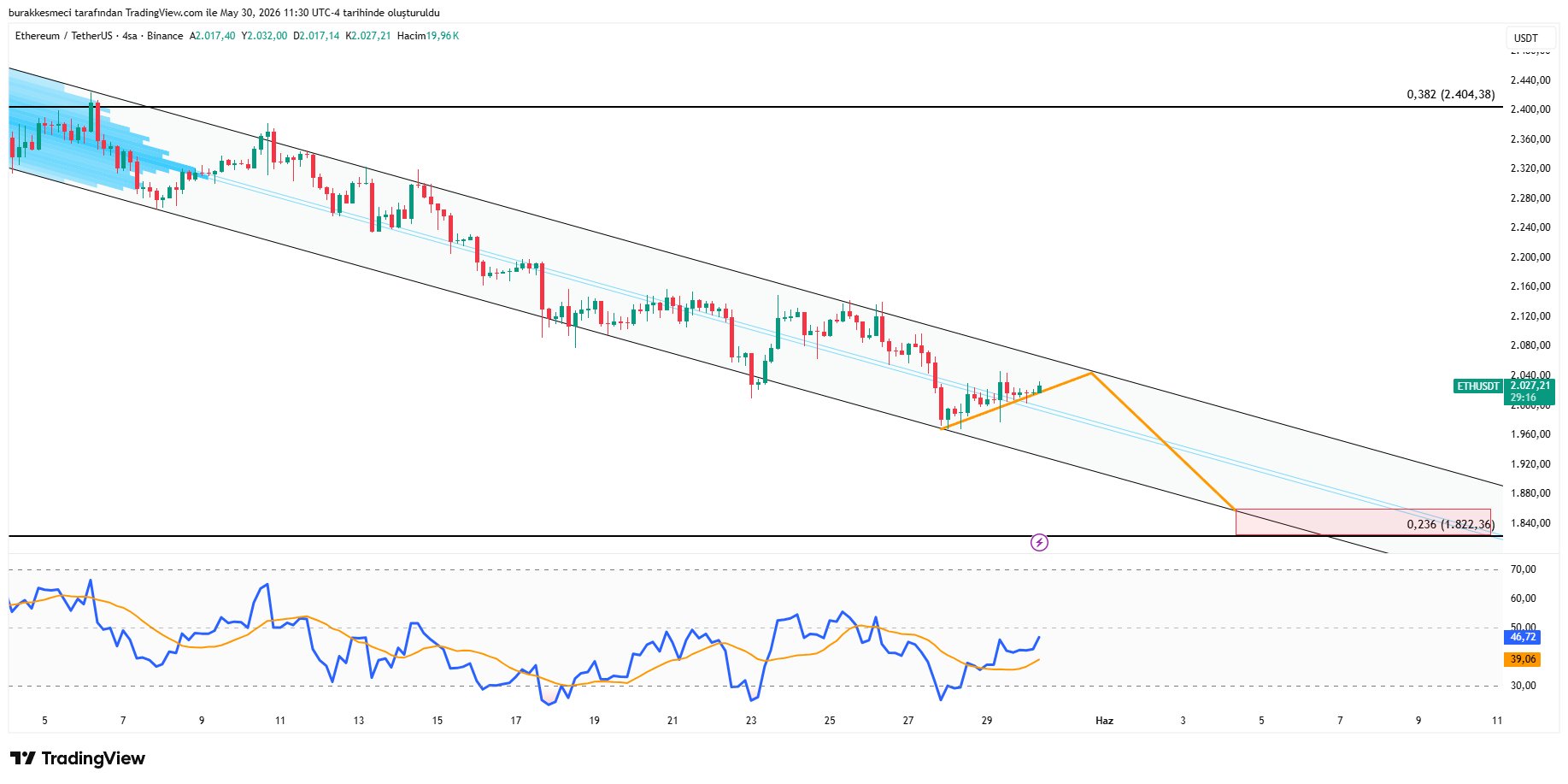
Source: @burak_kesmeci on X

According to Kesmeci, the persistence of the Ethereum price within the descending channel and the weak price momentum suggest that a downward move is on the cards. The crypto analyst highlighted that ETH could drop to the $1,822 – $1,850 range, so long as the overhead resistance at the upper boundary of $2,033 (Fibonacci 0.5) holds.

However, there is also the flipside scenario in which the price of Ethereum could break out toward $2,400 if the $2.033 resistance is breached. However, the decline toward the $1,850 region seems more likely, especially given current demand conditions.

Ethereum ETFs Post $241 Million In Outflows Over The Past Week

This dwindling demand in the Ethereum market is evident in rising spot ETF outflows, which climbed above $241 million over the past week. This past week’s record marked the third consecutive week with significant net outflows for the spot ETH exchange-traded funds.

The Ethereum price action over the past three weeks has been a fair reflection of this pessimistic market condition. According to CoinGecko data, the second-largest cryptocurrency has lost nearly 15% of its value in the last three weeks.

As of this writing, the price of ETH stands at around $2,023, with no significant change in the past 24 hours.

The price of ETH on the daily timeframe | Source: ETHUSDT chart on TradingView


Trending Cryptos

Related Questions

QWhat is the main bearish price target for Ethereum mentioned in the article, and who provided this analysis?

AThe main bearish price target mentioned is a decline to the $1,822-$1,850 range. This analysis was provided by crypto analyst Burak Kesmeci on the social media platform X.

QWhat technical chart pattern is the analyst using to support the bearish outlook for Ethereum?

AThe analyst is using a descending channel pattern on the four-hour timeframe of the Ethereum price chart to support the bearish outlook.

QAccording to the article, what is the key resistance level Ethereum needs to break to invalidate the bearish scenario?

AThe key resistance level Ethereum needs to break is $2,033. If breached, the price could potentially break out toward $2,400.

QWhat recent market development reflects the dwindling demand for Ethereum, and what is the specific figure mentioned?

AThe recent market development reflecting dwindling demand is the rising outflows from spot Ethereum ETFs, which climbed above $241 million over the past week.

QHow much value has Ethereum lost in the last three weeks according to CoinGecko data cited in the article?

AAccording to CoinGecko data cited in the article, Ethereum has lost nearly 15% of its value in the last three weeks.

Related Reads

Claude's Major New Feature: Screen Recording + Voice, Distilling Your Skills into AI Tasks in One Click

Claude has introduced a major new feature called "Record a Skill," available for Pro, Max, and Team users. This function, found in the Claude desktop app's CoWork menu, allows users to create reusable AI skills simply by recording their screen and providing voice narration while performing a task. Claude then automatically analyzes the recording and generates a functional Skill. A hands-on test confirmed the feature works seamlessly. Users start recording via the Skills manager, perform their workflow while verbally explaining the steps and logic, and avoid including sensitive information. After recording, Claude processes the content and creates the Skill, which can be saved and later invoked with a slash command (/). This eliminates the need for manual adjustments or writing complex instruction files. The innovation goes beyond mere efficiency. Previously, creating a Skill required writing a detailed SKILL.md file in Markdown—a significant barrier for non-technical users. "Record a Skill" bypasses this by directly capturing both actions and the implicit reasoning shared in the narration. This lowers the barrier to knowledge transfer and automation, addressing a core challenge in corporate knowledge management: the difficulty of getting experts to write and maintain documentation. However, the feature also highlights a shift in the nature of work. A case study from March 2026 showed a freelancer whose five-year client relationship was effectively replaced by a hand-coded Claude Skill automating their content workflow. With the even lower barrier of screen recording, the ability to distill personal expertise into automatable skills accelerates this trend. The "moat" for work is moving from simply knowing how to do a task to mastering tasks that are difficult or impossible to automate.

marsbit5m ago

Claude's Major New Feature: Screen Recording + Voice, Distilling Your Skills into AI Tasks in One Click

marsbit5m ago

Feeding AI "Noise" Can Also Boost Scores, This Work Enables Positive Transfer with Noise

Feeding "Noise" to AI Can Improve Performance: A Method Enables Positive Transfer from Noise This work, Semi-Supervised Noise Adaptation (SSNA), introduces a Noise Adaptation Framework (NAF) that challenges traditional transfer learning. Instead of requiring a labeled source domain of real data (e.g., images, text), NAF uses randomly generated Gaussian noise as the source. For a target task with C classes, it constructs C noise clusters by sampling from Gaussian distributions. Although this synthetic noise contains no semantic meaning, NAF trains it to form a discriminative class structure in a shared representation space—clustering same-class noise and separating different classes. The key is aligning this learned structure from the noise domain to the real, sparsely labeled target domain. A small number of target labels are still essential to establish the correspondence between noise clusters and actual classes. The training objective combines: 1) supervised loss on the few labeled target samples, 2) classification loss for the noise to build its structure, and 3) a distribution alignment loss (using Negative Domain Similarity) to minimize the gap between the noise and target domains in the shared space. Experiments show significant gains in few-label settings. With just 4 labels per class, NAF with a ResNet-18 backbone improves accuracy over a standard supervised baseline (ERM) by +12.35% on CIFAR-10, +7.61% on CIFAR-100, +4.38% on DTD-47, and +2.74% on Caltech-101. It also benefits fine-grained datasets and scales to ImageNet-1K (with 100 labels/class) and text classification (AG News). NAF can be integrated into existing semi-supervised methods like FixMatch for further gains. Ablation studies confirm the transferred benefit comes from the discriminative structure of the noise, not randomness itself. Collapsing all noise into a single point causes negative transfer, while increasing separation between noise cluster centers improves performance. The amount of noise per class is less critical once a basic structure forms. In conclusion, this work demonstrates that for positive transfer, the semantic content of source data may not be necessary. What can be effectively transferred is the *organizational structure* of categories within a representation space. This offers a promising alternative for scenarios where real source data is unavailable due to privacy, copyright, or procurement constraints.

marsbit6m ago

Feeding AI "Noise" Can Also Boost Scores, This Work Enables Positive Transfer with Noise

marsbit6m ago

Trading

Spot

Hot Articles

Discussions

Welcome to the HTX Community. Here, you can stay informed about the latest platform developments and gain access to professional market insights. Users' opinions on the price of ETH (ETH) are presented below.

活动图片