Ethereum Bearish Sentiment Intensifies As Taker Buy Sell Ratio Drops

bitcoinistPublished on 2026-02-15Last updated on 2026-02-15

Abstract

Ethereum's recent modest price recovery is overshadowed by a broader bearish structure, according to on-chain analysis. A key metric, the Taker Buy Sell Ratio on Binance, has plummeted to 0.97—its lowest level since November 2025. This indicates that aggressive sellers are dominating the futures market, signaling a significant shift in trader sentiment rather than a temporary reaction. While this doesn't guarantee an immediate sell-off, it suggests bears are more likely to profit in the short term. The market remains highly unstable; a sell-off could occur if spot demand fails to absorb the selling pressure, but a short squeeze is also a possibility if demand suddenly returns. Ethereum's price, at $2,085 at the time of writing, could move in either direction with high momentum.

Ethereum price might have experienced some modest recovery late last week. However, the popular altcoin still reflects a broader bearish structure. Interestingly, a recent on-chain evaluation has surfaced, which paints a dark picture for Ethereum’s mid-term future, as opposed to imagined sustained relief.

Taker Buy Sell Ratio Plummets To November 2025 Lows

In a recent post on QuickTake, market analyst CryptoOnchain reveals that Ethereum derivatives traders are currently being dominated by aggressive sellers as indicated by the Ethereum: Taker Buy Sell Ratio on Binance, smoothed over with the 30-day moving average.

For context, this metric measures whether aggressive market buyers or aggressive sellers are dominating the ETH futures market, and specifically on Binance (the world’s leading cryptocurrency exchange by trading volume). When the Taker Buy Sell ratio drops below the 1.00 threshold, it is a sign that taker sell volume is more than the taker buy volume.

Basically, this means that there are more aggressive sellers than there are buyers. On the other hand, sustained readings above 1.00 signal that the futures market is currently being dominated by aggressive buyers.

CryptoOnchain points out in his post that the metric’s readings currently sit around the 0.97 level, indicating that Ethereum’s current price action is being driven more by aggressive selling pressure. The 0.97 zone, interestingly, is the lowest since November, 2025. CryptoOnchain explains that this reveals a bigger sentiment shift among Ethereum futures traders over the past month, rather than being a temporary reaction to price action.
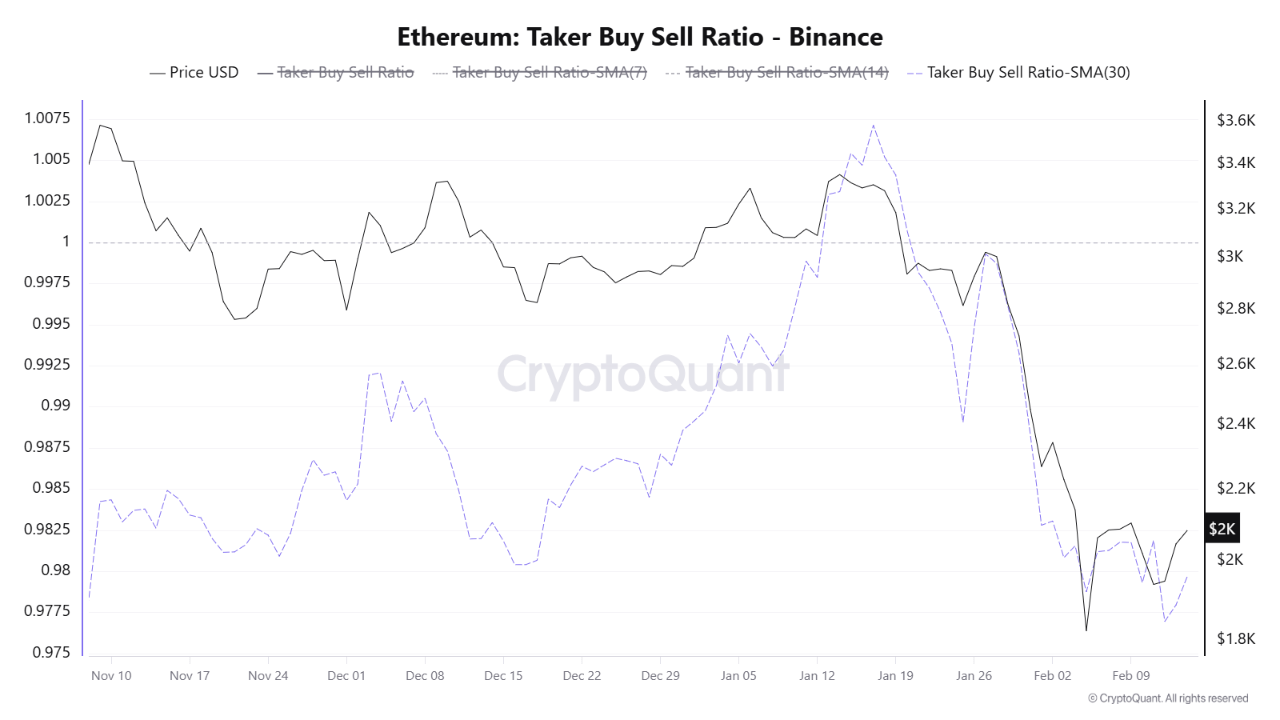
Source: CryptoQuant

What It Means For ETH Price

The decline of the Taker Buy Sell ratio to 0.97 does not guarantee an immediate sell-off; more accurately, it shows that the bears are more likely to profit from Ethereum in the short-term. In the event that this bearish pressure is absorbed by spot demand, a sell-off would not ensue. On the other hand, if demand at key support levels fails to buffer Ethereum’s fall, the second-largest cryptocurrency could fall further.

In addition, if there is a sudden injection of demand, the futures market simultaneously retains its extremely bearish sentiment; the Ethereum market could see a short squeeze, where the leveraged short positions are wiped out, thereby pushing prices to the upside with momentum.

Hence, the Ethereum market is still in a very unstable phase, as prices could go in either direction, and with high momentum, depending on what happens first. As such, market participants are advised to tread the charts with caution. As of this writing, Ethereum holds a valuation of $2,085, reflecting a slight 1.7% gain since the past day, according to data from CoinMarketCap.

ETH trading at $2,076 on the daily chart | Source: ETHSUDT chart on Tradingview.com

Featured image from Flickr, chart from Tradingview

Trending Cryptos

Related Questions

QWhat does the Taker Buy Sell Ratio dropping below 1.00 indicate for the Ethereum futures market?

AIt indicates that taker sell volume is greater than taker buy volume, meaning aggressive sellers are dominating the market.

QAccording to the article, what is the current level of Ethereum's Taker Buy Sell Ratio and why is it significant?

AThe current level is around 0.97, which is the lowest since November 2025, indicating a significant sentiment shift among futures traders towards bearishness.

QWhat are the two potential outcomes for Ethereum's price mentioned in the article, based on the current market pressure?

AIf bearish pressure is absorbed by spot demand, a sell-off may not happen. If demand at key support levels fails, the price could fall further. Alternatively, a sudden demand surge could cause a short squeeze, pushing prices up.

QWhich exchange's data is used for the Taker Buy Sell Ratio analysis in this article?

AThe analysis uses data from Binance, the world's leading cryptocurrency exchange by trading volume.

QWhat is the current price of Ethereum and its 24-hour performance as mentioned in the article?

AEthereum is trading at $2,085, reflecting a 1.7% gain over the past 24 hours.

Related Reads

Bitcoin Withdrawals Continue: 8 Years of Storage in a Coldcard Cold Wallet Ended in Zero

Coldcard Hardware Wallet Hacked: Losses Mount Due to Vulnerable Seed Generation A critical vulnerability in Coldcard hardware wallets has led to a continued wave of fund thefts. According to Galaxy Research, the total stolen has reached 1,367.05 BTC (approx. $88.6 million) from 4,585 addresses, a significant increase from the initial 594.5 BTC reported on July 30, 2026. Most of the stolen funds remain on the attackers' addresses. The issue is not with the current firmware, which Coinkite has updated, but with seed phrases generated on vulnerable devices between March 2021 and the release of fixed firmware versions. Due to a programmer error, devices switched from using a hardware random number generator to the software-based Yasmarang generator, which was initialized with publicly accessible data like the chip's serial number. This made the seed phrases predictable through offline brute-force attacks, meaning wallets remain at risk until funds are moved to a new wallet generated with the patched firmware. Affected devices include Mk2/Mk3 with firmware 4.0.1–4.1.9 (and up to 5.0.3), Mk4/Mk5 up to version 5.6.0, and Q models up to 1.5.0Q. The only exceptions are seeds created with a high-entropy method like at least 50 independent dice rolls or a strong unique BIP-39 passphrase. All other owners must generate a new seed on the fixed firmware and transfer their assets. A case highlighting the human impact involves a 39-year-old long-term investor who lost 2 BTC (approx. $130,000) in minutes. He had accumulated the Bitcoin over eight years through physical labor, viewing it as a financial lifeline and a retirement plan in a country suffering from hyperinflation. His story underscores that even conservative "buy and hold in cold storage" strategies can be compromised by such underlying technical flaws. From a technical perspective, this incident echoes historical failures where weak random number generators undermined cryptographic security, challenging the assumption that offline storage is automatically foolproof.

cryptonews.ru2h ago

Bitcoin Withdrawals Continue: 8 Years of Storage in a Coldcard Cold Wallet Ended in Zero

cryptonews.ru2h ago

Trading

Spot

Hot Articles

Discussions

Welcome to the HTX Community. Here, you can stay informed about the latest platform developments and gain access to professional market insights. Users' opinions on the price of ETH (ETH) are presented below.

活动图片















