Ethereum Anomaly: Full Activity, Dirt-Cheap Fees—What's the Catch Behind It?

比推Published on 2026-01-22Last updated on 2026-01-22

Abstract

Ethereum is experiencing a paradoxical surge in network activity, with daily transactions reaching a record 2.9 million and active addresses doubling, all while maintaining extremely low transaction fees of $0.1-$0.2. This follows major network upgrades like Pectra, Fusaka, and a subsequent blob parameter fork, which significantly increased data capacity and reduced costs. However, security researchers warn this record activity is not driven by organic growth but is largely fueled by industrial-scale "address poisoning" scams. Attackers exploit the low fees to send millions of micro-transactions (dusting) to new wallets, creating fake addresses that mimic a victim's real one in their transaction history. The goal is to trick users into accidentally sending funds to the fraudulent address. Analysis shows that 67% of new addresses received their first transaction as a sub-$1 stablecoin transfer from these poisoning contracts. Despite a success rate of only about 0.01%, the scheme is economically viable due to the low cost of transactions, with identified victims losing around $740,000. This artificial activity inflates on-chain metrics, masking a darker reality where low fees enable large-scale fraud disguised as legitimate adoption.

Author: Oluwapelumi Adejumo

Compiled by: Luffy, Foresight News

Original title: Ethereum Anomaly: Full Activity, Dirt-Cheap Fees—What's the Catch Behind It?


Ethereum's current daily network growth data has hit an all-time high. On the surface, this surge in statistics signals a massive return of user activity.

According to data from Token Terminal, the Ethereum mainnet processed 2.9 million transactions in the past week, setting a new historical record.

At the same time, the number of daily active addresses also saw a significant increase, rising from around 600,000 in late December to approximately 1.3 million.

The key point is that this explosion in throughput occurred while transaction costs remained extremely low. Despite record-high transaction demand, the average fee consistently stayed within the range of $0.1 to $0.2.
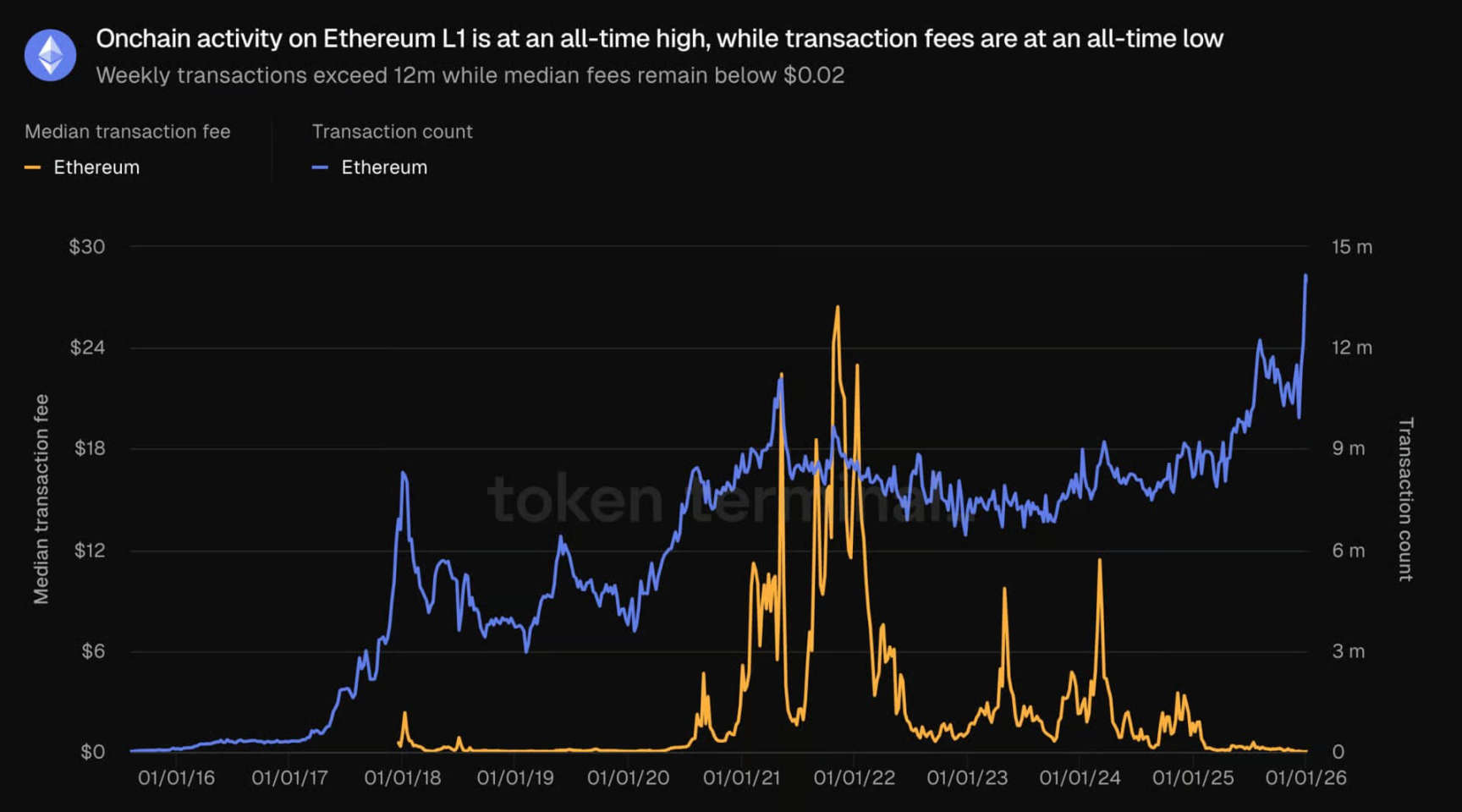
Ethereum On-Chain Activity, Data Source: Token Terminal

For a network like Ethereum, where fees soared to $50 to $200 during the 2021-2022 NFT boom, this change represents a fundamental shift in its transaction accessibility.

However, analysis shows that this growth is not entirely organic. Although surface indicators seem to herald a bull market recovery, security researchers warn that a significant portion of the network's traffic is actually driven by malicious actors.

These attackers are leveraging Ethereum's significantly reduced fees to launch industrial-scale "address poisoning" attack campaigns, disguising automated scam patterns as legitimate transactions to carry out targeted fraud against users.

Context of Network Scaling

To understand this sudden surge in transaction volume, one must focus on the recent structural changes to the Ethereum protocol. For years, the Ethereum network, while powerful, had transaction costs that were prohibitively high for most people.

Leon Waidmann, Head of Research at the Onchain Foundation, pointed out that since he entered the crypto industry, Ethereum mainnet fees have been outrageously high for the average user.

He stated that Ethereum was not only too expensive for retail users but also too costly for building consumer applications.

This situation began to change about a year ago: the Ethereum development team systematically optimized the network's scalability while striving to maintain decentralization and network security.

A series of protocol upgrades were implemented, advancing Ethereum's scaling roadmap, with three core upgrades.

The first was the Pectra upgrade in May 2025, which increased the target Blob data per block from 3 to 6 and the maximum from 6 to 9, directly doubling the expected processing capacity for Blob data.

Subsequently, in December 2025, Ethereum completed the Fusaka upgrade, introducing Peer Data Availability Sampling (PeerDAS). This technology allows validators to verify the availability of Blob data through sampling rather than downloading the full dataset, achieving a further improvement in network processing capacity while ensuring reasonable node operation requirements.

The latest upgrade was the Blob-Only Parameter Fork in January 2026, which increased the target Blob data per block from 10 to 14 and the maximum to 21. These upgrades aimed to unlock significant network processing power for Ethereum.

The economic effects of the upgrades quickly became apparent: Ethereum mainnet fees plummeted, and simple transactions returned to a low-cost state.

Leon Waidmann noted that it is now feasible to develop at scale directly on the Ethereum mainnet, which has also driven prediction markets, real-world asset trading, and payment businesses back to the mainnet.

Meanwhile, the scale of stablecoin transfers on the Ethereum network reached about $8 trillion in the fourth quarter of last year.

Ethereum's Record Activity Lacks Real Value Support

Although the record activity seems to mark Ethereum's rise, on-chain data shows that these transactions are not creating real value for the network.

Data from Alphractal shows that the Metcalfe Ratio, which measures the ratio of market capitalization to the square of the number of active users, is continuously declining. This means Ethereum's valuation growth has failed to keep pace with actual network adoption.
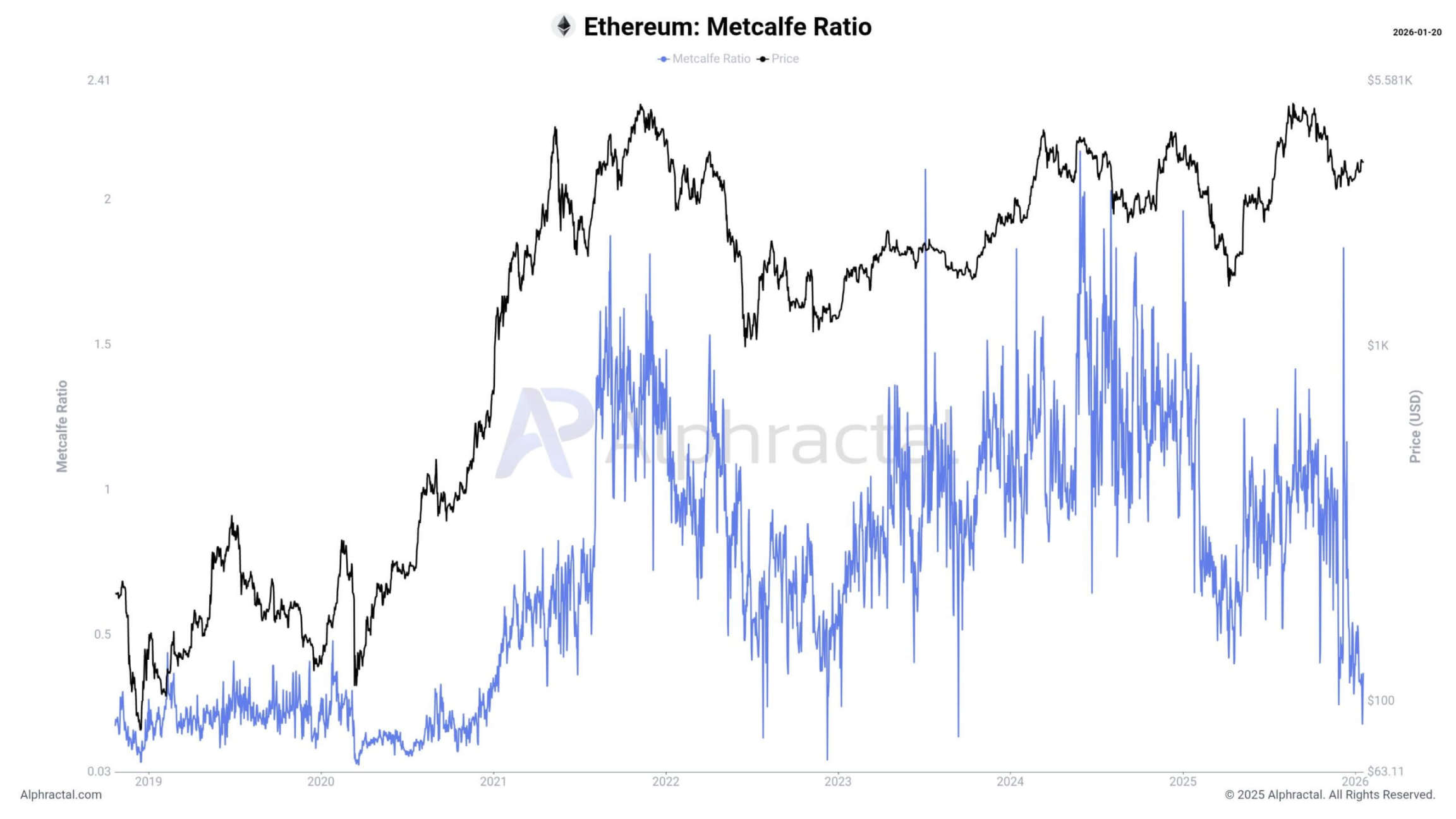
Ethereum's Metcalfe Ratio, Source: Alphracta

Furthermore, Ethereum's Network Adoption Score is currently at Level 1, its lowest historical tier. This data reflects the current market chill, with network valuation being low relative to on-chain activity.

Based on this, Matthias Seidl, co-founder of GrowThePie, believes that Ethereum's current activity surge is not organic.

He cited the example of a single address: this address received 190,000 ETH transfers from 190,000 unique wallets in a single day.

Matthias Seidl pointed out that the number of wallets receiving ETH transfers is relatively stable, but the number of wallets initiating transfers has grown significantly. He also emphasized that a large number of ETH transfers consume only 21,000 Gas, the cheapest transaction type in the Ethereum Virtual Machine (EVM).
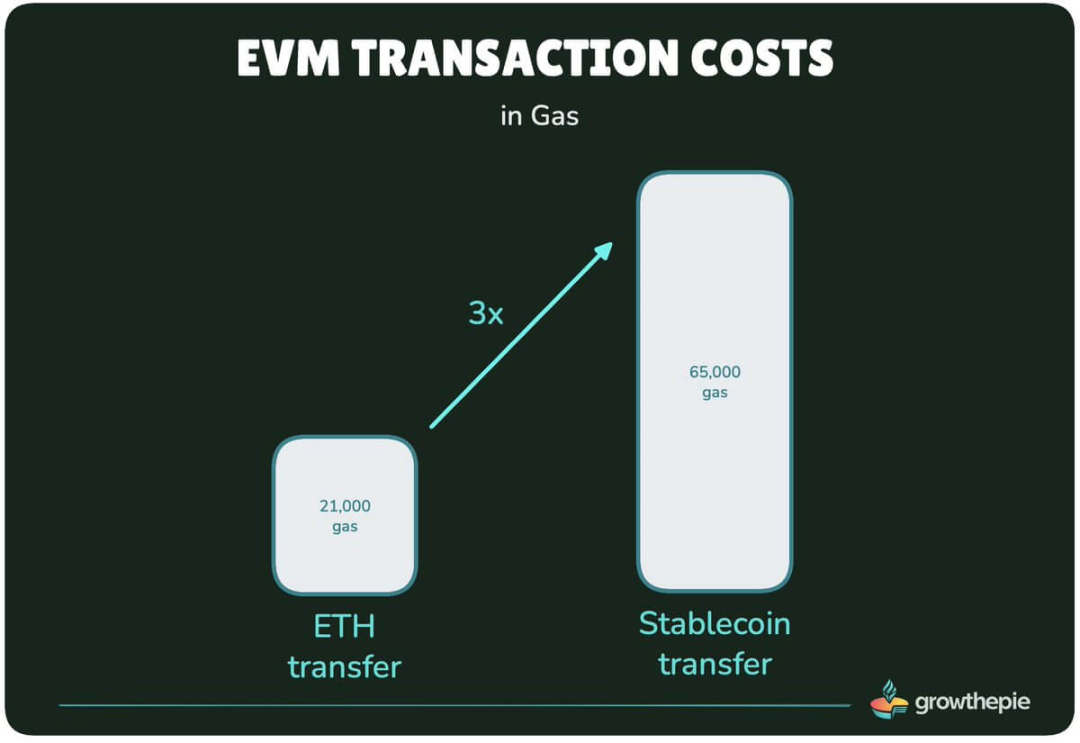
Ethereum EVM Transaction Costs, Data Source: GrowThePie

Currently, these low-cost native transfers account for nearly 50% of all Ethereum transactions. In comparison, sending an ERC20 token requires about 65,000 Gas, and the Gas cost of a stablecoin transfer is equivalent to three ETH transfers.

Address Poisoning: The Scam Makes a Comeback

Meanwhile, the surge in Ethereum's on-chain activity stems from an old scam that has made a comeback in this era of low fees.

Security researcher Andrey Sergeenkov pointed out that since last December, a wave of address poisoning attack campaigns has been spreading wildly by exploiting Ethereum's low Gas fees: while inflating various network metrics, they implant fake addresses into users' transaction histories,诱导 users to transfer real assets to the attackers.

The operation method of this type of attack is very simple: scammers generate "poisoned addresses" that share the same starting and ending characters as the target user's legitimate wallet address; after the victim completes a normal transfer, the attacker sends a small "dust transaction" to them, causing the fake address to appear in the victim's recent transaction history.

They bet that users will later copy this seemingly familiar address directly from their transaction history when making a transfer, without verifying the full address string.

Based on this, Andrey Sergeenkov linked the surge in new Ethereum addresses to this scam technique. He estimated that the current rate of new address creation on Ethereum is about 2.7 times the average level of 2025, with new address creation in the week of January 12th soaring to about 2.7 million.
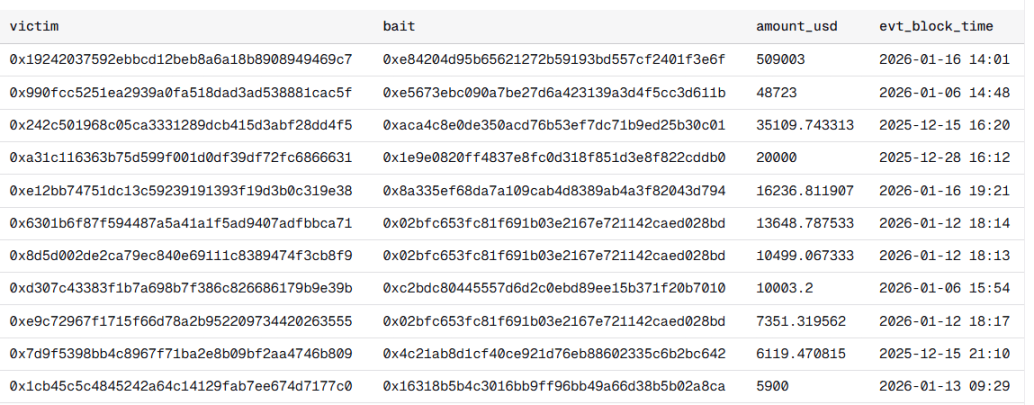
Address Poisoning Attack Victim Data, Data Source: Andrey Sergeenkov

After dissecting the fund flows behind this growth, he concluded that about 80% of the transaction activity is driven by stablecoin transactions, not organic user demand.

To verify if this growth was caused by address poisoning, Andrey Sergeenkov looked for a telltale sign: addresses whose first transaction was receiving a stablecoin transfer of less than $1.

Statistics showed that 67% of new addresses fit this characteristic. Specifically, out of 5.78 million new addresses, 3.86 million addresses had their first stablecoin transaction be receiving a "dust transfer."

Subsequently, he turned his research focus to the initiators of these transfers: counting accounts that sent less than $1 worth of USDT and USDC between December 15, 2025, and January 18, 2026.

Andrey Sergeenkov counted the number of unique recipient addresses for each initiating account and filtered for accounts that initiated transfers to at least 10,000 addresses. He found that behind these accounts were smart contracts specifically designed for the industrial implementation of address poisoning. This type of code can fund and coordinate the operations of hundreds of poisoning addresses in a single transaction.

One contract he studied contained a function labeled `fundPoisoners`, which, according to its description, can distribute stablecoin dust to large batches of poisoning addresses at once, along with a small amount of ETH to pay for Gas fees.

These poisoning addresses then disperse to send dust transfers to millions of potential targets, creating misleading entries in their wallets' transaction histories.

The core of this scam model lies in operating at scale: although most recipients will not fall for it, the entire scheme becomes economically viable as long as a tiny fraction of users are deceived.

Andrey Sergeenkov estimated the actual success rate of this scam to be about 0.01%, meaning its business model is fundamentally built on tolerating an extremely high failure rate. In the dataset he analyzed, 116 victims lost a total of approximately $740,000, with the single largest loss reaching $509,000.

Previously, the biggest constraint for such scams was cost. Address poisoning requires initiating millions of on-chain transactions, which themselves do not directly generate revenue unless a victim sends funds to the wrong address.

Andrey Sergeenkov believes that until late 2025, Ethereum's network fees made this large-scale transfer scam strategy unprofitable. But now, transaction costs have decreased by about 6 times, causing a drastic reversal in the risk-reward ratio, making the scam highly attractive to attackers.

Thus, he pointed out that while Ethereum has increased its transaction processing capacity, if user security protections are not strengthened, it creates a distorted environment: the network's "record-level" activity is indistinguishable from automated malicious behavior.

In his view, the crypto industry's excessive focus on network metrics may掩盖 a darker reality: low-cost block space easily allows scams targeting large-scale users to be whitewashed as legitimate network adoption, and the ultimate losses will be borne by users.


Twitter:https://twitter.com/BitpushNewsCN

BitPush TG Discussion Group:https://t.me/BitPushCommunity

BitPush TG Subscription: https://t.me/bitpush

Original link:https://www.bitpush.news/articles/7605224

Trending Cryptos

Related Questions

QWhat is the main reason behind the recent surge in Ethereum's daily active addresses and transaction volume?

AThe surge is largely driven by malicious actors conducting industrial-scale address poisoning attacks, which exploit Ethereum's significantly reduced transaction fees to send automated scam transactions disguised as legitimate ones.

QHow have Ethereum's recent protocol upgrades contributed to the decrease in transaction fees?

AKey upgrades like Pectra (increasing blob data capacity), Fusaka (introducing PeerDAS for efficient data verification), and the blob parameter fork (further increasing blob targets) have systematically expanded network capacity, making transactions much cheaper.

QWhat is an 'address poisoning' attack and how does it work?

AAddress poisoning is a scam where attackers generate fake wallet addresses that mimic the first and last characters of a victim's legitimate address. After a victim makes a genuine transaction, the attacker sends a small 'dust transaction' to the victim, making the fake address appear in their recent transaction history. The victim might later mistakenly copy this fake address and send funds to the attacker.

QWhat evidence suggests that the increased network activity is not due to organic user adoption?

AAnalysis shows a declining Metcalfe Ratio (indicating valuation isn't keeping pace with user growth), a low network adoption score, and that nearly 50% of transactions are minimal-cost native ETH transfers. Furthermore, 67% of new addresses received their first transaction as a dust stablecoin transfer under $1, characteristic of poisoning attacks.

QWhy have address poisoning attacks become economically viable for scammers recently?

AEthereum's transaction fees have decreased by approximately 6 times due to network upgrades, making it affordable for scammers to launch millions of low-cost transactions. The attack model tolerates an extremely high failure rate (~0.01% success rate) but becomes profitable if even a tiny fraction of victims fall for the scam.

Related Reads

Bank of America Quietly Positions: Could $6 Trillion in Bank Deposits Flow into Stablecoins?

Bank of America (BofA) is making strategic moves in digital assets, appointing senior leaders to advance a platform covering stablecoins, tokenized deposits, custody, and crypto settlement. This comes amid a broader discussion about the potential migration of trillions in bank deposits to stablecoins. A cited TBAC report estimated up to $6.6 trillion in transactional deposits could be at risk of moving to stablecoins long-term, a point BofA's CEO previously conditioned on stablecoins being allowed to pay interest. The regulatory landscape is evolving, with the GENIUS Act setting a final implementation deadline for January 2027. Major banks, however, are not waiting; JPMorgan, Citi, BofA, and others are already developing tokenized deposit networks and services. Industry observers note that while retail crypto trading is sluggish, institutional adoption of stablecoins for real-world use cases is driving growth. Despite the activity, some analysts remain cautious, noting banks have a long history of blockchain announcements and that true structural change is slow. The stablecoin market itself has seen a recent dip from its peak. Optimistic projections, however, foresee significant growth, with stablecoin settlement volume already reaching $33 trillion in 2025. The race is on for the post-January 2027 landscape, where regulatory clarity is expected to accelerate the fusion of traditional finance and crypto.

marsbit2m ago

Bank of America Quietly Positions: Could $6 Trillion in Bank Deposits Flow into Stablecoins?

marsbit2m ago

STAR 50 Soars 10.73%, Why Did A-Shares Stage a "V-Shaped Reversal"?

After a prolonged decline, the Chinese A-share market staged a strong rally on July 21. The STAR 50 index surged 10.73%, its largest single-day gain in nearly a year, leading a broad-based "V-shaped" reversal. The Shanghai Composite Index rose 1.79%, the Shenzhen Component Index gained 4.81%, and the ChiNext Index jumped 7.05%. Total market turnover reached 2.97 trillion yuan, an increase of 256.1 billion yuan from the previous session, with over 3,100 stocks advancing. The semiconductor sector spearheaded the rebound, with related ETFs posting significant gains. Analysts attribute the surge to three converging factors. First, coordinated capital inflows from "national team" institutions, insurance funds, listed company buybacks, and fund house self-purchases have bolstered market liquidity and confidence. Second, supportive policy signals, including commitments from regulators to ensure stable market operations, provided a favorable backdrop. Third, a stabilization and recovery in overseas markets, notably South Korea, created a positive external environment. Institutions suggest the most severe panic selling phase for the tech sector has likely passed, following a significant digestion of crowded positions and leveraged funds. While short-term volatility may persist, the medium to long-term outlook remains underpinned by enduring trends like AI computing demand expansion and semiconductor localization. The market's focus now shifts to the sustainability of supportive fund flows, earnings reports, and upcoming catalysts from the global AI industry chain.

marsbit40m ago

STAR 50 Soars 10.73%, Why Did A-Shares Stage a "V-Shaped Reversal"?

marsbit40m ago

U.S. Tech Momentum Stocks Post Largest Single-Day Gain Ever, But Is the Plunge Over?

US tech momentum stocks staged a sharp rebound on Tuesday (July 21st). Morgan Stanley's TMT Momentum Factor surged over 12%, marking its largest single-day gain on record, exceeding even peaks from the 2000 dot-com bubble. Key momentum indices from Goldman Sachs also posted their strongest daily performances in years. The rally was led by semiconductors, with the Philadelphia Semiconductor Index jumping 4.6%. This rebound followed three consecutive down days and a cumulative 33% plunge in momentum stocks, one of the steepest drawdowns since the dot-com era. Analysts attribute the surge largely to a short squeeze. Heavy selling had pushed high-beta momentum stocks into deeply oversold territory, forcing many short sellers, particularly in Asia, to cover their positions, creating a self-reinforcing buying spiral. However, the rebound's internals appear weak. Trading volume was notably low, and advancing stocks still lagged decliners on the S&P 500, indicating a narrow, concentrated rally rather than broad market participation. Diverging views emerge on the outlook. BTIG warns the bounce has hit key resistance and recommends selling into strength, citing extreme volatility and historical parallels to past market tops. Conversely, Goldman Sachs and UBS believe the momentum unwind is nearing its end, suggesting it may be time to gradually add exposure, as positioning has been significantly reduced. They caution, however, that high volatility warrants a measured approach, potentially using defined-risk strategies. The upcoming earnings season, particularly reports from major tech firms like Alphabet, is seen as a critical test for the rally's sustainability. Simultaneously, bond markets flashed a warning, with yields rising partly due to spiking oil prices. Analysts note that if long-term Treasury yields break decisively higher, it could pose a significant headwind for equities, especially growth stocks.

marsbit48m ago

U.S. Tech Momentum Stocks Post Largest Single-Day Gain Ever, But Is the Plunge Over?

marsbit48m ago

U.S. Tech Momentum Stocks Record Largest Single-Day Gain Ever, but Has the Rout Ended?

U.S. tech momentum stocks staged a dramatic rebound on Tuesday, July 21st. Key momentum indices like the Morgan Stanley TMT Momentum Factor and Goldman Sachs' High Beta Momentum Long Index posted historic or near-historic single-day gains, fueled largely by semiconductor stocks. This sharp rally followed a severe three-day sell-off that saw momentum stocks plunge 33%, marking one of the steepest pullbacks since the dot-com bubble. Analysts attribute the bounce primarily to a short squeeze, as forced covering from over-leveraged traders, particularly in Asia, created a buying spiral. However, the rally's health is questioned due to weak market breadth—overall trading volume was low, and decliners outnumbered advancers in the S&P 500 despite the index's gain—suggesting a narrow, concentrated surge rather than broad recovery. Opinions on the sustainability diverge. BTIG strategists warn the rebound has hit key resistance levels, citing extreme volatility and historic stock dispersion as signs of an ongoing broader correction, and recommend selling into strength. Conversely, Goldman Sachs and UBS view the aggressive momentum unwinding as nearing its end, noting reduced positioning and a lack of new fundamental catalysts. They suggest the sell-off presents a selective opportunity to add exposure, albeit cautiously and gradually using defined-risk strategies. The immediate trajectory hinges on the ongoing earnings season, with market focus on Alphabet's capital expenditure guidance for AI investment clarity. Meanwhile, bond markets present a risk, with rising Treasury yields—potentially heading toward 5.5%—and widening credit spreads for mega-cap tech companies posing a threat to equity valuations. The combination of technical factors, earnings results, and macro conditions leaves the durability of the rebound in doubt.

链捕手50m ago

U.S. Tech Momentum Stocks Record Largest Single-Day Gain Ever, but Has the Rout Ended?

链捕手50m ago

Trading

Spot

Hot Articles

Discussions

Welcome to the HTX Community. Here, you can stay informed about the latest platform developments and gain access to professional market insights. Users' opinions on the price of ETH (ETH) are presented below.

活动图片