Ethereum And Solana Are Topping Developer Activity Again, But Why Are Their Prices Struggling?

bitcoinistPublished on 2026-03-14Last updated on 2026-03-14

Abstract

Despite leading in crypto developer activity, Ethereum and Solana are experiencing significant price struggles. Data from Artemis shows Ethereum’s ecosystem, particularly its EVM, leads with 31,620 weekly commits, followed by Solana’s SVM with 7,056. However, both networks have seen sharp declines: Ethereum’s weekly commits dropped 54% and developer activity fell 34% over three months, while Solana saw declines of 43% and 40%, respectively. The broader crypto ecosystem has also suffered, with weekly commits plummeting from 870,900 in March last year to 217,500 in February. Analysts attribute the price weakness to an ongoing bear market. CryptoQuant’s Julio Moreno suggests Ethereum could fall to $1,500 by late 2024 if the downturn continues, citing an “adoption paradox” where network activity rises while prices fall. Market experts predict further declines, with Bitcoin potentially bottoming between September and October.

Ethereum and Solana are currently leading developer activity in the crypto space, while developer activity in the broader ecosystem declines. This comes as prices continue to struggle with the ongoing war between the U.S. and Iran, which is sparking rising oil prices.

Ethereum And Solana Lead Developer Activity Amid Broad Decline

Artemis data show that the Ethereum and Solana ecosystems are leading in developer activity amid declines in weekly commits and weekly active developers in crypto. In the Ethereum ecosystem, the Ethereum Virtual Machine (EVM) is seeing the most activity, with 31,620 weekly commits.

It is worth noting that several sectors in the Ethereum ecosystem currently rank among the top seven in developer activity. Meanwhile, the Solana ecosystem comes next, with the Solana Virtual Machine (SVM) Layer 1 and Layer 2 seeing the most activity, at 7,056 weekly commits. However, there has been a significant decline in the crypto ecosystem as a whole.

Further data from Artemis shows that weekly commits have dropped from a yearly high of around 870,900 in March last year to as low as 217,500 in February. Notably, weekly commits crashed around the time of the crypto market’s infamous ‘October 10’ crash, which led to the largest liquidation event in crypto history.
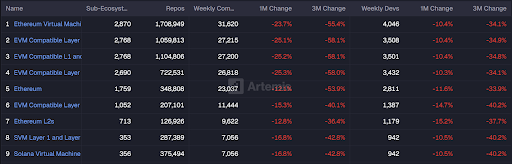
Source: Chart from Artemis

Similarly, the weekly active developers have also declined from a yearly high of 10,600 in May last year to as low as 4,000. This metric has been declining since the October 10 crypto market crash, suggesting that current price action is affecting developer sentiment. Ethereum and Solana have also seen declines in their weekly commits and developer activity despite leading in these metrics.

The Ethereum network has seen a 54% decline in weekly commits over the last three months and a 34% decline in developer activity over this same period. Meanwhile, the Solana network has seen 43% decline in weekly commits over the last three months and a 40% decline in developer activity over the same period.

Why Prices Continue To Struggle

Ethereum and Solana prices continue to struggle, as experts note that the crypto market is in a bear market. CryptoQuant’s Head of Research, Julio Moreno, recently reiterated this, stating that the bear market is still on despite the relief rally that Bitcoin saw this week, which pushed ETH and SOL higher.

Market analyst Doctor Profit recently stated that Bitcoin is likely to bottom between September and October, suggesting that Ethereum and Solana could still see larger declines. Meanwhile, Moreno told The Block that ETH could decline to $1,500 by the third quarter of this year or the early part of the fourth quarter if the bear market persists. The analyst also noted that Ethereum is facing an “adoption paradox,” with network activity rising while the ETH price falls.

ETH trading at $2,077 on the 1D chart | Source: ETHUSDT on Tradingview.com

Trending Cryptos

Related Questions

QAccording to the article, which two ecosystems are leading in developer activity despite a broad decline in the crypto space?

AEthereum and Solana are leading in developer activity.

QWhat major external event is mentioned as a reason for the struggling crypto prices?

AThe ongoing war between the U.S. and Iran, which is sparking rising oil prices.

QWhat was the largest liquidation event in crypto history, as referenced in the article?

AThe 'October 10' crash.

QWhat specific 'paradox' is Ethereum facing, according to CryptoQuant's Head of Research?

AAn 'adoption paradox,' where network activity is rising while the ETH price falls.

QWhat price level did analyst Julio Moreno suggest ETH could decline to if the bear market persists?

A$1,500 by the third quarter of this year or the early part of the fourth quarter.

Related Reads

Bitcoin Withdrawals Continue: 8 Years of Storage in a Coldcard Cold Wallet Ended in Zero

Coldcard Hardware Wallet Hacked: Losses Mount Due to Vulnerable Seed Generation A critical vulnerability in Coldcard hardware wallets has led to a continued wave of fund thefts. According to Galaxy Research, the total stolen has reached 1,367.05 BTC (approx. $88.6 million) from 4,585 addresses, a significant increase from the initial 594.5 BTC reported on July 30, 2026. Most of the stolen funds remain on the attackers' addresses. The issue is not with the current firmware, which Coinkite has updated, but with seed phrases generated on vulnerable devices between March 2021 and the release of fixed firmware versions. Due to a programmer error, devices switched from using a hardware random number generator to the software-based Yasmarang generator, which was initialized with publicly accessible data like the chip's serial number. This made the seed phrases predictable through offline brute-force attacks, meaning wallets remain at risk until funds are moved to a new wallet generated with the patched firmware. Affected devices include Mk2/Mk3 with firmware 4.0.1–4.1.9 (and up to 5.0.3), Mk4/Mk5 up to version 5.6.0, and Q models up to 1.5.0Q. The only exceptions are seeds created with a high-entropy method like at least 50 independent dice rolls or a strong unique BIP-39 passphrase. All other owners must generate a new seed on the fixed firmware and transfer their assets. A case highlighting the human impact involves a 39-year-old long-term investor who lost 2 BTC (approx. $130,000) in minutes. He had accumulated the Bitcoin over eight years through physical labor, viewing it as a financial lifeline and a retirement plan in a country suffering from hyperinflation. His story underscores that even conservative "buy and hold in cold storage" strategies can be compromised by such underlying technical flaws. From a technical perspective, this incident echoes historical failures where weak random number generators undermined cryptographic security, challenging the assumption that offline storage is automatically foolproof.

cryptonews.ru4h ago

Bitcoin Withdrawals Continue: 8 Years of Storage in a Coldcard Cold Wallet Ended in Zero

cryptonews.ru4h ago

Trading

Spot

Hot Articles

Discussions

Welcome to the HTX Community. Here, you can stay informed about the latest platform developments and gain access to professional market insights. Users' opinions on the price of ETH (ETH) are presented below.

活动图片















