Ethereum Activity Hits 7-Month Low: Active Addresses Drop 32% From August Peak

bitcoinistPublished on 2025-12-16Last updated on 2025-12-16

Abstract

Ethereum is facing significant challenges as it trades below the $3,200 level, with declining market sentiment and persistent selling pressure. On-chain data reveals a sharp contraction in network activity, with the 7-day SMA of Active Addresses dropping to 327,000—a 32% decrease from August's peak of 483,000 and the lowest level since May 2025. This decline in active users signals reduced network demand and cooling investor interest, historically correlated with bearish trends. Both price and network activity have fallen simultaneously, indicating diminished speculative participation and a lack of fundamental strength. For a sustained recovery, Ethereum needs a revival in active addresses to signal returning demand and ecosystem health.

Ethereum is struggling to regain traction as it continues to trade below the critical $3,200 level, weighed down by persistent selling pressure and growing macro uncertainty. Market sentiment has deteriorated notably in recent weeks, with many analysts increasingly calling for a broader bear market phase.

From a structural perspective, ETH remains below several key technical levels that previously acted as support, reinforcing the perception that downside risks are still present and that bullish momentum remains fragile.

Beyond price action, on-chain data is beginning to confirm this cautious outlook. According to a CryptoQuant report by CryptoOnchain, Ethereum’s network activity has contracted sharply, signaling a meaningful decline in underlying demand. The 7-day Simple Moving Average (SMA) of Active Addresses has fallen to 327,000, marking the lowest reading since May 2025.

This represents a significant pullback from earlier cycle highs and suggests that fewer users are actively interacting with the Ethereum network.

Historically, sustained bullish trends in ETH have been supported by expanding network usage and rising participation. The current decline in active addresses indicates a reduction in network utility, often associated with cooling investor interest and the exit of short-term participants.

Ethereum Network Activity Signals Cooling Demand

According to the CryptoQuant report, the current decline in Ethereum’s Active Addresses represents a sharp pullback from the peak of roughly 483,000 addresses recorded in August. Since that high, network participation has steadily weakened, highlighting a clear loss of momentum in on-chain activity.

This contraction has closely mirrored Ethereum’s market performance over the same period. As active addresses declined, ETH’s price corrected significantly, falling from a cycle high near $4,800 to the current $3,100 area.
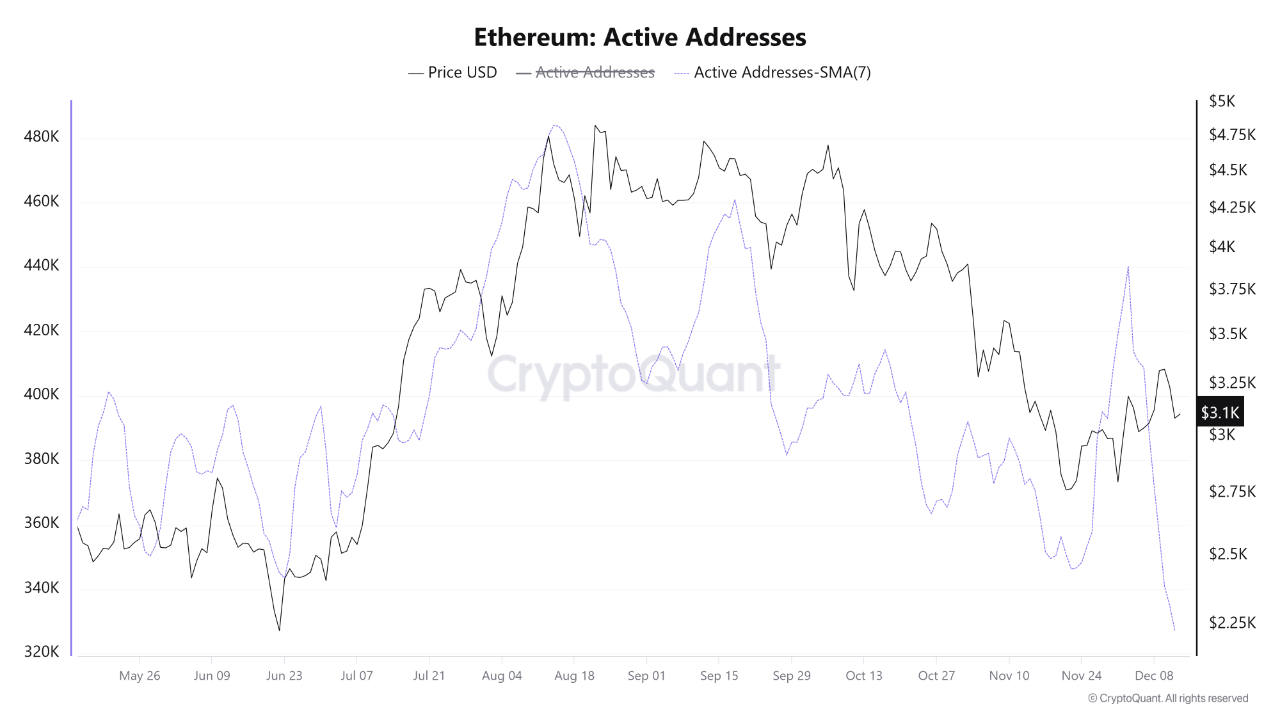
Ethereum Active Addresses | Source: CryptoQuant

The simultaneous drop in both price and network activity is a critical signal. It suggests a reduction in demand for block space and points to a potential exit of retail traders or short-term participants who typically drive spikes in transaction activity during strong bullish phases. When fewer users interact with the network, it often reflects lower speculative interest and diminished transactional demand.

In a healthy and sustainable bull market, rising prices are usually accompanied by expanding network usage, with active addresses trending higher as adoption and participation grow. The current divergence from that pattern indicates a cooling ecosystem rather than an acceleration phase.

For Ethereum to establish a durable price reversal, this metric will be essential to watch. A sustained recovery in Active Addresses would be one of the clearest early signals that demand is returning and that the network is regaining fundamental strength.


Trending Cryptos

Related Reads

Bitcoin Mining Farms Are Becoming AI Factories

Bitcoin mines are transforming into AI factories. This shift is driven by the convergence of three key assets from the previous crypto cycle: infrastructure, talent, and capital. Crypto mining companies like Crusoe, CoreWeave, and Bitdeer are repurposing their core competency—securing power, land, and grid connections in remote locations—to build data centers for AI clients. These firms are signing multi-billion dollar, long-term contracts with companies like Anthropic, AWS, and Microsoft, as AI's demand for reliable, high-capacity compute surpasses the profitability of Bitcoin mining. Simultaneously, crypto entrepreneurs and engineers are applying their skills to new AI ventures. Examples include OpenSea's co-founder launching OpenRouter (an AI model aggregator), and former Coinbase engineers building Fal.ai (a generative media infrastructure platform). Their experience in building scalable, global software networks translates effectively to the AI space. Furthermore, capital accumulated during the crypto boom is now fueling AI. Figures like Jed McCaleb (co-founder of Ripple) funded Voltage Park, a large-scale GPU cloud provider. Notably, some crypto investments, like FTX's early bets on Anthropic and Cursor, have generated astronomical paper returns, demonstrating how high-risk crypto capital flowed into AI before it became mainstream. The transition is not just about repurposing hardware, but about redirecting critical resources—power infrastructure, distributed systems expertise, and venture funding—to the next technological frontier: artificial intelligence.

链捕手22m ago

Bitcoin Mining Farms Are Becoming AI Factories

链捕手22m ago

Morpho Launches Fixed-Rate Product Midnight: Lenders and Borrowers Set Their Own Rates, Ending the Era of Interest Rate Models

Morpho Launches Fixed-Rate Product Midnight: Lenders and Borrowers Set Their Own Rates, Ending the Era of Algorithmic Interest Models On-chain lending has grown to $60 billion but remains minuscule compared to traditional finance's $200 trillion annual credit volume. Morpho identifies the lack of fixed rates and maturity dates as key bottlenecks. Institutions need predictability, not the passive floating rates set by algorithmic models. Midnight allows lenders and borrowers to directly quote rates, set terms, and become price makers, not takers. Fixed-rate lending is now viable due to cheaper, faster blockchains and the entry of institutions demanding control and certainty over returns, costs, and duration. Morpho Blue previously gave users control over risk; Midnight adds control over interest rates. Past attempts at on-chain fixed-rate lending failed primarily because they were built on top of floating-rate pools (creating unpredictability) or lacked sufficient active participants. Midnight avoids these pitfalls as a standalone primitive with fixed rates at its core, built upon Morpho Blue's existing large and active user base. Midnight offers distinct value: institutions gain predictable term structures and full control; fintech companies can offer tailored fixed-rate products; lenders/borrowers achieve predictability and efficiency; and curators can now differentiate by configuring both risk and interest rates. Morpho Midnight is not a replacement for Morpho Blue. The Morpho network will now feature two complementary market structures: floating-rate/open-term (Blue) for flexibility and fixed-rate/fixed-term (Midnight) for predictability. Liquidity can flow between them. The launch will be gradual, prioritizing security. Initially, it will support direct lending on Base network with one trading pair (cbBTC/USDC) and limited maturity dates. Advanced features like auto-rollovers will be introduced later.

marsbit23m ago

Morpho Launches Fixed-Rate Product Midnight: Lenders and Borrowers Set Their Own Rates, Ending the Era of Interest Rate Models

marsbit23m ago

Trading

Spot

Hot Articles

Discussions

Welcome to the HTX Community. Here, you can stay informed about the latest platform developments and gain access to professional market insights. Users' opinions on the price of ETH (ETH) are presented below.

活动图片














