Ethereum Accumulation Addresses See Continued Capital Inflows While Market Volatility Persists

bitcoinistPublished on 2026-03-02Last updated on 2026-03-02

Abstract

Despite bearish pressure and increased market volatility causing Ethereum's price to drop below $2,000, accumulation addresses continue to see steady capital inflows. Data from analyst CW shows persistent buying activity from large holders, indicating strong long-term conviction among strategic investors. This accumulation trend began in May 2025 at around $2,500, making the current price levels more attractive. However, hedge funds have been increasing short positions on both ETH and BTC since mid-February, suggesting institutional expectations of further downside or hedging against market risk. This divergence highlights ongoing tension between long-term accumulation and short-term bearish sentiment in the market.

As bearish pressure returns to the cryptocurrency market, the price of Ethereum has lost the $2,000 level. Despite the fact that volatility still lingers, conviction is building among investors again, as indicated by the steady inflows of capital into ETH accumulation wallet addresses.

A Steady Stream Of Ethereum Flows

Ethereum’s price may be struggling with ongoing volatility, causing it to revisit a key support level, but the activity of investors is painting a different story. A recent report indicates a persistent bullish sentiment and activity among ETH investors, who appear to be buying more of the leading altcoin.

This interesting report from CW, an investor and crypto analyst, reflects a steady flow of ETH into accumulation addresses even as broader market volatility fails to die down. Traders are currently on edge because of price fluctuations and market uncertainty, but the chart shows that deliberate players are gradually growing their exposure to the altcoin.

CW highlighted that the inflow of ETH into accumulation wallet addresses has continued for the past few months, as seen on the chart. Such a trend indicates that strategic investors are showing strong conviction in a turbulent environment and continued waning price action.
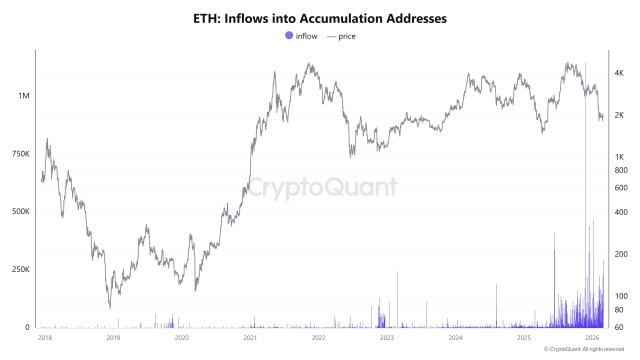
Source: Chart from CW on X

It is worth noting that the full-scale accumulation of ETH by large holders or whales started in May 2025. During the period, the expert noted that the price of Ethereum was trading at around the $2,500 level. Meanwhile, the current price is positioned at $2,000, but these investors are still stacking the altcoin.

Furthermore, whales find the position much more alluring because this is less than the original accumulation price of $2,500. Even with the drop in price, the accumulation of ETH still lingers. In the past, persistent ETH migration into accumulation wallets during turbulent times has frequently indicated a change in positioning from speculative to long-term.

Hedge Funds Turn Bearish On ETH And BTC

The market is highly volatile, and Ethereum and Bitcoin are quietly battling with newfound pressure. This fresh pressure is coming from Hedge Funds, who appear to be significantly stacking up on short positions in both assets across major derivatives markets.

CW took to the X platform to report that these players have been opening short positions in BTC and ETH between February 16 and 20, which signals that sophisticated investors are bracing for further downside or hedging against broader market risk. According to the investor, the cohort is the main factor dragging the market toward the downside direction.

Last week, these investors held more short positions, but this week has seen further declines. While the data is one week apart, this week’s data will be entering the market next week. As a result, the shifts in their holdings in the data that will be published to the public the following week are crucial. Rising short interest more immediately indicates a defensive posture from institutional participants, and it can also occasionally precede strong squeezes if sentiment changes.

ETH trading at $1,934 on the 1D chart | Source: ETHUSDT on Tradingview.com

Trending Cryptos

Related Questions

QWhat is the current price of Ethereum mentioned in the article, and what key level has it lost?

AThe current price of Ethereum is positioned at $2,000, and it has lost the $2,000 level.

QAccording to the report from analyst CW, what activity are strategic investors engaged in despite market volatility?

AStrategic investors are steadily accumulating ETH, with continuous capital inflows into accumulation wallet addresses for the past few months.

QWhen did the full-scale accumulation of ETH by large holders or whales begin, and at what price was Ethereum trading at that time?

AThe full-scale accumulation of ETH by large holders or whales started in May 2025, when Ethereum was trading at around the $2,500 level.

QWhat recent activity have Hedge Funds undertaken regarding Bitcoin and Ethereum in major derivatives markets?

AHedge Funds have been opening short positions in both Bitcoin and Ethereum, signaling a bearish stance or hedging against broader market risk.

QWhat does a persistent migration of ETH into accumulation wallets during turbulent times typically indicate?

AA persistent migration of ETH into accumulation wallets during turbulent times frequently indicates a change in positioning from speculative to long-term investment.

Related Reads

Annual Salary of Millions Competing for Electricians, Meta Rushes to Open Its Own Technical School

The AI boom is facing an unexpected bottleneck: a severe shortage of skilled construction workers and electricians. As tech giants like Meta, OpenAI, and Alphabet race to build massive data centers—such as OpenAI's $16 billion "Stargate" project—they are hitting a critical labor wall. The U.S. needs an estimated 130,000 more electricians, 240,000 construction workers, and 150,000 supervisors by 2030 for AI infrastructure alone, but tens of thousands of electrician jobs go unfilled each year. While AI companies offer high premiums, with electricians earning up to $280,000 annually, worker scarcity still causes massive losses—delays on a single project can cost $14.2 million per month. The complexity of building AI data centers, which require immense power (equivalent to powering hundreds of thousands of homes), sophisticated electrical systems, and advanced liquid cooling solutions, demands highly skilled technicians who are in short supply. To combat this, companies are investing heavily in training. Meta has committed $115 million to a free training school offering tuition, housing, and stipends, targeting 5,000 new workers. OpenAI is partnering with unions to secure skilled labor. These efforts are paying off, with a significant rise in Gen Z interest in trade schools over college. However, the power demands are staggering. AI data centers are driving a rapid surge in electricity consumption, projected to account for up to 12% of U.S. power use by 2028 and raising costs for consumers. Furthermore, the construction boom is project-based, leading to a potential future glut of trained workers once building peaks, which could depress wages industry-wide. The race for AI supremacy now depends as much on skilled hands as on advanced chips.

marsbit1h ago

Annual Salary of Millions Competing for Electricians, Meta Rushes to Open Its Own Technical School

marsbit1h ago

OpenAI No Longer Sells Its Most Expensive Model for Profit

OpenAI is shifting its business strategy away from promoting its most expensive, flagship models for every task. Recent price cuts—80% for GPT-5.6 Luna and 20% for Terra—signal a deeper change: the company now actively advises users that many tasks don't require the most powerful model. Instead, OpenAI recommends a tiered approach: use the high-end GPT-5.6 Sol for complex planning and analysis, then delegate execution to cheaper models like Luna. This mirrors moves by Anthropic, which recently launched Claude Opus 5 at half the price of its top model, Fable 5. Both companies are de-emphasizing flagship models as primary revenue drivers, using them instead for brand prestige and technological showcases. The industry is entering a "mass-market" phase, similar to automotive, where high-volume, cost-effective models handle daily operations and drive scale. OpenAI's price reductions are partly enabled by AI models themselves optimizing underlying code and infrastructure, creating a self-reinforcing cycle of efficiency gains and cost reduction. Competition is shifting from "who is smartest" to "who offers the best value." The goal is no longer selling individual models but fostering widespread API adoption and ecosystem lock-in. By making AI calls cheap and ubiquitous, companies like OpenAI aim to become the indispensable, utility-like infrastructure powering automated workflows—the "water and electricity" of software, quietly embedded everywhere.

marsbit1h ago

OpenAI No Longer Sells Its Most Expensive Model for Profit

marsbit1h ago

Trading

Spot

Hot Articles

Discussions

Welcome to the HTX Community. Here, you can stay informed about the latest platform developments and gain access to professional market insights. Users' opinions on the price of ETH (ETH) are presented below.

活动图片















