Ether price trend forecasts triple-digit rally as ETH ETF inflows resume

cointelegraphPublished on 2025-12-11Last updated on 2025-12-11

Abstract

Ether (ETH) price is consolidating near $3,200 after facing resistance between $3,350 and $3,650, a zone aligned with the 200-day EMA. Despite this pullback, spot ETH ETF inflows have shown early signs of recovery, rising 28% from $16.8 billion to $21.5 billion since November 21. Net taker volume, while still negative at –$138 million, has improved significantly from October’s –$500 million, indicating reduced selling pressure and a potential shift in market structure. If this trend continues, it could signal a bullish breakout, reminiscent of early 2025 before ETH’s 3x rally. However, ETH is currently testing key support between $3,100–$3,180. A hold above this level could lead to a rebound toward $3,450 and possibly $3,900, while a breakdown might trigger a retest of $3,000. Derivatives data shows neutral but fragile sentiment, with mildly positive funding rates and near-neutral bid/ask ratios. The next major price move depends on whether improving ETF inflows and taker activity translate into sustained buying pressure.

Ether’s (ETH) price action cooled this week after a sharp rejection from the $3,650 to $3,350 supply zone, with the altcoin now hovering near $3,200. The rejection aligned with the 200-day exponential moving average (EMA), reinforcing overhead resistance just as spot exchange-traded funds (ETFs) flows began showing early signs of recovery.

Key takeaways:

  • Spot Ether ETF flows have risen from $16.8 billion to $21.5 billion since Nov. 21, a 28% increase.

  • Net taker volumes rose, signaling that aggressive sellers are weakening while taker buyers slowly return.
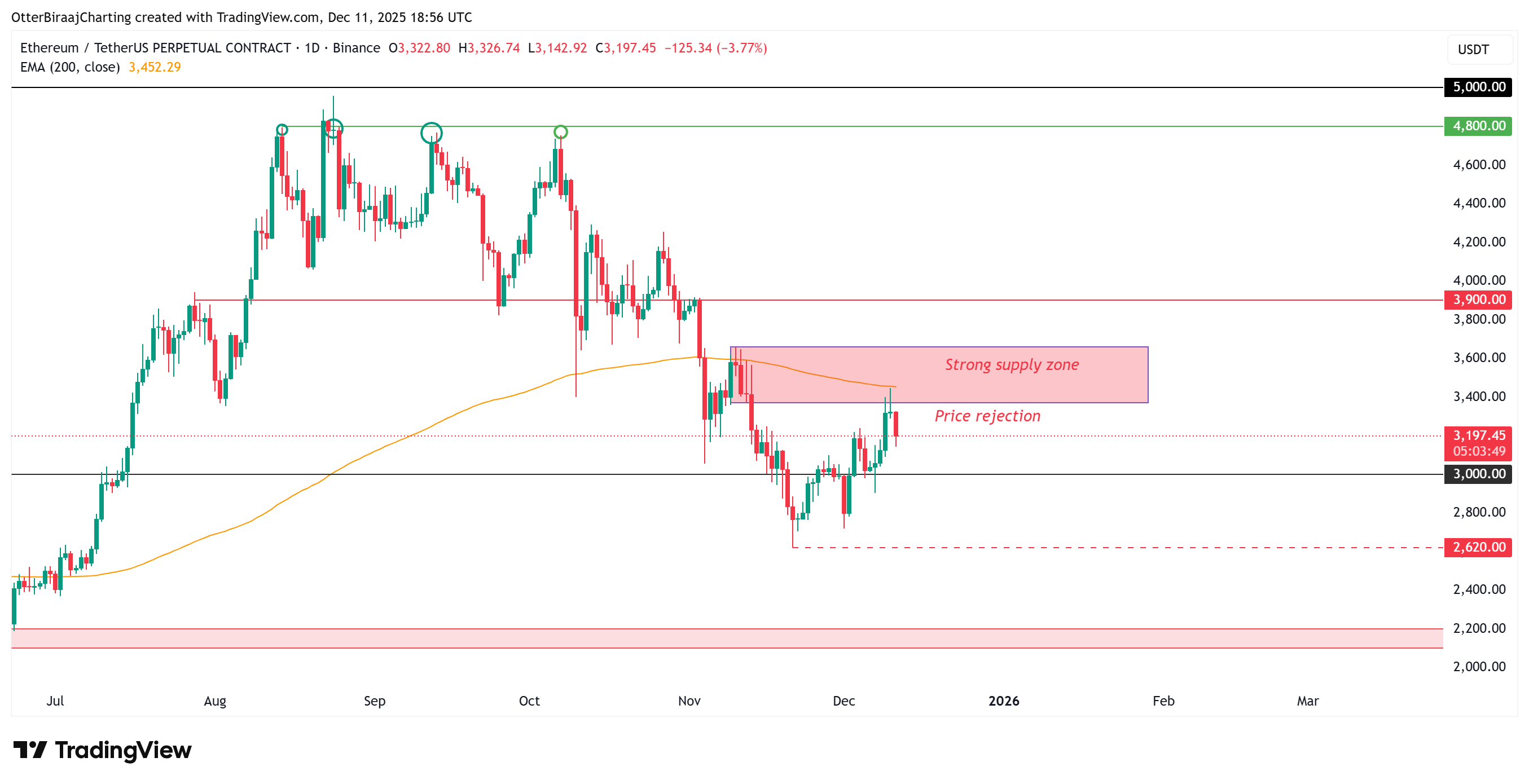
Ethereum one-day chart. Source: Cointelegraph/TradingView

ETF inflows resume, but ETH charts reflect traders’ fear

According to Glassnode, spot ETH ETFs are finally showing “the first signs of life” after several weeks of outflows. A 28% recovery since Nov. 21 in total net ETF assets hints at improving demand into year-end.

However, the rebound is still modest compared to the $32 billion peak in early October, suggesting that institutional conviction has not fully returned.
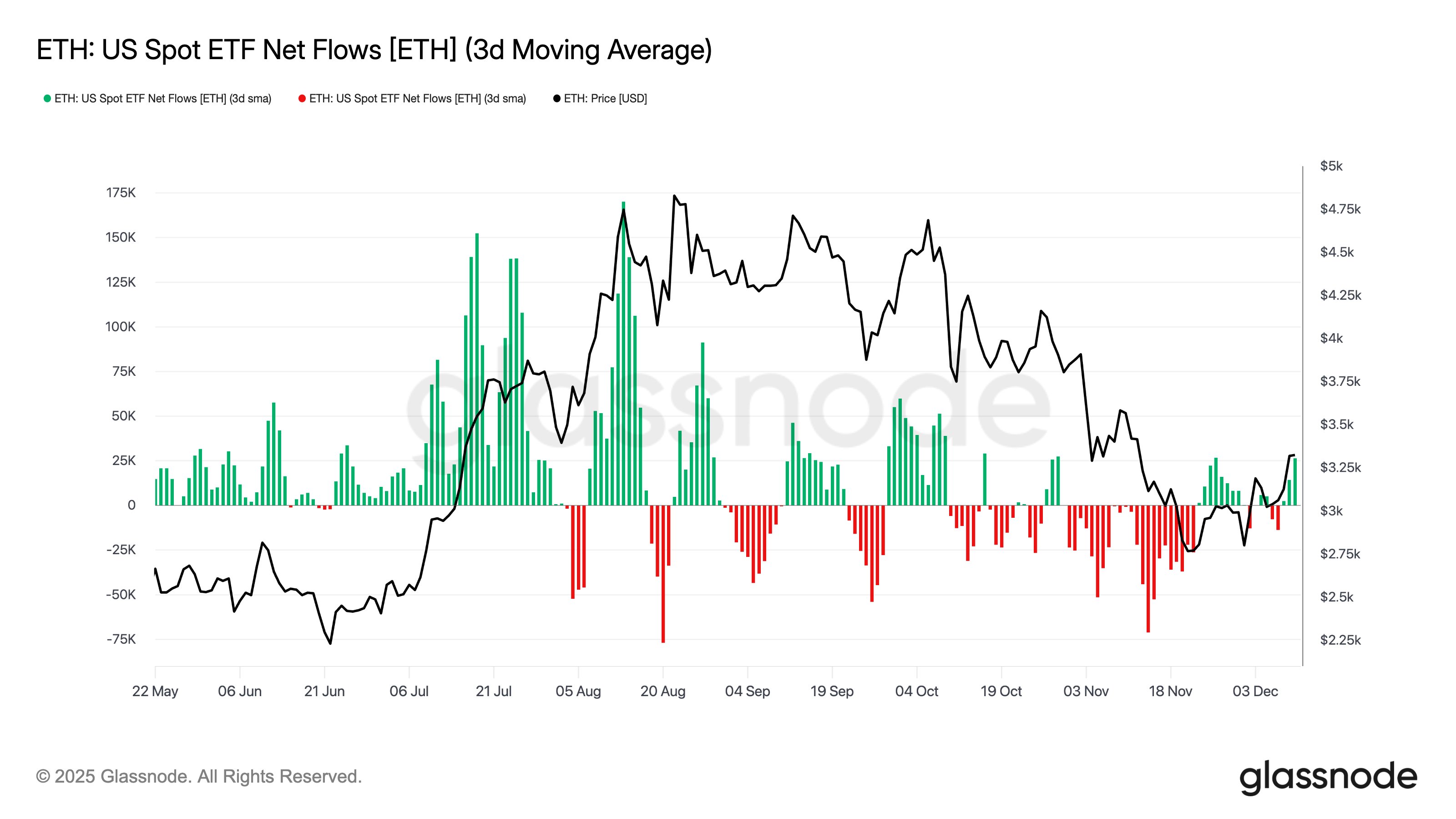
Spot ETH ETF net flows. Source: Glassnode

Data from CryptoQuant strengthened this narrative. The net taker volume remained negative at –$138 million, yet the improvement from October’s –$500 million extreme marks a structural shift. Aggressive sellers dominated the market during the September–October drawdown, but that dynamic is slowly fading.

The 30-day moving average of net taker volume also shows an ascending pattern in its lows, a structure last seen in early 2025, just before ETH launched a 3X rally and printed a new all-time high.

If the current trajectory holds, a positive flip in taker volume activity could be a high-probability trigger for another bullish breakout phase for ETH in the coming weeks.
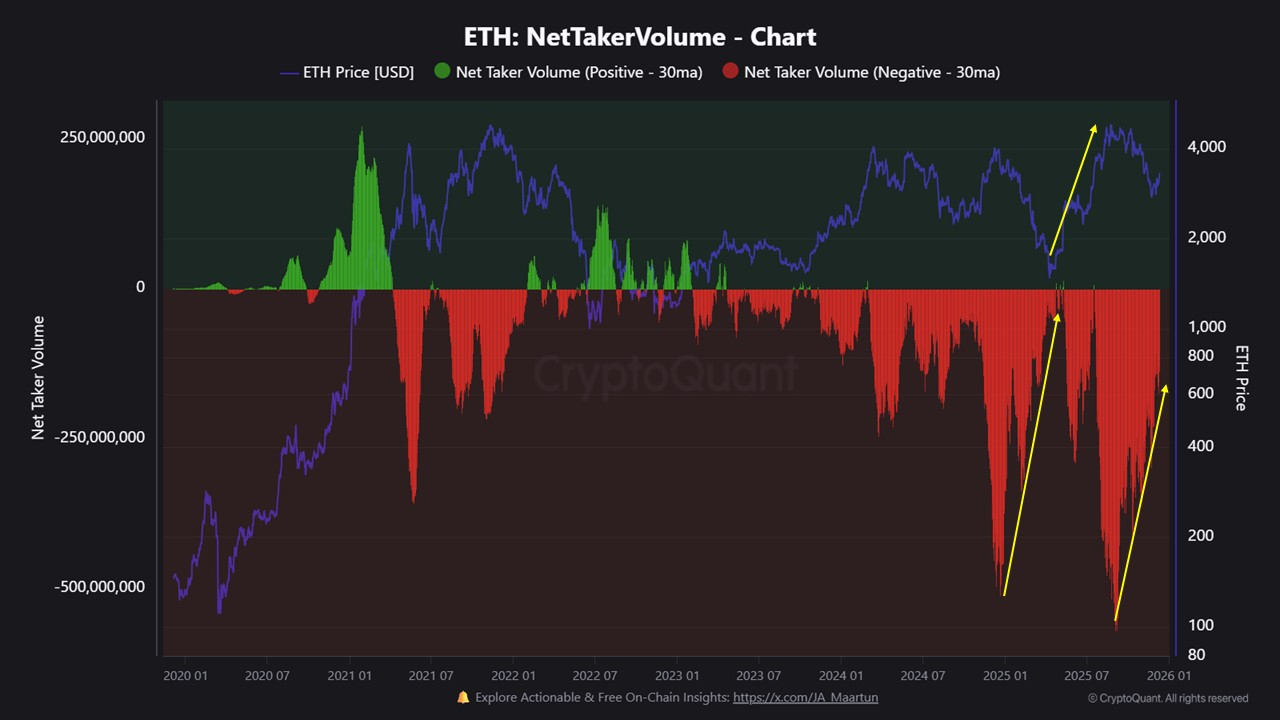
Ether Net taker volume data. Source: CryptoQuant

Related: Ether vs. Bitcoin: ETH price poised for 80% rally in 2026

ETH price compresses at support as derivatives cool off

Ether is currently testing the $3,100–$3,180 order block on the four-hour chart, a region that could serve as a demand zone. ETH price continued to respect its ascending channel, but momentum is clearly cooling. The market is now at a structural crossroads.
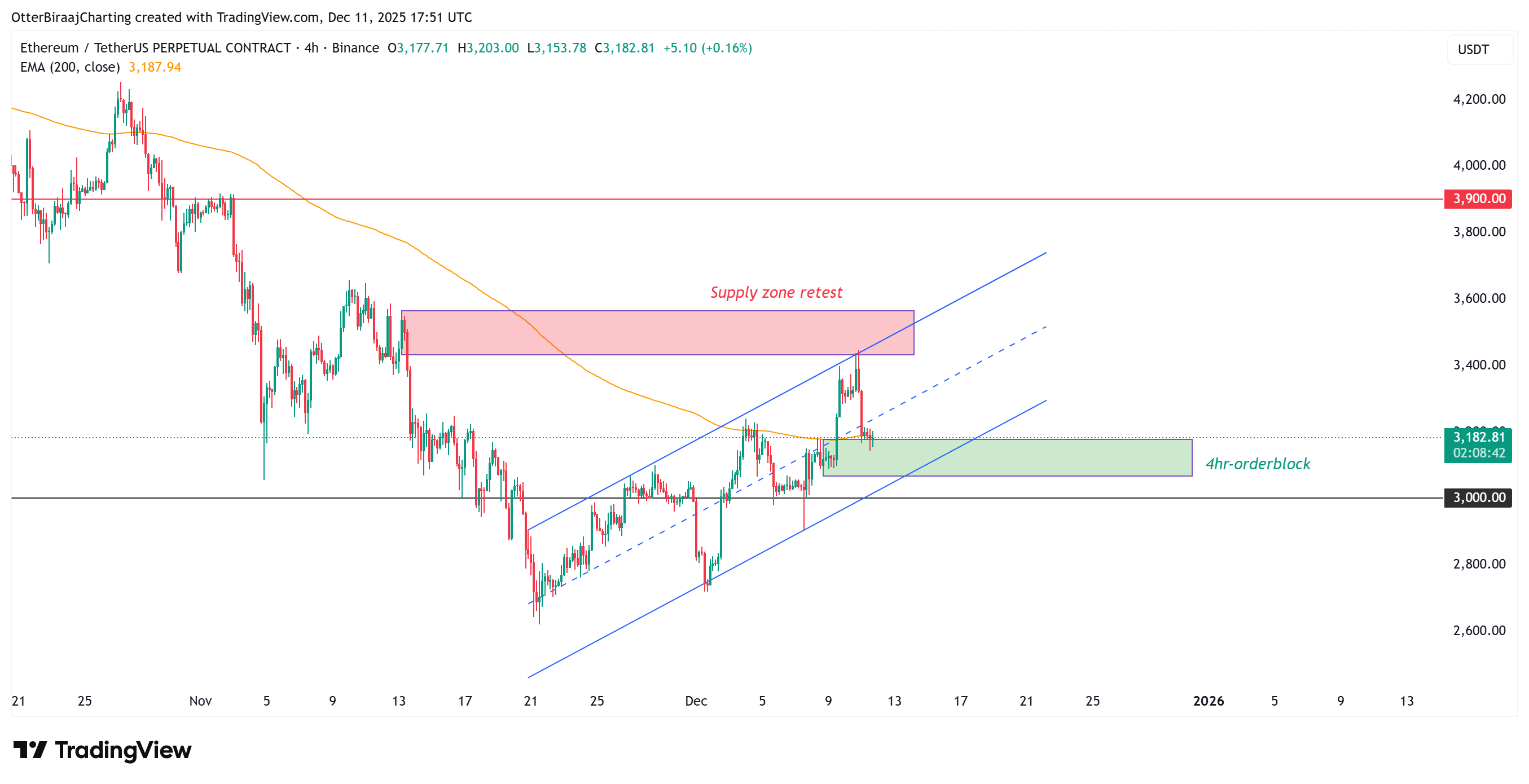
Ether four-hour chart. Source: Cointelegraph/TradingView

In a bullish scenario, holding the demand block and channel support would allow ETH to rebound toward the daily 200-EMA. A clean break above $3,450 would invalidate the rejection and reopen the path toward $3,900 resistance.

However, from a bearish standpoint, a breakdown below the ascending channel support exposes a bearish confirmation and a possible retest of $3,000, a key support level.

Data from Hyblock indicated that Ether derivatives support the neutral but fragile thesis. Aggregated open interest (OI) has unwound slightly after the rejection. The funding rate is mildly positive but not stretched, and the bid/ask ratio remains close to neutral, showing spot takers are not yet leaning aggressively bullish.
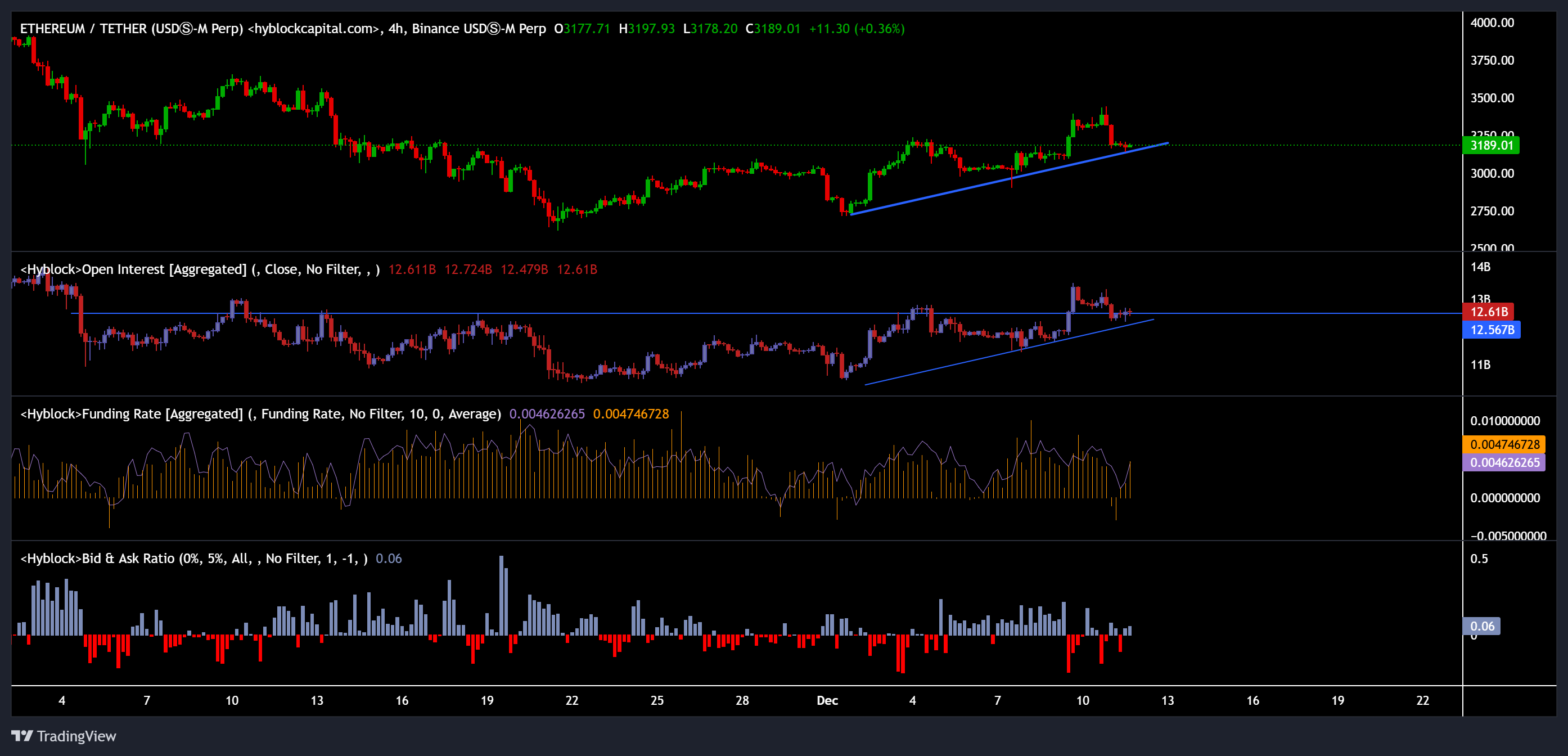
Ether futures data analysis. Source: Hyblock Capital

ETH’s next major move now depends on whether bulls can defend the demand zone long enough for improving taker flows and ETF demand to translate into sustained upside pressure.

Related: Bitcoin rallies fail at $94K despite Fed policy shift: Here’s why

This article does not contain investment advice or recommendations. Every investment and trading move involves risk, and readers should conduct their own research when making a decision. While we strive to provide accurate and timely information, Cointelegraph does not guarantee the accuracy, completeness, or reliability of any information in this article. This article may contain forward-looking statements that are subject to risks and uncertainties. Cointelegraph will not be liable for any loss or damage arising from your reliance on this information.


Related Reads

Cursor, Why Boarded Musk's Starship?

SpaceX announced its acquisition of AI programming startup Cursor's parent company, Anysphere, for $60 billion in an all-stock deal, just days after its record-breaking IPO. The move sent SpaceX's stock soaring, briefly making it the most valuable U.S. company. Cursor, founded in 2022 by MIT graduate Michael Truell and his classmates, is a popular AI coding assistant that allows developers to switch between models from OpenAI, Anthropic, and others. It saw explosive revenue growth, reaching a $4 billion annualized run rate in early 2026. However, its market share was eroded by the launch of competitor Claude Code from its key AI supplier, Anthropic. This dependence prompted Cursor to develop its own AI model, Composer, in early 2026. To scale Composer, Cursor needed immense computing power. In April 2026, it struck a deal with SpaceX, granting the latter an option to acquire it post-IPO. SpaceX exercised this option, offering Cursor access to its Colossus supercomputer, powered by hundreds of thousands of top-tier Nvidia AI chips. For SpaceX, the acquisition is a strategic move to bolster its AI capabilities, particularly for its xAI division, and advance its broader ambition of building orbital, solar-powered data centers. While the deal surprised some employees and investors given Truell's earlier stance on independence, it represents a high-stakes partnership. SpaceX CEO Elon Musk has projected the company could reach $1 trillion in revenue by 2030. For Truell, joining forces with SpaceX is a monumental gamble on an unprecedented scale in the race for AI dominance.

链捕手3m ago

Cursor, Why Boarded Musk's Starship?

链捕手3m ago

The More It Rises, the More Dangerous? The Systemic Risks Behind SpaceX's Soaring Valuation

Summary: The article raises concerns about the systemic risks posed by SpaceX's skyrocketing valuation, arguing that modern market mechanics, rather than fundamentals, are driving its price discovery. Following SpaceX's market capitalization surpassing $3 trillion in after-hours trading, the author contends that the market is no longer functioning properly. The core issue is not SpaceX's business prospects but the unhealthy market structure surrounding it. With limited float and the imminent launch of options trading, the stage is set for a potential "gamma squeeze"—a feedback loop where market makers hedging call options are forced to buy shares, pushing the price higher and attracting more speculative momentum traders. This mechanism, seen previously with Tesla and meme stocks, can decouple valuation from financial reality. The danger escalates as extreme valuations force passive funds, ETFs, pensions, and major indices to hold the stock. If SpaceX grows large enough—hypothetically reaching $5 or even $10 trillion—its performance would increasingly dictate broader market indices, embedding systemic risk. The author warns that when price appreciation itself becomes the primary bullish thesis, the market transforms from a capital allocation mechanism into a self-reinforcing speculative machine, endangering the retirement savings of ordinary investors tied to passive strategies. The piece questions whether such a system can still perform its fundamental role of price discovery.

marsbit8m ago

The More It Rises, the More Dangerous? The Systemic Risks Behind SpaceX's Soaring Valuation

marsbit8m ago

OpenAI's Hyperliquid Pre-IPO Pricing Venture: Why Did It Last Only Half a Year?

The article discusses the rise and fall of Pre-IPO pricing markets on the Hyperliquid blockchain. Trade.xyz, an anonymous team, successfully built the largest pre-market for SpaceX (SPCX) by launching a contract with a clear anchor: the eventual Nasdaq listing price. This provided inherent price stability and validation. In contrast, Ventuals, a team backed by Paradigm, failed despite holding exclusive contracts for highly sought-after companies like OpenAI and Anthropic. Its key mistake was its pricing mechanism. For companies with no near-term IPO date, Ventuals' oracle relied partly on opaque private market transactions and, critically, partly on its own contract's moving average price. This created a self-referential feedback loop where prices were artificially propped up and detached from genuine supply and demand, leading to illiquid markets. Ventuals shut down after nine months, settling positions at final prices of $1,341.80 for OpenAI and $1,618.90 for Anthropic. Ironically, some employees and late-stage investors of these very companies reportedly used these flawed Ventuals prices for valuation reference, highlighting the acute demand for any price signal in illiquid private markets. The article concludes that while demand for pre-IPO trading is real and growing, with players like Coinbase now entering the space, the fundamental challenge remains: without a public listing to provide a definitive price anchor, these markets struggle to establish truly accurate and liquid pricing. The need for a transparent, self-correcting market is the critical lesson from Ventuals' failure.

marsbit34m ago

OpenAI's Hyperliquid Pre-IPO Pricing Venture: Why Did It Last Only Half a Year?

marsbit34m ago

Trading

Spot
Futures

Hot Articles

Discussions

Welcome to the HTX Community. Here, you can stay informed about the latest platform developments and gain access to professional market insights. Users' opinions on the price of ETH (ETH) are presented below.

活动图片