Dubai, Hong Kong, and now Japan as regulatory heat intensifies for KuCoin!

ambcryptoPublished on 2026-03-27Last updated on 2026-03-27

Abstract

Japan's Financial Services Agency (FSA) has issued a warning to KuCoin and several other firms for operating unregistered over-the-counter (OTC) derivative services. This action is part of broader regulatory challenges for the exchange, which has recently faced operational bans or restrictions in Hong Kong, Austria, and Dubai for failing to meet local licensing and anti-money laundering requirements. These persistent regulatory issues have significantly eroded user trust, leading to a substantial decline in user funds. The exchange's stablecoin reserves plummeted from over $1.3 billion to $543 million in one year, indicating ongoing user caution and persistent outflows despite market rallies.

Japan’s financial market watchdog, the Financial Services Agency (FSA), has flagged KuCoin and other crypto exchanges and firms for operating certain services without proper registration.

In a statement on Thursday, the watchdog included KuCoin in the list of “unregistered businesses to which warning letters have been issued.”

The agency added that KuCoin, NeonFX, TheOption, and GTCFX were slapped with notices in March for “soliciting over-the-counter (OTC) derivative transactions via the internet.”

Interestingly, the escalation comes after the agency requested Apple and Google to block access to five unregistered crypto exchanges in February 2025. Amongst those targeted during the crackdown were KuCoin, Bybit, MEXC Global, LBank, and Bitget.

KuCoin’s regulatory headwinds

However, KuCoin’s regulatory woes go well beyond Japan. In May 2024, the exchange was forced to wind down its operations in Hong Kong. This followed restrictions and a crackdown on platforms with ties to mainland China.

Failure to meet the new licensing requirements prompted KuCoin to withdraw from Hong Kong and block users from the region from accessing the platform.

Fast forward to February 2026, and the exchange was partially banned by the Austrian Financial Market Authority (FMA). It failed to implement proper procedures to enforce anti-money laundering laws, as required by the EU’s MiCA guidelines. This was just three months after getting the MiCA license.

Earlier in March, the firm faced another regulatory hiccup with Dubai’s Virtual Assets Regulatory Authority (VARA). The agency issued a “cease and desist” order against KuCoin, alongside three other exchanges, for operating without a license. As such, the firms were banned from advertising or operating in Dubai without a valid license.

Impact of regulatory pressure on KuCoin

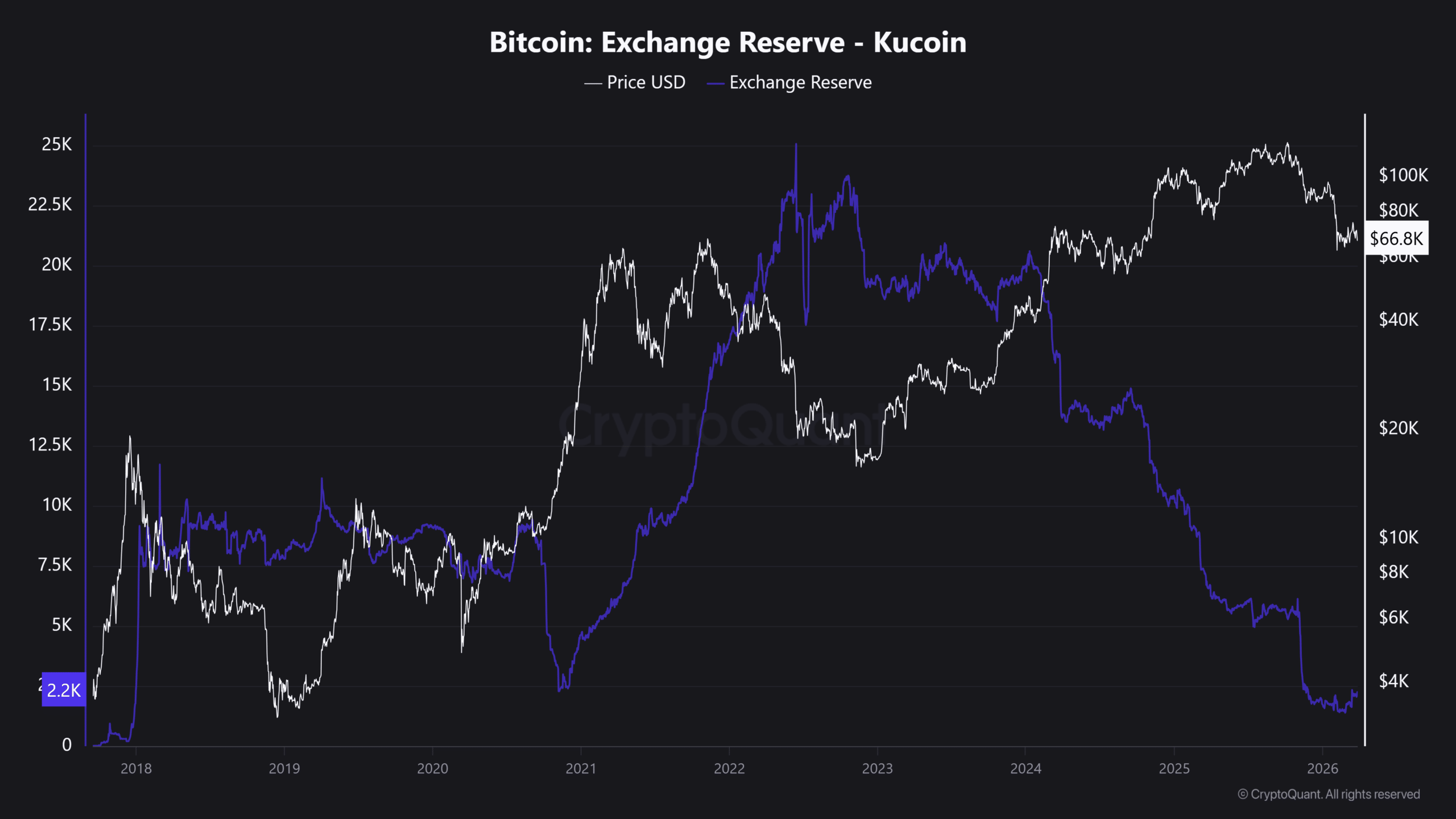
Unsurprisingly, the recurring patterns of regulatory hiccups have begun to affect user trust. This was illustrated by the Bitcoin and stablecoin reserves on the exchange. For Bitcoin, the exchange reserves dropped from 14K BTC in 2024 to 2100 BTC in early 2026.
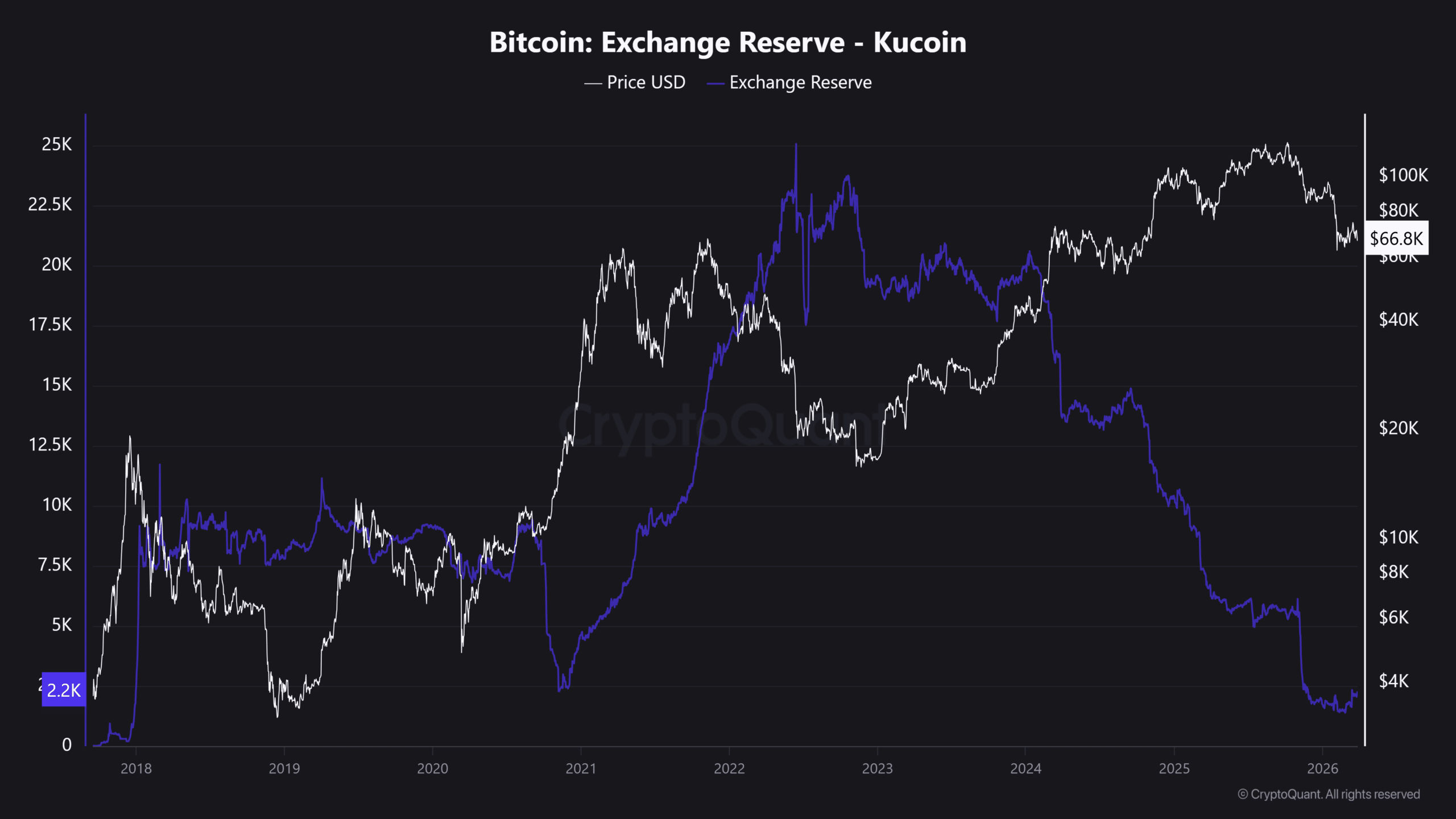
Source: CryptoQuant

Here, it’s worth noting that the BTC exchange reserve decline was a broader trend across other platforms, likely due to transfers to self-custody wallets.

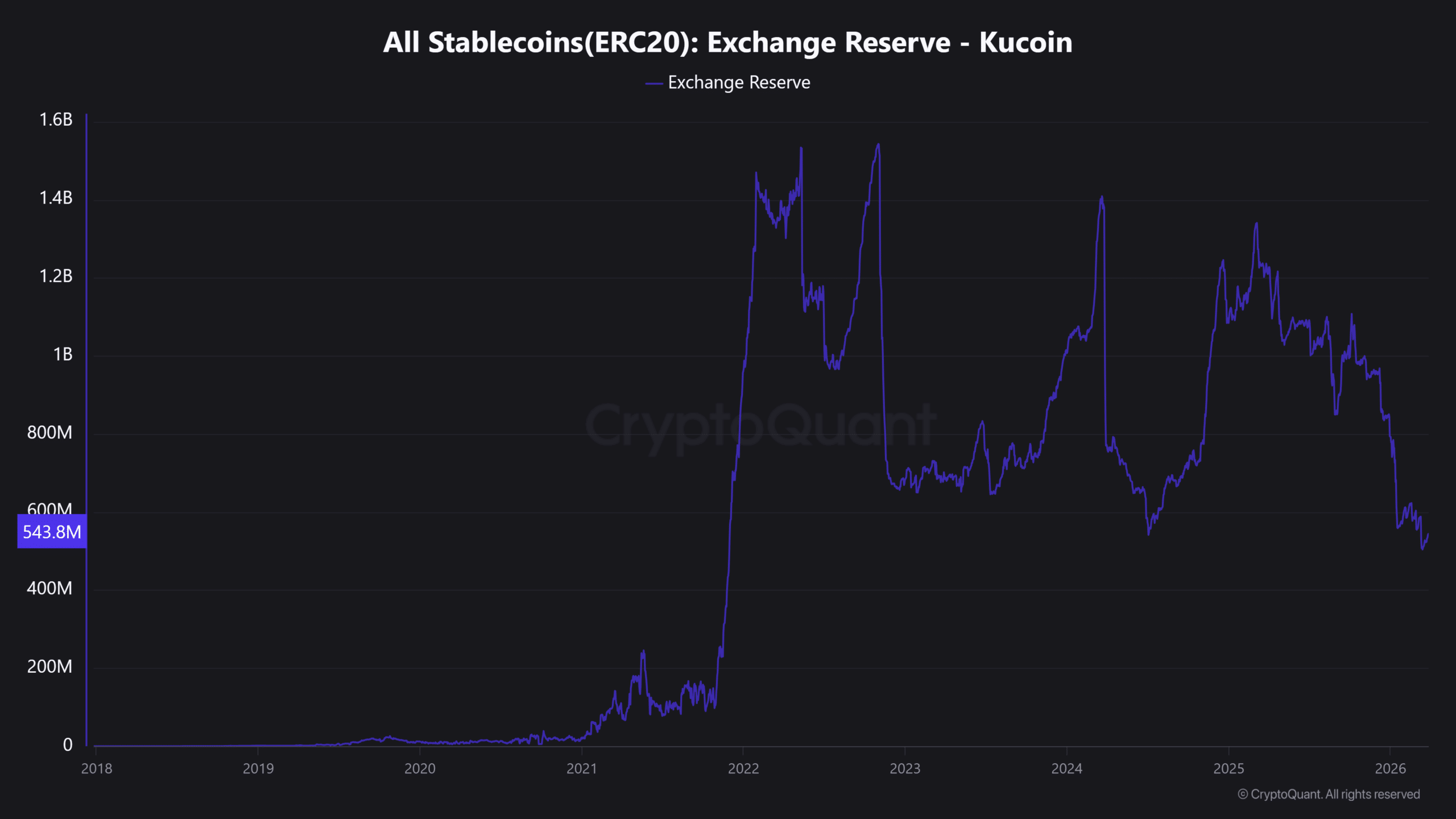
However, a deeper look at the liquidity or user funds held by the exchange, as painted by the stablecoin reserves, underscored a somewhat worried user base. The stablecoin exchange reserves fell from over $1.3 billion to $543M in just one year.

Even the mid-2025 rally and early 2026 recovery didn’t attract much flow into the exchange – Hinting at caution from users.
Source: CryptoQuant

Final Summary

  • Japan has sent a warning letter to KuCoin and other firms for operating unlicensed OTC derivatives trading.
  • Ongoing regulatory headwinds have eroded user trust, with user funds dropping from over $1.3B to $543M amid persistent outflows.


Related Questions

QWhat regulatory action did Japan's FSA take against KuCoin in March 2026?

AJapan's Financial Services Agency (FSA) issued a warning letter to KuCoin for soliciting over-the-counter (OTC) derivative transactions without proper registration.

QWhich other regions has KuCoin faced regulatory challenges in besides Japan?

AKuCoin has faced regulatory challenges in Hong Kong (May 2024), Austria (February 2026), and Dubai (March 2026).

QHow did KuCoin's stablecoin reserves change between 2025 and early 2026?

AKuCoin's stablecoin reserves dropped from over $1.3 billion to $543 million in just one year, indicating significant user fund outflows.

QWhy did KuCoin wind down its operations in Hong Kong in 2024?

AKuCoin withdrew from Hong Kong after failing to meet new licensing requirements following a crackdown on platforms with ties to mainland China.

QWhat was the consequence of KuCoin's failure to comply with EU's MiCA guidelines in Austria?

AThe Austrian Financial Market Authority (FMA) partially banned KuCoin for failing to implement proper anti-money laundering procedures as required by MiCA, just three months after obtaining the license.

Related Reads

AI is Revaluing the Real World: Why Gold, Silver, and Copper are Becoming Important Again

AI is reassessing the value of the real world: why gold, silver, and copper are regaining importance. For over a decade, financial innovation centered on digitalization, from internet platforms to RWA tokenization. However, AI's rapid development highlights a deeper dependency: the physical infrastructure underpinning the AI era, not just code. Contrary to being "dematerialized," AI strengthens reliance on the real world. Every model training and deployment requires vast resources—data centers, energy grids, cooling systems, and critical industrial materials like copper, silver, and gold, which provide irreplaceable conductivity and durability. This shift is redefining the asset layer structure. A new "Asset Stack" is emerging: - Physical Layer: Metals, energy, and raw materials. - Financial Layer: Government bonds, ETFs, structured products. - Digital Layer: Tokenization infrastructure and programmable assets. The digital layer relies on the financial layer, which ultimately depends on the physical layer. While markets previously rewarded upper-layer assets like stocks and digital platforms, AI is redirecting attention to foundational real-world resources. S&P Global forecasts data center copper demand will surge from 1.1 million tons in 2025 to 2.5 million tons by 2040, amid a growing global supply deficit. This signals a long-term structural shift where energy, metals, and infrastructure form a critical "Physical Layer" that could limit AI's expansion. Tokenization alone doesn't create value; it connects markets to already-trusted assets. Successful tokenization requires mature demand, deep liquidity, and institutional consensus. Thus, the logical progression begins with sovereign debt (highest liquidity and trust), followed by gold (centuries of global consensus), then silver (blending reserve and industrial utility). Future expansion may include industrially critical materials like copper. Within gold, a key divergence is appearing. Gold ETFs solved "investability" but keep gold within traditional financial systems. Gold tokens, like Matrixdock's XAUm, explore making gold a functional part of the digital financial system—enabling instant settlement, cross-border collateral, and programmable utility without intermediaries. Looking ahead, industrial metals are evolving from commodities to strategic "functional assets." Silver faces a structural supply deficit, driven by demand from solar, EVs, and AI infrastructure. While gold represents a "Store of Value," metals like silver and copper are becoming "Stores of Function." Tokenizing them, as with Matrixdock's XAGm for silver, focuses not just on reserve value but on bridging physical commodity systems with digital infrastructure for efficient circulation. Ultimately, the asset layer is evolving to be more grounded in the strategic, physical realities of the economy. The most valuable assets for tokenization may not be the easiest to digitize, but those most essential for long-term economic and technological foundations.

链捕手1h ago

AI is Revaluing the Real World: Why Gold, Silver, and Copper are Becoming Important Again

链捕手1h ago

TurboFlow Announces Strategic Partnership with Global Giant Susquehanna Crypto, Introducing Wall Street Institutional-Grade Liquidity and Dynamic Odds Market Structure Support

TurboFlow announces a strategic partnership with Susquehanna Crypto, a leading global proprietary digital asset trading firm. As part of this collaboration, Susquehanna Crypto will act as an on-chain liquidity provider and market maker for all TurboFlow products. This partnership brings institutional-grade liquidity, market-making support, and expertise in professional trading, market structure, price discovery, and risk management to the TurboFlow ecosystem. This marks a significant milestone for TurboFlow as it expands its product suite, which includes perpetual contracts and newly launched Event Contracts with durations as short as 30 seconds. Enhanced liquidity depth, efficient price discovery, and market stability are becoming increasingly critical for user experience. Notably, TurboFlow is transitioning its Event Contracts from a traditional fixed-odds model to a more dynamic, market-driven odds structure. Susquehanna Crypto will inject deep liquidity through TurboFlow's proprietary PFOF (Payment for Order Flow) architecture. This aims to ensure minimal slippage and millisecond-level execution for users, even during extreme market volatility, whether trading 1000x leveraged perpetuals or short-duration event contracts. Looking ahead, TurboFlow plans to onboard more top-tier institutional market makers to build a diversified liquidity network. The platform will continue expanding its product ecosystem across several verticals: Event Contracts (extending to assets like crude oil and gold), prediction markets and Telegram Mini Apps, and perpetual contracts. TurboFlow's mission is to democratize trading by making professional-grade infrastructure and a simplified, engaging experience accessible to all users.

链捕手2h ago

TurboFlow Announces Strategic Partnership with Global Giant Susquehanna Crypto, Introducing Wall Street Institutional-Grade Liquidity and Dynamic Odds Market Structure Support

链捕手2h ago

Trading

Spot
Futures
活动图片