Drift Protocol incident uncovered: Did ‘negligence’ lead to the $285M loss?

ambcryptoPublished on 2026-04-06Last updated on 2026-04-06

Abstract

Drift Protocol's $285 million hack underscores a critical industry lesson: security cannot be sacrificed for scalability. This incident, potentially linked to the same group behind the 2024 Radiant Capital hack, reveals a meticulously planned attack where perpetrators posed as a legitimate firm to gain trust. In response, Drift froze protocol functions and collaborated with law enforcement, though market confidence remained shaken. The timing is significant, as Solana recently tested quantum-resistant upgrades that slowed the network by 90%, highlighting the inherent trade-offs between security and performance. Public scrutiny has intensified, with some labeling the breach "civil negligence," signaling a shift in the 2026 cycle toward prioritizing security, accountability, and quantum-threat preparedness over mere scalability.

This cycle clearly favors security over scalability, which marks a big shift from previous years.

Back in 2025, protocols like Ethereum [ETH] and Solana [SOL] focused on scaling the network, boosting transaction throughput, reducing congestion, and staying competitive in the fast-growing DeFi space. Their goal was simple: make the blockchain more scalable, even if that meant taking on extra risk under the hood.

However, the recent Drift protocol incident drives home a clear lesson: you cannot trade security for speed. In this context, could the attack actually act as a blessing in disguise, pushing the community and protocol teams to rethink operational security and put integrity above scalability?
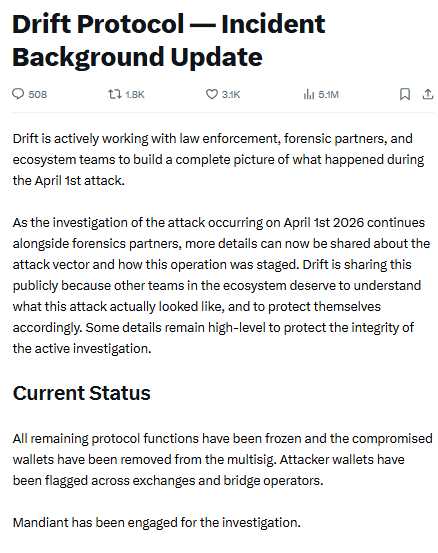
Source: X

According to the official statement, the team is working closely with law enforcement and forensic experts to investigate the Drift incident. Because of this, they froze all protocol functions, removed compromised wallets, and flagged attacker wallets across exchanges.

Interestingly, early evidence ties the attack to the same group behind the October 2024 Radiant Capital hack, though final attribution is still pending. The big takeaway? This was a months-long, carefully planned operation. The attackers posed as a legitimate trading firm, building trust through in-person meetings, and even deposited over $1 million to appear credible.

On paper, Drift’s response shows accountability in action, but the market reaction didn’t really reflect confidence. So, the question is, does this Drift incident expose security weaknesses and force the industry to rethink operational practices to prevent similar attacks in the future?

Drift incident sparks public pressure and industry wake-up call

Even with the massive $285 million hack, the Drift incident highlights some important lessons.

According to AMBCrypto, the “timing” makes this attack especially relevant. Solana recently tested a quantum-resistant model to prepare for future quantum threats, but the experiment slowed the network by 90%, showing that security upgrades can come at a cost.

In this light, the Drift incident clearly shows that security can’t be an afterthought, even as protocols chase speed, scalability, and new features. Put simply, even with Solana’s 90% slowdown, the focus must stay on robust, practical security, something the Drift incident helped bring into sharp focus.
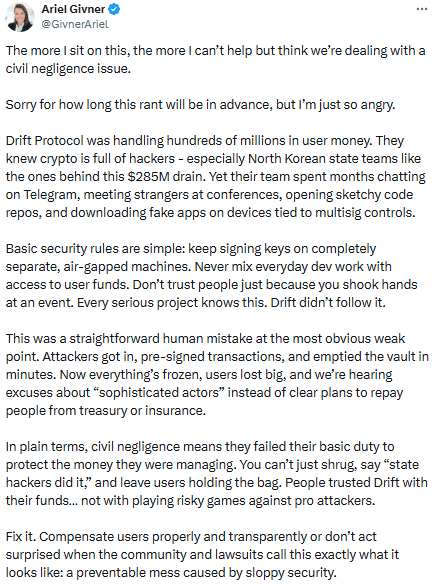
Source: X

Beyond the technical lessons, the public scrutiny that followed, though, adds another layer of pressure.

As the post above highlights, some reactions even called the hack “civil negligence,” implying that the protocol itself carried responsibility for the breach, alongside the attackers. This perspective isn’t too far-fetched, given the industry’s approach to security over the past few cycles.

Looking at it this way, the Drift protocol incident could be the wake-up call the market needed to move away from last year’s “scalability-first” mindset. The 2026 cycle is therefore shaping up to be security-driven, fueled by accountability, public pressure, and growing concerns around quantum threats.


Final Summary

  • The Drift incident highlights that security must come before speed, forcing protocols to rethink operational practices.
  • Public scrutiny and industry pressure are pushing the 2026 cycle to be security-driven, with quantum-threat preparedness taking center stage.


Trending Cryptos

Related Questions

QWhat was the main focus of blockchain protocols like Ethereum and Solana in 2025, according to the article?

AIn 2025, protocols like Ethereum and Solana focused on scaling the network, boosting transaction throughput, reducing congestion, and staying competitive in the fast-growing DeFi space, even if it meant taking on extra risk.

QWhat is the primary lesson the Drift protocol incident is said to drive home?

AThe primary lesson is that you cannot trade security for speed, and it should push the community to rethink operational security and put integrity above scalability.

QHow did the attackers gain the trust of the Drift protocol before the exploit?

AThe attackers posed as a legitimate trading firm, building trust through in-person meetings, and deposited over $1 million to appear credible.

QWhat broader industry shift is the Drift incident sparking for the 2026 cycle?

AThe incident is sparking a shift towards a security-driven cycle, fueled by accountability, public pressure, and growing concerns around quantum threats, moving away from the previous 'scalability-first' mindset.

QWhat was the estimated financial loss from the Drift Protocol incident?

AThe estimated financial loss from the Drift Protocol incident was $285 million.

Related Reads

Bitcoin Withdrawals Continue: 8 Years of Storage in a Coldcard Cold Wallet Ended in Zero

Coldcard Hardware Wallet Hacked: Losses Mount Due to Vulnerable Seed Generation A critical vulnerability in Coldcard hardware wallets has led to a continued wave of fund thefts. According to Galaxy Research, the total stolen has reached 1,367.05 BTC (approx. $88.6 million) from 4,585 addresses, a significant increase from the initial 594.5 BTC reported on July 30, 2026. Most of the stolen funds remain on the attackers' addresses. The issue is not with the current firmware, which Coinkite has updated, but with seed phrases generated on vulnerable devices between March 2021 and the release of fixed firmware versions. Due to a programmer error, devices switched from using a hardware random number generator to the software-based Yasmarang generator, which was initialized with publicly accessible data like the chip's serial number. This made the seed phrases predictable through offline brute-force attacks, meaning wallets remain at risk until funds are moved to a new wallet generated with the patched firmware. Affected devices include Mk2/Mk3 with firmware 4.0.1–4.1.9 (and up to 5.0.3), Mk4/Mk5 up to version 5.6.0, and Q models up to 1.5.0Q. The only exceptions are seeds created with a high-entropy method like at least 50 independent dice rolls or a strong unique BIP-39 passphrase. All other owners must generate a new seed on the fixed firmware and transfer their assets. A case highlighting the human impact involves a 39-year-old long-term investor who lost 2 BTC (approx. $130,000) in minutes. He had accumulated the Bitcoin over eight years through physical labor, viewing it as a financial lifeline and a retirement plan in a country suffering from hyperinflation. His story underscores that even conservative "buy and hold in cold storage" strategies can be compromised by such underlying technical flaws. From a technical perspective, this incident echoes historical failures where weak random number generators undermined cryptographic security, challenging the assumption that offline storage is automatically foolproof.

cryptonews.ru1h ago

Bitcoin Withdrawals Continue: 8 Years of Storage in a Coldcard Cold Wallet Ended in Zero

cryptonews.ru1h ago

Trading

Spot

Hot Articles

How to Buy DRIFT

Welcome to HTX.com! We've made purchasing Drift Protocol (DRIFT) simple and convenient. Follow our step-by-step guide to embark on your crypto journey.Step 1: Create Your HTX AccountUse your email or phone number to sign up for a free account on HTX. Experience a hassle-free registration journey and unlock all features.Get My AccountStep 2: Go to Buy Crypto and Choose Your Payment MethodCredit/Debit Card: Use your Visa or Mastercard to buy Drift Protocol (DRIFT) instantly.Balance: Use funds from your HTX account balance to trade seamlessly.Third Parties: We've added popular payment methods such as Google Pay and Apple Pay to enhance convenience.P2P: Trade directly with other users on HTX.Over-the-Counter (OTC): We offer tailor-made services and competitive exchange rates for traders.Step 3: Store Your Drift Protocol (DRIFT)After purchasing your Drift Protocol (DRIFT), store it in your HTX account. Alternatively, you can send it elsewhere via blockchain transfer or use it to trade other cryptocurrencies.Step 4: Trade Drift Protocol (DRIFT)Easily trade Drift Protocol (DRIFT) on HTX's spot market. Simply access your account, select your trading pair, execute your trades, and monitor in real-time. We offer a user-friendly experience for both beginners and seasoned traders.

5.6k Total ViewsPublished 2024.05.17Updated 2026.06.02

How to Buy DRIFT

Discussions

Welcome to the HTX Community. Here, you can stay informed about the latest platform developments and gain access to professional market insights. Users' opinions on the price of DRIFT (DRIFT) are presented below.

活动图片












