Drift Protocol halts operations after suspected $285m exploit as funds move across wallets

ambcryptoPublished on 2026-04-01Last updated on 2026-04-01

Abstract

Drift Protocol has halted deposits and withdrawals after confirming an active attack, with initial estimated losses around $285 million. Blockchain security firm PeckShield reported the losses span multiple assets, including $71.4M in USDC and $159.3M in JLP, among others. The attacker has begun moving funds across wallets, likely to obscure transaction trails. Unverified reports suggest the exploit may have involved a compromised administrative key, allowing manipulation of protocol parameters, though this remains unconfirmed. The incident reflects a trend of sophisticated DeFi attacks targeting governance and internal controls. An investigation is ongoing with no timeline for restoring operations.

Drift Protocol has halted deposits and withdrawals after confirming it is experiencing an active attack, with early estimates suggesting losses could reach hundreds of millions of dollars.

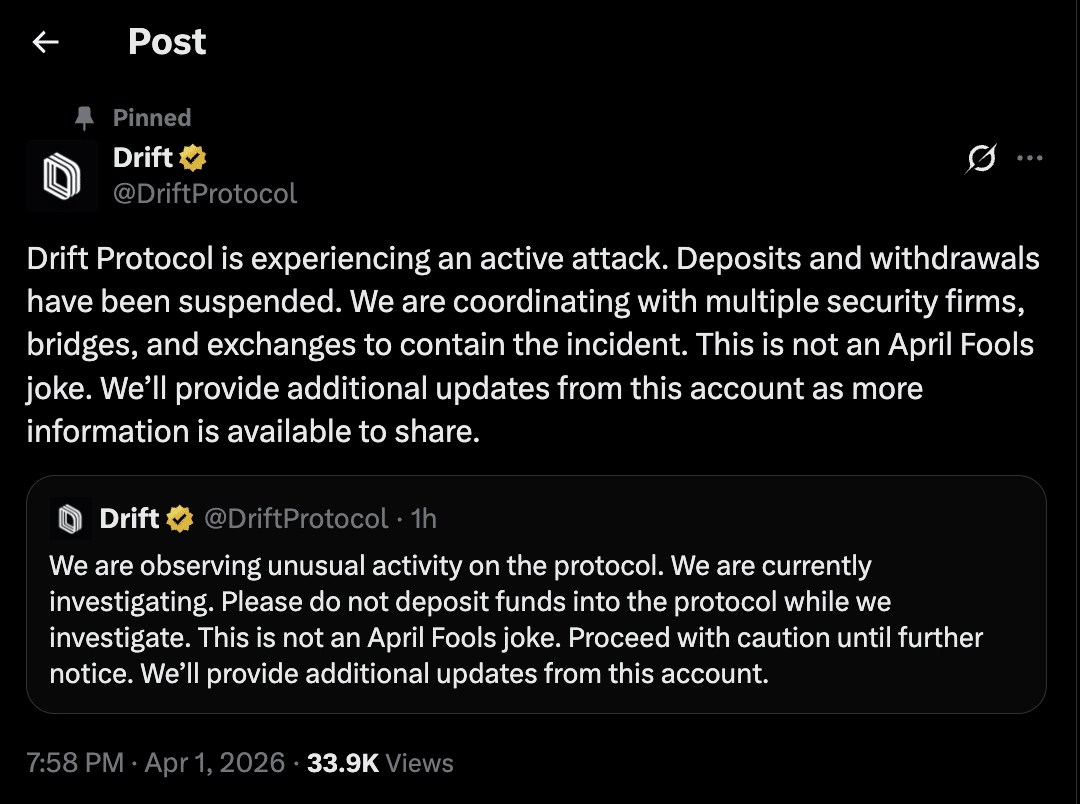
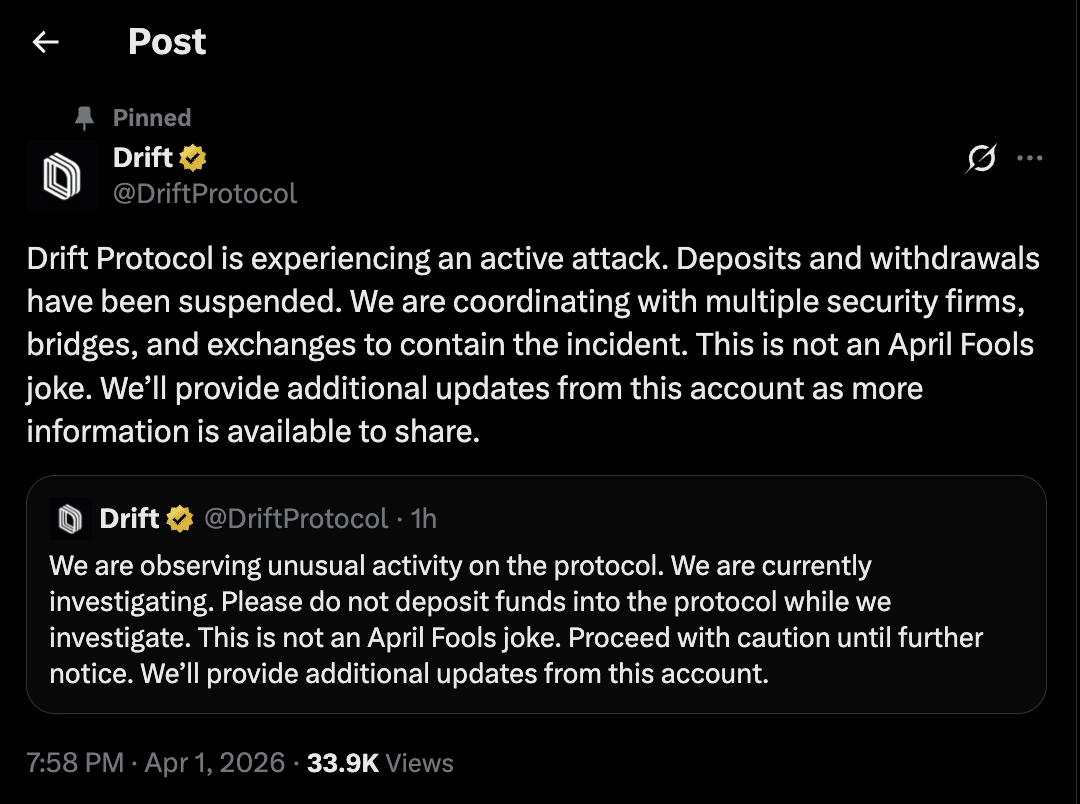
The protocol disclosed the incident in a public update on 1 April, stating that it is coordinating with security firms, bridges, and exchanges to contain the situation.

“This is not an April Fools joke,” the team said, adding that further updates will follow as the investigation develops.
Source: X

Estimated losses near $285m as breakdown emerges

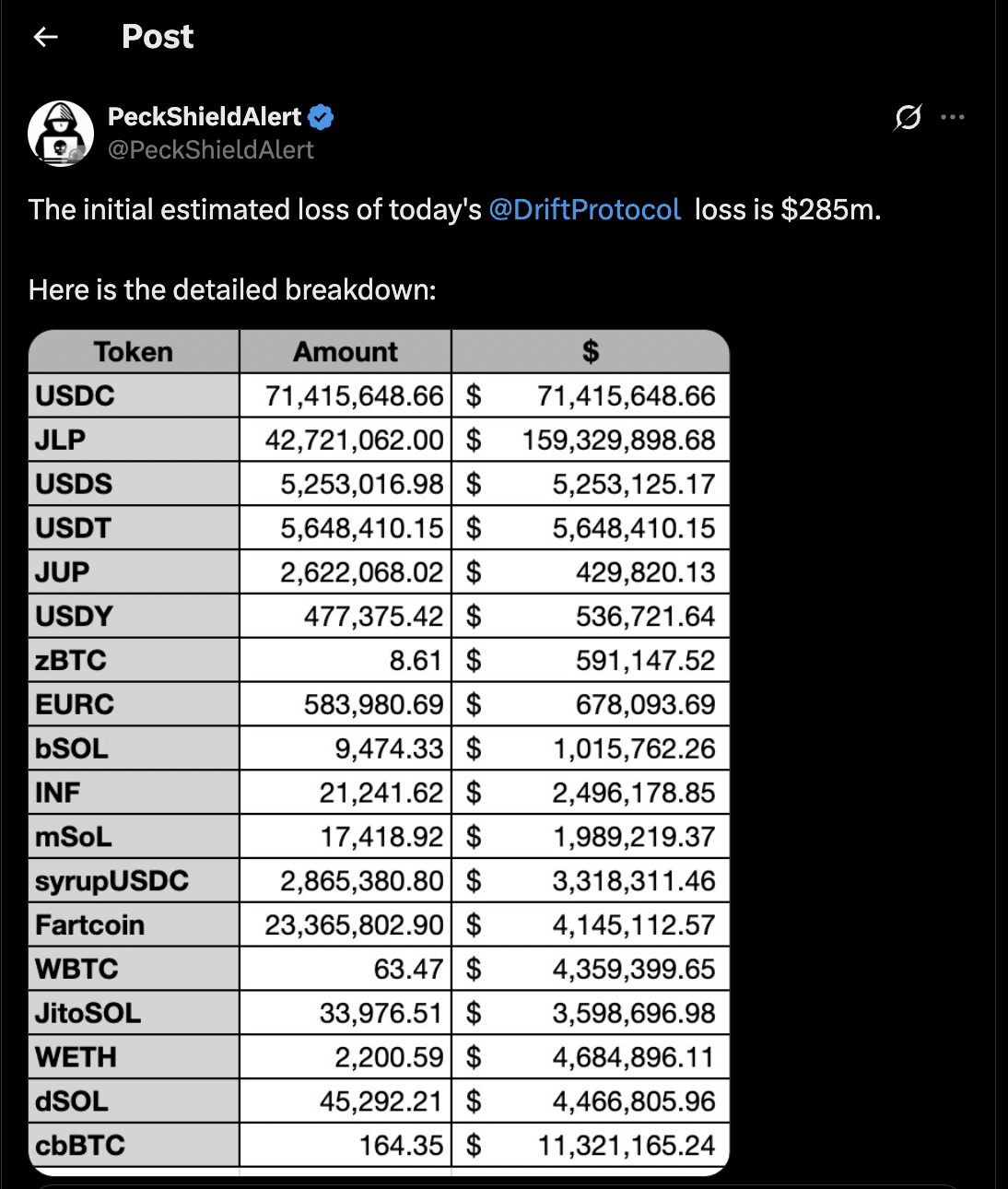
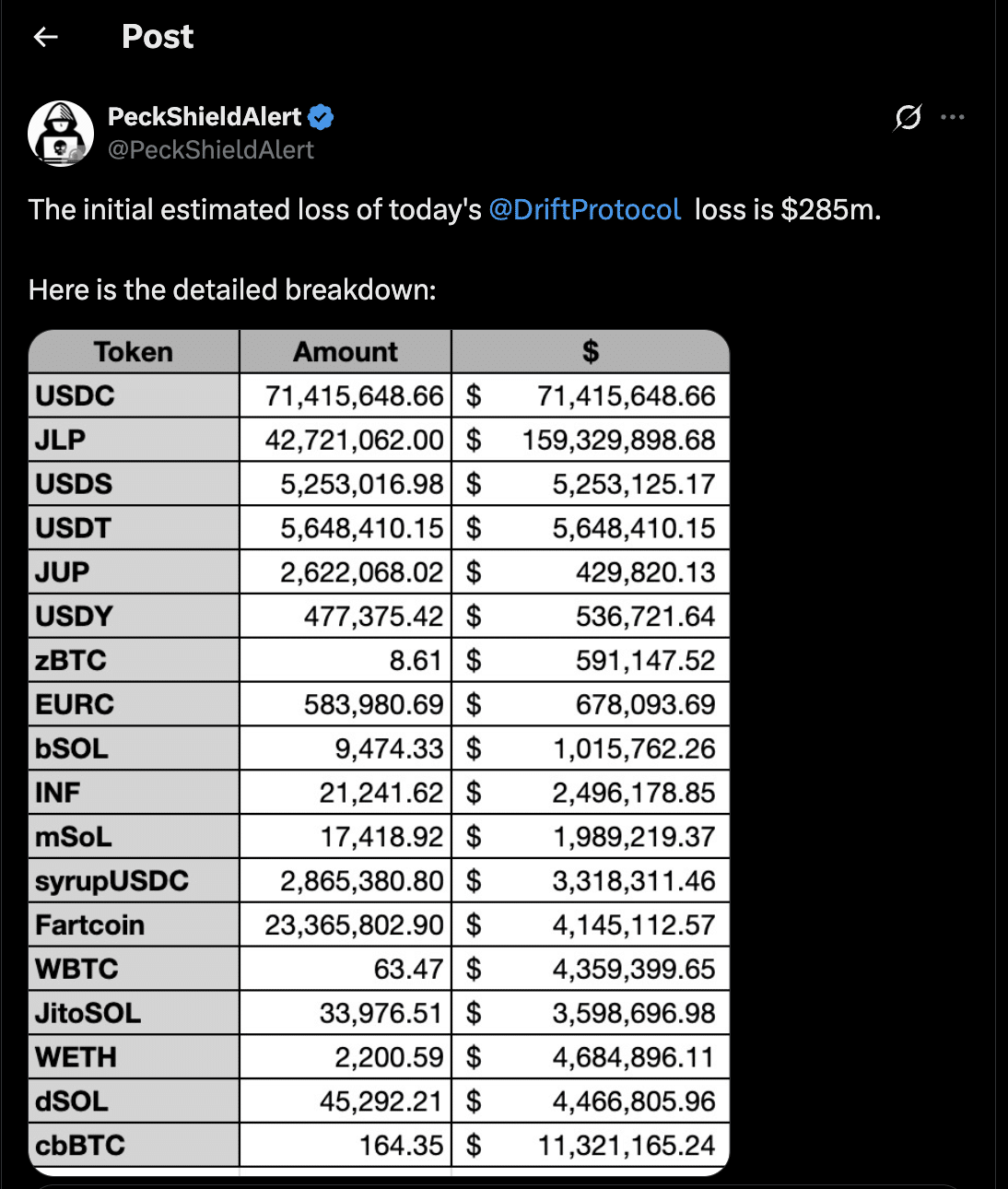
Blockchain security firm PeckShield estimated the initial losses at around $285m, based on early on-chain analysis.

A breakdown shared by the firm suggests the exploit spans multiple assets, including:

  • $71.4m in USDC
  • $159.3m in JLP
  • Smaller amounts across USDT, WETH, wrapped BTC, and Solana-based assets
Source: X

While the figures remain preliminary, the scale places the incident among the larger DeFi exploits in recent months.

Funds begin moving across wallets

Separate on-chain tracking indicates that the attacker has already begun moving funds across multiple wallets. This is a pattern typically associated with attempts to obscure transaction trails.

Initial flows suggest assets are being split and transferred through different addresses, with some movements potentially involving cross-chain bridges. This behavior is consistent with past exploits where attackers rapidly redistribute funds to reduce traceability and recovery risk.

At the time of writing, there has been no confirmed recovery of funds.

Unverified reports point to potential exploit mechanism

Unconfirmed reports circulating on social media suggest the attacker may have gained access to a privileged administrative key, allowing them to modify protocol parameters.

According to these accounts, the attacker allegedly manipulated collateral settings, inflated the value of a low-liquidity asset, and used it to borrow higher-value tokens before draining liquidity from the system.

However, these claims remain unverified, and Drift Protocol has not confirmed the attack vector.

A growing pattern of complex DeFi exploits

The incident adds to a broader trend of increasingly sophisticated exploits targeting decentralized finance protocols, where vulnerabilities often extend beyond simple smart contract bugs.

In several recent cases, attackers have exploited governance controls, oracle mechanisms, or internal parameter systems rather than purely external vulnerabilities.

If confirmed, the suspected method in this case would reflect a similar pattern, highlighting how complex protocol design and privileged access controls can introduce new risk surfaces.

Investigation ongoing

Drift Protocol said it is working with multiple partners to investigate the breach and contain further damage. No timeline has been provided for restoring normal operations.

The full scope of the exploit, including the exact attack vector and potential recovery efforts, remains unclear.


Final Summary

  • Drift Protocol has paused operations following an active attack, with early estimates placing losses at around $285m.
  • While funds are already being moved on-chain, the exact exploit method remains unconfirmed as investigations continue.


Related Questions

QWhat is the estimated financial loss from the Drift Protocol exploit according to initial on-chain analysis by PeckShield?

AThe estimated financial loss from the Drift Protocol exploit is approximately $285 million.

QWhat specific action did Drift Protocol take in response to the active attack?

ADrift Protocol halted all deposits and withdrawals in response to the active attack.

QWhat is one of the unverified potential mechanisms for the exploit that was circulating on social media?

AUnverified reports on social media suggested the attacker may have gained access to a privileged administrative key, allowing them to modify protocol parameters, manipulate collateral settings, and drain liquidity.

QWhich two assets made up the largest portions of the stolen funds according to the breakdown?

AAccording to the breakdown, the two largest portions of the stolen funds were $159.3 million in JLP and $71.4 million in USDC.

QWhat broader trend in decentralized finance (DeFi) does this incident contribute to?

AThis incident contributes to the broader trend of increasingly sophisticated exploits targeting DeFi protocols, where vulnerabilities often extend beyond simple smart contract bugs to include governance controls, oracle mechanisms, or internal parameter systems.

Related Reads

TechFlow Intelligence Bureau: Chip Stocks Lose Trillions in a Single Day, Bitcoin Falls Below $60,000, US-Iran Conflict Escalates

**Daily Tech & Markets Roundup: AI Advances, Market Turmoil, and Geopolitical Tensions** **AI / LLMs**: Anthropic's internal report on AI self-improvement sparked serious discussions about Recursive Self-Improvement (RSI). Meanwhile, debate continues on AI coding tools after Claude was accused of introducing bugs into the rsync codebase. In positive news, DeepSeek V4 Flash impressed in local deployment tests, and GitHub Copilot now supports custom endpoints for local models. A surprising research turn suggests removing chain-of-thought prompting can sometimes improve LLM performance. **Crypto / Web3**: Bitcoin plunged below $60,000, with its RSI hitting levels last seen during the COVID-19 crash, driven by strong U.S. jobs data reviving interest rate hike fears. Discussions highlight Ethereum DeFi's continued lack of a smooth consumer payment layer. **Chips / Hardware**: Chip stocks suffered a massive sell-off, with the Philadelphia Semiconductor Index posting its worst single-day drop in six years, erasing over a trillion dollars in value. Marvell, Micron, AMD, and Intel were among the biggest losers. **Tech Companies**: A leaked Microsoft document revealing goals to make Copilot "addictive" drew criticism. LinkedIn founder Reid Hoffman left Microsoft's board to focus full-time on his AI agent startup, Manus. Google was revealed to be paying SpaceX $920 million monthly for AI training compute. **Markets & Macro**: A blowout U.S. jobs report (172k vs. 80k expected) crushed hopes for near-term rate cuts, sending Treasury yields soaring and triggering a broad market sell-off. CEOs from Kraft, McDonald's, and Whirlpool simultaneously warned U.S. consumers are exhausting their savings. **Geopolitics**: U.S.-Iran tensions escalated with missile/drone interceptions and U.S. strikes on Iranian radar sites, keeping the critical Strait of Hormuz largely closed since late February and posing ongoing oil supply risks. **The Bottom Line**: The strong jobs data acted as a single trigger for correlated sell-offs across equities, crypto, and chips. Underlying the volatility is a stark contradiction between robust employment data and warnings of consumer weakness, alongside geopolitical risks that could reignite inflation, leaving markets to price in a fraught macro outlook with no clear "soft landing" path.

marsbit3h ago

TechFlow Intelligence Bureau: Chip Stocks Lose Trillions in a Single Day, Bitcoin Falls Below $60,000, US-Iran Conflict Escalates

marsbit3h ago

It Took Me a Year to See the Bitter Truth About Agent Payments

After a year building infrastructure for the Agent economy, engaging with major players like Stripe, Visa, and Coinbase, the author shares a sobering analysis of the current state of Agent payments. The core finding is a stark lack of genuine, immediate demand across most envisioned use cases. The article breaks down four key market segments: 1. **Agent-to-Merchant (Consumer Shopping):** For most product categories (e.g., clothing, electronics), conversational AI shopping is a step backwards from visual e-commerce interfaces. While agents excel at understanding needs, they can't replace side-by-side product comparison. Real merchant interest is defensive "Agent Engine Optimization," not driven by current customer demand. Potential exists for high-frequency, low-decision purchases (like food delivery) or navigating complex store UIs, but these require massive B2C distribution channels dominated by giants like Amazon. 2. **Agent-to-API (Developer Services):** Developers already have subscriptions and billing relationships for APIs (compute, data). Prepaid balances solve micro-payment issues for low transaction volumes. A deeper structural problem is that major SaaS vendors' business models rely on enterprise contracts, resisting granular pay-per-call pricing. While protocols like MPP and x402 serve the long tail of niche services, this market is small and developers are historically low-willingness-to-pay. 3. **Agent-to-Agent:** This remains largely theoretical with minimal transaction volume. While it represents a long-term bet on a fundamentally new transaction infrastructure (sub-second, micro-penny to million-dollar, multi-party settlements), it does not constitute a present market. 4. **Agent-to-Finance:** This is the only category with existing, paying demand. Integrating AI into financial workflows (trading, portfolio management) is a natural evolution and enables new capabilities like autonomous rebalancing. However, competition favors established, regulated institutions. The "real problem" is not moving money between agents, but the broader challenge of **coordination**—orchestrating work between agents and humans, verifying outcomes, and settling results. Payment is just one component of settlement, which is itself part of coordination. Companies that solve the coordination layer will subsume payment, not the other way around. While well-funded incumbents build defensively for a long-term future, startups must find where the market is today—which, for the author's team, lies outside these four categories in an area of real, growing, and underserved activity.

marsbit4h ago

It Took Me a Year to See the Bitter Truth About Agent Payments

marsbit4h ago

Trading

Spot
Futures

Hot Articles

How to Buy DRIFT

Welcome to HTX.com! We've made purchasing Drift Protocol (DRIFT) simple and convenient. Follow our step-by-step guide to embark on your crypto journey.Step 1: Create Your HTX AccountUse your email or phone number to sign up for a free account on HTX. Experience a hassle-free registration journey and unlock all features.Get My AccountStep 2: Go to Buy Crypto and Choose Your Payment MethodCredit/Debit Card: Use your Visa or Mastercard to buy Drift Protocol (DRIFT) instantly.Balance: Use funds from your HTX account balance to trade seamlessly.Third Parties: We've added popular payment methods such as Google Pay and Apple Pay to enhance convenience.P2P: Trade directly with other users on HTX.Over-the-Counter (OTC): We offer tailor-made services and competitive exchange rates for traders.Step 3: Store Your Drift Protocol (DRIFT)After purchasing your Drift Protocol (DRIFT), store it in your HTX account. Alternatively, you can send it elsewhere via blockchain transfer or use it to trade other cryptocurrencies.Step 4: Trade Drift Protocol (DRIFT)Easily trade Drift Protocol (DRIFT) on HTX's spot market. Simply access your account, select your trading pair, execute your trades, and monitor in real-time. We offer a user-friendly experience for both beginners and seasoned traders.

5.0k Total ViewsPublished 2024.05.17Updated 2026.06.02

How to Buy DRIFT

Discussions

Welcome to the HTX Community. Here, you can stay informed about the latest platform developments and gain access to professional market insights. Users' opinions on the price of DRIFT (DRIFT) are presented below.

活动图片