Dogecoin Whales Remain Quiet, What’s Going On And Is DOGE At Risk?

bitcoinistPublished on 2026-01-09Last updated on 2026-01-09

Abstract

Dogecoin started 2026 with a significant price surge, briefly reclaiming the $0.15 level after a bearish end to 2025. However, on-chain data reveals that mega whales (holders of 100M-1B DOGE) remained largely inactive during this rally, even reducing their holdings slightly. In contrast, smaller "shark" wallets (10M-100M DOGE) and mid-sized holders (1M-10M DOGE) were the primary accumulators, driving the buying pressure and increased trading volume. Despite the initial jump, DOGE has since pulled back to $0.1424, facing continued resistance at $0.15. The lack of participation from the largest whales introduces uncertainty into the meme coin's near-term outlook.

Dogecoin didn’t ease into 2026 quietly. Following several weeks of drifting and bearish price action at the end of last year, the memecoin suddenly picked up speed, jumping in the first few days of January and briefly reclaiming levels above $0.15. However, on-chain data shows that Dogecoin’s mega whales did not have a hand in the rally. These large Dogecoin holders have mostly stayed on the sidelines, avoiding both heavy buying and selling.

Dogecoin’s Whales Quiet During Recent Price Action

Dogecoin began the week with a quick burst of upside that carried the price from below $0.12 into mid-$0.15. Trading activity picked up during the move, and there was genuine buying interest. During this period, Dogecoin’s trading volume nearly tripled those seen during the last days of December, with notable examples of $3.56 billion trading volume on January 2 and $2.34 billion on January 4.

This intense trading activity briefly placed the Dogecoin price above $0.15 on January 5, a price level that has served as a resistance level that stopped the meme coin’s price action throughout December 2025. However, an interesting detail from recent on-chain analysis is how little large holders reacted to the price rally.

According to data from on-chain analytics platform Santiment, Dogecoin addresses holding 100 million to 1 billion DOGE saw their collective holdings increase into January 4, peaking around 35.8 billion DOGE, before a decline beginning on January 5.

Starting on January 5, this group began trimming exposure, and even as Dogecoin’s price action continued climbing to the $0.15 level, their combined holdings fell to roughly 34.59 billion DOGE by January 6. Since then, balances in this cohort have largely remained flat.
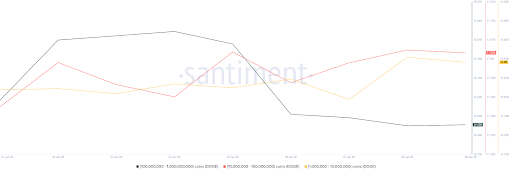
Dogecoin Large Holder Distribution. Source: Santiment

Sharks Doing Most Of The Bullish Work

On the other hand, Dogecoin sharks, i.e., wallets holding between 10 million and 100 million DOGE showed a much stronger appetite. After a brief pullback between January 2 and January 4, this group returned to accumulation during Dogecoin’s push higher. That buying trend has continued through the rest of the week, lifting their collective holdings to about 17.63 billion DOGE at the time of writing.

Smaller large holders in the 1 million to 10 million DOGE range followed a similar pattern, though with more hesitation early on. Activity in this group increased at the start of the week, followed by a dip around January 7. That decline was short-lived, however, as balances rebounded on January 8 and 9, rising to roughly 10.9 billion DOGE at the time of writing.

As it stands, Dogecoin’s price action seems to be taking a pause from the rally and is back to facing resistance at $0.15. The meme coin is now trading at $0.1424, and the lack of clear commitment from large whales is also keeping the outlook uncertain.

DOGE price fails to hold up | Source: DOGEUSDT on Tradingview.com

Related Questions

QWhat was the initial price movement of Dogecoin at the beginning of January 2026?

ADogecoin suddenly picked up speed, jumping in the first few days of January and briefly reclaiming levels above $0.15.

QHow did the trading volume of Dogecoin change during the price surge?

ADogecoin's trading volume nearly tripled compared to the last days of December, with notable examples of $3.56 billion on January 2 and $2.34 billion on January 4.

QWhat was the behavior of Dogecoin mega whales (addresses holding 100 million to 1 billion DOGE) during the rally?

AThey mostly stayed on the sidelines, avoiding both heavy buying and selling. Their collective holdings peaked around 35.8 billion DOGE on January 4 before declining to roughly 34.59 billion DOGE by January 6.

QWhich group of Dogecoin holders showed the strongest buying appetite during the price increase?

ADogecoin sharks (wallets holding between 10 million and 100 million DOGE) showed a much stronger appetite and returned to accumulation during Dogecoin's push higher.

QWhat is Dogecoin's current price and key resistance level mentioned in the article?

ADogecoin is trading at $0.1424 and is facing resistance at the $0.15 level.

Related Reads

Jensen Huang's CMU Speech: In the AI Era, Don't Just Watch, Build

Jensen Huang, CEO of NVIDIA and a first-generation immigrant, delivered the commencement address to Carnegie Mellon University's class of 2026. He shared his personal journey from a humble background to founding NVIDIA, emphasizing resilience, learning from failure, and the responsibility that comes with leadership. Huang framed the present moment as the dawn of the AI revolution, a shift he believes is more profound than previous computing waves. He described AI as fundamentally resetting computing—moving from human-written software to machines that understand, reason, and use tools. This will create a new industry for generating intelligence and transform every sector. While acknowledging AI's potential to automate tasks and displace some jobs, Huang distinguished between the *tasks* of a job and its core *purpose*. He argued AI will augment human capability, not replace humans. The real risk, he stated, is not AI itself, but people being left behind by those who effectively use AI. He presented AI as a generational opportunity for massive infrastructure investment—in chip factories, data centers, energy grids, and advanced manufacturing—that could re-industrialize nations like the U.S. and bridge the digital divide by making computing and intelligent tools accessible to all. Huang called for a balanced approach: advancing AI safely and responsibly, establishing prudent policies, ensuring broad access, and encouraging universal participation. He urged the graduates not to fear the future but to engage with optimism and ambition, reminding them of CMU's motto, "My heart is in the work." His core message was clear: this is their moment to actively build and shape the AI-powered future, not merely observe it.

marsbit23m ago

Jensen Huang's CMU Speech: In the AI Era, Don't Just Watch, Build

marsbit23m ago

The Era Has Arrived Where Human Writers Must Prove They Are Not Machines

The article describes an era where AI-generated content is flooding the market, forcing human authors to prove they are not machines. It begins with the example of dozens of AI-written, error-ridden biographies of Henry Kissinger appearing on Amazon within hours of his death, a pattern repeated for other deceased celebrities and even living experts who find fraudulent books under their names. This spam content has exploded, with monthly new book releases on platforms like Amazon reaching 300,000 by late 2025. The issue spans genres, from suspiciously high proportions of AI-written teen romance and self-help books to dangerous, AI-generated foraging guides containing lethal advice. The platforms' automated review systems, designed to catch plagiarism and banned words, are ill-equipped to detect AI-generated text that avoids these pitfalls while being nonsensical or fraudulent. The problem has infiltrated traditional publishing. A major publisher, Hachette, had to recall a bestselling horror novel after AI detection tools suggested 78% of its content was machine-generated. An acclaimed European philosophy book was later revealed to be entirely written by AI under a fake author persona. In response, authors are fighting back. At the 2026 London Book Fair, 10,000 writers published a blank book titled "Don't Steal This Book" containing only their signatures—using emptiness as a protest weapon in an age of AI overproduction. Initiatives like the "Human Author Certification" program have emerged, ironically placing the burden on humans to prove their work is not machine-made. The article warns of a vicious cycle: AI-generated low-quality books pollute the data used to train future AI models, leading to "model collapse" and an ever-worsening flood of digital waste, eroding trust in publishing and devaluing human creativity.

marsbit48m ago

The Era Has Arrived Where Human Writers Must Prove They Are Not Machines

marsbit48m ago

Trading

Spot
Futures
活动图片

