Dogecoin Price Forecast for 2026: The Path to $1 Amid Meme Rally

bitcoinistPublished on 2025-12-11Last updated on 2025-12-11

Abstract

Dogecoin (DOGE) is back in the spotlight as retail traders return to the meme segment. Analysts express cautious optimism, suggesting that under favorable conditions, including a continued bull market and increased risk appetite, DOGE could potentially reach the $1 mark in 2026. The price is currently consolidating after volatile swings, with significant trading volumes indicating ongoing speculative interest. Key drivers remain its meme narrative, support from high-profile figures, and its correlation with Bitcoin's cycles. The path to $1 is not linear. DOGE must hold key support levels, sustain derivatives interest without overheating, and receive fresh meme-driven momentum. Technical analysis highlights the importance of watching RSI levels and volume for signs of sustainable growth versus short-term pumps. Alongside DOGE, newer, more aggressive meme tokens like Maxi Doge (MAXI) are gaining attention. Having raised approximately $4.3 million in its presale, MAXI offers high-risk, high-reward speculation with features like staking rewards and trading tournaments. While it could amplify portfolio returns during a rally, it carries significant risks associated with early-stage projects, unlike the more established DOGE. The overall strategy for many investors is to combine a core position in DOGE with a smaller, speculative bet on tokens like MAXI to capitalize on the potential meme rally.

Dogecoin is once again in the spotlight among retail traders. After a volatile autumn and a series of sharp surges, the meme segment has revived, and $DOGE has returned to top discussions alongside Bitcoin and Ethereum. Investors are asking a direct question: can the legendary meme token finally reach the $1 mark in 2026.

The current picture for $DOGE combines sustained market interest and cautious optimism from analysts. The asset's price has been fluctuating around key levels in recent weeks, forming a base after sharp upward and downward movements. Volumes on spot and derivative platforms remain significant, indicating ongoing speculative activity and traders' readiness to aggressively react to news.

The main driver for $DOGE remains the combination of meme narrative, support from prominent entrepreneurs, and phases of the Bitcoin cycle. Against the backdrop of expectations for a continued bull market, recovering risk appetite, and liquidity flow into more speculative assets, the baseline scenario remains clearly positive. Under favorable market conditions, the market could well drive $DOGE back toward historical zones and attempt to consolidate near $1.

However, the path to such a valuation will not be linear. For this, the coin needs to hold key support levels, confirm interest in derivatives without overheating funding rates, and receive a fresh impulse from meme stories. This is why some traders combine bets on the "veteran" $DOGE with aggressive presales, including new meme projects like Maxi Doge, to enhance potential portfolio returns in case the rally continues.

BUY MAXI DOGE

Dogecoin on the Path to $1: Key Levels and Scenarios

The technical picture for $DOGE remains typical for a mature meme asset: prolonged consolidation phases are followed by explosive impulses amid news and growing interest on social media. On the daily chart, important milestones are the areas of recent highs and zones where significant profit-taking occurred previously. Holding above these levels confirms bullish sentiment and forms a platform for another upward move.

From an indicator perspective, it's worth monitoring the Relative Strength Index (RSI) and volumes. When RSI rises into overbought territory with increasing volumes, it often foreshadows aggressive pumps but also increases the risk of short-term pullbacks of tens of percent. A more sustainable scenario appears when RSI remains in a moderate "bullish" zone, and volumes are consistently above average, showing healthy interest without obvious euphoria.

$DOGE's fundamental story relies not only on meme culture. An important role is played by its status as the "oldest" meme token with broad recognition and relatively deep liquidity on major CEXs and DEXs. This facilitates entry and exit for large players, reduces slippage, and makes major speculative waves more realistic. Against the likely continuation of the crypto market growth cycle, this creates a solid position for Dogecoin to attempt another assault on psychological levels.

Scenarios can be divided into three trajectories. The bullish variant assumes holding key supports, growing interest in meme assets, and a new wave of hype, where $DOGE could test $1 and potentially exceed its previous all-time high. The baseline scenario is a prolonged range with fluctuations within several tens of percent around current levels, as the market digests past movements. The bearish variant triggers if key support is broken downward and overall sentiment deteriorates, which could return the price significantly below local highs and postpone reaching $1 indefinitely.

In the coming months, key reference points for traders will remain the price reaction to important levels and the dynamics of sentiment in the meme segment. If support holds and risk appetite strengthens, the chances of seeing $DOGE closer to $1 within the current cycle will remain substantial. It makes sense to closely watch how the price behaves when testing these zones, as well as the activity of derivatives and social metrics.

Maxi Doge as a Bet on Dogecoin

Amid renewed interest in Dogecoin, some retail traders are turning their attention to more aggressive meme tokens. One such project is Maxi Doge ($MAXI) with a culture of maximum leverage and competitive trading. The idea is simple: to give small market participants a tool and community aimed at hyper-profitable strategies in a bull cycle.

Such projects traditionally see maximum interest in their early rounds. According to the team, about $4.3 million has been raised in the pre-sale stage, with a token price of $0.0002725. For retail investors, this creates a feeling of an "affordable entry" with the potential for large multiples of growth if the meme narrative and trading activity continue to intensify.
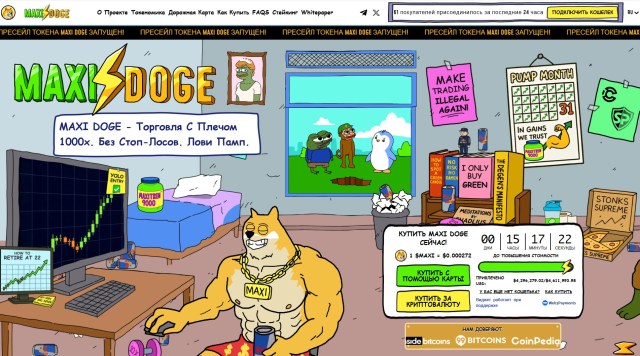
It's worth noting the interest from large participants separately. Two addresses purchased tokens for a total of about $503 thousand, with the largest transaction reaching $252 thousand. Such capital concentration at an early stage is usually viewed by project supporters as a signal of confidence in its potential in the upcoming bull market.

In terms of functionality, Maxi Doge bets on a culture of high leverage and constant "pumping" of results. The $MAXI token operates on the Ethereum network as a standard ERC-20, and the smart contract manages supply and distribution, including the Maxi Fund for liquidity and partnerships. Holders are offered staking rewards with dynamic APY from a separate distribution pool for up to one year, as well as profitability tournaments with leaderboards and prizes. All this is aimed at creating a "training ground" for aggressive traders within a single community.

However, this approach also means increased risks. Any presale token carries uncertainty regarding the regulatory environment, potential volatility in the first weeks of listing, and dependence on community activity. Unlike Dogecoin, which has already proven its resilience through several market cycles, $MAXI remains a speculative bet at an early stage. Therefore, a sensible approach for aggressive investors is to consider Maxi Doge as a high-risk addition to the portfolio, not a replacement for more liquid assets like $DOGE. Before participating, it is important to independently study the project, its tokenomics, and the smart contract.

The final view on the Dogecoin and Maxi Doge pairing looks like this: $DOGE remains the flagship of the meme segment with real chances to approach $1 again if the bull cycle continues. Against this backdrop, Maxi Doge acts as a potential accelerator for those willing to accept greater risk for super returns. This approach—combining a proven asset with a speculative presale—is what many market participants are choosing in anticipation of the next growth wave.


Trending Cryptos

Related Questions

QWhat is the main driver for Dogecoin's potential price increase according to the article?

AThe main driver for Dogecoin is a combination of the meme narrative, support from famous entrepreneurs, and phases of the Bitcoin cycle.

QWhat are the three potential price trajectories for Dogecoin outlined in the article?

AThe three scenarios are: 1) A bullish scenario where DOGE tests $1, 2) A base scenario of long-term consolidation, and 3) A bearish scenario where the price falls significantly below local highs.

QWhat is the name of the new meme project mentioned that is seen as a more aggressive bet alongside Dogecoin?

AThe new meme project is called Maxi Doge ($MAXI).

QWhat is the current price of the Maxi Doge ($MAXI) token during its presale, as stated in the article?

AThe price of the Maxi Doge token during its presale is $0.0002725.

QWhat key technical indicators should traders watch for Dogecoin to gauge its momentum?

ATraders should watch the Relative Strength Index (RSI) and trading volumes to gauge Dogecoin's momentum.

Related Reads

Agent Race Ends, Super Workbench Takes Over

The era of fragmented AI agents is ending. Over the past month, China's tech giants—Tencent, Alibaba, and ByteDance—have simultaneously shifted strategy: instead of launching new, standalone AI agents, they are consolidating their various agent projects into unified "super workbenches." Tencent integrated its QClaw teams into WorkBuddy, a strategic product hailed as a potential third flagship after QQ and WeChat. Alibaba is merging its QoderWork, Wukong, and MuleRun agents into a new "Qianwen Office" platform under DingTalk's leadership. ByteDance rebranded its TRAE SOLO coding agent to TRAE Work, signaling a broader focus on workflow collaboration. This convergence marks a pivotal industry consensus. The initial exploration phase, where companies rapidly built numerous overlapping agents for different scenarios, proved costly and inefficient. With open-source tools eroding technical barriers, competition has shifted from agent creation to resource consolidation and cost control. Historically, platform wars are won not by creating more products, but by simplifying them—as seen with browsers unifying web access and super-apps consolidating services. Now, the "super workbench" aims to become the unified AI entry point for work. This reflects a deeper market realization: the primary audience for AI is no longer just programmers (a market in the tens of millions) but all knowledge workers (a market of billions). The real opportunity lies in augmenting everyday tasks—managing emails, documents, data, and meetings—across the entire workday. The core battleground is becoming control over the primary AI entry point that employees use daily. Tencent's WorkBuddy leverages WeChat and Tencent Docs; Alibaba's Qianwen Office taps into DingTalk's organizational data; ByteDance's TRAE Work integrates with Feishu's workflows. Whoever owns this "super workbench" gains strategic control over orchestrating enterprise data and APIs. This shift is redefining enterprise software. Traditional SaaS applications, valued for their user interfaces, will recede into the background. Their core functionalities will be exposed as standardized "Skills" or APIs for the super workbench's agents to invoke. Software value will shift from selling user seats to charging based on API calls and outcomes delivered. The evolution of agents is moving through clear stages: first as novel standalone products, then as consolidated primary work entry points, and finally as pervasive, invisible capabilities embedded into the digital fabric. The recent moves by major tech firms signal the transition from the first stage into the second, accelerating toward the third. In the end, the most successful agent technology may become invisible—like electricity or the HTTP protocol—a fundamental, unnamed infrastructure powering work itself.

marsbit9m ago

Agent Race Ends, Super Workbench Takes Over

marsbit9m ago

Michael Saylor: 110 Reasons to Oppose BIP-110

Michael Saylor presents 110 arguments against Bitcoin Improvement Proposal (BIP) 110, a soft fork aimed at restricting certain non-monetary data storage uses (like inscriptions) on the Bitcoin blockchain. He acknowledges the proponents' valid concerns—such as node costs, fee pressure, and preserving Bitcoin's monetary focus—but fundamentally disagrees with the proposed solution. Saylor argues that BIP 110 represents a dangerous precedent of using consensus rules to enforce value judgments on transaction validity, moving away from Bitcoin's core principles of neutrality and permissionless innovation. His key objections are organized into eleven categories: 1) It violates neutrality and hard consensus by banning currently valid transactions. 2) It fails to meet the high burden of proof required for a consensus change, lacking concrete data on the alleged crisis. 3) Its seven bundled technical restrictions are overly broad, targeting generic script functionalities and blocking future upgrade paths. 4) It sacrifices compatibility and future optionality by closing off designed upgrade hooks. 5) Its temporary rules add significant complexity (grandfathering, expiry states) without sufficient justification. 6) The economic and security impacts, particularly on miner revenue and fee markets, are uncertain and unmodeled. 7) Superior, market-based tools (fee markets, relay/mining policies) already exist to manage blockchain load. 8) It stifles innovation by creating a chilling effect for developers. 9) Its modified activation mechanism (55% threshold, forced signaling) is aggressive and risks network splits. 10) The precedent it sets—using consensus to suppress disliked but legal uses—is more dangerous than the problem it aims to solve. 11) A better path exists: improving measurements, refining resource-based policies, and allowing market forces to work. Saylor concludes that Bitcoin's strength lies in its neutral rules, open markets, and hard consensus. Changing these foundational elements to target specific use cases is an unnecessary and risky "iatrogenic" intervention. He advocates for guarding Bitcoin's neutrality rather than acting as its redeemer.

marsbit24m ago

Michael Saylor: 110 Reasons to Oppose BIP-110

marsbit24m ago

Trading

Spot

Hot Articles

Discussions

Welcome to the HTX Community. Here, you can stay informed about the latest platform developments and gain access to professional market insights. Users' opinions on the price of MEME (MEME) are presented below.

活动图片