Delphi Digital: Solana to Undergo the Most Radical Technical Upgrade Cycle in Its History

marsbitPublished on 2026-01-21Last updated on 2026-01-21

Abstract

Delphi Digital outlines Solana's ambitious 2026 roadmap, describing it as the network's most radical upgrade cycle. The goal is to transform Solana into an exchange-grade environment where its on-chain Central Limit Order Book (CLOB) can compete with centralized exchanges (CEX) in latency, liquidity depth, and fairness. Key upgrades include: - **Alpenglow:** A major consensus overhaul introducing Votor and Rotor. Votor reduces finality time to 100-150ms by aggregating votes off-chain. It ensures liveness with up to 40% of nodes offline or malicious. Proof of History is deprecated. - **Firedancer:** A second validator client built in C++ by Jump, aimed at increasing client diversity and network resilience. - **DoubleZero:** A private fiber-optic network overlay for validators, minimizing latency disparities and enabling faster consensus. - **Block Building:** Innovations like Jito's BAM, which uses Trusted Execution Environments for transaction privacy, and Harmonic, an open block builder aggregation layer. - **Raiku:** A scheduling/auction layer providing deterministic, guaranteed execution for applications like high-frequency trading. These upgrades aim to position Solana as the premier L1 for on-chain capital markets, supporting everything from meme coins to perpetuals and native chain-on stocks, by achieving performance parity with traditional exchanges.

Written by: Delphi Digital

Compiled by: Nicky, Foresight News

Solana's 2026 roadmap may be the most radical upgrade cycle in the network's history, featuring a comprehensive overhaul from the consensus mechanism to infrastructure, aiming to become the decentralized Nasdaq.

Solana's roadmap aims to transform it into an exchange-grade environment, enabling native on-chain central limit order books (CLOBs) to compete with centralized exchanges (CEXs) in terms of latency, liquidity depth, and fairness. Here are all the upgrades to achieve this goal.

Alpenglow: A Comprehensive Overhaul of the Consensus Mechanism

Alpenglow is the most significant protocol-level change in Solana's history. It introduces a completely new consensus architecture built around two core components: Votor and Rotor.
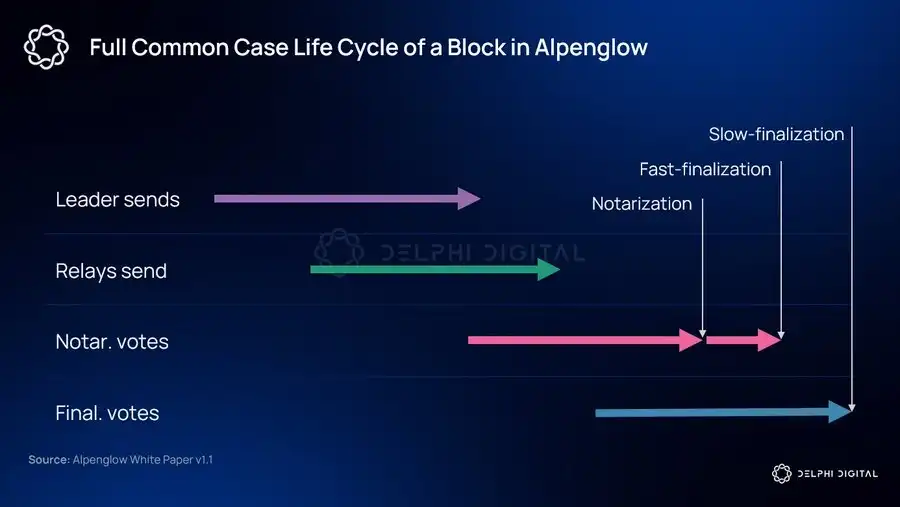
Votor completely revamps how the network reaches consensus. Instead of chaining multiple voting rounds together, it allows validators to aggregate votes off-chain and submit finality within one or two rounds. The result is a theoretical reduction in finality time from the original 12.8 seconds to 100-150 milliseconds.

Votor runs two finality paths in parallel. If a block receives overwhelming support (over 80% stake) in the first round, it is finalized immediately. If support is between 60%-80%, a second round of voting is initiated. If the second round also garners over 60% support, the block is finalized. This design ensures finality even if parts of the network are unresponsive.

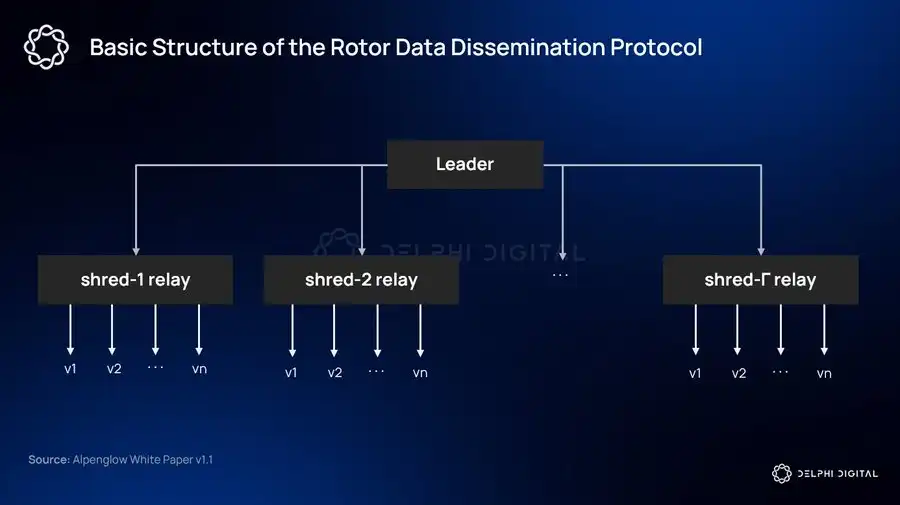
Rotor revolutionizes the block propagation mechanism by routing messages directly through validators with high stake and stable bandwidth.
Alpenglow also introduces a "20+20" resilience model: security is guaranteed as long as malicious stake does not exceed 20%; liveness is maintained even if an additional 20% goes offline. This means Alpenglow can still achieve finality even with up to 40% of the network's nodes being malicious or offline.

Under Alpenglow, the Proof of History mechanism is effectively deprecated, replaced by deterministic epoch scheduling and local timers. This upgrade is expected to launch in early to mid-2026.

Firedancer: Runtime Performance Improvements

Since its inception, Solana has relied on a single validator client (now called Agave). This monoculture has long been a core weakness of the network. Any bug or failure at the client level could lead to a full network outage.

Firedancer is a second, independent validator client developed by Jump, written in C++. Its design goal is to turn Solana validators into deterministic, high-throughput engines capable of handling millions of TPS with minimal latency variance.

Frankendancer is its transitional version, combining Firedancer's network and block production modules with Agave's runtime and consensus components. As Firedancer gradually becomes mainnet-ready, validator diversity is expected to increase significantly.

In this competitive context, both teams have been iterating heavily.

DoubleZero: High-Performance Fiber Infrastructure

DoubleZero is a private network overlay that connects validators via dedicated fiber optic cables, the same infrastructure used by traditional exchanges (like Nasdaq and CME) for microsecond transmissions.
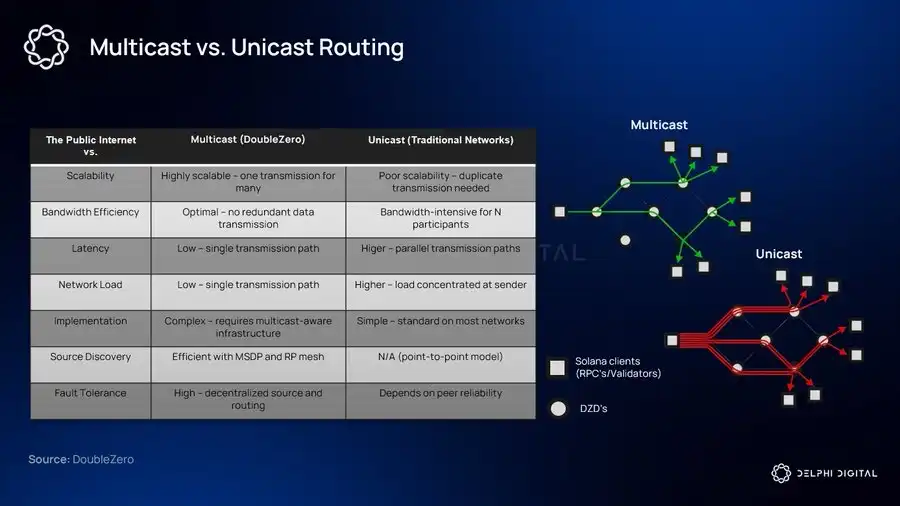
As the validator set expands, information propagation becomes more difficult. More nodes mean more destinations, introducing time inconsistencies in the network. DoubleZero eliminates this variance by routing messages along optimal paths, rather than bouncing around the public internet.

Alpenglow's finality model relies on validators receiving and responding to messages within strict time windows. If propagation is inconsistent, votes arrive late, quorums form slower, and finality takes longer. By narrowing the latency gap between validators, DoubleZero allows Votor to achieve finality faster and enables more uniform propagation for Rotor.

DoubleZero also supports multicast, replicating data within the network and delivering it to all validators simultaneously.

Block Building: BAM and Harmonic

Two complementary trends are reshaping Solana's block building layer:

BAM (Block Assembly Marketplace) is Jito's reimagining of Solana's transaction pipeline. Instead of the slot leader unilaterally deciding transaction ordering, it inserts a market and privacy layer between ordering and execution. Transactions are imported into a Trusted Execution Environment (TEE), meaning neither validators nor builders can see the raw transaction content before ordering is finalized. This prevents opportunistic pre-execution behaviors like front-running.

Harmonic targets another part of the pipeline – who builds the block. It introduces an open block builder aggregation layer, allowing validators to accept block proposals from multiple competing builders in real-time. Think of Harmonic as a meta-market, while BAM is a micro-market.

Raiku: Deterministic Execution Guarantees

Raiku fills the remaining void. Solana has arguably solved most throughput bottlenecks, but it does not natively provide deterministic latency or programmable execution guarantees for specific applications. The granular control required for high-frequency trading (HFT)-style matching and on-chain central limit order books (CLOBs) far exceeds what an L1 can reasonably provide.
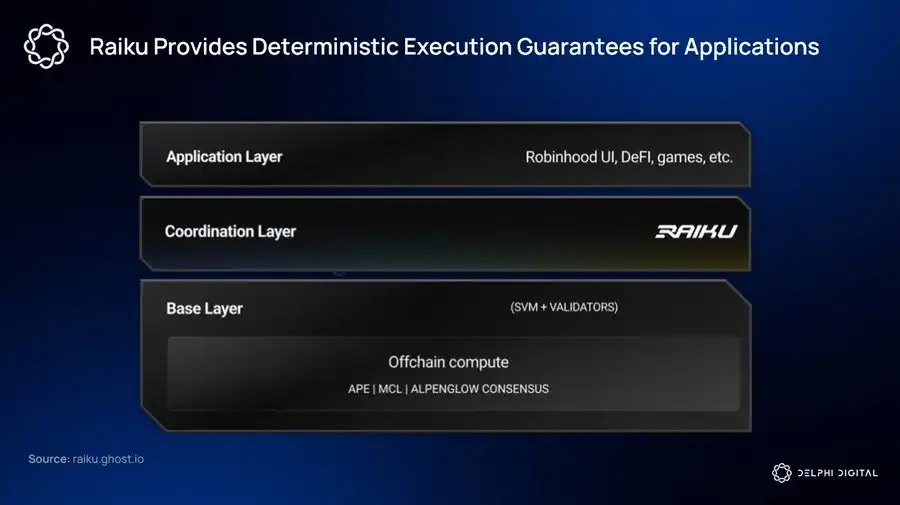
Raiku provides a scheduling/auction layer that runs parallel to the Solana validator set, offering applications a programmable, deterministic pre-execution environment without modifying the L1 consensus mechanism. It achieves guaranteed execution for pre-committed workflows through Ahead-of-Time (AOT) transactions and meets real-time execution needs via Just-in-Time (JIT) transactions.

Bringing Capital Markets On-Chain

Among high-performance public chains, Solana remains the dominant player, but this dominance is meaningless without users and efficient on-chain markets. While the vast majority of meme coins are still traded on Solana, the on-chain perpetual futures market is rapidly consolidating on a few platforms.

To compete with centralized players, performance must be on par. We believe the Solana ecosystem recognizes this issue and is optimistic about closing the gap. The upcoming upgrades are highly anticipated, and new Solana-native perpetual exchanges like BULK are set to launch early in the year.

Retail demand for trading spot assets on Solana remains huge. While Hyperliquid has temporarily captured the perpetuals market, Solana has established itself as the preferred L1 for trading any spot pair. Centralized exchanges still lead significantly, but Solana is currently the go-to solution for on-chain trading.

Products like xStocks are bringing on-chain stocks directly to Solana. Liquidity, price discovery, and speculative attention are converging onto this single chain that offers faster settlement, better user experience, and denser capital.

This is Solana's rationale for bringing capital markets on-chain.

Trending Cryptos

Related Questions

QWhat is the main goal of Solana's 2026 roadmap according to Delphi Digital?

AThe main goal is to transform Solana into an exchange-grade environment where native on-chain centralized limit order books (CLOBs) can compete with centralized exchanges (CEXs) in terms of latency, liquidity depth, and fairness.

QWhat are the two core components of the Alpenglow consensus mechanism upgrade?

AThe two core components are Votor, which overhauls how the network reaches consensus, and Rotor, which revolutionizes block propagation.

QHow does Firedancer improve Solana network's performance and security?

AFiredancer is a second independent validator client written in C++ that aims to turn Solana's validators into deterministic, high-throughput engines capable of handling millions of TPS with minimal latency variance, thereby increasing client diversity and reducing the risk of network-wide outages.

QWhat is the purpose of DoubleZero in the Solana ecosystem?

ADoubleZero is a private network overlay that connects validators via dedicated fiber optics, reducing latency inconsistencies and enabling faster finality by routing messages on optimal paths rather than over the public internet.

QWhat problem does Raiku solve for applications like high-frequency trading (HFT) and on-chain CLOBs?

ARaiku provides a deterministic execution guarantee and a programmable pre-execution environment, offering granular control for applications that require assured execution timing, which is essential for HFT-style matching and on-chain CLOBs.

Related Reads

Annual Salary of Millions Competing for Electricians, Meta Rushes to Open Its Own Technical School

The AI boom is facing an unexpected bottleneck: a severe shortage of skilled construction workers and electricians. As tech giants like Meta, OpenAI, and Alphabet race to build massive data centers—such as OpenAI's $16 billion "Stargate" project—they are hitting a critical labor wall. The U.S. needs an estimated 130,000 more electricians, 240,000 construction workers, and 150,000 supervisors by 2030 for AI infrastructure alone, but tens of thousands of electrician jobs go unfilled each year. While AI companies offer high premiums, with electricians earning up to $280,000 annually, worker scarcity still causes massive losses—delays on a single project can cost $14.2 million per month. The complexity of building AI data centers, which require immense power (equivalent to powering hundreds of thousands of homes), sophisticated electrical systems, and advanced liquid cooling solutions, demands highly skilled technicians who are in short supply. To combat this, companies are investing heavily in training. Meta has committed $115 million to a free training school offering tuition, housing, and stipends, targeting 5,000 new workers. OpenAI is partnering with unions to secure skilled labor. These efforts are paying off, with a significant rise in Gen Z interest in trade schools over college. However, the power demands are staggering. AI data centers are driving a rapid surge in electricity consumption, projected to account for up to 12% of U.S. power use by 2028 and raising costs for consumers. Furthermore, the construction boom is project-based, leading to a potential future glut of trained workers once building peaks, which could depress wages industry-wide. The race for AI supremacy now depends as much on skilled hands as on advanced chips.

marsbit8m ago

Annual Salary of Millions Competing for Electricians, Meta Rushes to Open Its Own Technical School

marsbit8m ago

OpenAI No Longer Sells Its Most Expensive Model for Profit

OpenAI is shifting its business strategy away from promoting its most expensive, flagship models for every task. Recent price cuts—80% for GPT-5.6 Luna and 20% for Terra—signal a deeper change: the company now actively advises users that many tasks don't require the most powerful model. Instead, OpenAI recommends a tiered approach: use the high-end GPT-5.6 Sol for complex planning and analysis, then delegate execution to cheaper models like Luna. This mirrors moves by Anthropic, which recently launched Claude Opus 5 at half the price of its top model, Fable 5. Both companies are de-emphasizing flagship models as primary revenue drivers, using them instead for brand prestige and technological showcases. The industry is entering a "mass-market" phase, similar to automotive, where high-volume, cost-effective models handle daily operations and drive scale. OpenAI's price reductions are partly enabled by AI models themselves optimizing underlying code and infrastructure, creating a self-reinforcing cycle of efficiency gains and cost reduction. Competition is shifting from "who is smartest" to "who offers the best value." The goal is no longer selling individual models but fostering widespread API adoption and ecosystem lock-in. By making AI calls cheap and ubiquitous, companies like OpenAI aim to become the indispensable, utility-like infrastructure powering automated workflows—the "water and electricity" of software, quietly embedded everywhere.

marsbit8m ago

OpenAI No Longer Sells Its Most Expensive Model for Profit

marsbit8m ago

Will the Fed Definitely Raise Interest Rates in September? How Will Crypto and U.S. Stocks Withstand the Pressure?

The market's expectation for a September Fed rate hike surged dramatically in early August, jumping from under 50% to over 80% within a week. This shift followed a contentious July FOMC meeting, where a 9-3 vote to hold rates revealed growing dissent from hawkish members advocating for an immediate hike to combat persistent inflation. The primary catalyst for this repricing is rising oil prices, driven by renewed geopolitical tensions around the Strait of Hormuz, which threaten global supply. Energy costs directly influence inflation metrics, making the upcoming July CPI report (due August 12th) a critical data point. If it shows inflation reaccelerating, the probability of a September hike will solidify. For Bitcoin and crypto assets, this is typically bearish news. Bitcoin continues to behave as a high-beta, liquidity-sensitive risk asset. A rate hike raises the opportunity cost of holding non-yielding assets and could drive capital toward money markets, pressuring crypto prices in the short term. However, historical patterns suggest that if a hike is perceived as the end of a tightening cycle rather than the start, any negative price impact may be brief. U.S. stocks, particularly crypto-linked equities like Coinbase and growth-oriented tech stocks, are also vulnerable. Higher rates increase discount rates in valuation models, putting pressure on high-multiple companies. This coincides with a pivotal tech earnings season where investor focus has shifted from massive AI capital expenditure to tangible revenue and cash flow generation. Companies with negative cash flow and weak growth narratives could face heightened volatility if borrowing costs rise in September. In summary, a September Fed hike has evolved into a mainstream market scenario. Key factors to watch are oil prices, the July CPI report, and Fed communications, which will determine the final decision and its impact on volatile crypto and equity markets.

marsbit19m ago

Will the Fed Definitely Raise Interest Rates in September? How Will Crypto and U.S. Stocks Withstand the Pressure?

marsbit19m ago

Trading

Spot

Hot Articles

Discussions

Welcome to the HTX Community. Here, you can stay informed about the latest platform developments and gain access to professional market insights. Users' opinions on the price of SOL (SOL) are presented below.

活动图片















