Defending Champions or New Kings? World Cup Final Sees All AIs Backing the Same Side

Odaily星球日报Published on 2026-07-17Last updated on 2026-07-17

Abstract

Will the 2026 World Cup final see Argentina successfully defend their title or a new champion crowned? AI models from various platforms have made their prediction. The final in Buenos Aires pits defending champions Argentina against a resilient Spanish side that has reached this stage with a record of exceptional defensive solidity, conceding only one goal in seven matches. Argentina's path was dramatically different, filled with late comebacks and narrow victories, including a semi-final win over England secured by late goals assisted by the 39-year-old Lionel Messi. A poignant subplot adds narrative weight: a nearly 20-year-old photo shows a young Messi bathing an infant Lamine Yamal, who is now a 19-year-old key player for Spain, symbolizing a potential passing of the torch. In the semi-finals, most AI models incorrectly predicted a French victory over Spain, with only Google's Gemini correctly picking Spain's advancement and also accurately forecasting Argentina's win over England. For the final, however, all six surveyed AIs—ChatGPT, Claude, Gemini, Grok, DeepSeek, and Qwen—unanimously predict a Spanish victory. Their reasoning centers on Spain's superior defense, midfield control, and better physical preparedness after a less strenuous knockout stage journey. While consensus favors Spain as champions, five of the six AIs believe the match will be tightly contested, predicting a draw (1-1 or 0-0) within regular time, with Spain's advantage potentially telling in extr...

Original | Odaily Planet Daily (@OdailyChina)

Author | Asher (@Asher_ 0210)
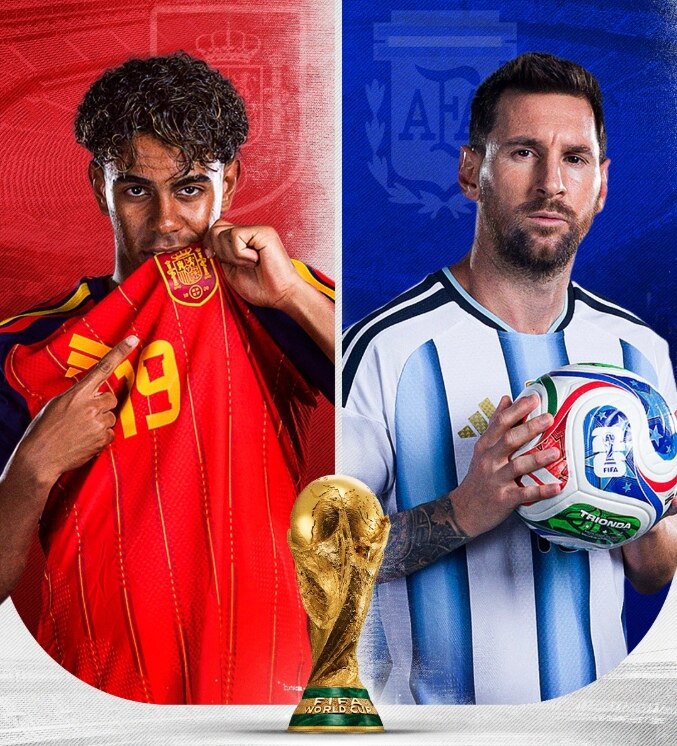
At 3 a.m. Beijing Time on July 20, the 2026 FIFA World Cup will crown its champion between Argentina and Spain. On one side is Argentina, attempting to defend their title and achieve a historic back-to-back World Cup win; on the other is Spain, who have marched steadily to the final with an almost unbreakable defense.

Spain's path to the final has demonstrated remarkable stability. In the knockout stages, they successively defeated Austria, Portugal, Belgium, and France, maintaining tight control of the game rhythm against multiple strong opponents. Particularly in the semi-final against France, Spain allowed little space for counterattacks from the Mbappé-led frontline, ultimately advancing with a 2-0 victory. With only 1 goal conceded and 6 clean sheets in 7 matches, their solid defense and formidable midfield control have been the bedrock of their journey.

Argentina's road, in contrast, has been fraught with danger and comebacks. Since entering the knockout rounds, they have hardly secured a comfortable win. They narrowly defeated Cape Verde and Egypt 3-2 each; in the quarter-final against Switzerland, they only scored consecutive goals deep into extra time; facing England in the semi-final, they were still trailing in the 85th minute before relying on Messi's assists for Enzo and Lautaro to complete a dramatic turnaround.

Furthermore, this final carries a storyline almost worthy of a movie script.

During a charity photoshoot in 2007, a young Lionel Messi was photographed bathing an infant Lamine Yamal. No one could have imagined that nearly two decades later, the two would meet for the first time in their careers on the World Cup final stage.

Now, Messi is 39 years old, while Yamal is just 19. One is potentially playing his final World Cup match; the other stands at the threshold of his own era. This nearly 20-year-old photo adds a layer of symbolic generational transition to this final.

Before delving into which side the AIs predict will lift the trophy, let's review their performance in the two semi-finals (related content can be read here: Semi-final AI Prediction Battle: Is France a Lock? England vs Argentina Hangs in the Balance).

Most Stumbled in Semis, Gemini Nailed Both

In the quarter-finals, all 6 AIs correctly predicted France, Spain, England, and Argentina to advance. However, by the semi-finals, the overall prediction performance of the AIs became somewhat "lackluster."

For France vs. Spain, ChatGPT, Claude, Grok, DeepSeek, and Qwen not only unanimously favored France to advance but also all predicted a 2-1 win for France. These five models reasoned that France could exploit the spaces left by Spain's advancing full-backs to decide the match with swift counterattacks. In reality, France failed to execute the expected counters, were instead controlled by Spain's rhythm, and ultimately exited with a 0-2 loss. Gemini, the sole model to pick Spain, got the advancing team right, but it predicted the match would go to a penalty shootout, thus also missing the exact process.

For England vs. Argentina, the 6 AIs were split down the middle. Grok, DeepSeek, and Qwen supported England, while ChatGPT, Gemini, and Claude backed Argentina. In the end, Argentina completed a 2-1 comeback. The three models supporting Argentina correctly predicted the advancing side, with only Gemini also accurately predicting the final score.

After the two semi-finals, Gemini emerged as the only model to correctly pick both finalists, delivering the most accurate predictions of this round. Yet, as we approach the ultimate championship match, all 6 AIs have once again aligned on the same side.

Consensus Returns for Final, All 6 AIs Favor Spain

Monitoring by prediction market tools shows that in the "World Cup Final Argentina vs Spain" event on predict.fun, the implied probability for an Argentina win is temporarily reported at 27%; a draw at 32%; and a Spain win at 43%. Furthermore, including extra time and penalties, Spain's implied championship probability stands at 59%, compared to Argentina's 41%.
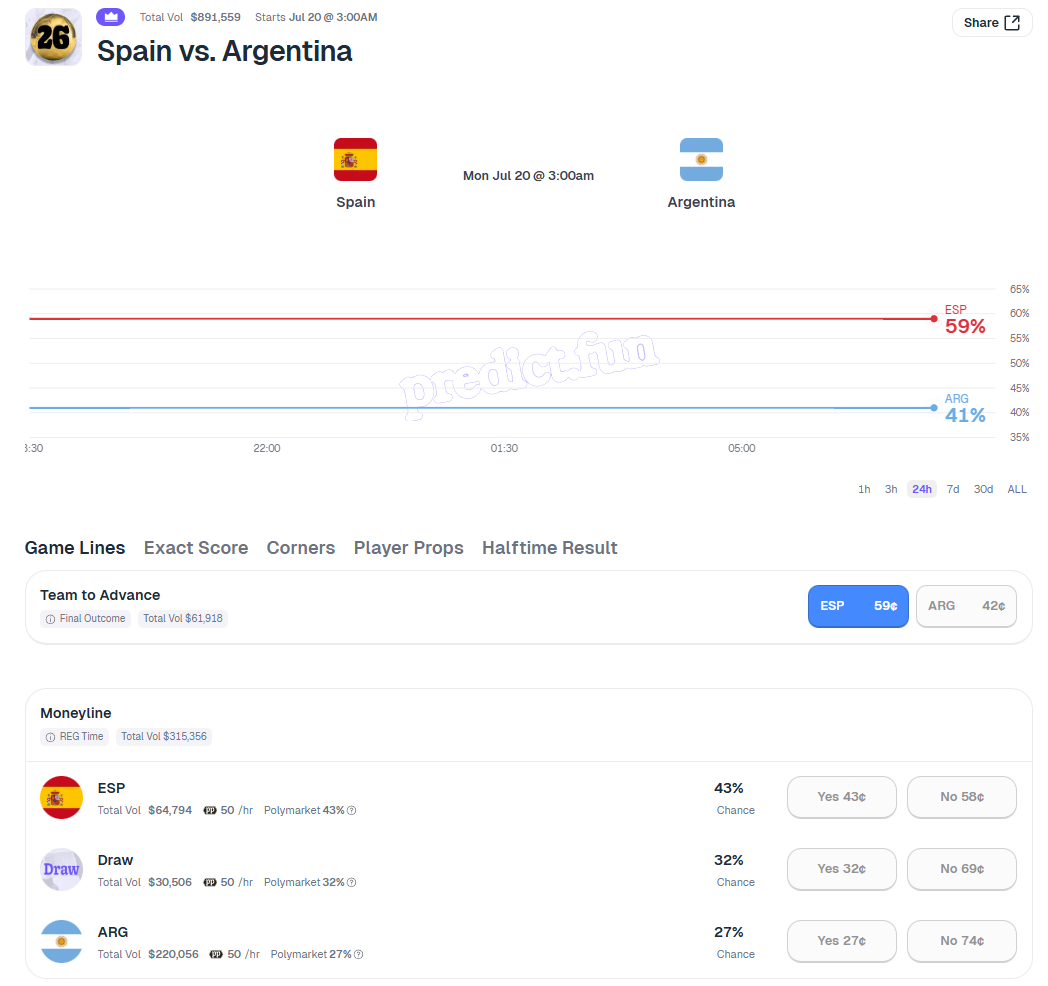
While the prediction market shows a close championship probability, the stance of the 6 AIs is highly unanimous: ChatGPT, Claude, Gemini, Grok, DeepSeek, and Qwen all favor Spain to win the title.

Why Do All AIs Predict a Spanish Victory?

The reasons cited by the AIs for favoring Spain are highly consistent: defense, midfield control, and physical preparedness.

Spain's most compelling advantage is their near-impenetrable defense this tournament. Conceding only 1 goal in the first 7 matches and successively containing Portugal, Belgium, and France in the knockouts. While Argentina possesses greater offensive firepower, facing Spain's compact formation, they are unlikely to find the same open spaces for counterattacks as before.

Midfield control will dictate the pace of the match. Rodri orchestrates the attack, Olmo consistently infiltrates the attacking channels between defenders, and Yamal can continuously stretch Argentina's defense from the wings. Argentina excels at compressing the center and launching rapid attacks through Messi, Álvarez, and Lautaro, but Spain has the ability to reduce transitional play through prolonged possession, making it difficult for Argentina to settle into their preferred rhythm.

Physical preparedness is also a variable widely mentioned by the AIs. Spain finished their semi-final a day earlier than Argentina and had a relatively smoother path; Argentina, meanwhile, played 120 minutes against Switzerland and battled until stoppage time against England. If the match goes into extra time, Spain's younger squad and deeper bench could become decisive advantages.

5 AIs Don't Favor a Spanish Win Within 90 Minutes

Although unanimous on the champion, the 6 models still have different judgments on how Spain might win the match.

Gemini, the top performer in the semis, predicts a 1-1 draw in regulation time, a continued stalemate in extra time, and ultimately a penalty shootout to decide the champion, picking Spain to emerge victorious.

ChatGPT, Grok, and Qwen offer similar predictions, all leaning towards a 1-1 scoreline after 90 minutes. They believe Argentina has the ability to equalize through Messi's playmaking and attacking efficiency, but in extra time, Spain's superior physical conditioning and squad depth will gradually tell, leading to a winning goal in the additional 30 minutes.

Claude does not predict a specific score but believes the match will be locked in a low-scoring range (1-1, 1-0, or 0-0). It emphasizes the cautious atmosphere typical of finals, suggesting the sides may remain evenly matched for long periods until a set piece, counterattack, or individual moment of brilliance breaks the deadlock.

DeepSeek is the only model leaning more towards Spain resolving the match within the 90 minutes. It expects Spain to continue their defensive solidity, limit Argentina's attack, and secure a direct 2-0 or 2-1 victory.

Before the semi-finals, 5 AIs unanimously backed France to advance, only for Spain to deliver a 2-0 masterclass, collectively proving the AIs wrong. This time, will Spain fulfill the promise of their overall strength, or will Argentina once again drag the match into familiar desperate straits and find a path to another miraculous turnaround?


Related Questions

QWhat is the main storyline surrounding the upcoming 2026 World Cup final between Argentina and Spain, according to the article?

AThe main storyline is the potential passing of the torch between two generations, symbolized by a nearly 20-year-old photo of a young Lionel Messi giving a bath to a baby Lamine Yamal. Now, a 39-year-old Messi potentially faces a 19-year-old Yamal in what could be Messi's final World Cup match, representing a symbolic shift of eras.

QWhich was the only AI model to correctly predict both finalists from the semifinals, and what was its performance?

AGemini was the only AI model to correctly predict both finalists. It was the sole model to pick Spain to advance over France (though it predicted a penalty shootout, not a 2-0 win). It also correctly predicted Argentina to beat England and was the only model among those picking Argentina to also get the exact 2-1 scoreline right.

QWhat are the three primary reasons cited by the AI models for unanimously favoring Spain to win the World Cup final?

AThe three primary reasons are: 1) Spain's nearly impenetrable defense, having conceded only 1 goal in 7 matches with 6 clean sheets. 2) Superior midfield control, allowing them to dictate the game's tempo and limit Argentina's preferred fast transitions. 3) Better physical and squad depth, having had an easier path to the final and more rest, which could be decisive if the match goes to extra time.

QHow did the predictions of ChatGPT, Grok, and Qwen (Qianwen) differ from DeepSeek's regarding how Spain would win the final?

AChatGPT, Grok, and Qwen predicted the match would be tied 1-1 in regular time, with Spain's superior fitness allowing them to score a winning goal in extra time. In contrast, DeepSeek was the only model that favored Spain winning within the 90-minute regulation time, predicting a 2-0 or 2-1 victory, citing their strong defense to contain Argentina's attack.

QWhat was the general performance of AI models in the World Cup semifinals compared to the quarterfinals, as described in the article?

AIn the quarterfinals, all six AI models correctly predicted the advancement of France, Spain, England, and Argentina. However, their overall performance was poor ('拉胯') in the semifinals. Five models (ChatGPT, Claude, Grok, DeepSeek, Qwen) incorrectly predicted France would beat Spain 2-1. Only three models (ChatGPT, Gemini, Claude) correctly picked Argentina over England, with only Gemini getting the exact score right for that match.

Related Reads

A Critical Review of Base Co-founder's "Letter of Self-Criticism"

Yesterday, Base co-founder Jesse Pollak published a self-critical post on X, reflecting on Base's successes and failures over the past two years. While his candor is commendable, the author argues his analysis still misses key points. Jesse admitted his primary mistake was heavily betting that onchain social platforms (like Farcaster) and creator tokens would drive mainstream crypto adoption. The author harshly criticizes this strategy, giving it a "0/100" score. They argue onchain social offers no superior user experience, and creator tokens, like Jesse's own $JESSE, fail to solve fundamental issues about value and creator adoption, unlike successful memecoins on other chains. The author is more forgiving regarding Base lagging in areas like perpetual DEXs and prediction markets, giving this an "80/100". They note strong competitors like Hyperliquid had unique advantages, and Base has found significant success in other narratives like AI and RWA. The author gives Jesse's overall reflection a "60/100" or passing grade. While Jesse now correctly sees multiple paths to adoption (stablecoins, payments, AI Agents) beyond just social, he, along with other industry leaders like Toly and Vitalik, still underestimates the powerful role of memecoins in driving mainstream awareness and adoption. The critique concludes that leaders often leverage memes for user acquisition but fail to genuinely embrace or thoughtfully develop the space, revealing a retreat from idealism and a disconnect from grassroots, viral growth mechanisms.

marsbit26m ago

A Critical Review of Base Co-founder's "Letter of Self-Criticism"

marsbit26m ago

When Traditional Finance Fails People in Crisis, Bitcoin Succeeds

When traditional finance fails to reach people in crisis, Bitcoin succeeds. This article highlights how fundraising platforms like GoFundMe face severe limitations in delivering aid to conflict zones like Gaza due to banking regulations, sanctions, and compliance rules. For instance, Sami Jamal Al-Shannat raised over £55,000 for his family but couldn't receive the funds directly; instead, money had to be routed through a beneficiary in another country, leading to disputes and loss of access. The piece explores how compliance requirements often force reliance on intermediaries, shifting risk and responsibility away from platforms and onto individuals. In contrast, Bitcoin and blockchain-based platforms like Geyser and Agora enable direct, peer-to-peer transactions, bypassing traditional financial bottlenecks. These platforms shift trust from centralized institutions to verifiers—local partners or trusted organizations—who validate projects, allowing donors to send funds directly to recipients' wallets. While not a panacea, Bitcoin offers a way to circumvent "transnational financial repression," where sanctions and AML rules inadvertently harm legitimate aid recipients, activists, and dissidents. The conclusion emphasizes that open payment networks and decentralized trust models represent a systemic shift, empowering beneficiaries and providing more resilient humanitarian fundraising in crisis situations. However, challenges around verification, accountability, and fraud prevention remain.

marsbit52m ago

When Traditional Finance Fails People in Crisis, Bitcoin Succeeds

marsbit52m ago

Bitcoin Shifts Towards Consolidation, Long-Term Holder Selling Pressure Significantly Eases

Bitcoin's Bottoming Process Shows Signs of Shifting Dynamics Bitcoin's bottom formation is ongoing, but key characteristics are changing. The capitulation selling by long-term holders (LTHs), a primary source of selling pressure this cycle, has begun to cool from its recent peak. Buyers successfully absorbed the selling at the June lows, and price is now recovering to challenge overhead resistance. The market is testing higher resistance levels. Bitcoin reacted more strongly to soft inflation data than major equity indices, signaling sellers may be exhausted and buyers are waiting for a catalyst. Its correlation with stocks is weakening while its inverse relationship with the USD is deepening, suggesting liquidity dynamics are now more influential than risk sentiment. On-chain, price sits between the network's Realized Price (a historical bear market floor) and the Short-Term Holder (STH) cost basis near $69k, a key resistance level where recent buyers break even. LTH profit-taking has largely dried up, and losses now dominate realized on-chain volume—a typical late bear market signal. Crucially, the pace of LTH capitulation has started to decline. Derivatives markets show bearish positions are being unwound, with put/call ratios falling and crash protection costs moderating. However, this derisking hasn't been accompanied by significant spot buying, a missing link for sustained recovery. US spot ETF outflows have slowed but not reversed. In conclusion, foundational elements for a bottom are forming: LTH selling is easing, low-point selling was absorbed, and the market is responding to positive macro cues. The next critical test is whether spot-driven buying can push price through and hold above the STH cost basis near $69k. The follow-through is not yet confirmed.

marsbit1h ago

Bitcoin Shifts Towards Consolidation, Long-Term Holder Selling Pressure Significantly Eases

marsbit1h ago

From a Loss of 19.2 Billion to a Profit of 7.1 Billion, ChangXin Technology States 'Downturn Cycle Remains a Concern'

Changxin Technology, China's leading domestic DRAM manufacturer, is nearing its IPO on the STAR Market. After reporting significant net losses of -192.25 billion yuan and -90.51 billion yuan in 2023 and 2024 respectively, the company achieved a net profit of 71.44 billion yuan in 2025. This turnaround is attributed to an AI-driven surge in DRAM demand and tight industry supply, leading to a 33.69% increase in average selling prices alongside reduced unit costs. Despite the improved profitability, with gross margins rising from -1.93% in 2023 to 40.99% in 2025, Chairman Zhu Yiming cautions that the strongly cyclical DRAM industry remains vulnerable. Risks include potential macroeconomic shifts, uncertain AI demand, and new capacity expansions that could trigger another downturn. The company still faces high fixed costs, with depreciation reaching 246.8 billion yuan in 2025. Changxin plans to raise 29.5 billion yuan through its IPO to fund technology upgrades, DRAM advancement, and R&D. While its capacity ranks fourth globally, its 7.67% Q4 2025 market share lags behind leaders Samsung, SK Hynix, and Micron. Analysts note the company must now prove its ability to achieve stable mass production with high yields and low cost-per-bit, especially for advanced products. Its growth currently relies on transitioning from DDR4/LPDDR4X to DDR5/LPDDR5X and increasing domestic substitution. Successfully developing and commercializing high-value AI products like HBM is seen as crucial for future competitiveness and closing the gap with international giants.

marsbit1h ago

From a Loss of 19.2 Billion to a Profit of 7.1 Billion, ChangXin Technology States 'Downturn Cycle Remains a Concern'

marsbit1h ago

Trading

Spot
活动图片