DeepSeek Paralyzed for 12 Hours: Is the Computing Power of Domestic Large Models Failing to Keep Up with Ambitions?

marsbitPublished on 2026-04-03Last updated on 2026-04-03

Abstract

On the evening of March 29, DeepSeek, a leading Chinese large language model, experienced a 12-hour service outage affecting both its web and app platforms. The disruption, marked by repeated server failures and instability, raised significant concerns about the platform's reliability. Initial explanations pointed to overwhelming user traffic, but data did not support a sudden surge in users. Instead, the incident highlighted deeper structural challenges, particularly in computational supply struggling to keep pace with growing AI demands. As models become more complex—supporting longer context, advanced reasoning, and multimodal tasks—the computational load increases substantially. The outage also underscored emerging usage patterns like “lobster farming,” where automated, high-frequency API calls amplify server load. Meanwhile, anticipation for DeepSeek’s upcoming V4 model—featuring major upgrades like million-token context and stronger multimodal capabilities—suggests even greater future computational pressure. This incident signals a shift in the AI industry: competition is no longer just about model capability but also infrastructure stability, cost efficiency, and engineering scalability. The outage serves as an early warning of the systemic challenges facing AI platforms as adoption expands.

If you used AI on the evening of March 29, you likely experienced a sudden "disconnection."

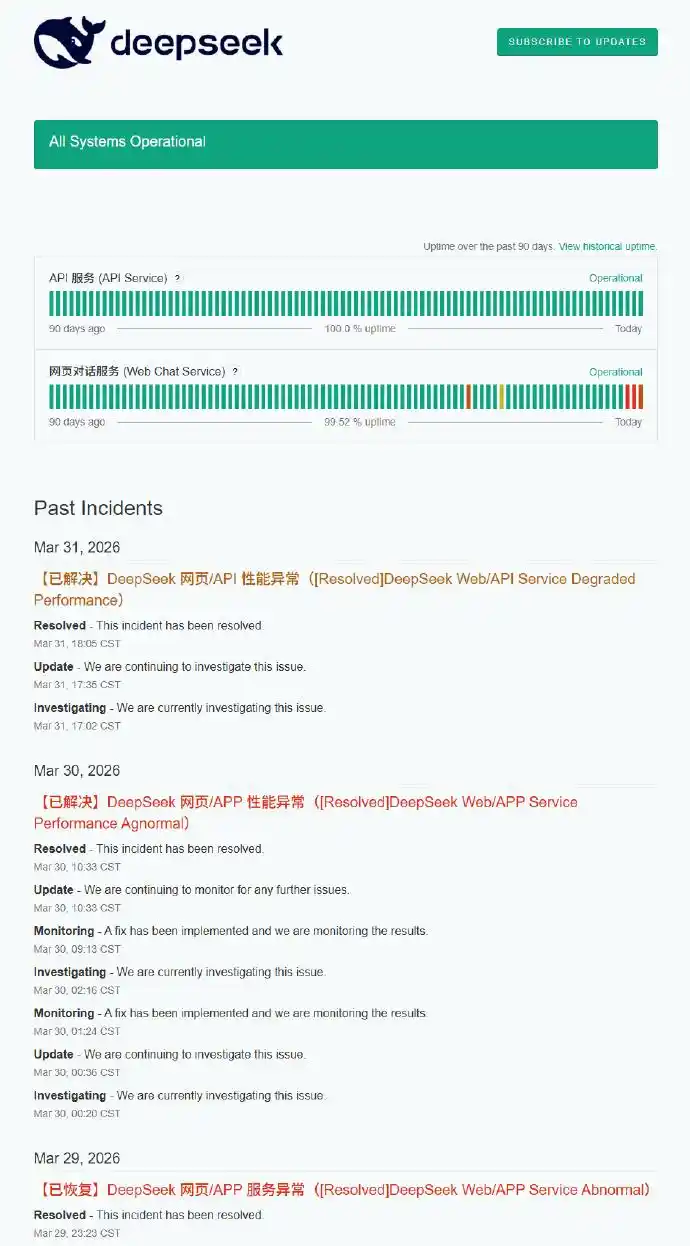
The center of this storm was DeepSeek, a leading domestic large model provider. Starting at 9:35 PM that night, its web and app services simultaneously encountered anomalies—login failures, interrupted conversations, lost content, and screens flooded with "server busy" prompts. For ordinary users, this was merely a temporary inconvenience, but for students rushing to finish papers and workers racing against deadlines, it felt more like an unannounced "disaster."
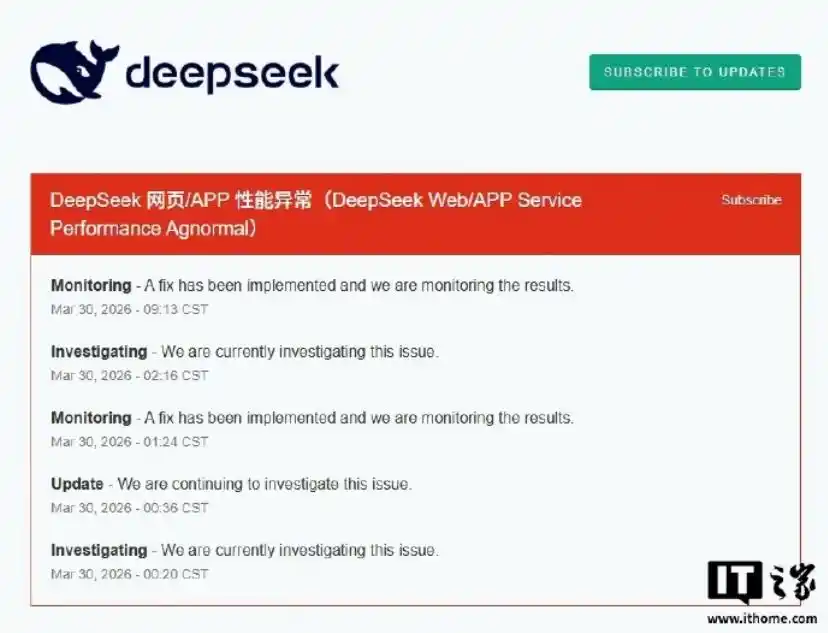
What made it even more frustrating was that this outage wasn’t a one-time crash but a typical case of "repeated fluctuations." Briefly restored at 11 PM, crashed again at midnight, urgently repaired in the early morning, and gradually stabilized only by the next morning.

A full 12 hours of instability not only set a new record for DeepSeek’s downtime but also led users to question the stability of large models like never before.

01 An Unexpected Crash: Was the Problem Really Just "Too Many Users"?

When the outage occurred, the first explanation offered was that "too many users overloaded the servers."

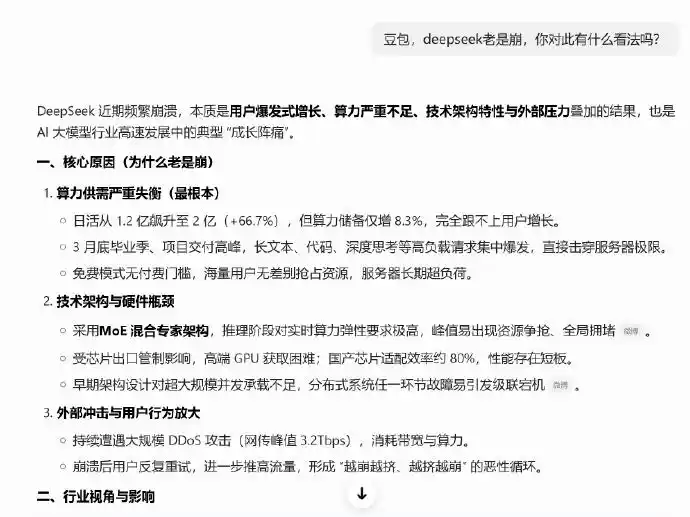
While this sounded plausible, it was quickly contradicted by real data. According to recent AI application rankings, DeepSeek’s monthly active user base is around 150 million—a substantial number, but not indicative of explosive growth. In other words, this wasn’t a typical "breakout traffic surge."
That makes the situation even more intriguing: If there was no sudden spike in user numbers, why did the system completely fail in such a short time?

The answer likely lies in deeper structural issues.

02 Computing Power vs. Demand: The Hidden Crisis in the AI Industry

Over the past year, large models have evolved at an almost visible pace. From longer context windows to stronger reasoning capabilities and the continuous expansion of multimodal abilities, the "upper limits" of model capabilities have been constantly raised.

But at the same time, a more fundamental yet critical issue is becoming increasingly apparent—computing power supply is gradually approaching its limits.

Every response from a large model is essentially a consumption of computing power. The larger the model, the longer the context, and the more complex the reasoning, the higher the computational resources required. When user scale, call frequency, and model complexity rise simultaneously, system strain is almost inevitable.

It is against this backdrop that DeepSeek’s outage appears less like an isolated incident and more like a "system-wide stress test."

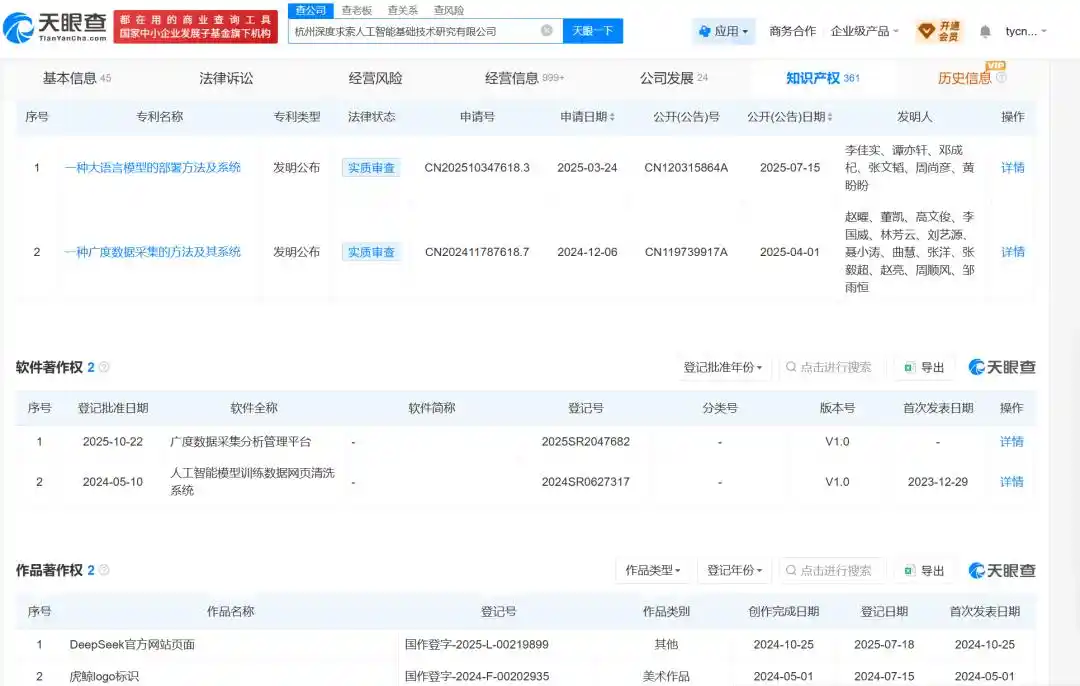
According to information from Tianyancha, DeepSeek’s affiliated entities have been increasing investments in AI algorithm R&D and computing infrastructure, continuously strengthening related technological inputs and industrial collaboration.
In fact, DeepSeek isn’t the only one under pressure. Recently, other vendors, including MiniMax, have begun limiting call frequencies during peak hours, while computing service providers like Alibaba Cloud have also adjusted their pricing strategies to varying degrees.

On the surface, these are business decisions, but they reflect the same reality—AI infrastructure supply is struggling to keep up with the pace of demand growth.

03 The "Lobster Farming" Trend: An Overlooked Traffic Amplifier

Another easily overlooked yet highly influential factor in this incident is the so-called "lobster farming" trend.

This approach essentially involves continuously calling the model via API to automate tasks, representing an early form of Agent applications. Compared to ordinary conversations, these calls occur at an extremely high frequency, sometimes triggering every minute or even every second.

When only a small number of users employ this method, it’s just an interesting experiment; but once it scales, it quickly becomes an "amplifier" of computing power consumption. This also explains why, even without a significant change in total user numbers, the system can still experience a "snowball" effect.

In a way, this outage is a classic case of "new application forms impacting old infrastructure."

04 V4 Is Approaching: Greater Expectations, Greater Pressure

Interestingly, this 12-hour outage did not significantly dampen market expectations for DeepSeek; instead, it amplified attention.

The reason is simple—the next-generation model, V4, is coming soon.

Industry rumors suggest that DeepSeek V4 will achieve leaps in multiple key capabilities: context length is expected to increase from the previous 128K tokens to millions, while multimodal and Agent execution capabilities will also be enhanced. More importantly, its computing power adaptation may further align with domestic chip systems, which holds significant meaning for China’s AI ecosystem.

But the problem is equally clear: as model capabilities improve, the demand for computing power will also increase. If the underlying infrastructure isn’t upgraded simultaneously, similar stability issues are likely to recur.

05 From "Model Competition" to "Infrastructure Competition"

Looking back at this incident, its significance may extend beyond a single product level.

Over the past two years, competition in the large model industry has centered on "capabilities"—who is smarter, who is more powerful, who leads in benchmarks. But as applications scale, a new dimension is emerging: stability and cost.

Users are starting to care not just about "whether it works" but "whether it keeps working"; enterprises are focusing not only on performance metrics but also on overall operational costs and sustainability.

In other words, AI competition is shifting from the "model layer" to the "infrastructure layer."

DeepSeek’s 12-hour outage serves as an early warning: when AI truly enters the phase of large-scale application, the deciding factor may not be the model itself but the underlying computing power, architecture, and engineering capabilities.

06 Conclusion: An Accident or a Signal?

So, what does these 12 hours really mean?

It can be seen as an accident in the development process, or it can be interpreted as a "structural warning." The former pertains to the individual, the latter to the industry.
One thing is certain: as AI applications deepen, similar stress tests will continue to occur. And each fluctuation will push the entire industry one step closer to maturity.

In a sense, DeepSeek’s crash is not an end but a beginning.

Finally, we’d like to ask: What were you using AI for during those 12 hours?

This article is from WeChat public account "Laotech," author: Laotech

Related Questions

QWhat was the main cause of the 12-hour DeepSeek service outage according to the article?

AThe outage was not primarily due to a sudden surge in users, but rather a systemic issue where computing power (算力) could not keep up with growing model complexity and usage patterns, including high-frequency API calls from 'lobster farming' applications.

QHow did the 'lobster farming' phenomenon contribute to the server instability?

A'Lobster farming' refers to automated, high-frequency API calls that act as a traffic amplifier, significantly increasing compute resource consumption even without a large growth in total user numbers.

QWhat broader industry trend does the DeepSeek incident reflect?

AIt reflects a shift in AI industry competition from a focus solely on model capabilities to a critical need for robust infrastructure, including computing power, system architecture, and engineering capabilities to ensure stability and manage costs.

QWhat upcoming DeepSeek model version is mentioned, and what challenges might it bring?

ADeepSeek V4 is mentioned, which is expected to have significantly enhanced capabilities like million-token context windows. This could put even greater pressure on computing infrastructure if not matched with corresponding upgrades.

QWhat was the significance of the 12-hour outage beyond being a single service failure?

AThe outage served as a structural early warning for the entire AI industry, highlighting that as AI applications scale, the stability and scalability of the underlying infrastructure become paramount to success.

Related Reads

From South Korea to the United States: Blue-Collar Jobs Are Becoming Increasingly Popular, Thanks to AI

AI is reshaping the labor market's value proposition. The traditional four-year college degree is losing its appeal as a guaranteed career path, while skilled blue-collar trades like electricians, welders, and plumbers are experiencing historic demand and wage premiums. This shift is driven by dual pressures: AI's displacement of certain white-collar roles and a booming need for physical infrastructure and data center construction. Data confirms the trend. In the U.S., vocational school revenue surged, and a significant portion of recent layoffs are AI-related. Surveys show a majority of Gen Z adults plan to pursue blue-collar work, citing better job security against AI automation. Vocational education interest has exploded recently. Experts cite a psychological shift as younger generations seek tangible, AI-resistant careers and avoid high student debt. In many cases, salaries for skilled trades now match or exceed those requiring a bachelor's degree. In South Korea, semiconductor vocational high schools boast near-total employment, with graduates securing high-paying roles at companies like Samsung. The shortage is structural, exacerbated by a retiring baby boomer workforce and massive infrastructure projects. Companies like JPMorgan Chase, Meta, and Lowe's are investing heavily in training programs. However, overcoming historical stigma and a "perception gap" around trade careers remains a key challenge to closing the talent gap.

marsbit1h ago

From South Korea to the United States: Blue-Collar Jobs Are Becoming Increasingly Popular, Thanks to AI

marsbit1h ago

Qualcomm: AI Hype Subsides, When Will Smartphones Emerge from the Gloom?

Qualcomm reported its Q3 FY2026 results (ending June 2026), with revenue of $9.95B, down 4% YoY but above expectations. Gross margin declined to 53.1%, pressured by rising costs across manufacturing and memory. Key business segments showed mixed performance: Handset revenue fell 19.6% YoY to $5.09B, dragged by an 11% decline in non-Apple Android shipments and weaker high-end mix. Conversely, Automotive revenue surged 61% to $1.59B, and IoT grew 9% to $1.83B. Core operating profit dropped 41% YoY due to margin compression and higher expenses. Management's Q4 FY2026 guidance projects revenue of $9.7B-$10.5B, in line with consensus, but Non-GAAP EPS guidance of $2.05-$2.25 fell short of expectations. Amidst persistent weakness in its core handset market, Qualcomm is pursuing growth in AI, focusing on Edge AI (smartphones, PCs, automotive) and Data Center AI. Its data center strategy includes four pillars: AI accelerators (e.g., AI200), commercial CPUs (Dragonfly C1000), custom silicon, and connectivity solutions. While these initiatives initially boosted its stock, concerns over AI capital expenditure sustainability have since erased those gains. The company targets $5B in data center revenue for FY2027 and $15B for FY2029. The report concludes that with the traditional handset business still under pressure, the data center opportunity is currently viewed as a longer-term option, and a more conservative valuation based on core operations may be warranted until AI contributions materialize.

marsbit1h ago

Qualcomm: AI Hype Subsides, When Will Smartphones Emerge from the Gloom?

marsbit1h ago

From TPU to Self-Evolving Agents: How Jeff Dean Predicts the Next Step in AI

At the 2026 YC Startup School, Jeff Dean outlined his vision for AI's next phase, shifting focus from simply scaling models to building intelligent, autonomous systems. He believes AI's progress is no longer just about creating smarter models, but about integrating them into systems capable of long-term, iterative work, automated experimentation, and continuous learning. This evolution moves the competition from "who has the bigger model" to "who can best organize intelligence." Dean suggests AI capabilities are now comparable to a junior engineer, enabling the automation of complex workflows. However, the true challenge and opportunity lie in managing these AI "workers" at scale. He emphasizes the importance of **context engineering**—structuring tools, memory, and feedback loops—over raw model power. For startups, this means building deep expertise in niche domains where general models currently fail (near 0-1% success rates), leveraging proprietary data, specialized tools, and domain-specific evaluators. A recurring theme is re-examining fundamental constraints. Dean's past work, like moving Google's search index to memory or creating the TPU, stemmed from questioning outdated assumptions about hardware and cost. He sees similar inflection points today, particularly in **specialized inference hardware** to drastically reduce latency and energy consumption for real-time Agent operation. Notably, he points out that in modern AI systems, the dominant cost is often not computation but **data movement**. Reliable, long-running Agents require robust system design, borrowing concepts from distributed computing like checkpointing, state management, and parallel exploration to handle failures and maintain progress over days or weeks. As AI automates execution, the scarcest human skills will shift to **defining clear specifications**, **judging what problems are worth solving** (taste), and designing effective feedback loops. Ultimately, Dean's framework prioritizes understanding the problem deeply, identifying the true bottlenecks, and systematically building closed-loop systems where AI can not only perform tasks but also improve AI itself.

marsbit1h ago

From TPU to Self-Evolving Agents: How Jeff Dean Predicts the Next Step in AI

marsbit1h ago

Trading

Spot
活动图片





