DDC Extends Its Bitcoin Accumulation Streak: The $LIQUID Presale Brings Smoother Cross-Chain Actions

bitcoinistPublished on 2026-02-05Last updated on 2026-02-05

Abstract

DDC continues its Bitcoin accumulation strategy, purchasing an additional 105 BTC, signaling a corporate shift toward treating Bitcoin as a treasury asset rather than speculative investment. This institutional buying reduces liquid supply, potentially causing a supply shock and price appreciation. However, it also creates liquidity fragmentation, making it difficult to use Bitcoin on high-performance chains like Ethereum or Solana. LiquidChain ($LIQUID), a Layer 3 protocol, aims to solve this by unifying liquidity from major blockchains into a single execution environment. Its architecture allows developers to build applications that access users and assets across chains simultaneously, enabling seamless cross-chain actions like using Bitcoin collateral on a Solana DEX. The project's presale has raised over $527K, with the $LIQUID token priced at $0.01355, attracting investors betting on infrastructure that abstracts away blockchain complexity for users.

DDC extends its Bitcoin accumulation streak. That move marks yet another chapter in the corporate race to secure hard assets on balance sheets.

It reinforces a shift we’ve been tracking for months: non-crypto native entities are no longer viewing digital gold as a speculative punt, but as a treasury imperative. Seen as DDC bought another $105 BTC. This aligns with the aggressive strategies seen from Strategy and Semler Scientific, basically, a vote of no confidence in cash reserves and a pivot toward scarce digital property.
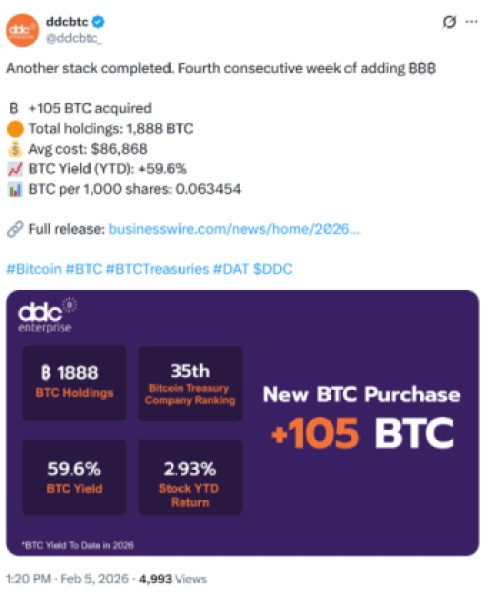
The specific dollar amount matters less than the signal: supply is vanishing. When corporate treasuries send Bitcoin to cold storage, they rip liquid supply from the market. This sets the stage for a ‘supply shock’ dynamic that historically triggers violent price appreciation. But there’s a catch.

This institutional hoarding creates a secondary problem, liquidity fragmentation. As capital gets trapped in the ‘store of value’ silo, utilizing that value on high-performance ecosystems like Solana or Ethereum becomes incredibly difficult (and risky) without centralized intermediaries.

That friction, between holding rigid assets and using agile DeFi, is the industry’s current bottleneck. While DDC and its peers lock down the asset layer, the market needs infrastructure to make that capital productive without selling it.

This narrative shift from simple accumulation to active utilization is driving interest toward interoperability solutions, specifically, LiquidChain ($LIQUID), a Layer 3 protocol built to solve this exact fragmentation headache.

LiquidChain L3 Architecture Unifies Fragmented Ecosystems For Seamless Execution

Let’s be honest: the current state of blockchain interoperability is a mess of inefficient bridges and risky ‘wrapped’ assets. When institutions or retail users want to move value from Bitcoin to Ethereum or Solana, they typically face high fees, anxiety-inducing wait times, and the security risk of custodial bridges.

LiquidChain flips this script by positioning itself as a Layer 3 (L3) infrastructure that fuses liquidity from these major chains into a single execution environment.

What makes LiquidChain different is its ‘deploy-once’ architecture. Developers can build applications on the LiquidChain L3 that instantly access users and assets on Bitcoin, Ethereum, and Solana.

This eliminates the need to maintain three separate codebases. For a market increasingly dominated by multi-chain activity, that technical capability is critical. It allows for verifiable settlement and single-step execution; theoretically, a user could use Bitcoin collateral to execute a trade on a Solana-based DEX without ever manually bridging assets.

The implications for liquidity efficiency are profound. By acting as a Unified Liquidity Layer, LiquidChain reduces the slippage and capital inefficiency that plague fragmented markets. As corporate entities continue to accumulate Bitcoin, the demand for non-custodial ways to generate yield on those assets, or use them as transaction fuel across other networks, will likely drive adoption for this specific type of L3 infrastructure.

EXPLORE THE UNIFIED LIQUIDITY LAYER AT LIQUIDCHAIN

Early Adopters Target The $LIQUID Presale As Infrastructure Plays Heat Up

While headlines fixate on spot Bitcoin buys, smart money is increasingly rotating into the ‘pick and shovel’ plays, the infrastructure rails that will support the next cycle’s volume.

Infrastructure plays historically command high valuations because they service the entire ecosystem rather than a single niche. The LiquidChain presale has emerged as a focal point for investors looking to hedge against liquidity fragmentation.

LiquidChain ($LIQUID) has already raised $527K, signaling robust early interest despite the market’s recent consolidation. The token, $LIQUID, is currently priced at $0.01355. This entry point is garnering attention because it represents a valuation heavily discounted compared to established Layer 2 or cross-chain protocols.

That funding goes directly into the Cross-Chain VM (Virtual Machine), the engine powering the protocol’s interoperability features.

You could see the $0.01355 price point not just as a speculative entry, but as a bet on the ‘abstraction’ narrative, the idea that future users won’t care which chain they are on, as long as the liquidity is available.

By smoothing out the clunky user flows that currently hold DeFi back, LiquidChain positions itself to capture volume from both retail traders and institutional desks looking for smoother execution.

CHECK OUT THE OFFICIAL $LIQUID PRESALE

This article is for informational purposes only and does not constitute financial advice. Cryptocurrencies are volatile; conduct your own due diligence before investing.


Trending Cryptos

Related Questions

QWhat is the main reason DDC's continued Bitcoin accumulation is significant according to the article?

AIt signals a shift where non-crypto native entities view Bitcoin not as a speculative asset but as a treasury imperative, reinforcing the trend of corporations securing hard assets and reducing liquid supply, which could lead to a supply shock.

QWhat specific problem does institutional Bitcoin hoarding create, as mentioned in the text?

AIt creates liquidity fragmentation, where capital gets trapped in the 'store of value' silo, making it difficult and risky to utilize that value on high-performance ecosystems like Solana or Ethereum without centralized intermediaries.

QHow does LiquidChain's Layer 3 architecture aim to solve blockchain interoperability issues?

ALiquidChain acts as a unified liquidity layer with a 'deploy-once' architecture, allowing developers to build applications that instantly access users and assets from Bitcoin, Ethereum, and Solana, enabling verifiable settlement and single-step execution without manual bridging.

QWhat is the current price of the $LIQUID token in its presale, and why is it attracting investor interest?

AThe $LIQUID token is priced at $0.01355 in the presale, attracting interest because it represents a heavily discounted valuation compared to established Layer 2 or cross-chain protocols, and it is seen as a bet on the 'abstraction' narrative for seamless multi-chain liquidity.

QWhat broader market trend is driving smart money towards infrastructure plays like LiquidChain?

ASmart money is rotating into 'pick and shovel' infrastructure plays that support ecosystem-wide volume, as these projects service the entire market rather than a single niche, with demand driven by the need for non-custodial yield generation and smoother cross-chain execution.

Related Reads

Wall Street Morning News: V-shaped Rebound at Month-end, but Nasdaq Suffers Worst July in 12 Years; Funds Accelerate Concentration Towards Cloud Giants

Despite a V-shaped rebound at the end of July, the Nasdaq posted its worst July since 2004, while the S&P 500 had its worst July since 2014. Markets were jolted by geopolitical shifts, as President Trump canceled a planned strike on Iran, leading WTI crude to plunge over 8%. This, alongside OPEC+ announcing a supply increase, reversed crude's sharp July gains. Treasury yields surged, with the 10-year yield rising over 30 basis points in July—its largest July increase since 2005. In a rare move, the US and Japan jointly intervened to weaken the USD/JPY, aiming to prevent potential Japanese sales of US Treasuries. While the tech sector faced deleveraging pressure throughout July, cloud giants staged a massive rally on strong earnings. Microsoft, Amazon, and Google collectively added nearly $1.5 trillion in market value last week. Amazon soared over 15% on accelerating AWS growth, Microsoft extended historic gains, Google fully recovered post-earnings losses, and Meta ended an 11-day losing streak. In contrast, Apple tumbled over 7% on supply chain and guidance concerns, ceding its "world's most valuable company" title to Nvidia. The memory and storage sector corrected sharply. Gold edged up 0.91% in July, with analysts viewing the ~30% pullback from January highs as a potential basing period, supported by long-term central bank demand. Key events to watch this week include earnings from Palantir, AMD, SpaceX (its first post-IPO report), and memory giants like Western Digital. The US July non-farm payrolls report on Friday will be critical for gauging the Fed's policy path. SpaceX also faces a significant lock-up expiration, testing market liquidity.

marsbit37m ago

Wall Street Morning News: V-shaped Rebound at Month-end, but Nasdaq Suffers Worst July in 12 Years; Funds Accelerate Concentration Towards Cloud Giants

marsbit37m ago

Rubin Ultra Makes Major Cuts, Even Nvidia Can't Handle Memory Price Hikes?

NVIDIA's Rubin Ultra, the top-tier variant of the newly announced Rubin AI accelerators, has reportedly seen significant specification downgrades, according to an industry report from SemiAnalysis. Initially designed with four compute dies (4-die), the Rubin Ultra is now said to be reduced to a 2-die design. Key changes highlighted in the report include: * **No increase in peak theoretical compute performance**, remaining at 35 PFLOPs like the standard Rubin. * **Severe reduction in memory capacity** to 192GB using 8-Hi HBM stacks, which is less than the standard Rubin's 288GB using 12-Hi stacks. * **Negligible memory bandwidth improvement** of only 1 TB/s. * **Slightly higher chip-level power consumption**. * The **primary upgrade is a massive increase in scale-up interconnect capacity**, supporting connections for up to 576 GPUs via NVLink, compared to 72 for the standard Rubin. The report suggests the redesign is primarily a cost-optimization move driven by the sharp rise in HBM (High-Bandwidth Memory) prices. By reducing the expensive HBM content and shifting investment towards enhanced system-scale networking, NVIDIA aims to maintain the platform's value for large-scale AI training clusters while managing soaring material costs. The news reportedly triggered a sell-off in South Korean memory stocks, with SK Hynix and Samsung shares falling around 8%, as markets grew concerned that NVIDIA—a major HBM buyer—might be reducing its reliance on high-capacity memory, potentially capping future pricing power for memory makers.

Odaily星球日报58m ago

Rubin Ultra Makes Major Cuts, Even Nvidia Can't Handle Memory Price Hikes?

Odaily星球日报58m ago

Can Generative Models Finally Be Trained End-to-End? The Core Is a For Loop

This article introduces a novel training paradigm for generative models called Explorative Modeling (XM), which enables true end-to-end training. Traditionally, powerful generative models like autoregressive and diffusion models are not trained end-to-end. They are trained to predict a single small step but require iterative multi-step sampling for inference. This "exposure bias" leads to error accumulation and limits performance. The core challenge XM addresses is "mode blurring." In generative tasks, a single input (e.g., "generate a dog") corresponds to many valid outputs (multiple modes). Standard training objectives like reconstruction loss force the model to average these modes, producing unrealistic, blurry outputs. To avoid this, existing models break generation into many small, almost deterministic steps, sacrificing end-to-end training. XM tackles this by restructuring the training loop itself. Its key insight is to amplify "generative expressivity." For each training input, instead of generating one sample, the model generates K candidate outputs. Only the candidate closest to the real data is used for computing the loss and updating the model via backpropagation. This simple "best-of-K" mechanism is implemented as a short for-loop. By exploring multiple possibilities, the model learns to distribute its guesses across different modes rather than collapsing to their uninformative average. The paper demonstrates that "exploration" acts as a new, powerful scaling axis. Gains from XM increase with model size, data scale, and compute. Experiments show improvements in FID scores for image generation and significant efficiency gains, sometimes outperforming larger models without exploration. When pushed to the limit, XM enables fully single-step, end-to-end generative models. In robotics tasks, an "Explorative Policy" matched the performance of a 100-step Diffusion Policy with a single forward pass, drastically improving inference speed. While the best-of-K concept is not entirely new, the authors' contribution lies in formally understanding it as a direct method to boost generative expressivity without fragmenting the generation process. This work suggests that as models scale, enhancing exploration during training may become crucial for overcoming fundamental performance bottlenecks.

marsbit1h ago

Can Generative Models Finally Be Trained End-to-End? The Core Is a For Loop

marsbit1h ago

Trading

Spot

Hot Articles

What is $BITCOIN

DIGITAL GOLD ($BITCOIN): A Comprehensive Analysis Introduction to DIGITAL GOLD ($BITCOIN) DIGITAL GOLD ($BITCOIN) is a blockchain-based project operating on the Solana network, which aims to combine the characteristics of traditional precious metals with the innovation of decentralized technologies. While it shares a name with Bitcoin, often referred to as “digital gold” due to its perception as a store of value, DIGITAL GOLD is a separate token designed to create a unique ecosystem within the Web3 landscape. Its goal is to position itself as a viable alternative digital asset, although specifics regarding its applications and functionalities are still developing. What is DIGITAL GOLD ($BITCOIN)? DIGITAL GOLD ($BITCOIN) is a cryptocurrency token explicitly designed for use on the Solana blockchain. In contrast to Bitcoin, which provides a widely recognized value storage role, this token appears to focus on broader applications and characteristics. Notable aspects include: Blockchain Infrastructure: The token is built on the Solana blockchain, known for its capacity to handle high-speed and low-cost transactions. Supply Dynamics: DIGITAL GOLD has a maximum supply capped at 100 quadrillion tokens (100P $BITCOIN), although details regarding its circulating supply are currently undisclosed. Utility: While precise functionalities are not explicitly outlined, there are indications that the token could be utilized for various applications, potentially involving decentralized applications (dApps) or asset tokenization strategies. Who is the Creator of DIGITAL GOLD ($BITCOIN)? At present, the identity of the creators and development team behind DIGITAL GOLD ($BITCOIN) remains unknown. This situation is typical among many innovative projects within the blockchain space, particularly those aligning with decentralized finance and meme coin phenomena. While such anonymity may foster a community-driven culture, it intensifies concerns about governance and accountability. Who are the Investors of DIGITAL GOLD ($BITCOIN)? The available information indicates that DIGITAL GOLD ($BITCOIN) does not have any known institutional backers or prominent venture capital investments. The project seems to operate on a peer-to-peer model focused on community support and adoption rather than traditional funding routes. Its activity and liquidity are primarily situated on decentralized exchanges (DEXs), such as PumpSwap, rather than established centralized trading platforms, further highlighting its grassroots approach. How DIGITAL GOLD ($BITCOIN) Works The operational mechanics of DIGITAL GOLD ($BITCOIN) can be elaborated on based on its blockchain design and network attributes: Consensus Mechanism: By leveraging Solana’s unique proof-of-history (PoH) combined with a proof-of-stake (PoS) model, the project ensures efficient transaction validation contributing to the network's high performance. Tokenomics: While specific deflationary mechanisms have not been extensively detailed, the vast maximum token supply implies that it may cater to microtransactions or niche use cases that are still to be defined. Interoperability: There exists the potential for integration with Solana’s broader ecosystem, including various decentralized finance (DeFi) platforms. However, the details regarding specific integrations remain unspecified. Timeline of Key Events Here is a timeline that highlights significant milestones concerning DIGITAL GOLD ($BITCOIN): 2023: The initial deployment of the token occurs on the Solana blockchain, marked by its contract address. 2024: DIGITAL GOLD gains visibility as it becomes available for trading on decentralized exchanges like PumpSwap, allowing users to trade it against SOL. 2025: The project witnesses sporadic trading activity and potential interest in community-led engagements, although no noteworthy partnerships or technical advancements have been documented as of yet. Critical Analysis Strengths Scalability: The underlying Solana infrastructure supports high transaction volumes, which could enhance the utility of $BITCOIN in various transaction scenarios. Accessibility: The potential low trading price per token could attract retail investors, facilitating wider participation due to fractional ownership opportunities. Risks Lack of Transparency: The absence of publicly known backers, developers, or an audit process may yield skepticism regarding the project's sustainability and trustworthiness. Market Volatility: The trading activity is heavily reliant on speculative behavior, which can result in significant price volatility and uncertainty for investors. Conclusion DIGITAL GOLD ($BITCOIN) emerges as an intriguing yet ambiguous project within the rapidly evolving Solana ecosystem. While it attempts to leverage the “digital gold” narrative, its departure from Bitcoin's established role as a store of value underscores the need for a clearer differentiation of its intended utility and governance structure. Future acceptance and adoption will likely depend on addressing the current opacity and defining its operational and economic strategies more explicitly. Note: This report encompasses synthesised information available as of October 2023, and developments may have transpired beyond the research period.

1.4k Total ViewsPublished 2025.05.13Updated 2025.05.13

What is $BITCOIN

Discussions

Welcome to the HTX Community. Here, you can stay informed about the latest platform developments and gain access to professional market insights. Users' opinions on the price of BTC (BTC) are presented below.

活动图片