Data Modeling: How to Improve the Quality of Interaction on Polymarket?

Odaily星球日报Published on 2026-02-22Last updated on 2026-02-22

Abstract

Polymarket, a leading prediction market platform, is anticipated to have one of the largest airdrops in the sector. This analysis provides a data-driven strategy to optimize user interactions for potential rewards. A critical finding is that public dashboards often double-count trading volume by including both sides of a trade. The true, single-sided figure is likely half of what is displayed, which will be the metric Polymarket uses internally. User distribution data reveals extreme concentration: only 0.51% of addresses profited over $1,000, and a mere 1.74% traded over $50,000. Crucially, 79% of traders have never earned even $1 in liquidity provider (LP) rewards, making LP activity a currently undervalued and highly capital-efficient interaction. Historical airdrop precedents suggest rewards will be based on active behavior—not profitability—to avoid favoring insiders. A multi-dimensional model is predicted, likely featuring: * 40% weight on trade volume (using a square root compression formula to limit whale dominance). * 35% weight on LP rewards. * 15% weight on market diversity (number of distinct markets traded in). * 10% weight on longevity (months active). The analysis advises users to accumulate genuine, on-chain provable volume across diverse markets, hold positions for 1-24 hours, and, most importantly, begin providing liquidity to accumulate LP rewards, which are a strong anti-Sybil signal. A hard cap per address is also expected to prevent excessive...

This article is from:arise

Compiled by | Odaily Planet Daily (@OdailyChina); Translator | Azuma (@azuma_eth)

The core content of this article is only one — how to prepare for the potential largest airdrop in the prediction market track.

Data Issues That Must Be Declared

Before building each model, we need real and reliable data. The trading volume data of Polymarket has been widely misreported.
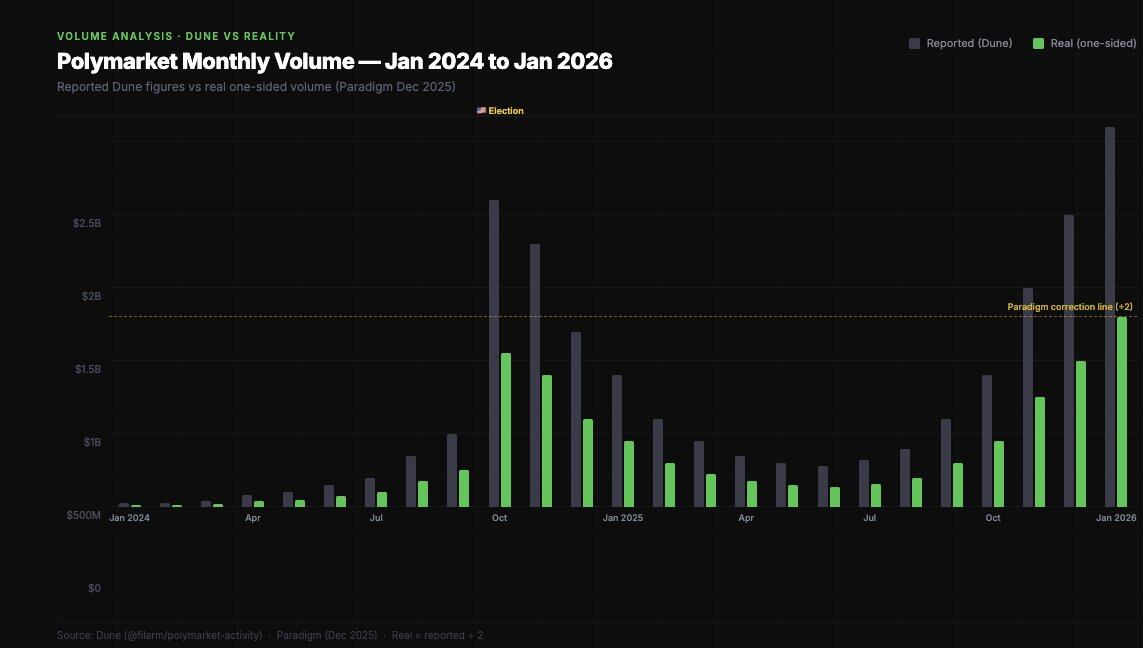
Paradigm published a key finding in a study in December 2025: Most Polymarket data dashboards count trading volume by summing all "OrderFilled" events, but this event is triggered on both the maker and taker sides of the same transaction, resulting in double counting. The actual trading volume is only about half of the number presented on the dashboards.

Dashboard volume vs. one-sided volume — the latter is the number that truly matters in airdrop modeling.
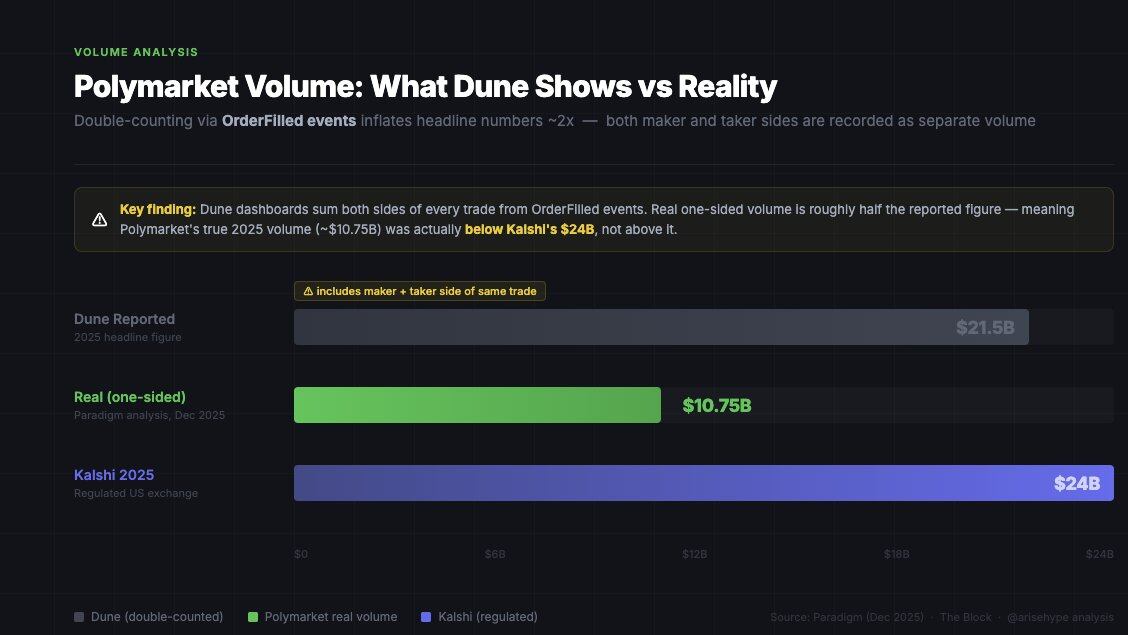
This is crucial for airdrop modeling. If Polymarket considers trading volume as a metric, they will only use internal data, not the various statistics on Dune. Your actual volume "score" is likely only half of what tools like Polycool show.

User Distribution

Regarding airdrop speculation, the most important dataset comes from a study by IMDEA Networks Institute, which covered over 86 million transactions (April 2024 – April 2025).

  • Only 0.51% of addresses achieved profits exceeding $1,000;
  • Only 1.74% of addresses (estimated) had a trading volume exceeding $50,000;
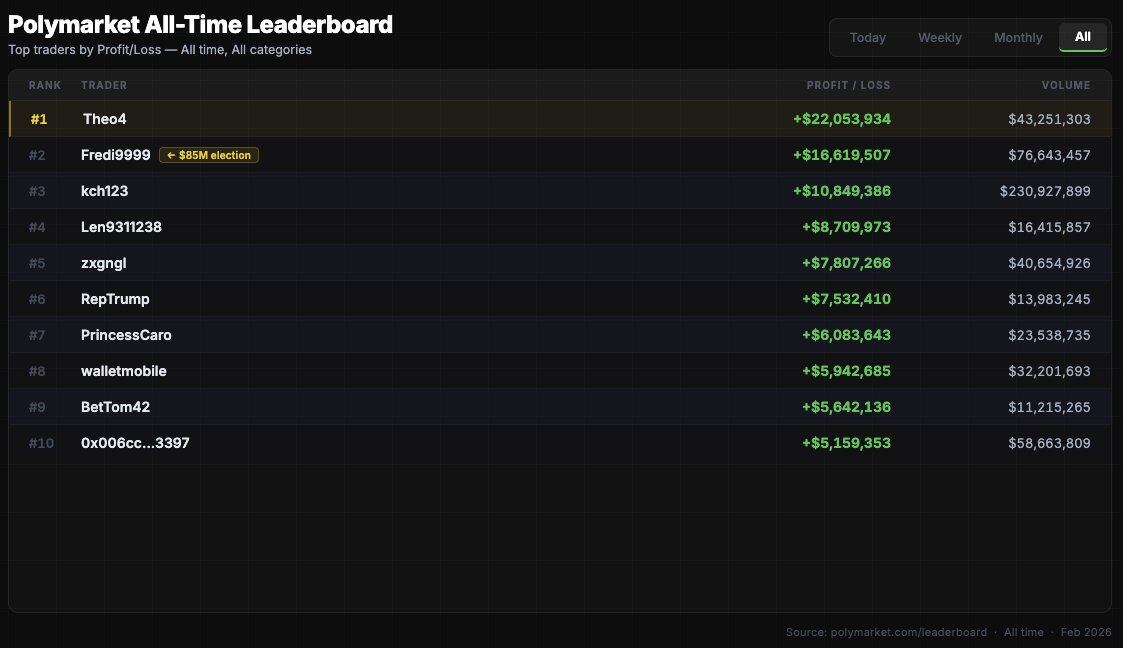
  • The top 3 arbitrage addresses alone extracted $4.2 million in "risk-free profits";
  • The top traders could profit over ten million dollars.
In terms of LP rewards, the stratification is even more pronounced.
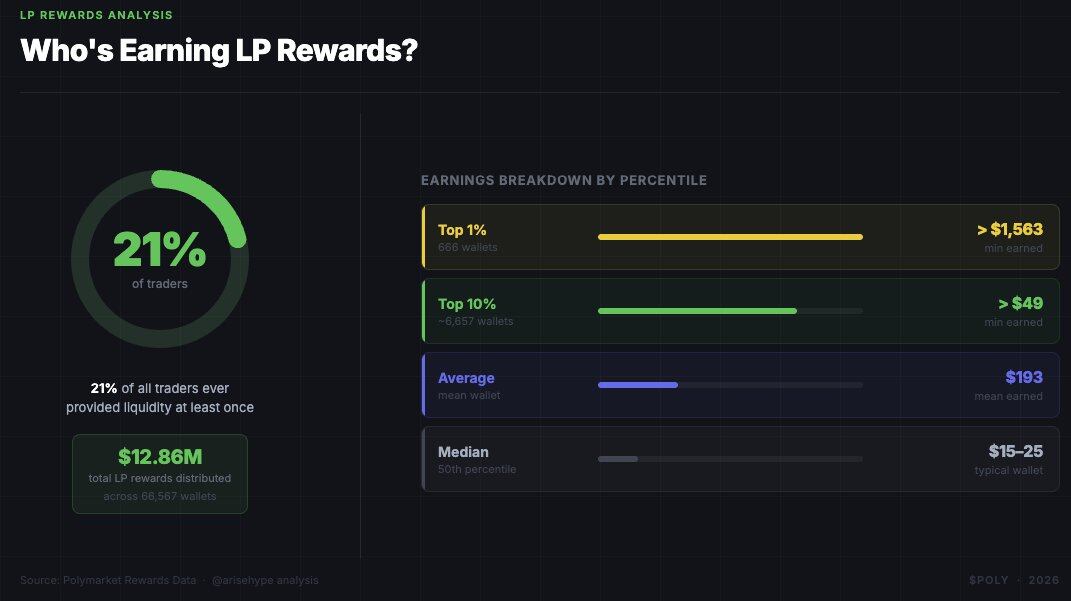
79% of traders have never earned even $1 in LP rewards — this is currently the most overlooked interactive behavior. Among 314,000 traders, only 66,567 wallets have ever received LP rewards. This means only 21% of traders have ever provided liquidity. Compared to overall participation, this reward mechanism is clearly neglected.

Lower usage is generally seen as a signal of being "undervalued" in airdrop models.

Airdrop Precedents: What Has History Told Us?
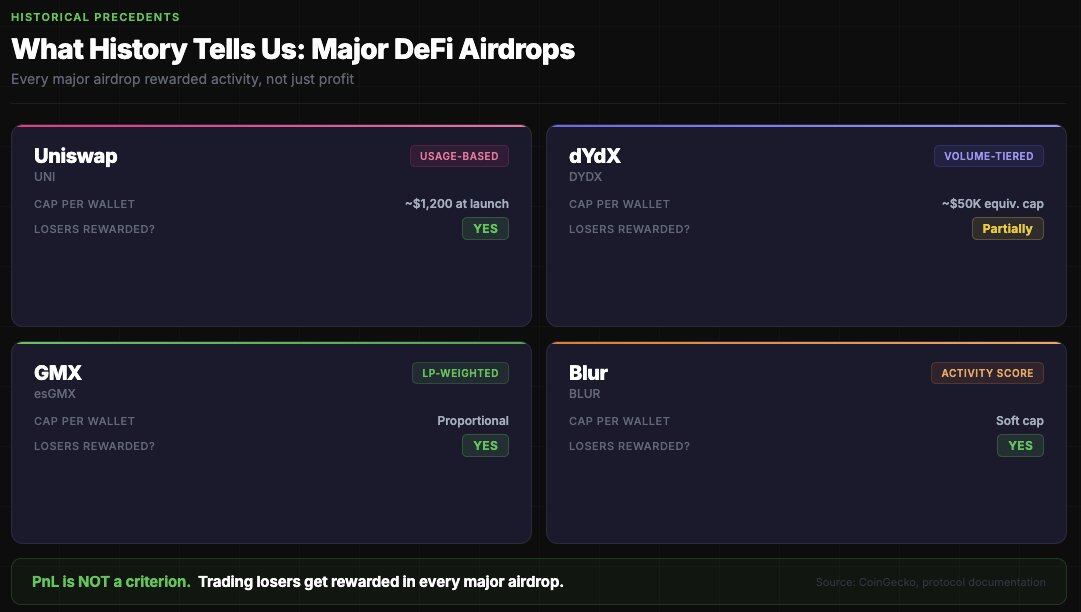
All major DeFi airdrops reward "active behavior," not "profitability." Polymarket will follow the same logic.

Commonalities of all large-scale airdrops include:

  • Purely equal distribution would be abused by Sybil attacks (Polymarket will certainly not distribute equally);
  • Purely distributing based on trading volume would overly concentrate the airdrop on whales (PR risk + SEC risk);
  • Best strategy: tiered hierarchy + reward caps + multiple dimensions (volume + LP + diversity + active duration);
  • In all major airdrops, losers are also rewarded — PnL is not a criterion.

The last point is crucial: If you traded $100,000 and lost $20,000, you are more likely to be rewarded than someone who traded $1,000 and made $500. The platform does not want to only incentivize profitable trading — that would more easily screen for insiders.

Reverse Thinking: How to Limit Whales?

Some airdrop calculators on the market use the simplest volume ratio model: Airdrop share = Individual volume / Total volume × Airdrop amount.

This is wrong because mainstream airdrops consistently use a "diminishing curve."
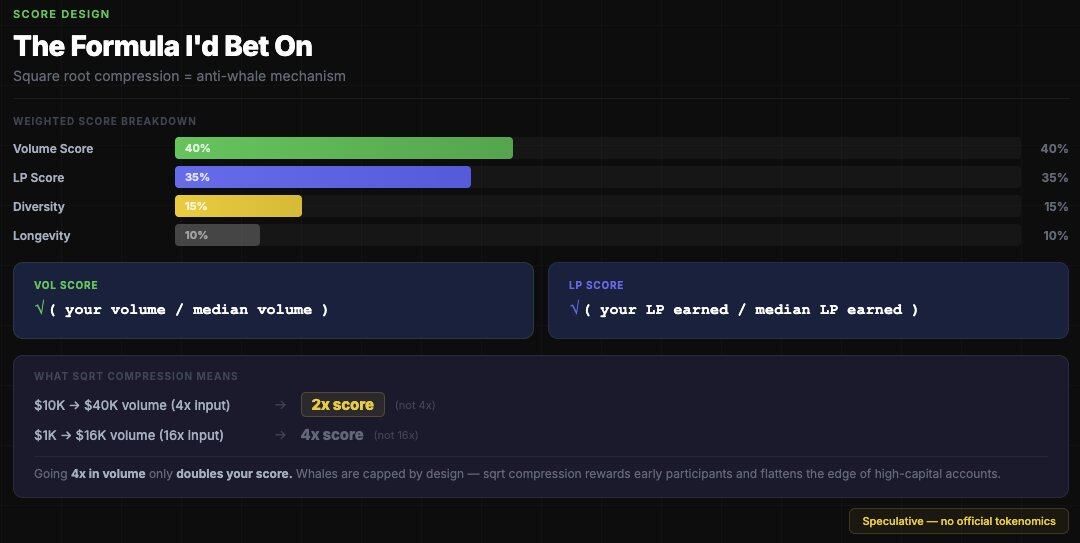
The model I'm more inclined to bet on is that Polymarket will use square root compression to limit the airdrop size for whales — for example, every 4x increase in volume only yields a 2x increase in score, which would completely change the airdrop results for the whale group.
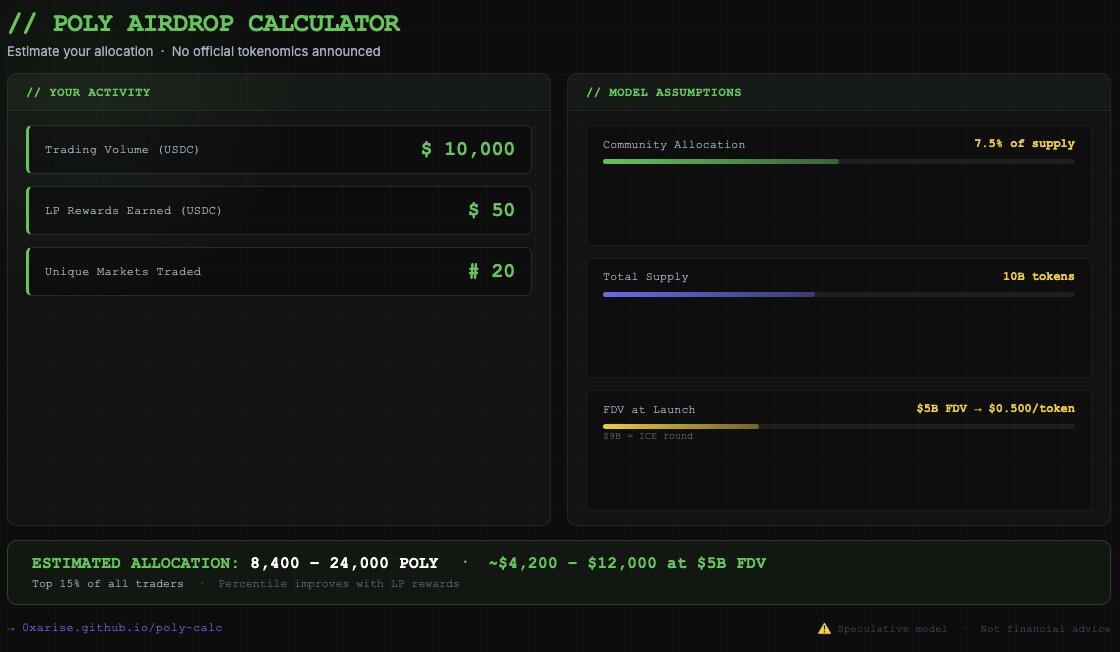
So how much would top wallets get? Assuming a total POLY supply of 10 billion, with 7.5% allocated for community airdrop (750 million POLY), and an FDV at TGE of $30–90 billion.

Without a cap on airdrop amount per address, for a volume of $85 million (taking top trader fredi999 as an example), the model estimates about 3–5 million POLY. At a $90 billion FDV, this is equivalent to $3–4.5 million. Theoretically possible, but the PR effect would be terrible.

A more realistic scenario is to cap the airdrop per address, e.g., the cap might be 500,000–2 million POLY. At a $5 billion FDV, top addresses could get about $450,000–$1 million.

"LP" vs. "Volume": Where is the Opportunity Now?

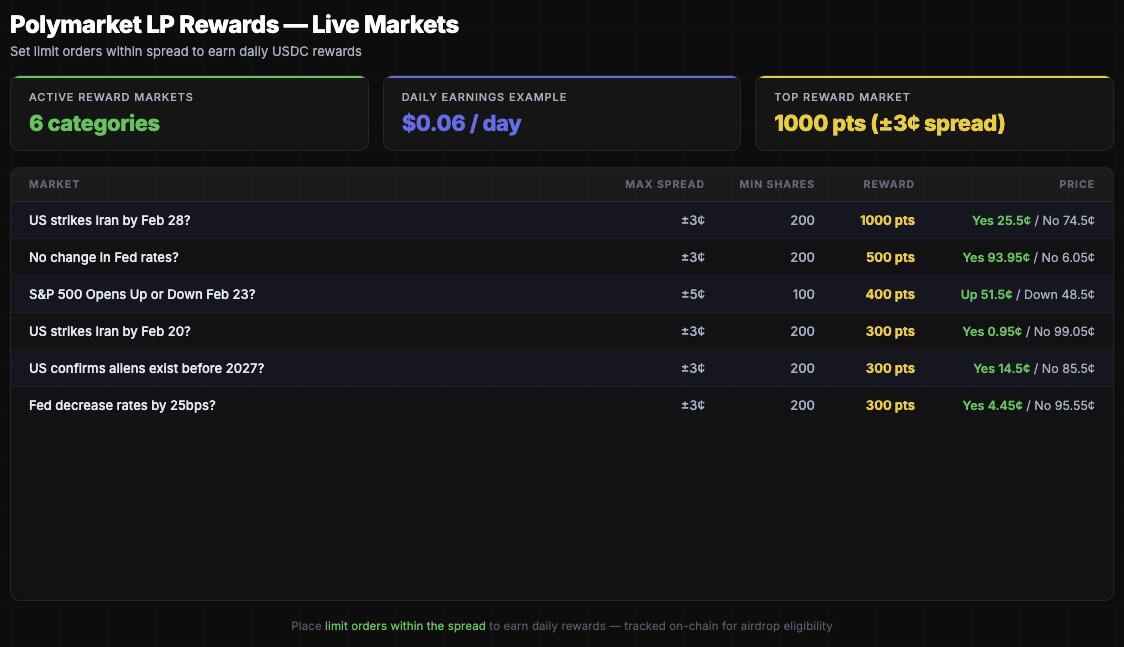
If you start interacting with Polymarket in February 2026 with a principal of $5,000, mathematically, deploying LP is a more favorable option for new participants.
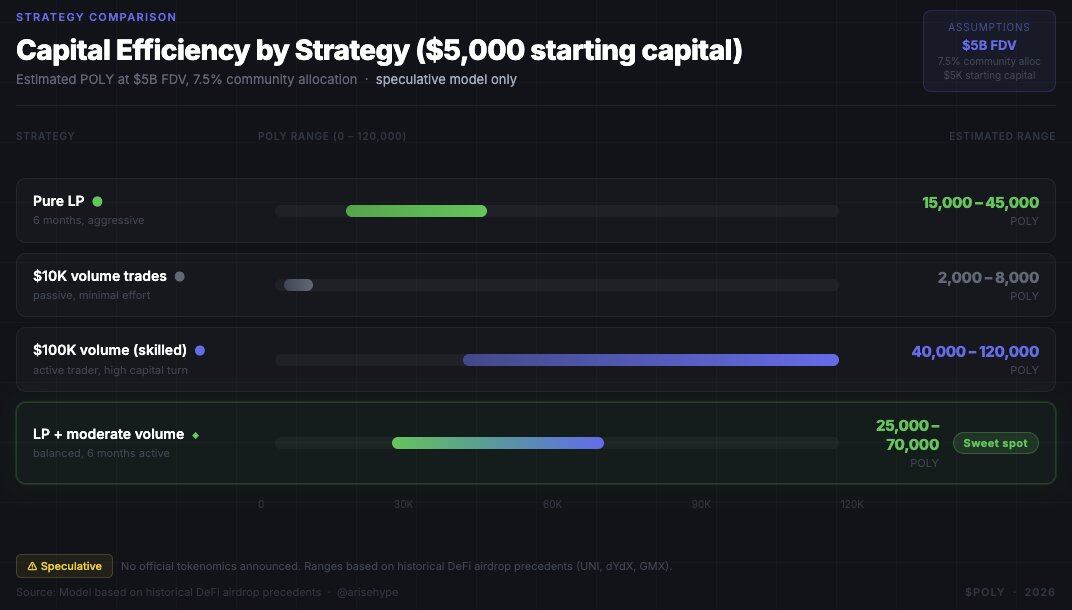
  • To earn $49 in LP rewards (top 10%), you need to consistently place limit orders in high-reward markets. This is achievable in 30–60 days using $500–$1,000 in capital.
  • To earn $1,563 in LP rewards (top 1%), higher capital or sustained high-frequency participation is required.
As for volume, you need to accumulate real volume without wash trading:

  1. Trade in 5 or more different categories of markets (politics, crypto, sports, science, culture);
  2. Hold positions for at least 1–24 hours before closing;
  3. Do not engage in wash trading the same market across different addresses;
  4. Lose money moderately — this is proof of "real participation";
  5. Target markets with volume > $500,000 (Polymarket might filter out micro markets);
  6. Single bet size: $50–$500.

Airdrop Model Speculation

The airdrop will not be as most people expect.

Most airdrop guesses are based on the simplest volume-weighted distribution, but Polymarket will do it smarter and more interestingly. They have on-chain LP data, which is clean, verifiable, and all measured in USD. They also have volume data that can filter out Sybil patterns. They also have wallet age, market diversity, and geographic distribution data.

This is my model — Polymarket has not confirmed anything, so this is just my speculation.

  • Volume weight: 40% — will use a square root compression formula, minimum threshold around $500;
  • LP reward weight: 35% — on-chain verifiable, Sybil-resistant;
  • Market diversity weight: 15% — number of unique markets participated in;
  • Active duration weight: 10% — number of active months before the snapshot.

Additionally, Polymarket will cap rewards per address (likely $500,000), otherwise the top 50 addresses would get too large a share, damaging the community narrative. Losers will receive the same reward as profiteers with equivalent volume; profitability is not a criterion — this cannot be philosophically justified and would create perverse incentives.

79% of traders have never received $1 in LP rewards. If LP weight accounts for 35% of the airdrop formula, the most capital-efficient behavior currently is to provide limit orders in high-volume markets and start accumulating on-chain verifiable proof of contribution.

In short, POLY could become the largest airdrop in the history of prediction markets. Calculated at a $9 billion FDV, the total value of the community airdrop could reach $450–$900 million. Even capturing just 0.1% of that is $450,000. This is why optimizing LP data now is more important than most people realize.


Related Questions

QWhat is the key data issue highlighted in the article regarding Polymarket's volume reporting?

AThe key data issue is that most Polymarket data dashboards double-count volume by summing all 'OrderFilled' events, which fire on both the maker and taker sides of a trade. The true volume is approximately half of what is displayed on these dashboards.

QAccording to the research from IMDEA Networks Institute, what percentage of Polymarket traders have never earned even $1 in LP rewards?

AAccording to the research, 79% of Polymarket traders have never earned even $1 in LP rewards.

QWhat is a common characteristic of all major DeFi airdrops mentioned in the article?

AA common characteristic is that all major DeFi airdrops reward 'active behavior' rather than 'profitability'. Loss-making traders are also rewarded, as profitability is not a criterion.

QWhat is the proposed model for how the airdrop might be weighted across different user actions?

AThe proposed model suggests the airdrop might be weighted as follows: 40% for volume (using a square root compression formula), 35% for LP rewards, 15% for market diversity, and 10% for longevity (active months before the snapshot).

QWhy does the article suggest that providing liquidity (LP) is currently a more capital-efficient action for new participants seeking the airdrop?

AProviding liquidity is suggested as more capital-efficient because LP data is clean, on-chain, verifiable, and resistant to sybils. Furthermore, 79% of traders have never earned LP rewards, making it an underutilized activity that could carry significant weight in the airdrop formula.

Related Reads

In Conversation with Ray Dalio: We Are Currently in an AI Bubble, with 1% of My Portfolio in Bitcoin

Ray Dalio, founder of Bridgewater Associates, warns in an interview that the current AI boom shows classic bubble characteristics, which could lead to significant economic downturns as seen in past cycles like 1929 or 2000. He explains that speculative enthusiasm, fueled by debt and overvaluation, often precedes a crash when rising rates or taxation force asset sales, causing widespread losses and recession. Dalio also outlines his "Big Cycle" theory, describing an approximate 80-year pattern where widening wealth gaps, massive government deficits, and shifting geopolitical power (like China's rise) create internal conflict and global instability. He emphasizes that we are in a late-cycle, transitional phase where traditional powers like the US and UK face decline. For personal wealth protection, Dalio advises diversification beyond cash into assets like stocks, bonds, real estate, and particularly gold, which he prefers over Bitcoin. While he holds about 1% of his portfolio in Bitcoin as a non-printable hard asset, he views gold as more secure from technological or governmental threats. Regarding AI's impact, Dalio believes it will disproportionately benefit capital owners, worsening inequality by replacing both physical and cognitive labor. He suggests that human intuition and emotional intelligence, combined with AI, will be key for future workers. On taxation, Dalio argues that wealth taxes are impractical and risk triggering asset sell-offs, reducing productive investment. He points to the UK as a cautionary example of debt, low productivity, and political strife. Geopolitically, Dalio foresees a more regionalized world, with the US showing weakness in prolonged conflicts like with Iran, akin to past imperial declines. The ideal outcome, he suggests, is coexisting powerful blocs (e.g., Americas, China-Asia Pacific) without major war.

marsbit1h ago

In Conversation with Ray Dalio: We Are Currently in an AI Bubble, with 1% of My Portfolio in Bitcoin

marsbit1h ago

Daily 7.2 Trillion KRW: Foreign Capital's Record Net Buying on Friday! Wall Street Says Headwinds for Korean Stock Fund Flows Have Subsided

South Korean stock market sees a dramatic shift in fund flows. On July 31, foreign investors made a record net purchase of approximately KRW 7.2 trillion in KOSPI stocks, marking a fundamental reversal from the persistent large-scale net outflows seen in previous months. This contributed to a significant narrowing of foreign net selling in July to KRW 9.8 trillion, down sharply from KRW 48.4 trillion in June and KRW 44.5 trillion in May. Simultaneously, domestic institutional pressure eased. South Korean pension funds and asset managers turned to a net buying position in July, purchasing KRW 1.0 trillion worth of KOSPI shares, contrasting with net sales in May and June. Market volatility is expected to be dampened by new financial regulations. Effective July 31, the Financial Services Commission tightened access for retail investors to single-stock leveraged ETFs by raising the minimum cash deposit requirement. Trading volumes for these products subsequently dropped to about 50% of their monthly average. Citigroup Research maintains its year-end KOSPI target of 10,000 points. The firm cites several supportive factors: the substantial easing of headwinds from capital outflows, a robust fundamental outlook for the semiconductor sector, historically low market valuations, strong economic fundamentals, and the potential for policy support from financial authorities if needed.

marsbit1h ago

Daily 7.2 Trillion KRW: Foreign Capital's Record Net Buying on Friday! Wall Street Says Headwinds for Korean Stock Fund Flows Have Subsided

marsbit1h ago

Thanks to Dice Rolls, Bitcoin Keys Are Stored Offline, But Not Everyone Will Do It

The article discusses using dice rolls to generate secure Bitcoin wallet seeds, providing entropy independent of potentially flawed hardware random number generators. It explains that each fair dice roll offers about 2.585 bits of entropy, with around 50 rolls needed for a standard 12-word seed phrase and 99+ recommended for higher security. This method gained attention after a vulnerability was revealed in some Coldcard hardware wallets, where a faulty firmware RNG (dating back to 2021) compromised generated keys. The analysis notes that while a dice-generated main seed was safe from this specific flaw, other Coldcard functions (like creating paper wallets, backup keys, or passwords) could still be vulnerable if they used the defective RNG. The piece argues that while dice-based entropy is technically robust, the manual process is error-prone, tedious, and unrealistic for most new users, who might make mistakes in recording or inputting rolls. It concludes that while manual entropy generation should remain an option for advanced users, the long-term goal is to develop reliable, user-friendly hardware and software that securely generates randomness without requiring specialized knowledge. Coldcard users are advised to check their firmware version and replace any secondary secrets (like paper wallet keys) created with vulnerable devices, while also considering multi-signature setups with devices from different manufacturers for added security.

cryptonews.ru6h ago

Thanks to Dice Rolls, Bitcoin Keys Are Stored Offline, But Not Everyone Will Do It

cryptonews.ru6h ago

Trading

Spot
活动图片




