Cursor vs. Anthropic and OpenAI: Thanks for Raising Me, Now I'm Here to Take the Market

marsbitPublished on 2026-03-31Last updated on 2026-03-31

Abstract

Cursor, a VS Code plugin initially built on OpenAI's API, has transitioned from a dependent customer to a formidable competitor by launching its proprietary coding model, Composer 2. This model reportedly outperforms Claude Opus 4.6 on key benchmarks at one-tenth the cost. The case exemplifies a critical strategic dilemma in tech—when to open or close an API. The authors propose a framework: opening an API risks eroding a company’s moat if competitors can use it to bootstrap their own products and aggregate demand, eventually enabling vertical integration. This is especially risky in AI, where API outputs can directly improve a rival’s model training and product refinement—exactly what Cursor achieved by leveraging OpenAI and Anthropic models to gather user data and refine its own offering. Companies then face two choices: restrict API access (like Twitter, which closed its API to protect its social graph) or keep it open but find alternative moat, such as network effects or Lindy effects (like crypto protocols, e.g., Morpho). The authors predict that leading AI companies (like OpenAI and Anthropic) will likely restrict access to their most advanced models over time, as switching costs remain low, network effects are weak, and distillation techniques reduce training costs. This could stifle consumer AI innovation but create opportunities for open alternatives.

Author: Daniel Barabander

Compiled by: Deep Tide TechFlow

Deep Tide Introduction: Three years ago, Cursor was a VS Code plugin running on the OpenAI API. Today, it has released its own self-developed model, outperforming Claude Opus 4.6 on key benchmarks at one-tenth the price.

This article uses this case to systematically answer the most important strategic question on the internet: When should you open your API, and when should you close it? The conclusion serves as a warning to all platform builders.

Full text as follows:

Co-authored with Elijah Fox(@PossibltyResult).

In early March, Cursor released Composer 2—a proprietary programming model built on an open-source base model that outperforms Claude Opus 4.6 on key benchmarks at one-tenth the price. Three years ago, Cursor was a VS Code fork running entirely on the OpenAI API.

Cursor's journey from a dependent customer to a genuine competitor epitomizes the most critical strategic question on the internet: When should a company open its capabilities via an API, and when should it keep them closed?

We developed a framework to answer this question, which depends on two things. First: Does opening the API erode your moat? If yes: Can you find a moat elsewhere?

Whenever a company opens its intellectual property to the outside world via an API, it risks eroding its moat through demand aggregation. Simply put: Competitors can use this intellectual property to bootstrap the early stages of their own products, and once they accumulate enough demand, they can vertically integrate and cut off the API. Netflix did exactly this: it first licensed film and TV content, and then, once it had a large enough user base to amortize the huge fixed costs, it produced "House of Cards" in-house.

But the truly dangerous scenario is when the API's output can directly serve as input, compounding the quality of the competing product. This is a double whammy because competitors can both use the API to bootstrap and aggregate demand *and* directly improve their own production process. This is precisely what is happening in the AI field. Although OpenAI and Anthropic explicitly prohibit companies accessing their APIs from using the output to train competing models, they cannot stop companies like Cursor from using cutting-edge models to bootstrap the workflows needed to collect proprietary product data and improve their own models over time.

This seems to be exactly what happened behind Composer 2. Cursor used foundational models like Claude and GPT to aggregate enough demand, reaching an annualized revenue of approximately $2 billion, and then built a cutting-edge programming model using the open-source base model Kimi K2.5, plus data from continuous pre-training and reinforcement learning from its IDE.

When this output/input dynamic exists, API providers have only two choices: either close the API to stem the bleeding, or keep it open and find complementary assets that leverage their moat.

Twitter is a classic case of taking the first path. It was initially known for its generous, freely accessible API—at its peak, developers could pull 500,000 tweets per month for free. But Twitter closed most of its interfaces because the API leaked its moat: the proprietary social graph. Today, the API is effectively closed: access is strictly rate-limited, expensive at any meaningful scale, and structurally, building a serious product requires strictly controlled B2B integration.

The second path is to keep the API open and supplement it with another source of power. No industry understands this better than crypto—where APIs are forced open, and the only way to survive is to find a moat elsewhere.

The lending protocol Morpho provides a representative case. The protocol was born by accessing the open APIs of Aave and Compound and building optimizer products on top of them. It then used the output of these protocols—their aggregated liquidity—as input to bootstrap its own platform. Thus, Cursor and Morpho followed strikingly similar paths in leveraging APIs to build competing products.

However, the truly interesting dynamic is what Morpho did next. Since Morpho itself is also an open API, it needed to find a moat to compensate for the lack of switching costs. So it decided to make the protocol as aggregatable as possible, instead building its moat through other means—such as the Lindy Effect and the network effects arising from deep liquidity from diverse lenders and borrowers.
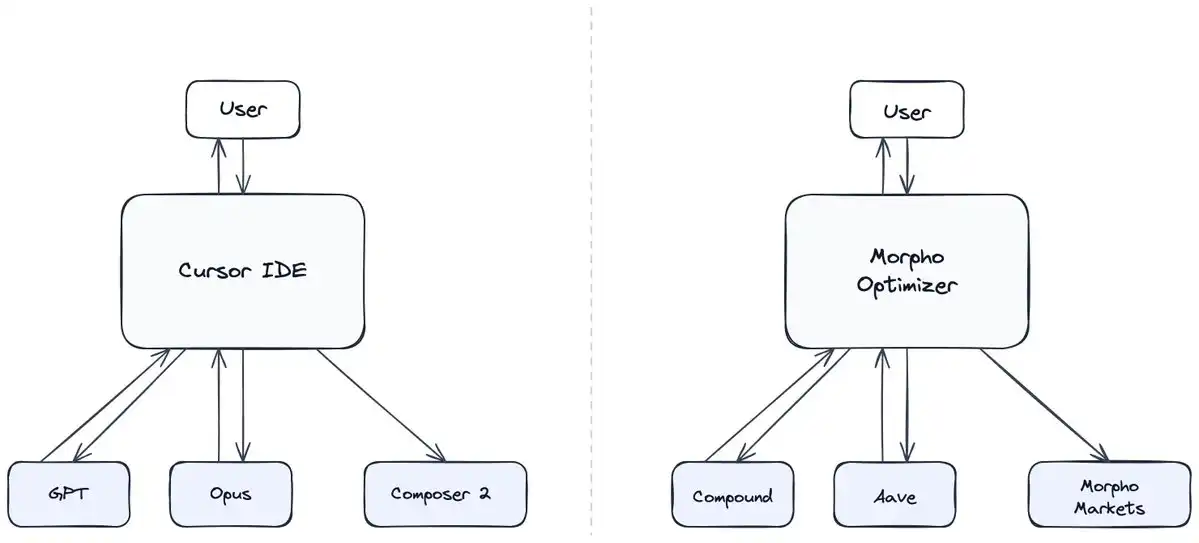
Applying this framework forward, we can make a prediction: Over time, foundational model companies will likely choose the first path, gradually restricting API access to their most cutting-edge models.

To believe in the second path, you must believe that models like Opus and GPT are powerful and trusted enough to remain open, allowing competing models to use their output as input, yet third parties still won't leave. This means the model companies are betting on other sources of power: the Lindy Effect (if they believe users won't want to build trust in a new model), developer network effects (if they believe users will build ecosystems tightly dependent on the openness of their API), or economies of scale (if they believe maximizing API calls allows them to amortize the fixed costs of training cutting-edge models).

But current evidence points in the opposite direction. The 'hottest model of the month' dynamic remains strong, and users migrate without hesitation to the best model available at the moment—we saw this again in the recent surge in Claude usage after the Opus 4.5 release. At the model level, developer network effects are also not yet evident—interoperability between APIs is increasing, not decreasing, and the surrounding tooling ecosystem is actively fighting lock-in, deliberately making it easy to switch suppliers. And currently, economies of scale in the training phase are insufficient as a moat because distillation techniques allow competitors to train models with comparable performance at a much lower cost. Without alternative sources of power, foundational AI companies will likely reserve limited access for enthusiasts and focus their efforts on B2B deployments with strict usage controls and monitoring. Increasingly, the winning choice will be to refuse to play this game.

This is a worrying outcome because the current explosion of consumer AI products is built on top of these model providers. It also opens the door for counter-positioning: if the leading labs increasingly restrict access, there is value to be captured by choosing a competitor with a weaker moat but a strong commitment to remaining open.

Thanks to @systematicls(@openforage) and @AlexanderLong(@Pluralis) for their thoughtful feedback on this article.


Trending Cryptos

Related Questions

QWhat is the main argument of the article regarding when a company should open or close its API?

AThe article argues that a company should open its API if it can find a moat elsewhere to compensate, but should close it if the API erodes its core competitive advantage, especially when the API's output can be used as input to improve competing products.

QHow did Cursor transition from a dependent customer to a competitor of Anthropic and OpenAI?

ACursor initially relied on OpenAI's API as a VS Code plugin, used it to aggregate demand and gather proprietary product data, and then built its own advanced programming model (Composer 2) using an open-source base model and data from its IDE, achieving comparable performance at a lower cost.

QWhat is the 'output/input dynamic' mentioned in the article, and why is it dangerous for API providers?

AThe 'output/input dynamic' refers to the situation where a competitor can use the API's output directly as input to improve its own product quality. This is dangerous because it allows competitors to bootstrap demand and enhance their production process simultaneously, accelerating their ability to become direct competitors.

QWhat prediction does the article make about the future of API access for leading foundation model companies like OpenAI and Anthropic?

AThe article predicts that leading foundation model companies will likely restrict API access to their most advanced models over time, opting for stricter B2B deployments with controlled usage, as they lack alternative moats like strong network effects or Lindy effects to justify open access.

QHow does the article use the example of Twitter to illustrate the strategy of closing an API?

ATwitter initially had a generous, free API but eventually closed most access because the API leaked its moat—the proprietary social graph. It now imposes strict rate limits and high costs, making large-scale product development dependent on controlled B2B integrations.

Related Reads

Must-Watch Events Next Week|CLARITY Act Could Face Senate Vote; SpaceX, Circle to Report Earnings (8.3-8.9)

**Summary: Key Events and Developments to Watch (August 3-9)** The upcoming week is marked by significant financial disclosures, key legislative deadlines, and notable product updates. **Major Financial Events:** Several companies are scheduled to release their Q2 2026 earnings. American Bitcoin (ABTC) will report on August 3, followed by SpaceX and Hut 8 Mining Corp. on August 4, and Circle on August 5. Notably, a significant portion of SpaceX shares (up to 12% of total shares) will be unlocked on August 6 following their earnings release. **Key Legislative Deadline:** The U.S. Senate faces an August 7 deadline to secure 60 votes for the CLARITY Act, a bipartisan bill aiming to establish a federal regulatory framework for cryptocurrencies. The Senate may hold a full vote on the bill during the week. **Economic Data:** The U.S. July Non-Farm Payrolls report will be released on August 7, providing crucial labor market data. **Technology & Product Updates:** * **Shutdowns:** DeFi portfolio tracker Zapper and wallet app Ctrl Wallet will cease operations on August 3. * **Upgrades:** LayerZero will deprecate its v1 relayers on August 3. XRP Ledger's new version 3.3.0, featuring five new functions, is expected next week. * **AI:** Elon Musk announced that the advanced Grok 4.6 AI model is set for release around August 7. * **Bitcoin:** The BIP-110 forced signaling for a potential Bitcoin network change is scheduled to begin around August 8. **Other Notable Events:** Chinese robotics firm Unitree Tech has set its preliminary price inquiry for its IPO for August 5. South Korean exchange Upbit will delist AQT and AERGO tokens on August 3.

marsbit1h ago

Must-Watch Events Next Week|CLARITY Act Could Face Senate Vote; SpaceX, Circle to Report Earnings (8.3-8.9)

marsbit1h ago

Stocks Are Plummeting More Sharply Than Cryptocurrencies. Where Has the Money Gone?

Stock Markets Plunge Deeper Than Cryptocurrencies: Where Did the Money Go? In late July, Seoul's Kospi index triggered circuit breakers for two consecutive days, plummeting over 40% from its June high. The collapse was led by heavyweight stocks like SK Hynix, whose record profits still disappointed investors, and devastating leveraged ETFs, with one major product losing over 83% of its value. This signaled a global, forced deleveraging targeting the most crowded trades. Interestingly, while stocks exhibited extreme volatility akin to crypto markets, Bitcoin rose nearly 15% in July after a prior steep drop. Analysis shows the money fleeing equities did not flow into Bitcoin. Instead, Bitcoin had already absorbed its sell-off in May-June, when U.S. spot Bitcoin ETFs saw historic outflows. The true safe-haven beneficiary was gold, whose price rose over 20% year-on-year, highlighting a decoupling between Bitcoin and gold as "digital gold." The sell-off was a targeted unwinding of leveraged positions in tech and semiconductors, accelerated by broker-dealer risk management and shifts in the AI narrative, including new competition from Chinese memory chipmakers. The retreat path was clear: from high-valuation tech stocks to cash and U.S. Treasuries, then to gold. For Bitcoin to attract sustained institutional inflows, conditions like eased global liquidity pressure, a "soft-landing" Fed rate cut, and U.S. regulatory clarity via legislation like the stalled CLARITY Act are needed. Currently, Bitcoin is not a safe haven but an already-cleared asset. Its low correlation with tech stocks, however, makes it a potential diversification play for institutional portfolios once the storm passes. The money isn't here yet, but the positioning is underway.

marsbit2h ago

Stocks Are Plummeting More Sharply Than Cryptocurrencies. Where Has the Money Gone?

marsbit2h ago

In Conversation with Ray Dalio: We Are Currently in an AI Bubble, with 1% of My Portfolio in Bitcoin

Ray Dalio, founder of Bridgewater Associates, warns in an interview that the current AI boom shows classic bubble characteristics, which could lead to significant economic downturns as seen in past cycles like 1929 or 2000. He explains that speculative enthusiasm, fueled by debt and overvaluation, often precedes a crash when rising rates or taxation force asset sales, causing widespread losses and recession. Dalio also outlines his "Big Cycle" theory, describing an approximate 80-year pattern where widening wealth gaps, massive government deficits, and shifting geopolitical power (like China's rise) create internal conflict and global instability. He emphasizes that we are in a late-cycle, transitional phase where traditional powers like the US and UK face decline. For personal wealth protection, Dalio advises diversification beyond cash into assets like stocks, bonds, real estate, and particularly gold, which he prefers over Bitcoin. While he holds about 1% of his portfolio in Bitcoin as a non-printable hard asset, he views gold as more secure from technological or governmental threats. Regarding AI's impact, Dalio believes it will disproportionately benefit capital owners, worsening inequality by replacing both physical and cognitive labor. He suggests that human intuition and emotional intelligence, combined with AI, will be key for future workers. On taxation, Dalio argues that wealth taxes are impractical and risk triggering asset sell-offs, reducing productive investment. He points to the UK as a cautionary example of debt, low productivity, and political strife. Geopolitically, Dalio foresees a more regionalized world, with the US showing weakness in prolonged conflicts like with Iran, akin to past imperial declines. The ideal outcome, he suggests, is coexisting powerful blocs (e.g., Americas, China-Asia Pacific) without major war.

marsbit5h ago

In Conversation with Ray Dalio: We Are Currently in an AI Bubble, with 1% of My Portfolio in Bitcoin

marsbit5h ago

Trading

Spot

Hot Articles

What is DOGE M

Doge Matrix ($doge m): The New Breed of Community-Driven Cryptocurrency Introduction In the ever-evolving landscape of cryptocurrency, new projects constantly emerge, each aiming to capture the interest of investors and enthusiasts alike. One of the latest entrants to this domain is Doge Matrix, represented by the ticker symbol $doge m. This project has attracted attention thanks to its roots in the popular meme culture surrounding Dogecoin, establishing its place within the web3 space. This article aims to provide a comprehensive analysis of Doge Matrix, covering its overview, creator, investors, functionality, timeline, and notable aspects. What is Doge Matrix ($doge m)? Doge Matrix is a community-driven cryptocurrency project that seemingly builds upon the widespread appeal of Dogecoin, a digital currency known for its Shiba Inu mascot and its meme origins. While the overarching objectives of Doge Matrix are not extensively defined, it is characterised by a commitment to harnessing community involvement and support. Unlike traditional cryptocurrencies that often emphasise utility or intrinsic value through underlying technologies, Doge Matrix positions itself within a space that embraces the cultural phenomenon of cryptocurrencies, particularly appealing to those who resonate with the ethos of meme-based assets. Drawing on the strengths of the Dogecoin community, Doge Matrix operates as part of a broader ecosystem, inviting participation and engagement from users who share an interest in cryptocurrency and the digital landscape. Who is the Creator of Doge Matrix ($doge m)? The identity of the creator of Doge Matrix remains unknown. This lack of transparency is not an uncommon occurrence in the cryptocurrency space, where some projects are launched without revealing the identities of their founders. The absence of information regarding the founding team can raise questions among potential investors about the project’s accountability and direction. Who are the Investors of Doge Matrix ($doge m)? As it stands, there is no publicly available information detailing the investors or investment foundations that back Doge Matrix. The project appears to rely primarily on community support rather than institutional investment. This model aligns with the community-driven nature of the initiative, fostering an environment where the direction of the project is shaped by its participants rather than being dictated by a select few financial backers. How Does Doge Matrix ($doge m) Work? The specifics regarding the operational mechanisms of Doge Matrix are somewhat vague, reflecting a broader trend of projects in the meme coin space where innovative functionalities are not always clearly articulated. Nonetheless, Doge Matrix seems designed to tap into the existing cryptocurrency ecosystem by encouraging user participation while tapping into the familiar cultural references associated with Dogecoin. Its potentially unique characteristics derive from community interactions rather than technological advancements, emphasising shared experiences and collaboration among token holders. While the exact innovations have not been explicitly outlined, the project appears to create a space where community members can engage, share ideas, and propel the project's potential forward. Timeline of Doge Matrix ($doge m) Reflecting on the project’s timeline reveals notable events that have defined its journey thus far: November 25, 2024: Doge Matrix reached its all-time high value, marking a significant milestone in its early history. January 1, 2025: Conversely, Doge Matrix hit its all-time low value, illustrating the volatility often associated with cryptocurrencies, especially in the early stages of a project's lifecycle. Ongoing: The project continues to be actively traded and supported by its community, although specific future milestones or objectives have yet to be disclosed. Key Points About Doge Matrix ($doge m) Community Focus At the heart of Doge Matrix is a commitment to community engagement. The project thrives on the premise of collaboration and shared objectives among its members, emphasising the importance of collective effort. Unlike centralised projects that often have a defined leadership structure, Doge Matrix at present showcases a more fluid approach to governance, where every community member's voice matters. Volatility The cryptocurrency market is notorious for its volatility, and Doge Matrix is no exception. Its price history reflects significant fluctuations between high and low values, which is typical of many new cryptocurrencies but underscores the risks associated with investment in emerging tokens. Lack of Detailed Information One of the most striking features about Doge Matrix is the scarcity of detailed information regarding its technological underpinnings and operational mechanisms. This ambiguity necessitates that potential investors conduct thorough due diligence before engaging with the project. Conclusion In summary, Doge Matrix ($doge m) illustrates a new wave of cryptocurrency projects that lean heavily on community engagement and cultural relevance. While lacking in certain specifics—such as clear leadership, defined objectives, and detailed functionality—the project has managed to generate interest within the crypto community, leveraging the established appeal of meme culture. As with any investment in the cryptocurrency space, understanding the inherent risks and conducting comprehensive research is essential for potential participants. Doge Matrix stands as a reminder of the dynamic, sometimes unpredictable nature of the crypto industry, marked by constant evolution and enthusiasm for community-driven initiatives.

593 Total ViewsPublished 2025.02.03Updated 2025.02.03

What is DOGE M

What is $M

Understanding Mantis ($M): A New Era in Cross-Chain Interoperability In the continually evolving landscape of Web3 and cryptocurrency, new projects strive to offer innovative solutions aimed at enhancing the user experience and expanding functional possibilities within the decentralised financial ecosystem. One such project garnering attention is Mantis ($M), a pioneering protocol founded on the principles of cross-chain interoperability and intent-based settlements. This article delves into the essential aspects of Mantis, including its core functionality, creators, investment backing, innovative features, and critical milestones. What is Mantis ($M)? Mantis is described as a multi-domain intent settlement protocol that simplifies cross-chain interactions, enabling users to execute complex financial transactions across various blockchain platforms seamlessly. The protocol operates through three primary layers: Intent Expression: Users can articulate their transaction goals using natural language facilitated by the DISE LLM, an advanced AI language model. For instance, a user might express a desire to swap Ethereum (ETH) for Solana (SOL) with a specific slippage tolerance of 1%. Execution: This layer employs a network of solvers that compete to fulfil user intents. Transactions are executed using mechanisms such as Coincidence of Wants (CoWs) and Order Flow Auctions (OFAs), which ensure that user demands are met optimally. Settlement: Leveraging the Inter-Blockchain Communication (IBC) protocol, Mantis enables atomic cross-chain transactions, allowing users to operate across various supported chains, including Ethereum, Solana, and Cosmos. Mantis is engineered to introduce native yield generation for idle assets, employing cryptographic proofs to maintain the integrity of transactions throughout the entire process. Creators & Development Team Mantis was conceived by the Composable Foundation, a research-driven organisation notable for its emphasis on blockchain interoperability solutions. This foundation collaborates with esteemed academic institutions, including Harvard University and the University of Lisbon, contributing to extensive research and development efforts that inform Mantis's architecture and functionality. The Composable Foundation’s commitment to fostering innovation in the blockchain space positions Mantis as a robust solution for the growing demand for interoperability among multiple blockchain networks. Investors & Backing While specific details about individual investors have not been publicly disclosed, Mantis enjoys substantial backing from various entities, including: Ecosystem grants from IBC-enabled chains, which support the protocol's growth and integration within decentralised finance ecosystems. Strategic partnerships with infrastructure providers that enhance Mantis's network capabilities and deployment strategies. Funding through the Composable Foundation's treasury, ensuring sustained financial support for ongoing development and operational costs. These collaborative efforts reflect a consensus among stakeholders about the importance of enhancing cross-chain functionality and the potential utility of Mantis's infrastructural innovations. Key Innovations Mantis sets itself apart through several pioneering innovations that enhance its functionality and utility: Chain-Agnostic Intents: Users can initiate transactions from any supported chain while settling on another. This flexibility empowers users, driving increased interaction among different platforms. AI-Powered Interface: The integration of DISE LLM allows users to conduct complex DeFi operations using natural language, thereby simplifying interactions and making blockchain technology accessible to a broader audience. Cross-Domain MEV Capture: Mantis creates an internal market for maximal extractable value (MEV) through competitions among solvers. This innovative approach allows for greater efficiency and value extraction in complex transactions. Modular Settlement Layer: The protocol supports various verification methods, including zero-knowledge proofs and optimistic rollups, providing a versatile framework that can adapt to emerging blockchain technologies. Historical Timeline Mantis's development is marked by several critical milestones that chart its trajectory and growth: | Year | Milestone | |————|————————————————————————-| | 2022 | Initial concept development within the Composable Foundation's research division. | | Q3 2024 | Launch of the testnet with bridging capabilities between Solana and Ethereum. | | Q1 2025 | Anticipated Token Generation Event (TGE) alongside the mainnet launch. | | Q2 2025 | Expected integration of DISE LLM and expansion of cross-chain capabilities. | | 2025 H2 | Planned support for over 15 chains through further IBC upgrades. | This timeline outlines Mantis's evolution, from conceptual discussions to active implementation and future growth phases. Ecosystem Growth Strategy Mantis's strategy for ecosystem growth includes several initiatives designed to encourage user participation and developer engagement: Credits System: Users can earn protocol credits by providing liquidity and engaging in referral programmes. These credits are redeemable for incentives in the future, fostering a robust user community. Modular Software Development Kit (SDK): This toolkit empowers developers to create applications based on intent-driven models utilising Mantis's infrastructure, thus promoting innovation within its ecosystem. Governance Model: As the protocol matures, $M token holders will have a voice in protocol governance, allowing them to vote on proposed upgrades and changes, thereby enhancing community engagement and decentralisation. Mantis represents a significant advancement in the realm of cross-chain architecture. By seamlessly integrating advanced AI algorithms with a robust settlement framework, Mantis seeks to tackle the problems of fragmentation within multi-chain ecosystems. Its innovative approach prioritises improved user experiences while adhering to the foundational principles of decentralisation and security, setting a new standard for the future interoperability of blockchain technologies. As Mantis continues its journey of growth and implementation, it promises to be a project to watch closely in the competitive landscape of Web3 and decentralised finance. With its focus on crossing boundaries and elevating user engagement, Mantis is poised to be an integral part of the future developments in the cryptocurrency space.

105 Total ViewsPublished 2025.03.18Updated 2025.03.18

What is $M

Discussions

Welcome to the HTX Community. Here, you can stay informed about the latest platform developments and gain access to professional market insights. Users' opinions on the price of M (M) are presented below.

活动图片












