Editor's Note: After experiencing a continuous decline and volatility, last week, crypto concept stocks saw a phased broad-based rebound. Stocks of BTC treasury companies, represented by Strategy, warmed up one after another. Although there is still a considerable distance from the high point, signs of a rebound are emerging. At the same time, the main influencing factors in the market are gradually focusing on events such as the nomination of the new Federal Reserve Chairman, expectations for Federal Reserve interest rate cuts, and the progress of the US CLARITY Crypto Act. Considering the overall market situation, crypto concept stocks will continue to face pressure. It is recommended to maintain the previous "short-term rebound博弈 (gaming/strategy)" strategy and avoid going all-in.
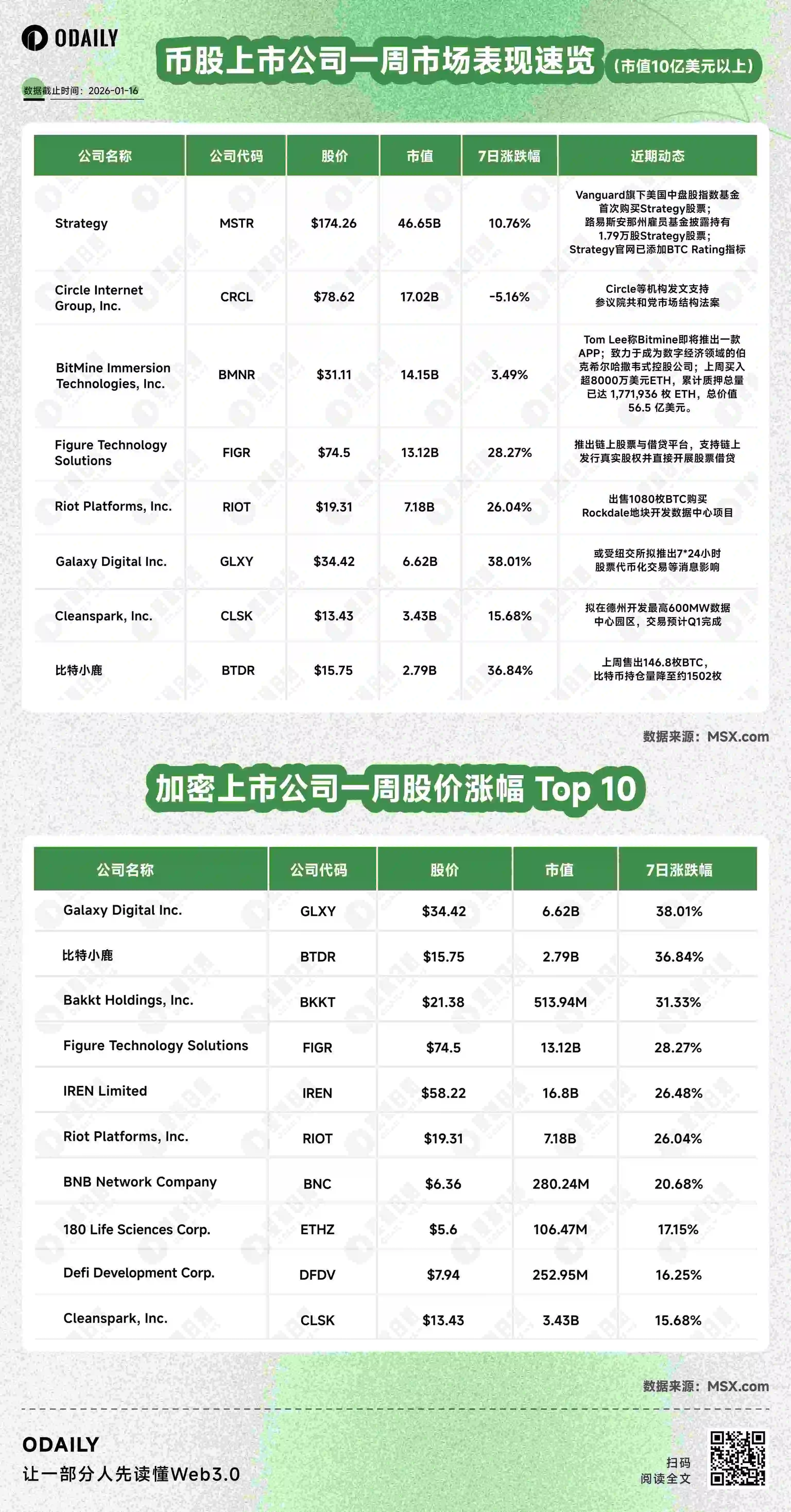
Below is a summary of last week's currency and stock market information compiled by Odaily Planet Daily. All US stock data are from msx.com.
Overview of Main Factors Affecting Crypto Concept Stocks
Trump's Rejection of Hassett Leads to Significant "Shrinkage" in Fed Rate Cut Expectations
As Trump hinted at nominating someone other than National Economic Council Director Hassett to succeed Powell, US bond prices fell, and traders reduced their expectations for two US rate cuts in 2026. The decline in US Treasuries pushed the two-year yield up by 5 basis points to 3.61% at one point, hitting its highest level since the Fed's last rate cut in December. After Trump's comments on Hassett, short-term interest rate contracts reflected a decreased probability of the Fed implementing two 25-basis-point rate cuts this year. Meanwhile, the Treasury market continues to be troubled by the employment data released a week ago, which prompted Wall Street banks that had previously predicted a Fed rate cut at the next meeting on January 28 to abandon this view. Morgan inflation economists predict that the Fed will not cut rates further, despite the change in leadership. John Fath, Managing Partner of BTG Pactual Asset Management US, said: "The previous trade was betting that whoever becomes the next Fed chair would be dovish. This dynamic has reversed in the past few days."
Crypto Industry Divided on Market Structure Bill: a16z, Ripple, etc. Take Opposite Stance to Coinbase
Coinbase CEO Brian Armstrong had stated that he intends to withdraw support for the crypto market structure bill (CLARITY), saying "I'd rather have no bill than a bad bill." However, several major industry players hold the opposite view to Coinbase. Kraken CEO Arjun Sethi said legacy issues should be resolved through negotiation, not by abandoning years of bipartisan progress. a16z Managing Partner Chris Dixon, Ripple CEO Brad Garlinghouse, and White House Special Advisor for AI and Crypto David Sacks expressed similar views, urging all parties to resolve differences before the end of the month. Ledger Global Policy Head Seth Hertlein pointed out that it is hard to imagine a future environment as favorable as the current one. There is a widespread feeling in the industry that if legislation is not completed now, it will either not happen in the future or will happen under very unfavorable conditions. The crypto industry does not want software usability or content publishing permissions to change with each administration.
Additionally, the NYSE plans to open 7*24 tokenized stock trading and launch an on-chain settlement platform, which may impact crypto concept stocks to some extent. Related concept stocks may rise on this positive news. For details, recommended reading "NYSE Plans to Start 7*24 Hour Tokenized Stock Trading, 'Competitors' Are Stunned" and "NYSE Launches 7*24 Crypto-Stock Trading, Which Crypto Businesses Will Be Directly Benefited and Hurt?".
Weekly Updates on Listed Companies in Currency and Stock Markets
Representative BTC Treasury Listed Companies
Vanguard's US Mid-Cap Index Fund Makes First Purchase of Strategy Stock
Vanguard's US Mid-Cap Index Fund, Vanguard Group Mid-Cap Index Fund Institutional Shares (VMCIX), disclosed its first purchase of Strategy stock. It is reported that the fund bought 2.91 million shares, worth approximately $505 million.
Furthermore, Strategy announced that it will report its financial results for the fourth quarter of 2025 after the US financial market closes on Thursday, February 5, 2026, and will hold an online conference at 5:00 PM Eastern Time to discuss the performance. The company currently holds 687,410 bitcoins, with a持仓 (holding) market value of approximately $66.47 billion.
Strive Completes Acquisition of Semler Scientific and Becomes the 11th Largest Public Company by BTC Holdings
On January 16, Nasdaq-listed bitcoin financial services company Strive announced the formal completion of its acquisition of Semler Scientific. The merged company now holds a total of 12,797.9 bitcoins and has become the 11th largest public company globally by BTC holdings. The company also announced the appointment of Avik Roy as Chief Strategy Officer, while Semler Scientific's former chairman, Eric Semler, joined Strive as an independent director, and Bitcoin Strategy Director Joe Burnett became Strive's Vice President of Bitcoin Strategy.
Steak'n Shake Buys $10 Million in Bitcoin, Advancing Corporate BTC Treasury Strategy
US fast-food chain Steak ‘n Shake announced that this week it allocated $10 million to bitcoin, officially adding BTC to its corporate balance sheet. This move continues its crypto strategy of accepting bitcoin payments at all US stores over the past eight months.
The company stated that this decision is part of its so-called "self-reinforcing cycle": consumer payments with bitcoin drive sales growth, and related revenue is continuously invested into the company's Bitcoin Reserve (SBR), thereby providing funds for operational inputs such as ingredient upgrades and store renovations without raising menu prices.
Steak'n Shake has accepted bitcoin payments via the Lightning Network at all US stores since May 2025, aiming to reduce credit card fees and attract young crypto users. The company disclosed that same-store sales in the second quarter of 2025 increased by over 10% year-over-year. When customers choose to pay with bitcoin, payment processing fees can be saved by about 50%.
US Listed Company DDC Enterprise Completes Additional Purchase of 200 BTC, Total Holdings Increase to 1,383 BTC
On January 16, US listed company DDC Enterprise Limited announced the completion of its first bitcoin purchase in 2026, adding 200 BTC. After the transaction, DDC's total bitcoin holdings increased to 1,383 BTC.
The announcement showed that DDC's current average bitcoin holding is approximately $88,998, with a阶段性 (phase/period) bitcoin收益率 (return rate) of 16.9%. Every 1,000 shares of DDC stock correspond to approximately 0.046482 BTC. The company stated that this purchase continues its prudent, disciplined capital allocation strategy and regards bitcoin as a strategic reserve asset aligned with long-term value creation.
Representative ETH Treasury Listed Companies
BitMine Total Staking Exceeds 1.77 Million ETH, Total Value $5.65 Billion
According to OnchainLens monitoring, BitMine recently staked an additional 86,848 ETH, worth $279.4 million. Currently, its cumulative staking total has reached 1,771,936 ETH, with a total value of $5.65 billion. Last week, Bitmine purchased 24,068 ETH ($80.57 million) via FalconX.
On January 17, Ethereum treasury company Bitmine Chairman Tom Lee announced at a recent shareholders' meeting that the company is about to launch an APP, but no further details have been disclosed yet. However, based on shareholder reactions, they seem dissatisfied with this move and believe it is unnecessary to invest significant costs in an APP. Additionally, Tom Lee revealed that Bitmine no longer wishes to扮演 (play) the role of a单一 (single) Ethereum yield tool but is considering positioning itself as a Berkshire Hathaway-style holding company in the digital economy field. In this model, Ethereum would serve as the cash flow-providing base layer and capital allocation, driving the next stage of growth.
Furthermore, on January 15, Beast Industries announced the completion of a $200 million financing round, led by BitMine. This project's main business is media and consumer holdings, covering content production, consumer brand Feastables, MrBeast Burger, and commercial investments.
BitMine stated that it has agreed to invest $200 million in Beast Industries, a media and consumer holding company founded by YouTube creator MrBeast. BitMine currently holds over 4 million ETH, worth approximately $13 billion, making it the world's largest Ethereum treasury holder. Beast Industries CEO Jeff Housenbold said the funds will be used to support growth plans and explore the integration of decentralized finance functions into future financial service products. The transaction is expected to be completed around January 19.
Treasury Company FG Nexus, Holding $120 Million in ETH, Sells 2,500 ETH
On-chain analyst Yu Jian monitored that Ethereum treasury company FG Nexus (fg-nexus) sold 2,500 ETH on January 20, worth $8.04 million. FG Nexus储备 (reserved) 50,770 ETH at an average price of $3,944 during August to September last year, worth $200 million. As the ETH price fell, the company has so far减持 (reduced holdings) 13,475 ETH at a price of $3,089, realizing a loss of $11.52 million. Currently, FG Nexus still holds 37,594 ETH, worth $120 million. The company's mNAV is 0.84, meaning its stock market value is lower than the value of the ETH it holds.
Representative SOL Treasury Listed Companies
SOL Treasury Company Sharps Technology Reaches 90-Day Stock Lock-Up Agreement with SOL Markets
According to a Globenewswire report, Nasdaq-listed Solana treasury company Sharps Technology (STSS) announced that it has reached a 90-day stock lock-up agreement with SOL Markets. According to the agreement, SOL Markets agrees to restrict the sale of its advisor warrants and related shares for 90 days. The agreement is effective from January 16, 2026. Previously, Sharps Technology's board approved a stock repurchase plan of up to $100 million. It is currently developing a universal digital identity and authentication framework through strategic partnerships with Coinbase, Crypto.com, and Jupiter.
Forward Industries: SOL Holdings Increase to Nearly 6.98 Million, Staking Rewards Reach 133,450 SOL
Nasdaq-listed Solana treasury company Forward Industries公布 (published) its financial performance report, disclosing that as of January 15, the company holds a total of 6,979,967.46 SOL. Since establishing the Solana treasury, it has staked almost all SOL and received 133,450 SOL in staking rewards. Additionally, Forward Industries disclosed that its SEC-registered stock was launched on the Solana blockchain last December via the Opening Bell platform under Superstate.
Solana Treasury Company Upexi Reaches Securities Purchase Agreement Aiming to Raise $36 Million
Last week, Nasdaq-listed Solana treasury company Upexi announced that it has reached a securities purchase agreement with Hivemind Capital Partners aiming to raise $36 million. The note issuance is expected to be completed around January 14, 2026, subject to customary closing conditions. The notes are backed by locked SOL tokens and will be incorporated into the company's Solana treasury after the transaction is completed. The transaction is expected to increase Upexi's SOL holdings by 12%, to over 2.4 million SOL, making it the second-largest corporate SOL holder after Forward Industries, which holds 6.9 million SOL.
Representative Altcoin Treasury Listed Companies
TON Treasury Company AlphaTON Capital Raises $15 Million Through Registered Offering of Common Stock
On January 16, Nasdaq-listed TON treasury company AlphaTON Capital announced that it raised $15 million through a registered offering of common stock, issuing a total of 15,000,000 shares of common stock at a price of $1 per share. HC Wainwright & Co. acted as the exclusive placement agent for this offering. The company stated that it plans to use the net proceeds from this offering to expand the GPU deployment scale of Cocoon AI, supplement working capital, and for general corporate purposes.




















