Crypto’s Slide May Not Be Fear — It’s A US Liquidity Crunch, CEO Says

bitcoinistPublished on 2026-02-02Last updated on 2026-02-02

Abstract

A sharp sell-off in crypto markets wiped out approximately $250 billion in value over the weekend, with Bitcoin falling below $80,000—down 40% from its 2025 high. Analysts note weakening retail interest, large ETF outflows, and a loss of momentum. Support around $73,000–$75,000 is now critical. According to Raoul Pal, CEO of Global Macro Investor, the decline is not crypto-specific but stems from a broader U.S. dollar liquidity crunch. Factors include Treasury General Account rebuilds, higher funding costs, and a reduced Reverse Repo Facility buffer. Pal stated that gold’s rally absorbed marginal liquidity that might have flowed into risk assets like Bitcoin and SaaS stocks, leaving the most exposed positions vulnerable. The nomination of Kevin Warsh as Fed Chair added uncertainty, with some fearing slower rate cuts. While markets remain fragile, some expect liquidity conditions to improve, potentially allowing a recovery if dollar flow normalizes.

A sharp hit to risk markets left crypto with heavy losses over the weekend. Reports say roughly $250 billion was wiped from combined market value as investors pulled back. Some of the selling hit Bitcoin hard. Others said it spread to tech stocks at the same time.

Bitcoin Faces A Confidence Test

Bitcoin has been searching for a base. As of today, it slipped below $80,000 and is down about 40% from the 2025 high above $126,000.

Traders and on-chain trackers show weaker buying pressure. Retail interest has cooled. Large outflows from spot ETFs have been recorded, and momentum has been lost across several indicators.

Support near $73,000–$75,000 is now the zone many are watching, while some market participants expect more stops to be run before calm returns.

BTCUSD now trading at $76,822. Chart: TradingView

Markets Are Moving Together

Analysts note that Software-as-a-Service stocks and Bitcoin fell in tandem. That matters because both depend a lot on hopes about future growth; they tend to be hurt first when money gets tight.

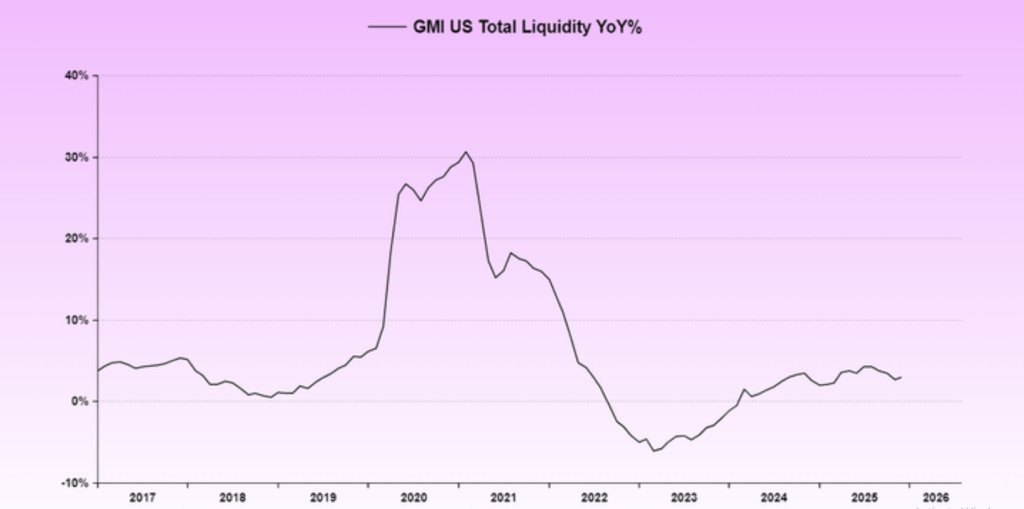
Gold was rising at the same time, and some traders argued that the move into bullion drew marginal cash away from riskier bets. When fewer dollars are freely moving between banks, hedge funds trim leverage fast and the riskiest positions suffer most.

Source: LSEG Datastream/Global Macro Investor

Macro Liquidity, Not A Crypto-Only Issue

According to Raoul Pal, founder and CEO of Global Macro Investor. the squeeze came from a narrower pool of US dollar liquidity rather than a problem unique to crypto.

The mechanics he points to are technical: Treasury General Account rebuilds, higher funding costs, and a smaller buffer in the Reverse Repo Facility that used to soak up extra cash.

“The rally in gold sucked all marginal liquidity out of the system that would have flowed into BTC and SaaS,” Pal said.

“There was not enough liquidity to support all these assets, so the riskiest got hit,” he added.

Those shifts can quietly remove liquidity even when no single headline screams crisis. Government funding hiccups were also blamed for adding friction to the system. When liquidity is chased away, assets tied to future cash flows get hit hard.
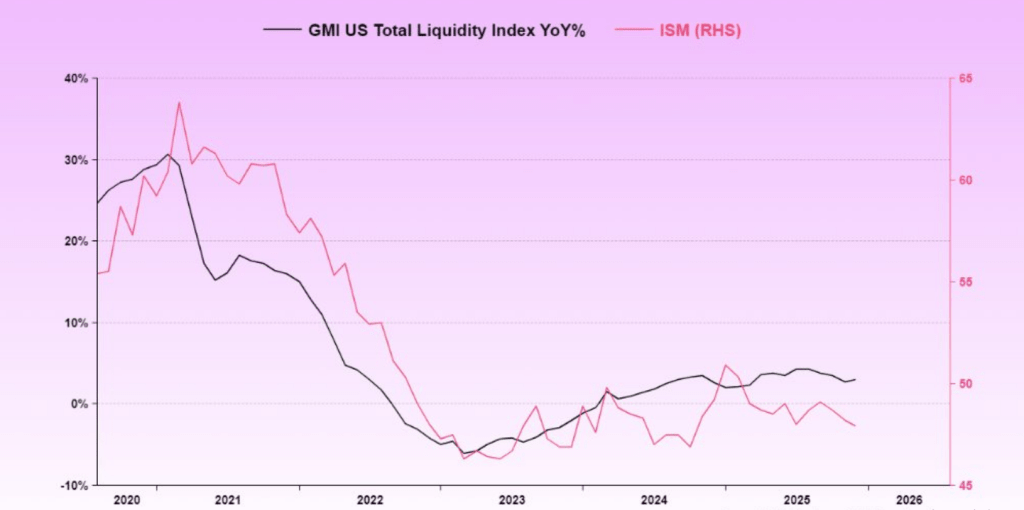
Source: LSEG Datastream/Global Macro Investor

Different Voices On The Fed Nomination

Reports say the nomination of Kevin Warsh to run the Federal Reserve has added to the nervous mood. Some market pros worry he won’t cut rates as quickly as hoped.

Some analysts said that sentiment swung on the idea that rate relief might be delayed. But Raoul Pal pushed back, arguing that US President Donald Trump’s team will steer policy toward easier rates and that Warsh will follow that playbook.

Views differ. That uncertainty has left many traders unwilling to put fresh money into stretched trades.

A Cautious But Not Despairing Close

At the time of writing, price action looks fragile and rallies have been short-lived. Yet some analysts expect the liquidity drain to ease and for capital to trickle back once funding conditions normalize.

The coming weeks will show whether buyers return around the low-$70k area or if selling finds a deeper level. Reports note that risk appetite often returns before headlines change, but only when dollars are flowing again.

Featured image from Unsplash, chart from TradingView

Related Questions

QWhat is the main reason for the recent sharp decline in crypto markets according to Raoul Pal?

AThe main reason is a US dollar liquidity crunch, caused by factors like Treasury General Account rebuilds, higher funding costs, and a reduced buffer in the Reverse Repo Facility, rather than a problem unique to crypto.

QHow much has Bitcoin fallen from its 2025 high, and what is the key support level being watched?

ABitcoin has fallen about 40% from its 2025 high above $126,000. The key support level many are watching is near $73,000–$75,000.

QAccording to the article, what two asset classes fell in tandem, indicating a broader risk-off sentiment?

ASoftware-as-a-Service (SaaS) stocks and Bitcoin fell in tandem, as both are growth-dependent assets that are often the first to be sold when liquidity gets tight.

QWhat role did the rally in gold play in the market dynamics described?

AThe rally in gold sucked marginal liquidity out of the system that would have otherwise flowed into riskier assets like Bitcoin and SaaS stocks, exacerbating their decline.

QWhat event added to market nervousness regarding future Federal Reserve policy?

AThe nomination of Kevin Warsh to run the Federal Reserve added to the nervous mood, as some market professionals worry he will not cut interest rates as quickly as hoped.

Related Reads

380,000 Apps Exposed, 2,000+ Apps Leaked Secrets: AI Programming Turns 'Intranet' into Public Internet

Israeli cybersecurity firm RedAccess uncovered a severe data exposure trend linked to "vibe coding" or AI-powered software development tools. Their research found approximately 38,000 publicly accessible web applications built with platforms like Lovable, Base44, Netlify, and Replit. Of these, an estimated 2,000 apps exposed sensitive corporate and personal data, including medical records, financial information, internal strategic documents, and customer chat logs. In some cases, access even granted administrative privileges. The core issue stems from default privacy settings that make applications public by default, combined with a lack of built-in security controls (like authentication) in the AI-generated code. This allows employees without security expertise—"citizen developers"—to easily create and deploy applications that bypass standard corporate security reviews. The exposed apps, often indexed by search engines, are trivially discoverable. While some platform providers (Replit, Lovable, Wix/Base44) argue that security configuration is the user's responsibility and question the validity of some findings, security researchers confirm the widespread reality of such exposures. This pattern, also noted in prior studies, highlights a critical security gap as AI democratizes app creation, potentially leading to massive, unintentional data leaks.

marsbit9m ago

380,000 Apps Exposed, 2,000+ Apps Leaked Secrets: AI Programming Turns 'Intranet' into Public Internet

marsbit9m ago

Attracting Global Capital, Asia's New 'Super Cycle' Is Unfolding

Investors are turning to Asia as the next frontier for global equity growth, with a new "super cycle" unfolding across the region. Driven by the AI revolution, Asian markets, particularly South Korea, have seen significant rallies. According to Morgan Stanley analysis, the underlying drivers of Asia's industrial cycle are shifting from traditional sectors like real estate and manufacturing to massive investments in AI infrastructure, energy security and transition, and supply chain resilience. Fixed asset investment in Asia is projected to grow from around $11 trillion in 2025 to $16 trillion by 2030, with a 7% annual growth rate from 2026-2030. The AI wave is a primary catalyst, driving immense capital expenditure for chips, servers, data centers, and power systems. Asia is central to this hardware supply chain. In China, AI investment is focused on building a full-system domestic capability, with the local AI chip market potentially reaching $86 billion by 2030. Beyond AI, China's export story is expanding from EVs and batteries to robotics. The country already captures about half of new global industrial robot demand and over 90% of humanoid robot shipments. This growth phase mirrors the early stages of China's EV export boom. Simultaneously, energy security investments, spurred by AI's massive power needs, are rising, with China benefiting from its leadership in solar, batteries, and EVs. Regional defense spending is also increasing structurally, supporting demand for advanced manufacturing. The main beneficiaries are China, South Korea, and Japan, positioned in core supply chain areas. However, risks remain, including potential overcapacity, profit margin pressures from competition, persistent technological restrictions, geopolitical friction, and workforce displacement due to AI-driven automation. Market volatility is also expected to increase as investor expectations diverge on the realization of these capital investment and export themes.

marsbit10m ago

Attracting Global Capital, Asia's New 'Super Cycle' Is Unfolding

marsbit10m ago

Funding Weekly Report | 14 Public Funding Events, Kalshi Completes $10B New Funding Round at $220B Valuation Led by Coatue Management

Weekly Funding Roundup: 14 Deals and $10.49B+ in Total Funding, Led by Kalshi's $1B Round Last week (5.4-5.10) saw 14 notable funding events in the global blockchain ecosystem, raising over $10.49 billion in total. Key highlights include Kalshi, a prediction market platform, securing a $1 billion round led by Coatue Management, reaching a $22 billion valuation. The platform now boasts ~2 million MAUs and $178B in annualized trading volume. In DeFi, regulated on-chain reinsurer OnRe raised $5 million in Series A funding, and Bitcoin-backed credit protocol Saturn Credit completed a $2 million seed round. For Infrastructure & Tools, OpenTrade raised $17 million to expand its stablecoin yield infrastructure, and RWA platform Balcony secured $12.7 million to deploy its property settlement service in the US. Centralized Finance saw one deal: AI-driven trading platform Stockcoin.ai completed a seed round led by Amber Group. In the prediction market sector alongside Kalshi, AI-powered platform Elastics raised $2 million. Other notable deals include SC Ventures' strategic investment in crypto market maker GSR and Centrifuge securing a "seven-figure" investment from Coinbase to become a core RWA partner for Base. On the investor side, Haun Ventures raised a new $1 billion fund targeting crypto and AI, and Multi Investment raised ~$616 million to focus on blockchain and Web3 investments.

marsbit1h ago

Funding Weekly Report | 14 Public Funding Events, Kalshi Completes $10B New Funding Round at $220B Valuation Led by Coatue Management

marsbit1h ago

Trading

Spot
Futures
活动图片