Crypto’s CLARITY Act Sits At 50-50 For 2026 Passage, Galaxy Says

bitcoinistPublished on 2026-04-23Last updated on 2026-04-23

Abstract

Galaxy Digital estimates a 50-50 chance that the CLARITY Act, a key U.S. crypto market structure bill, will be passed into law in 2026. The bill, which passed the House with bipartisan support, is now in the Senate Banking Committee. A planned markup was delayed until May, and Galaxy warns that if it slips past mid-May, the odds of passage drop sharply. Key unresolved issues include stablecoin rewards language, protections for software developers, and SEC commissioner vacancies. The report emphasizes that the bill is strong on policy but faces a tight legislative calendar and significant procedural steps. Failure to pass it by May could delay crypto legislation indefinitely, especially with midterm elections potentially shifting priorities.

The crypto industry’s most important US market structure bill is entering a narrowing window in Washington, with Galaxy Digital putting the odds of the CLARITY Act becoming law this year at roughly 50-50. The firm’s central argument is not that one issue alone threatens the bill, but that too many unresolved questions still need to be settled in sequence, on a calendar that is quickly tightening.

In a research note published April 22, Galaxy said the Digital Asset Market Clarity Act of 2025 is now in “endgame stage” after passing the House in July 2025 with bipartisan support and spending months in Senate negotiations. The immediate focus is the Senate Banking Committee, which had been expected to announce a markup for the last week of April. But that timeline appears to be slipping. According to Galaxy, Sen. Thom Tillis, a key negotiator on stablecoin rewards language, called on Monday for delaying the markup until May.

May Could Be The Last Chance For Crypto’s CLARITY Act

Galaxy framed the bill’s prospects in unusually blunt terms: “In our view, the odds of CLARITY being signed into law in 2026 are roughly 50-50, and possibly lower, though others at Galaxy are more optimistic. The uncertainty stems not from any single issue but from the number of unresolved questions that must be settled, in sequence, under severe time pressure.”

The report argues that a markup in early or mid-May would still leave a viable path, but not much margin for error. “If the markup slips past mid-May, the probability of enactment in 2026 drops sharply,” Galaxy wrote. “The remaining legislative calendar simply does not easily accommodate the full five-step process described above, particularly given the competing demands on floor time.” In the firm’s view, a July floor vote is still theoretically possible, but only with “extraordinary political will and coordination.”

The procedural burden is significant. From committee markup, the bill would still need to clear a 60-vote Senate floor threshold, then be reconciled with the Agriculture Committee’s version, then reconciled again with the House-passed CLARITY Act, before reaching the president’s desk. Galaxy said each step consumes time that the Senate may not have in abundance, especially with Iran military authorization debates, the unresolved DHS funding standoff, and a backlog of nominations competing for floor space.

The best-known sticking point remains stablecoin rewards language, where banks and crypto firms have been fighting over whether exchanges can offer incentives tied to stablecoin holdings and usage. Galaxy said a compromise being negotiated by Tillis and Sen. Angela Alsobrooks would still ban rewards paid “solely for holding” a stablecoin while allowing narrower, activity-based incentives tied to payments, transfers, or platform usage. But the text has not yet been released, and until it is, the committee’s 48-hour notice clock cannot start.

Galaxy also made clear that stablecoin yield is only part of the problem. The note highlighted several other live issues in Senate negotiations, including the Blockchain Regulatory Certainty Act’s protections for noncustodial software developers, ethics provisions related to government officials’ crypto holdings, concerns over Section 505’s impact on SEC exemptive relief for tokenization, and the political question of SEC commissioner vacancies. None of those is necessarily fatal on its own. Together, they create a far more fragile timeline.

Notably, US Senator Bernie Moreno is sharing a similar position like Galaxy Digital. When was asked about the timeline for crypto market structure legislation, he said: “I think we’re going to get it done by the end of May.” But the Ohio Republican also warned last month that if the Clarity Act isn’t passed by May, crypto legislation could be off the table for the foreseeable future.

The report is broadly favorable on the substance of the legislation. Galaxy called CLARITY “a strong bill both on technical terms and as a policy matter,” arguing that it would establish jurisdictional boundaries between the SEC and CFTC, define pathways for tokens to be treated as non-securities once sufficiently decentralized, and create the kind of durable legal framework that institutional capital has long lacked.

It also warned that the post-midterm outlook could be materially worse. A change in control of either chamber, Galaxy said, would likely produce different committee chairs, different priorities, and a much less hospitable path for crypto legislation.

That is why the near-term milestones now matter so much. Galaxy said the next signals to watch are the release of Tillis’s revised stablecoin text, Chairman Tim Scott’s markup announcement, the size and bipartisan character of any committee vote, and whether Senate leadership allocates floor time before the July 4 recess.

At press time, the total crypto market cap stood at $2.58 trillion.
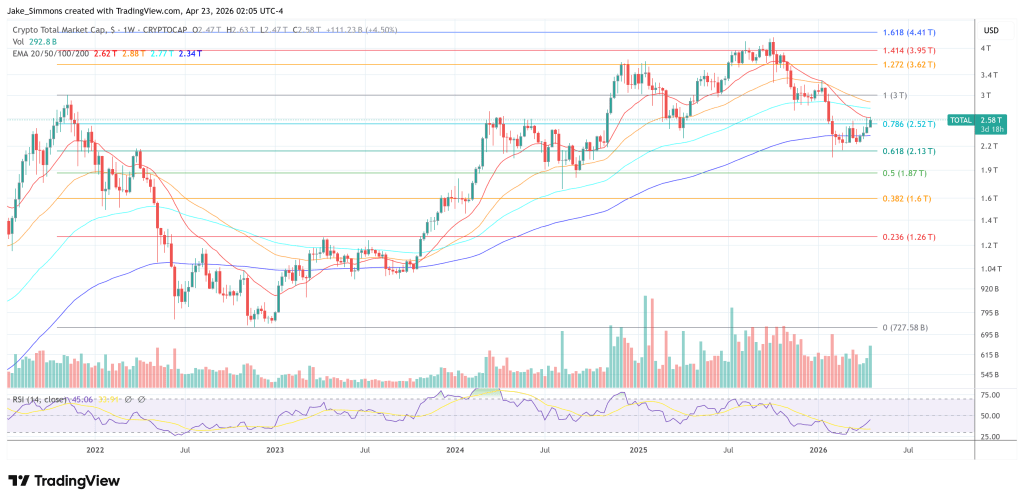
Total crypto market cap rises above the 0.786 Fib, 1-week chart | Source: TOTAL on TradingView.com

Related Questions

QWhat are the odds of the CLARITY Act being signed into law in 2026 according to Galaxy Digital?

AGalaxy Digital puts the odds of the CLARITY Act becoming law in 2026 at roughly 50-50.

QWhich Senate committee is the immediate focus for the CLARITY Act's progress?

AThe immediate focus is the Senate Banking Committee.

QWhat is the key sticking point in the negotiations, as mentioned by Galaxy?

AThe key sticking point is the stablecoin rewards language, specifically whether exchanges can offer incentives tied to stablecoin holdings and usage.

QAccording to the report, what is the consequence if the committee markup slips past mid-May?

AIf the markup slips past mid-May, the probability of the CLARITY Act being enacted in 2026 drops sharply.

QWhat did Senator Bernie Moreno say about the timeline for passing the crypto market structure legislation?

ASenator Bernie Moreno said, 'I think we’re going to get it done by the end of May,' but also warned that if it isn't passed by May, crypto legislation could be off the table for the foreseeable future.

Related Reads

Manus Buyback Plan Emerges: Chinese Investors Plan to Repurchase Equity with $2 Billion, Path to Hong Kong IPO Becomes Clearer

According to a report by The Information, early Chinese investors of Manus, including Tencent, Sequoia Capital China, and ZhenFund, are planning to repurchase the company from Meta for $2 billion—the same price Meta paid in its acquisition last December. This move is a direct response to the Chinese government's prohibition of the foreign acquisition in April. As part of the repurchase plan, Manus is considering establishing a Sino-foreign joint venture within China. This structure is seen as a way to ensure regulatory compliance for its Chinese investors and to pave the way for a future IPO in Hong Kong. Notably, U.S. investor Benchmark will not participate in the buyback, which will concentrate ownership even more among Chinese capital. Since its acquisition by Meta, Manus's business has grown rapidly, with its annualized revenue run rate reportedly increasing four-to-fivefold to $400-$500 million in roughly six months. This strong growth underpins the investors' willingness to repurchase at the original price. Financially, the forced unwinding of the deal may benefit the early investors, allowing them to regain equity at a cost far below the company's current implied valuation, with the added prospect of an independent future listing. However, specific terms of the repurchase, including funding proportions and the joint venture's equity structure, are still under negotiation. This "repurchase-joint venture-Hong Kong IPO" approach could serve as a reference model for other Chinese AI startups navigating cross-border M&A regulations.

marsbit26m ago

Manus Buyback Plan Emerges: Chinese Investors Plan to Repurchase Equity with $2 Billion, Path to Hong Kong IPO Becomes Clearer

marsbit26m ago

STRC Loses Peg by 11%, Can Strategy's Perpetual Motion Machine Keep Running?

The article discusses the significant and concerning depegging of MicroStrategy's (MSTR) preferred stock, STRC. Designed to trade near its $100 target par value, STRC has recently fallen sharply, reaching a low of $83.26 and closing at $88.59, representing an over 11% discount. STRC is a core component of MicroStrategy's financial strategy. As a perpetual preferred stock, it allows the company to raise capital through an "at-the-market" (ATM) issuance program without diluting common shareholders (MSTR). This capital is primarily used to purchase Bitcoin, creating a "capital flywheel": issuing STRC → raising cash → buying BTC → increasing net assets → supporting STRC's value. The flywheel's operation depends on STRC maintaining its $100 price. To enforce this, MicroStrategy employs a dynamic dividend mechanism, recently raising the rate to 11.5% and increasing payout frequency. However, this has failed to halt the depegging, indicating market concerns extend beyond yield. Analysts cite two main reasons. First, technical factors like forced liquidations from leveraged arbitrage trades may have exacerbated the sell-off. Second, and more fundamentally, is waning confidence in MicroStrategy's financial resilience. A JPMorgan report highlighted the company's limited cash relative to its ~$1.7 billion annual dividend obligation, raising liquidity concerns. While MicroStrategy counters that its massive Bitcoin holdings provide decades of coverage, this argument relies on the potential need to sell BTC—a departure from its long-standing "never sell" narrative. The company's recent sale of a small amount of Bitcoin for "testing," despite being framed as minor, has intensified these fears. The persistent depegging threatens to cripple MicroStrategy's primary funding channel. If STRC remains discounted, the company's ability to fund further Bitcoin purchases weakens. Should cash reserves dwindle while financing is constrained, the market may increasingly price in the risk of MicroStrategy becoming a forced seller of Bitcoin to meet obligations. This shift from a major marginal buyer to a potential seller could pose significant downside risk to the broader Bitcoin market.

链捕手35m ago

STRC Loses Peg by 11%, Can Strategy's Perpetual Motion Machine Keep Running?

链捕手35m ago

Behind the AI Scorecards Lies a Chinese 'Question Setter'

Behind the AI scorecards that dominate industry discussions—benchmarks like MMLU-Pro, MMMU, and MMMU-Pro—stands a Chinese-Canadian researcher: Wenhu Chen. As an assistant professor at the University of Waterloo and founder of the TIGER Lab, Chen has become a key "exam-setter" for evaluating large language and multimodal models. Chen first gained broader recognition with MMLU-Pro, a more challenging and stable update to the popular MMLU benchmark. As top models like OpenAI’s o3 began achieving near-perfect scores on the original MMLU, it became difficult to distinguish their true capabilities. MMLU-Pro introduced more complex reasoning questions, expanded answer choices, and filtered out ambiguous or simple items, effectively reintroducing differentiation among state-of-the-art models. His work on MMMU addressed the evaluation of multimodal models, requiring them to integrate visual information (like charts, diagrams, or tables) with textual knowledge across diverse academic subjects. Even the strongest models initially scored only around 56-59%, highlighting significant room for improvement in genuine multimodal reasoning. MMMU-Pro further refined this by preventing models from bypassing visual cues. Chen’s research focus has long been on complex information understanding and reasoning. His background—including a PhD at UC Santa Barbara, research at Google/DeepMind on Gemini, and now a role in Meta’s superintelligence lab—provides deep insight into model development and their potential weaknesses. His TIGER Lab also builds models (e.g., for video understanding and generation), ensuring his evaluation benchmarks are grounded in practical challenges. While AI headlines often spotlight company leaders and product launches, Chen’s work exemplifies the critical, behind-the-scenes contributions of researchers crafting the rigorous standards that define and drive progress in AI capabilities.

marsbit1h ago

Behind the AI Scorecards Lies a Chinese 'Question Setter'

marsbit1h ago

Trading

Spot
Futures
活动图片